Trying to find math inside everything else

Posts tagged ‘Math’

Recursive Combinations with Replacement

So I was in my classroom last night with my boyfriend, waiting for his phone to charge before we went to dinner. Since we had some time, we played some of the math games I have in my room. (He’s a math PhD student, so he was all for it.) We played Set, of course, and then played a bit of 24. We idly wondered if it were possible to get 24 with any combination of 4 digits. So I looked at the box, and saw it came with 192 possible configurations. Well, if we determined how many possibilities there were (maybe there were 192), that might give us an idea of the feasibility.
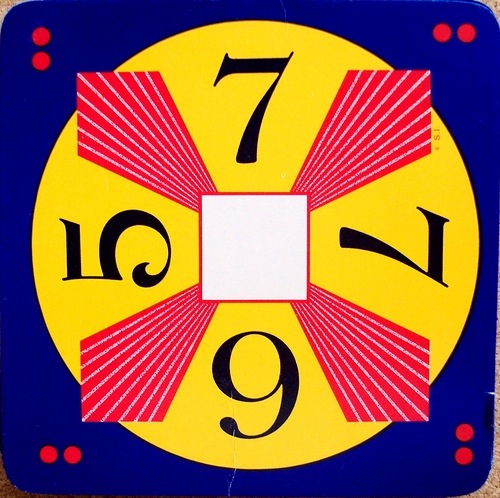
20121020-162604.jpg

So we tried to calculate how many configurations there were. Shouldn’t be too hard, right? Well, it kinda is, especially when you’re not already familiar with combinations with replacement. So we started using what we did know of combinations, but were stuck because we could use the same number multiple times, which made it trickier. Otherwise it would just be 9 C 4.

So, unsure how to solve, we tried to make a simpler case. What if we only had 2 digits to choose from, not 9? There’s there’s 5 possibilities. (1111, 1112, 1122, 1222, 2222.) And with 3 digits, there’s 15 (1111, 1112, 1113, 1122, 1123, 1133, 1222, 1223, 1233, 1333, 2223, 2233, 2333, 3333). We got a lot of fruitful thinking out of this, finding patterns, but didn’t really get closer to the answer. (Four digits had 35, btw. But we didn’t want to list all the ones for 5 digits and beyond.)

At this point it was time to go to dinner, so we put the whiteboard aside. But that couldn’t stop us thinking and talking about it, which we did as we walked to the restaurant and waited for out table, when we finally had a breakthrough.

Instead of trying to figure out the pattern with fewer digits but the same number of slots, let’s try to iterate up with the same number of digits, but using increasing number of slots. Let me explain, using 4 possible digits.

If we only have 1 number slot on the card, there are only 4 possibilities. (1, 2, 3, 4.) When we increase to 2 slots, we could start by putting a 1 in front of each of those possibilities. (11, 12, 13, 14). But, because order doesn’t matter, we can’t also put 2 in front of everything, because 21 is the same as 22. So we don’t use the one, and get 22, 23, 24. Same logic for 3 gives us 33, 34, and then finally 44.

This gives us a total of 10 possibilities. (4 + 3 + 2 + 1.) Now let’s think about 3 slots. In the same way, we can add a 1 in front of everything we’ve done so far. So for 3 digit possibilities there are 10 that start 1. Since we have to eliminate the four that two-digit configurations that have 1, there are 6 remaining, so that’s how many will start with 2. (3 + 2 + 1). Then three will start with 3. (2 + 1) And 1 will start with 4.

The process here is to add up all of what we had before, chopping off the start, to get the total number of new possibilities. So now, with 3 slots, we have 20 possibilities. (10 + 6 + 3 + 1.) To get for 4 slots, we use the same process: 20 start with 1, 10 start with 2 (6 + 3 + 1), 4 start with 3 (3 + 1), and 1 starts with 4, for a total of 35. Which is what we found before.

(If there were 5 slots, it would be 35 + 15 + 5 + 1, or 56.)

I don’t know of this recursive method of solving for combinations with replacements has been done before. I’m sure it is, but I haven’t found it in a very short google search. If someone knows of it, please let me know. But I wanted to share what I did. You can tell I love math, and so does my boyfriend, because we got completely distracted from a board game by solving a problem. He told me I’d make a good mathematician, because of how I tackled the problem. That may be true.
How Many Representatives Should We Have

Back in 1788, James Madison wrote up 20 proposed articles to amend to the constitution. 12 of those were approved by Congress. The latter 10 were ratified by the states and became the Bill of Rights. The second was ratified over 200 years later and became the 27th Amendment. But Article the First was never ratified. Here’s what it said (corrected):

After the first enumeration required by the first article of the Constitution, there shall be one Representative for every thirty thousand, until the number shall amount to one hundred, after which the proportion shall be so regulated by Congress, that there shall be not less than one hundred Representatives, nor less than one Representative for every forty thousand persons, until the number of Representatives shall amount to two hundred; after which the proportion shall be so regulated by Congress, that there shall not be less than two hundred Representatives, nor less than one Representative for every fifty thousand persons.

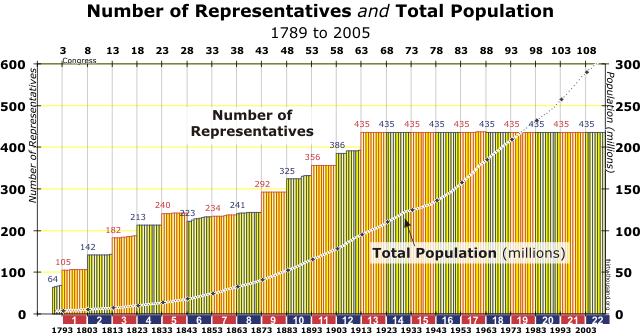
Back in 1911, Congress froze its size at 435 members of the House of Representatives, and so the amount of people representative by each representative has grown extraordinarily. (Note that this is before we even had all the states (only 46), so the Reps continued to spread thinner.) The average district size now is about 700,000 people, which is a lot of people and opinions to accurately represent. Of course, if we followed Article the First to the letter, we would now have about 6300 representatives, which seems like a lot.

Source: thirty-thousand.org

But what if the article is a formula, not meant to stop at districts of 50000? The way it is written, it seems like every 100 Representatives would prompt an increase in the size cap of districts by 10000. So how could we model that to determine how many reps we need?

Well, in general, the population divided by the number of people in the average district should give us the number of reps. So if P = U.S. Population, R = number of representatives, and D = max size of district, then R=\frac{P}{D}.

To represent Article the First, since 0-100 reps have 30000 each, 100-200 have 40000 each, 200-300 have 50000, etc, it seems like we could say R=\frac{D-20000}{100} to give a rough estimate. (Anyone have anything more precise?) So we can substitute, as well as plugging in 308,745,000 for P (according to the 2010 census), to get

\frac{D-20000}{100}=\frac{308745000}{D}, and solving for D gets us approximately 186000 people per district. Plug in for D to get 1660 representatives. (Exact amount varies by the precise district make-up.) That seems quite possible, not even four times as many as we have now.

Follow-up questions to consider:

  • Is 700000 people too many to represent? Is 190000? What would be an ideal amount?
  • How would representing 30000 people in 1790 be different from representing that many people now? How does technology change how effectively we can represent people?
  • How could we accommodate having 1700 representatives? What changes would need to be made?
  • What other representative systems could you come up with? How would it work?
  • How would having more representatives change our current representation?
  • How are representatives apportioned in other countries? What methods do they use for determining the size?

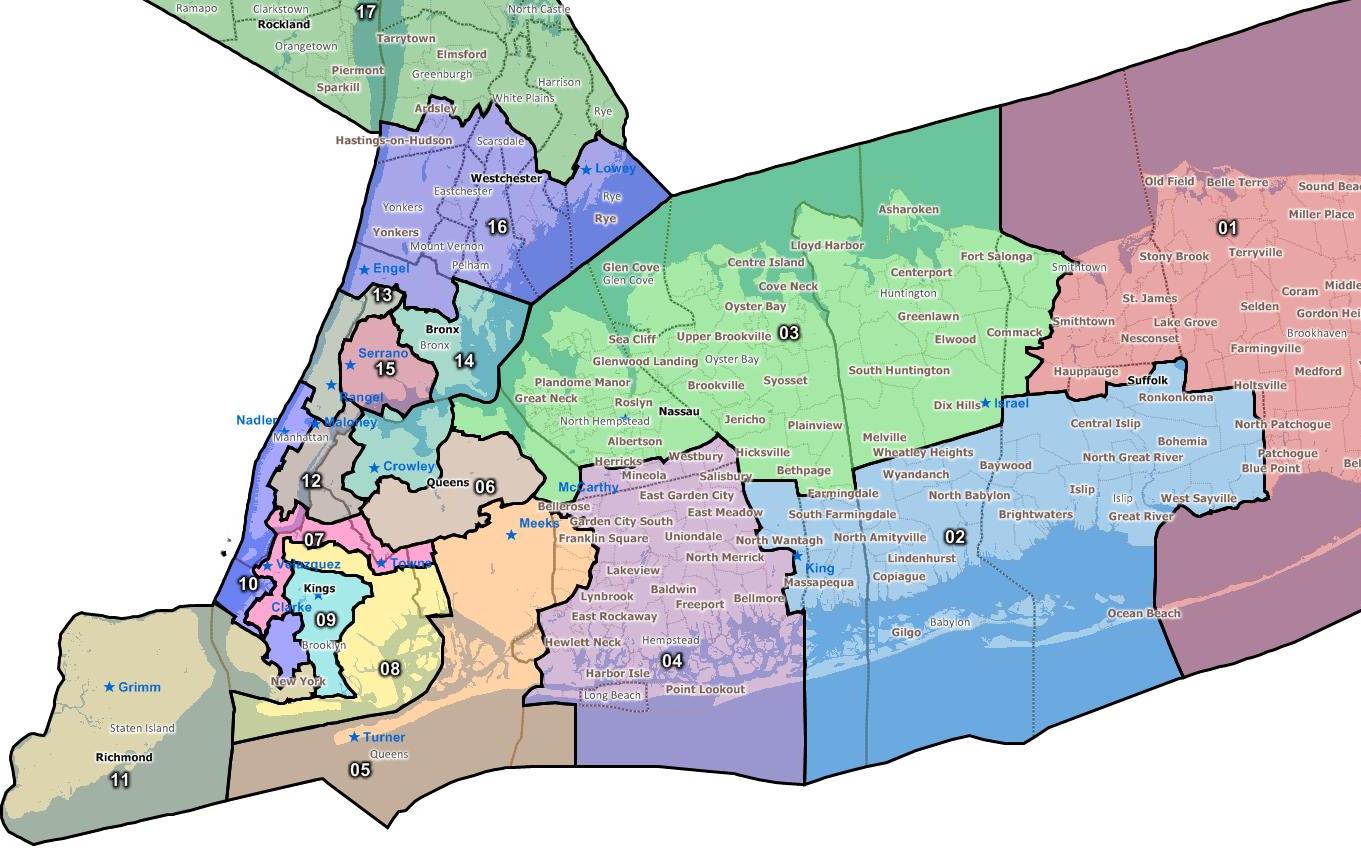
For that last one, I think it’s interesting to just look at the Congressional districts of New York City as an example.

I live in District 12. It’s easy to see that the district is half in Manhattan, in the affluent Upper East Side, and half in Queens, in Astoria/Sunnyside/Long Island City. I think it would be very easy to believe that the desires of the people on the UES don’t always line up with the desires of the Queens constituents. Yet we are represented by just one person. However, with a smaller district, they can be divvied up more logically. All of Astoria has 166,000 people, which is almost a full district, and it would be nice to have a district that is clearly where you live.

Since US History doesn’t usually line up with Algebra, this idea might be hard to implement in math. Though it could work fine in Algebra 2. And it might work even better as a history lesson with a bit of math, instead of a math lesson with a bit of history? I dunno. But I think it can definitely be food for thought for any class.

Is Algebra 2 Necessary?

So, of course, Andrew Hacker’s article “Is Algebra Necessary?” had caused quite the stir, and the obvious answer to that question was “Yes, algebra is necessary.” But the article makes you think if all of what we learn of algebra is necessary. And I think it isn’t, but that comes from thinking about what high school is for.

Do we expect that, when a student gets to college, they can skip the lower levels of Biology because they took bio in high school? No, of course not. (Excepting AP courses, of course.) So what is our goal for learning biology in high school? It’s to provide a general foundation of the subject, that most people should know, and it prepares you for a college level course or major in Biology.

Really, all of what we learn in high school is designed to broaden our horizons, to provide experiences and content we wouldn’t see otherwise, and to provide a baseline of knowledge that we feel everyone should have.

I remember reading from someone, though I don’t recall who, that they had struggled through Algebra 2 and Pre-Calculus, slogging along, and then when they got to Calculus a light turned on. “This was why we’ve been learning everything we’ve done in the past two years! It was all for this!” Even the wikipedia page on Pre-Calc says “…precalculus does not involve calculus, but explores topics that will be applied in calculus.” It’s putting the work before the motivating problem, again.

But now thinking about the normal course sequence for a student that is not advanced: Algebra –> Geometry –> Algebra 2 –> Pre-Calculus –> Graduated from High School, so no Calc! So these students will have two whole years of math without the payoff that shows why we do it.

And as teachers we know that you need to start with the motivating factor, not have it at the end. So why don’t we have calculus first, before those two? If we consider our goal in high school is to spread ideas people might not see otherwise, I think Calculus has a lot of important ideas people should see that would improve their lives. Optimization? The very idea of it can improve how you look at all the problems in your life. Related rates, limits, the idea of changing rates and local rates, the relationships between functions, these are all good ideas to be familiar with.

Can the students learn these things without having done Algebra 2/Pre-Calc? I think so. As Bowman Dickson says, “The hardest part of calculus is algebra.” So what if we taught it in a way that didn’t rely on that? We can get the ideas across without jumping into the nitty-gritty of a lot of it. Save that for AP level classes, or for college calc. What you take in college is more in depth that high school, so it should be the same here.

Now, there would certainly be some stuff from Algebra 2/Pre-Calc that we really need first. But why not have those in Algebra 1? I accidentally taught several things from Alg 2 when I taught Alg 1 my first year, because they seemed like natural extensions of what we were doing, and I didn’t know they weren’t required until I started planning for the next year. But also, consider this. If we made Probability & Statistics one of the main courses of the math sequence, I don’t have to teach it in Algebra 1. I spent about 7 weeks on those topics last year. That’s 7 weeks of Alg 2 content I could fold in, without worrying about reviewing old stuff because we just did it.

So then the new math sequence could be Statistics –> Geometry –> Algebra –> Calculus. (And I think that might fit well with the science sequence of Biology –> Earth Science –> Chemistry –> Physics.)
Thoughts?

No Right Answer

A bit ago I got yelled at by a commenter on Kate’s blog who claimed that being always right is why we like math. The problem with that point of view is that, while yes, you can always be right while doing computation, math isn’t just computation. So the other day I was talking with a friend of mine, and that prompted me to post the following tweets:

My friend Phil (@albrecht_letao) responded to the question, and he came up with an answer of $20/hr. When I worked it out with my friend, we came up with $14.25. Does that mean one of us is wrong, since we got different numbers?

No, of course not. What happened is we approached the problems in different ways. Phil only calculated the monetary value: with his amount, my friend would earn the same amount of money she does now. He figured this was an important way to look at it, for paying bills and whatnot. Our calculation came from thinking about how her time is being compensated. Since those 16 hours are being wasted (she has to work them for free; actually, she pays to lose that time), we calculated her “real” hourly rate and used that.

There can be more answers than even these two, depending on what you think is important. But it’s a clear example of a problem, solved using math, with no one right answer. That’s what math is about. I tweeted it thinking maybe it could be a problem worth considering in class, to show that essential idea to students.

What do you think?

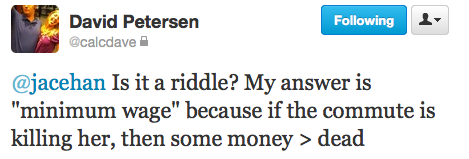
P.S. The right answer, of course, came from @calcdave:


Totally Radical

So I’ve been working on creating this board game, Totally Radical. (Tagline: Don’t Be a Square.) After some play-testing and adjustments, and bouncing ideas off of other teachers, I’m ready to post about it.

(But first, thanks to my co-teacher Sarah for helping come up with the game, my coworkers Cindy and Jenn and my Tweeps Max, Jami, and Jamie for playtesting.)


The idea behind the game came before I didn’t really have a good application for simplifying radicals. But I’ve been annoyed at how I see math games designed: do some math action and, if you are correct, you then get to do some game action. While this is certainly how some games work (like Trivial Pursuit), it just separates the math from the game and makes the math seem worthless. So I wanted a game where the math action WAS the game action.

You can read the rules of the game right here: Totally Radical Rules. During the game you have a choice of 5 actions: 3 involve actions we take when simplifying (breaking a number into two factors, taking a root and putting it outside the radical symbol, multiplying two terms together) while two are purely game actions (draw a card, play a special “Action” card).

Other touches of note: the factor cards are exactly half the size of the radicand cards, so that students break up “larger” numbers into “smaller” ones.

You can use factor cards on their own or combined into multi-digit numbers, like so:

(the top would be two factors, 2 and 5, and the bottom would be one factor, 25)
The numbers in the radicand cards are not just simple numbers. There’s prime numbers, composite numbers that can’t be simplified, perfect squares, as well as numbers that can be simplified (going all the way up to 250).

So, how can get this game, you may ask? Two ways!

Make It Yourself

If you want it for free, or are just in that #Made4Math mindset, you can print out the following files on card stock:

Prototype Factor Deck

Prototype Radicand Deck

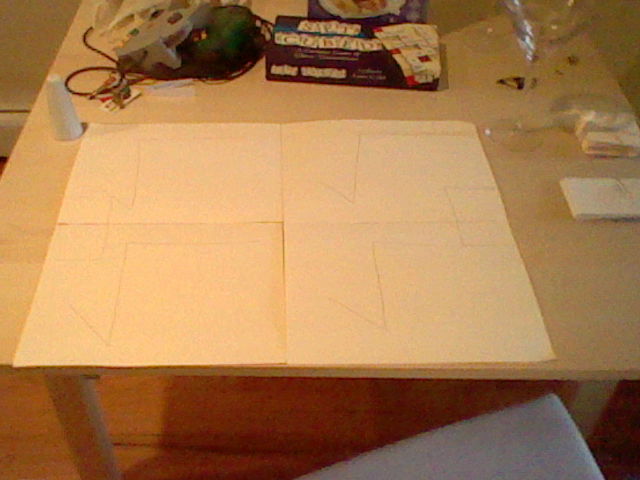
Cut the cards out and label the backs. Print out the instructions (found here). You’ll also need to make a board: 4 big radical signs (I also recommend cardstock.) That might look something like this:

(I also drew in spots to put the card decks in).

Don’t want to make it or want the awesome one pictured above? Then go for option 2:

Buy It

I found this great website called The Game Crafter where you can send in artwork, pick out the pieces, etc, and they will print and construct the game for you. So if you click the button below, it should bring you to the shop to buy it.

TOTALLY RADICAL
DON’T BE A SQUARE

Lab –> Lecture –> Assessment

Next year, the weekly schedule at my school is going to be 2 double periods for a particular class (alternating sections on an A/B day schedule) with a single period for every section on Wednesday. Because of the new schedule, I wanted to make a new structure for my class, which is the title of this post: Lab –> Lecture –> Assessment.

There are roughly 30 proper weeks of learning in the year, so I figured I would have 30 Learning Goals to cover, and do one each week. I would introduce each learning goal with a “math lab,” which may be an actual lab (like the popular M&M Lab for exponential growth/decay) or a 3 Act problem or something else that the students can really engage in before getting down to the nitty-gritty and symbolic way mathematicians deal with the problem.

The next double wouldn’t necessarily just be lecture, but it would be the abstraction of what we did the lesson before, including lecturing on technique and practicing what we’ve learned. Then assessment could be any number of things, but will almost certainly involve a targeted quiz.

Seems like a good structure, right? Problem is, while I have a lot of good labs and problems for most of the topics (and will keep improving), not all of them do. Particularly:

  1. Radicals – Simplifying & Arithmetic
  2. Unit Conversion
  3. Solving in Terms Of
  4. Box-and-Whisker Plots / Percentiles
  5. Scientific Notation
  6. Statistics Vocabulary (univariate/bivariate, etc.)


So my major goal this summer will be to develop something for each of those. The rest I can fall back on what I have, even if I don’t come up with something new/better. But these have nothing. My first task/idea is to develop a board game about radicals. That’s still under development. Any other suggestions would be appreciated.

My Final Exam

My second post was about the game Facts in Five and how I thought the scoring system would be helpful for my assessments. I had also been having thoughts about the way to measure synthesis while using SBG. So I thought having a final exam specifically designed to measure synthesis would be the best way to go about it. Here’s how I went about it. (This was the final for the Fall semester, since for the Spring they have the Regents.)

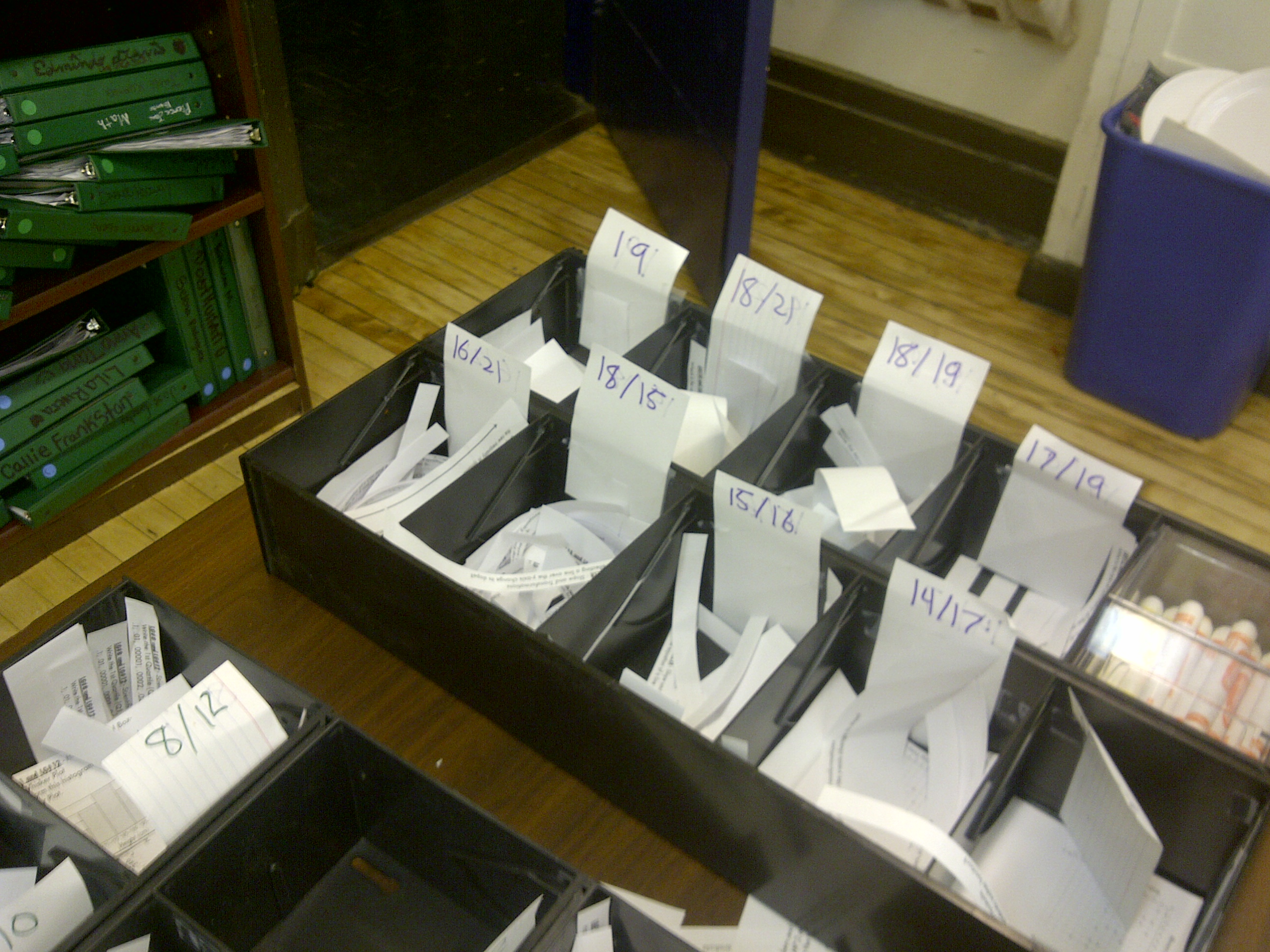
In each bin, I put a slip of paper containing a question. Students will go to the bins and choose which questions they would like to answer, and compile them into a coherent exam.

Those aren’t fractions on each bin label, though. They denote which Learning Goal each question consists of. Instead of having each Learning Goal have its own questions, they mix. But each goal still has 4 questions that apply to it, like so:

Not every topic can be combined with others, but now the student can choose which goals to work on: either they can try to improve a Learning Goal that they got a lower grade on, or pick ones they did well on and show they can perform Synthesis, which is above mastery. But, of course, all of these questions are harder than what they’ve done before.

To score the exams, I use the same scoring system as in Facts of Five, with students squaring what they get right in each Learning Goal. So they will get more points by focusing on completing a goal, instead of jumping around. An example:

Here this student got a decent score by focusing on completing four of the learning goals (9, 11, 16, and 18), and receiving assorted other points.

I definitely like the idea here, but I do need to refine the delivery. It was hectic. But I did not want to print out all 44 questions for everyone, when not everyone will do all of them. That would be a lot of paper. Suggestions are welcome.

The Monty Hall Problem

(Step one in going through a bunch of posts I’ve wanted to make.)

After reading this post on the Monty Hall problem last year, I decided to do a lesson on it. And it worked out okay. But, as Riley Lark did in that post, I did it at the end of the probability unit. So this year, I decided to go for it and do it first. And I must say it worked out quite well, because from the get-go it shows them that what they think about probability isn’t quite right.

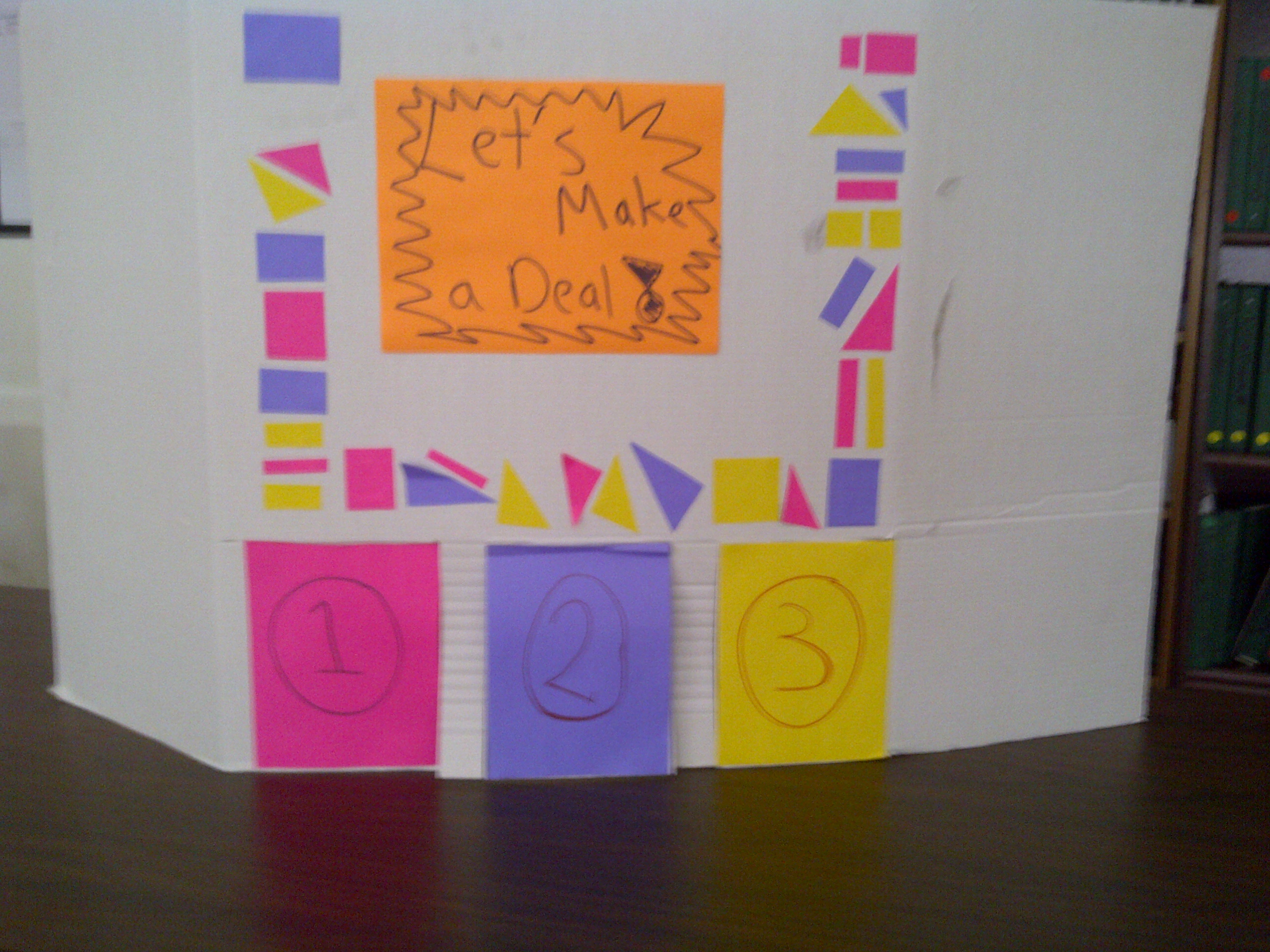
First, to play the game itself, it’s good to have a little showboat, plus something that is easy to reset. So I built this:

Image

(It’s a display board and I cut the doors open.) So it was much easier to play the game from the stay, and to keep my hands hidden as I do things behind the doors.

The other thing I did was, before we discussed the theoretical solution, I had them experiment. I gave each pair of students 3 playing cards, 1 red (for the car) and 2 black (for the goats), so one player played host while the other switched or stayed.

The main thing to learn is you really need to MAKE them switch, because teenagers are stubborn and are sure they were right the first time. But only staying won’t show all the necessary results.

Which Is Bigger?

I was going through some old stuff and dug out this gem:

It caused some disagreement when I first posted it, and my students jumped right in, arguing with each other and demanding to know who was right.

It’s a good way to show how mathematical language is precise, and it’s important to choose your words carefully.

3 Acts – Potatoes

I tried this out today in class (and will repeat tomorrow), and it worked out quite well. So now I want to share, my first 3 Acts problem.

Act 1

Potatoes – Act 1 from James Cleveland on Vimeo.

The question I intended to be asked was “How many of each potato do I need for the recipe?” or variants such as “What does he do now that the scale is broken?” or “Did he buy enough potatoes?” Those were all asked, along with some others.

Act 2

The video shows some things (how many potatoes I bought the first time, and the cashier says the totals), but it’s easier to lay that out when the students ask.

After that, they also wanted to know how much the potatoes cost, so I provided that.

But that’s all the information I can give: my scale is broken and I didn’t take the receipts from the cashier. Luckily, this is enough.

Act 3

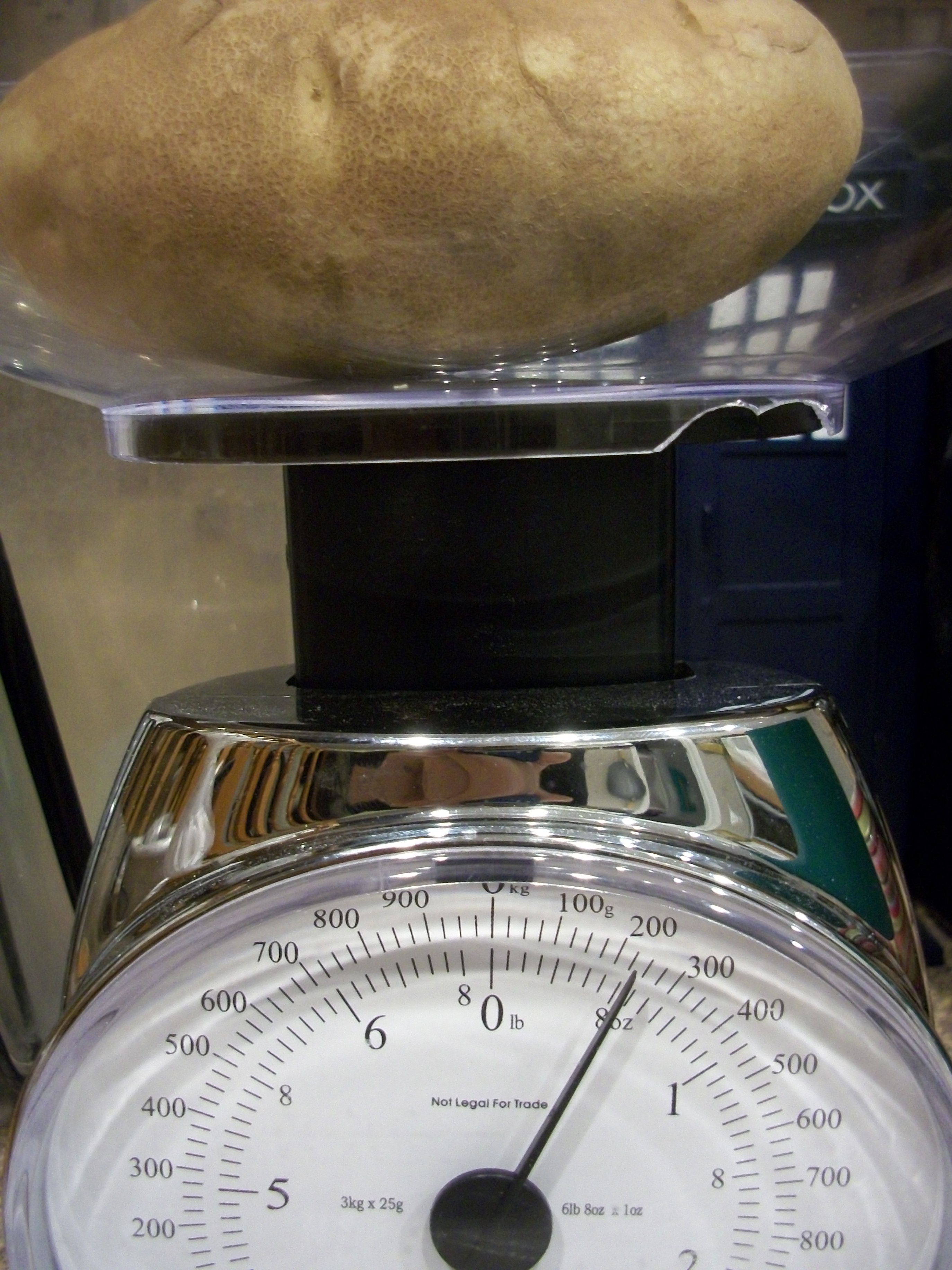
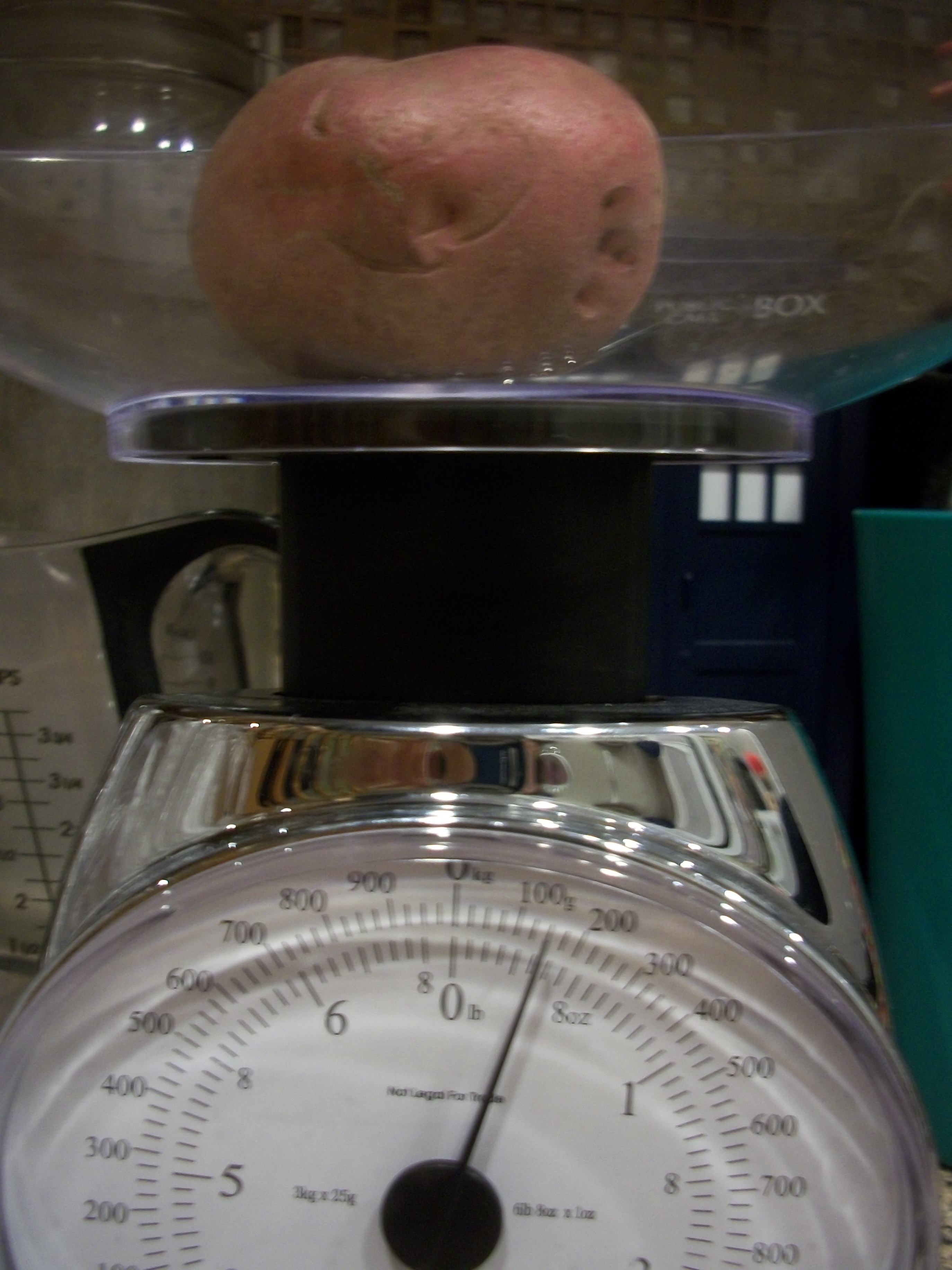
After we calculated the weight, we compared when I weighed them in my “new” scale.

I wish I had my digital scale for a better Act 3, but it’s actually broken (and the calculations I had to do when it was inspired this problem) and the analog was cheaper. The solutions you calculate (.36 lb and .43 lb) are pretty close to the values on the scale (which I peg at .37 lb and .5 lb).

The problem itself, in terms of the system of equations involved, is not that complicated (because I am using it to introduce the concept of elimination), but for the students who solved it quickly, I had a trickier problem up my sleeve:

Extension

What if I had bought 3 Idaho potatoes on the second trip? How can I figure out how much each one weighs now?

The Complete Problem

Potatoes.zip