Trying to find math inside everything else

This time I did purposefully combine two weeks – we had 3 days of no class between them, with the PSAT, a PD day, and a holiday.

We started week 5 with another quiz – they asked for this one to be on paper instead of on the computer, and who was I to go against the will of the people? So below is the quiz I gave:

At this point we wanted to finish off our chart of Methods vs Criteria (except for IIA).

We were able to explain the whether most of the methods passed or failed Condorcet and Anti-Condorcet logically or with a counterexample, but the proof that the Borda Count passes Anti-Condorcet is a little more subtle, and a little more algebraic, so I broke that out into a worksheet.

This led to a good combinatorics connection for me. The standard way to calculate the Borda Count is to assign points based on how many candidates you beat, so if you look at it from the point of view of a ballot, in an election of 5 candidates, e.g., a single ballot gives out 4 + 3 + 2 +1 + 0 = 10 points. But another way to view the Borda Count is that you earn a point from a candidate (as opposed to from the voter/ballot) every time you beat them in a 1v1 match. Well, with 5 candidates, how many possible 1v1 matches are there? 5C2 = 10. Oh wait, that’s the same as before! And shows why the C2 column of the Arithmetic Triangle (sometimes known as Pascal’s) is the Triangle Numbers.

Speaking of combinatorics, the next part was fun. First, we considered how many different ways there are to seed an 8 person tournament. There’s lots of ways to represent this number – my first conception of it involved double factorials!! (Sam was shocked I had found a natural use for double factorials.) Thought the final conception was came up with (n! / 2^k, where k is the number of symmetries in the bracket) was easier to calculate and made more sense.

But the real fun part was thinking, well, if there’s 315 different ways to seed the bracket, is there a way to seed it such that every person can win? So I challenged them to seed the tournament so that A wins, and then so that C wins. (Some candidates couldn’t win, like B and D, because they had fewer wins than the number of matches in the tournament. A and C were possible but harder because they had few paths to victory.)

After this I introduced the concept of a Condorcet method, which tournaments are, despite their manipulability flaw. So I expanded our chart to include the methods we’d be doing soon: Copeland’s, Minimax, Nanson, and Ranked Pairs.

Finally, we had another quiz:
Here’s a fun problem I worked on recently – fun enough that I nerdsniped two of my coworkers about it. Here’s the problem:


In the Pokémon TCG Pocket app, I would earn 10 points for winning a match and lose 7 points when losing a match. However, you also get a win streak bonus – the second win in a row gets a bonus of 3 points, the third gets 6, the fourth 9, and the fifth (and all subsequent) gets 12. Assuming I have a win rate of 50% (which I did at the time), what’s my expected value for playing n games? (How many games would I expect to play to earn x points?)

Below is a journey through my thought process – you can jump to the end if you just want the answer.


I started by writing out the different possibilities of runs of wins and losses for 1 game, 2 games, 3, etc. Thinking that if I listed them by hand I might miss some, I realized that I could use CONCATENATE in a spreadsheet to work recursively – take all the runs from (n-1) games and append a W at the end, then repeat the process with an L. So I did that here:

https://docs.google.com/spreadsheets/d/1izBy3wN-sVFV8SxExDxGC9rNVebEA5C7iPydU_kmP1Y/edit?gid=748567562#gid=748567562

(There’s 3 tiers, each with its own sheet – Master Ball Tier, where you lose 10 points on a loss, Ultra Ball with 7 [the tier I’m in], and Great Ball with 5. It makes sense to work through the problem in Master Ball, so you can just focus on the streak, and then adjust afterwards.)

Notably because I had some errors in my data, my calculated EVs and EV/game didn’t seem like nice numbers, so my first instinct was to turn to statistics. I did a log regression for the EV/game numbers and then used that to calculate when I would hit the number of points I needed (340). [You can just change which function it is to change tiers.]

https://www.desmos.com/calculator/tspirmvama

This felt unsatisfactory and I wondered if my logic was sound, so I roped in the inimitable Sam Shah and talked him through the problem. He voiced his belief that there would be an explicit solution, so that turned me back to my table. As I walked him through it, we found the errors I had, which made things look nicer, so on the right track.

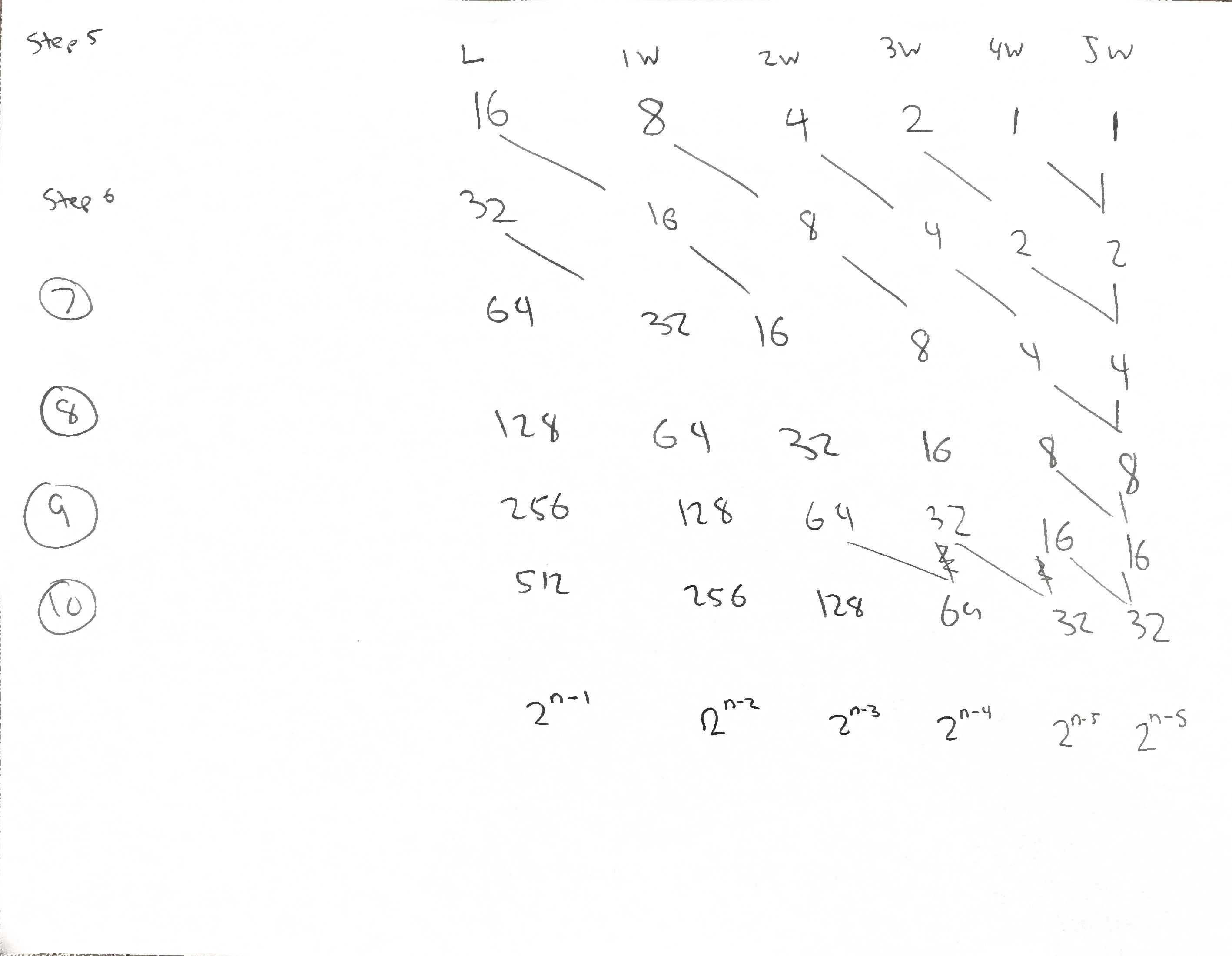
What really matters as you go through each game in the run, once you get past 5 games, is just the final five games. As you go through each game, we’ll notice that there’s a doubling happening. For example, after 2 games there’s 1 way to end in 2 wins, 1 way to end in 1 win, and 2 ways to end in a loss. After 3 games, there’s 1 way to end in 3 wins, 1 way to end in 2 wins, 2 ways to end in 1 win, and 4 ways to end in a loss. Once you get past 5 games, you no longer need to be introducing new sequences to look for, so then they start combining, as below:

For every game that represents a run that ends in 5 wins, I need to add 22 points. For every game that represents a run that ends in 4 wins, I need to add 19 points. And so on. And the total number of possible runs is 2^n, so to get the expected value of a single game, I would need this expression (for Ultra Ball tier):

Then I just need to add that value for every game past 5 onto the value I already calculated for 5 games, and voila!

But wait, you may have noticed that that expression could be reduced. In fact, once you reduce it, it no longer depends on the variable n – it’s constant!


So basically we have linear function with this value as the slope (and a domain of more than 5 games). So I made this graph to represent the three tiers – just input for y how many points you’ll need and the x-value for each intersection will tell you how many games you expect to play for each tier.

https://www.desmos.com/calculator/jdrc6qzrsh

Extension questions: What if I didn’t have a 50% win rate? How low could my win rate go and still have a positive expected value? I leave those as an exercise to the reader.

I totally purposefully combined these two weeks because they were short due to holidays, and not because I forgot about week 3. Yep.

First was our first quiz on what we covered in the first 7 days. (My quizzes are always slightly lagging, in all of my classes.) It was…longer than I anticipated. I think my usual metric for how long students need for work doesn’t apply to this class, because it’s so new to them. It was also testing some spreadsheet commands they needed to learn, so I made it an online quiz. I did it by sharing it through Google Classroom, highlighting cells they needed to fill in, and having them turn off their Wi-Fi once they opened the quiz. See below:

https://docs.google.com/spreadsheets/d/1qyLIkmBhQqvS-Zk4VsEivnQuTDUsYn_-BPJbXpW5iFw/edit?usp=sharing

We started off my returning to some of the criteria we looked at for two-candidate systems, now applied to the multi-candidate systems. We started filling out the chart in the first slide below.

We worked through counterexamples for why IRV/et al fails monotonicity, and why Borda and Survivor fail majority. I also discovered this website that both calculates winners and has a bunch of example elections, which has been very handy: https://rob-legrand.github.io/ranked-ballot-voting-calculator/

We also read this argument about why IRV failing monotonicity doesn’t matter: https://archive3.fairvote.org/reforms/instant-runoff-voting/irv-and-the-status-quo/how-instant-runoff-voting-compares-to-alternative-reforms/monotonicity-and-instant-runoff-voting/

Then we got to Condorcet, which took the bulk of our time. We learned how to make pairwise comparison matrices both by hand and using spreadsheets, which we see in the Pairwise Matrices tab of my example spreadsheet: https://docs.google.com/spreadsheets/d/11XoeRwnayoBUOO6psc2n4fGoKtOrDIDmWzkNwLCMKGE/edit?usp=sharing

This took the bulk of the time, and also I realized I needed to give more practice so we did more for the RCV election systems and the matrices.

The last thing we covered was using the pairwise matrix to find the Condorcet winner, loser, and also to resolve the results of a tournament/pairwise agenda election. We hinted at the idea that the person who sets the agenda/seeds the tournament has a lot of power to determine the winner, but that’s an idea we’ll dig into more this week.

So we ended the first week with a proof of May’s Theorem, but really only in the case of an even number of votes. I assigned the proof with an odd number for homework, and none of them where able to quite get it on their own but a majority got close.

(As an aside, here’s the chart I mentioned that we did in the previous post, but filled in.)

Then we started talking about voting systems with three or more candidates. In particular, not only how to tabulate the winner by hand, but how to tabulate automatically using spreadsheets. First, the slides:

When I first worked on these problems over the summer, my spreadsheet solutions were definitely…inelegant, let’s say. Compare what I did then vs. what I did this week with the students.

Summer: https://docs.google.com/spreadsheets/d/1Z0s_cQ9vAUZRDTXB_8BFCNlbjrrjVo8aoW8fjm9XH7Y/edit?gid=2074741057#gid=2074741057

Better: https://docs.google.com/spreadsheets/d/11XoeRwnayoBUOO6psc2n4fGoKtOrDIDmWzkNwLCMKGE/edit?gid=0#gid=0

What’s especially nice about the newer version is how it displays who wins or is eliminated in a particular round – learning the XLOOKUP command was pretty hand.

Anyway, going through those methods and implementing them in spreadsheets took the whole week, on top of additional practice with the second election preference schedule. (We did the Apple one as a class and then I assigned them the Alli/Bell/Choi/Diaz one to do on their own.)

This year I’m teaching a new class called Discrete Math and Democracy, which is a course I’ve wanted to teach for a long time, ever since I helped my ex prepare to teach a similar course at his university. I spent a lot of time learning things and gathering materials over the summer, including ones I got from previous workshops at Math for America. I thought about doing a Blog180 to document my time teaching the course, but that’s not the kind of blog this is, so I figure I’ll debrief somewhere more private and then do weekly updates here, along with any materials I use. (Hopefully I can still squeeze in some other posts on other topics in the meantime.)

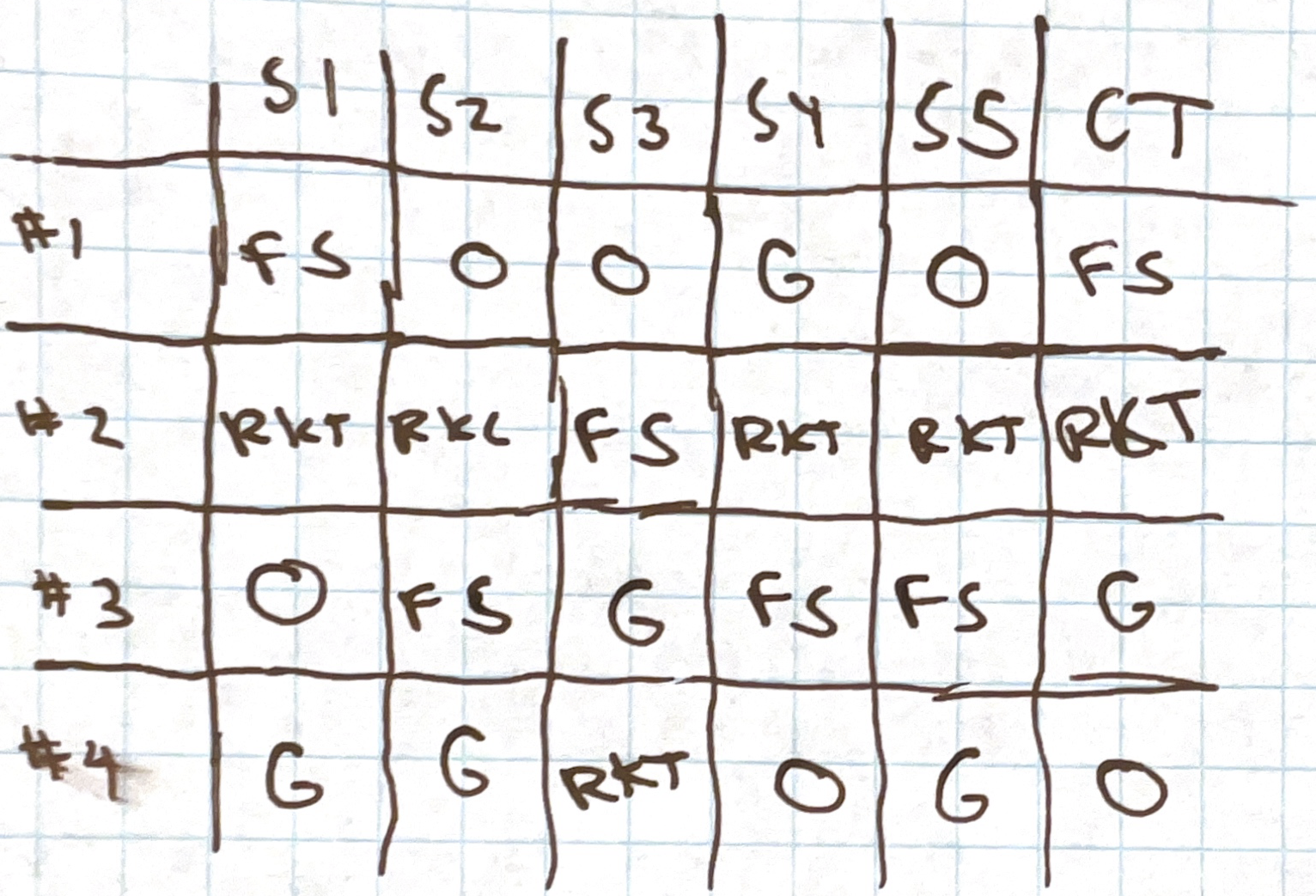
The first day I started off asking the students to think of a process for choosing a snack. They suggested each person suggesting a snack and then we’d decide, so we got straight to the idea of nominating candidates. At first three people were going to make the same nomination (Oreos) so it seemed like that might be the winner, but then I had them make preference ballots for our four candidates. The voting profile for those are below.

It became clear that while Oreos were the plurality winner, Rice Krispies Treats were more of the consensus choice, so we right away had a tension between what they might have expected for a voting system and what might be “right,” so that couldn’t have worked out better. I then had them read this article on different kinds of distributive justice by Matt Bruenig to help get at the idea that there are different ways to structure society that all have merit, and a similar thing applies to electoral systems as well. We need to know what our goals are before we can decide on a best system.

The next day, Rice Krispies Treats in hand, we looked at a tabulated voting profile and I gave them the challenge of coming up with a reasonable way to count the votes such that each candidate can be the winner. (This is adapted from a material I got from a workshop so long ago I don’t remember which, although it was probably led by Kate Belin.) I turned it into the worksheet below:

The students were able to come up with equivalents to plurality and Borda count on their own, as well as a system where they counted all #1 & #2 votes (which I guess could be equivalent to a kind of approval voting). They needed a little hint to get Edamame and Bagels to win. (Spoiler: it’s IRV and Top Two Runoff.)

After that I had them learn some basics of spreadsheets, as we’ll be doing a lot of work with them, using this wonderful tutorial by Jed Williams.

Next, I pared it back to two-candidate election systems and we looked at various kinds and what properties they have.

I was reminded of the important of having examples and, even better, non-examples. An important social choice theorem is May’s Theorem that states that the only two-candidate system that is anonymous (treats all voters equally), neutral (treats all candidates equally), monotone (you can’t lose by gaining more votes), and nearly decisive (always has a victor unless the candidates have the same number of votes) is a simple majority.

But simple majority is such a basic and obvious system that it’s hard to see why this theorem is a big deal, and often the only counterexamples given in textbooks are dictatorship and monarchy, which are obviously antidemocratic. But I found a new book (A Mathematical Look at Politics) that gives a few more examples of systems that are reasonably democratic but don’t have all of those properties, which helped clarify it.

They are supermajority (you need a higher threshold to win, like 2/3 of states to pass an amendment), status quo (if a challenger doesn’t get a certain number of votes, the status quo wins – this is how the filibuster works), and probabilistic (a winner is chosen at random, with more votes increasing odds).

Filling out the chart was a good exercise, though how to determine the properties of probabilistic systems was a little tricky.

Lastly, we worked on another sheet where we worked out the winner with several systems, and then proved May’s Theorem with a few fill-in-the-blanks.

The proof actually went quite well! It took me a while to wrap my head around it when I read it myself, but I think the blanks helped us consider the various properties and how it works. (This proof is for an even number of voters, so I had them do the other case, with odd, for homework.)

Off to a good start!

Anagrams and Quads

In geometry we’re learning about the correspondence of congruence statements (i.e. ∆ABC ≅ ∆DEF means that A maps to D, BC = EF, angle CAB ≅ angle FDE, etc). One fun type of problem you can do with this is a self-referential congruence statement to highlight symmetry. For example, if LIMA ≅ MALI, what type of quadrilateral is it?

So the first question I had was “How many of these types of problems can you have?” The answer is not just the same as how many ways there are to arrange 4 letters (4!), because you still need to connect the four points in the same order (although you can change whether you go clockwise or counterclockwise). So if our starting ordering is 1234, you can have the following orderings:

1234IdentityOPTS
2143Isosceles TrapezoidPOST
2341SquarePTSO
3412ParallelogramTSOP
4123SquareSOPT
1432KiteOSTP
4321Isosceles TrapezoidSTPO
3214KiteTPOS

(As a side note, how do you solve these problems? You can list out all the sub-congruencies and mark up a diagram. But I like to think of the mapping of points and determine what transformation that would be. For example, with OPTS to POST, P and O switch places, and S and T switch places, so it must be a reflection with the line of reflection down the middle of lines PO and ST. This makes an isosceles trapezoid.)

I picked OPTS as a starting point because it’s the four-letter work with the most anagrams (OPTS, STOP, SPOT, POST, POTS) so I figured some would should up in this work and was surprised there was only one. But then I realized that which one I start with matters: if I start with OPTS, only POST is a valid shape, but if I start with STOP, then SPOT and POTS are valid.

So then I went through a list of four letter anagrams to find more that fit the patterns I need above. Below is a non-comprehensive list you can use for these types of problems if you, like me, like using words instead of just ABCD.

2143MANEAMEN
2143ACTSCAST
2143TIMEITEM
2143SUREUSER
2341EMITMITE
2341MITEITEM
2341EACHACHE
2341ABETBETA
3412MALILIMA
3412EMITITEM
3412ARTSTSAR
3412REPOPORE
3412CODEDECO
3412DEMOMODE
3412GOERERGO
4123ALESSALE
4123LOTSSLOT
4123OPENNOPE
1432BETABATE
1432DEMODOME
1432MATEMETA
1432GORYGYRO
4321ABUTTUBA
4321TIMEEMIT
4321RATSSTAR
4321BARDDRAB
3214AGEDEGAD
3214TIMEMITE
3214RATSTARS
3214MANENAME

If you have more anagram suggestions, leave them in the comments!

Derivative Clicker

I was looking for a derivative-based game to play in Calculus as we were just closing out our first unit on derivatives and the semester was ending. That’s when I found Derivative Clicker:

https://gzgreg.github.io/DerivativeClicker/

It hit the spot with my students. I explained the game and had them all start playing simultaneously, and then saw who had earned the most money in 20-25 minutes. Yes, it’s a little addictive and “brain rot” (as one student said, but, like, it was a positive review) but they had a lot of fun.

The thing about math games, though, is that the real power is not in the game itself but in the debrief. Just the lesson before this was my students’ first exposure to the idea of higher order derivatives. They asked “But what does a second derivative actually tell us about the function” and I explained, but it still felt ungrounded to them. So I thought this would help them feel the power of derivatives viscerally.

Then we filled out some tables: what if I just had a single 1st derivative (or, in other words, f'(t) = 1), how much money would I have after time? What if instead f”(t) = 1? f”'(t) = 1? This helped build up the idea of increasing rate and how the rates grew polynomially.

They also had debate question about strategy – in the game, with $500, you can buy 1 second derivative or 65 1st derivatives. Which is better? (There’s no a clear answer here – if you were to buy the second derivative and then walk away, it’ll probably be better for you by the time you get back. But if you buy the 65 1st derivatives, you’ll have enough money to buy a second derivative way before buying a second derivative will get you 65 1sts.)

Below is the debrief sheet we did today.

Oof, well, I certainly meant to write this up sooner, not almost a full month later, but it felt like it took this long just to feel caught up from having missed those three days! That’s definitely a struggle with the conference timing. Anyway, I figured I’d go through some of the sessions I went to, and my notes, as a way to debrief myself but also share any gems I picked up.

Two Students, One Device

I missed the beginning of this session because I went to two other ones first, neither of which worked out, but I knew Liz (Clark-Garvey) wouldn’t let me down (as well as Amanda Ruch and Quinn Ranahan). I’ve used the practice of two students on one device before, but I realized it was natural to do it back when I was at a school where we were using class carts of laptops/tablets, so I could just give one per pair. Now I’m at a school where everyone has their own device, so making them pair up needs to be a more intentional move, and it’s easy to default to not doing that.

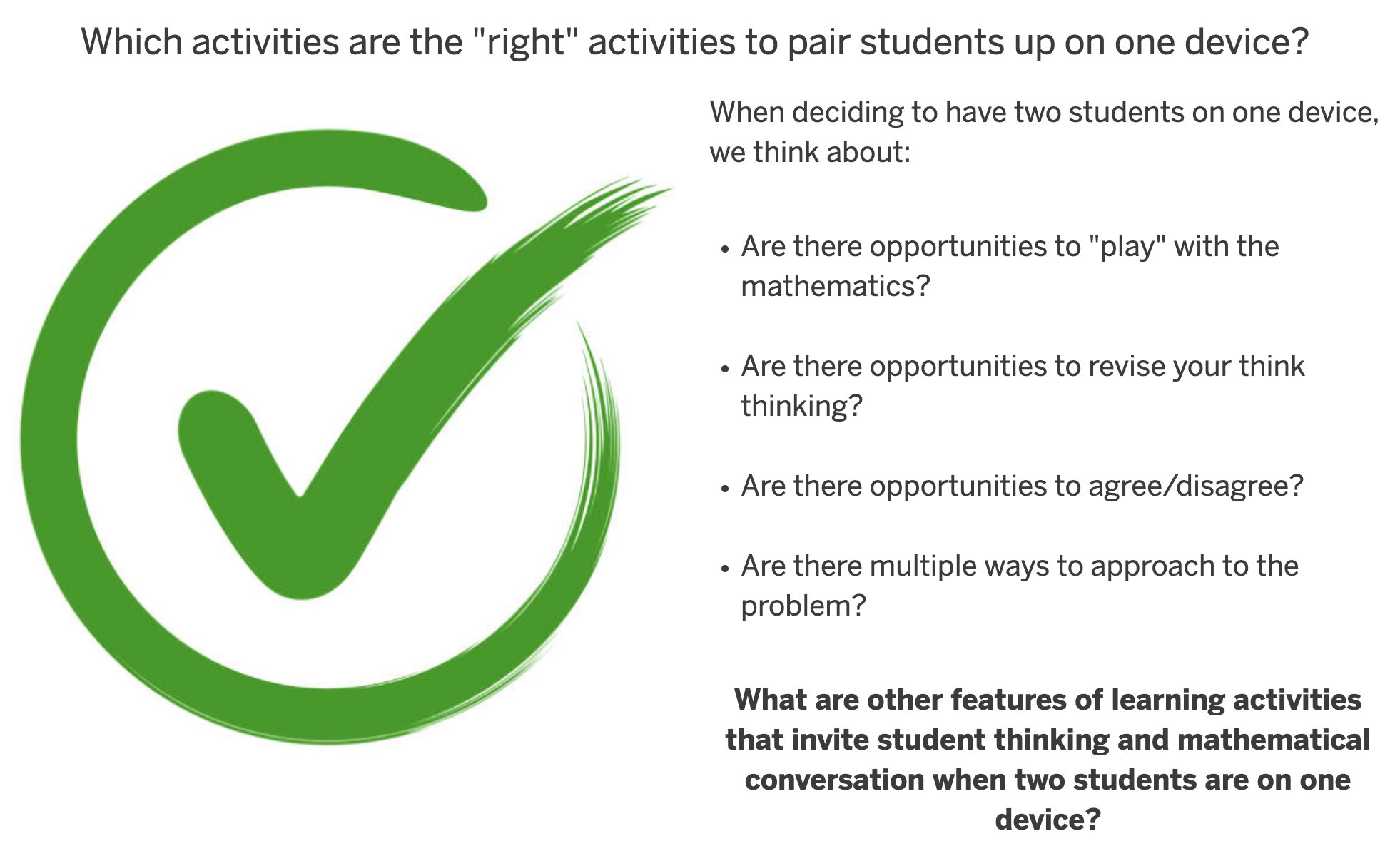
So then the question is, when to do it? If students are doing practice problems on DeltaMath, that doesn’t need to be paired. This is the slide the presenters had for this:

But they also talked about how just choosing the right activity isn’t enough, so other strategies are useful. For example, setting norms such as “type other people’s thoughts, not your own” or mixing up the groups and having them revise their responses.

Fawn

Sure, I could use the title, “Helping Students Become Powerful Math Learners,” but really this was the Fawn session. (Or should I say “The legendary Ms. Nguyen”?) The first quote I wrote down was “The pacing guide does one thing for me – it tells me how behind we are.”

Fawn had four maxims to follow:

  1. Ask students to seek patterns and generalize
  2. Ask students to provide reasoning
  3. Build fluency
  4. Assign non-routine tasks

One routine that stuck out was an open middle-type problem. We had to create the largest product using 5 numbers, 3-digit times 2-digits. Fawn had us all share our possibilities, and then we discussed which possibilities we could remove – someone would nominate one, explain how they knew it wasn’t the greatest (often because it was strictly less than another), and it would be removed only if there was 100% consensus. Then we could narrow it down before we ended up checking the top two choices.

Another thing of note was about the non-routine tasks and games: in particular, they should be non-curricular. This doesn’t mean not based on your curriculum at all, but rather not based on what they just did. This makes sense, as if they are always using the skill they just learned, that turns it into a routine, and thus won’t have the same benefit.

Just Civic Math

I don’t have that many notes from this session, and I don’t see any slides attached on the NCTM website. One note says “Limiting civics to just ‘social justice math’ is restricting. Dialogic math helps.” I think the idea here is similar to what I’ve used before, Ben Blum-Smith’s Math as Democracy. Jenna Laib’s Slow Reveal Graphs were mentioned, and I mentioned the similar graphs.world to the presenter. They also mentioned the book “Constitutional Calculus” which I will look into in the future.

Miscellaneous

Two notes I took on the patty paper session: use felt pens to be more visible on patty paper, and when folding, pinch from the middle and press outwards (more likely to get accurate folds on lines then).

I went to a really cool session on making art using mirrors and laser pointers from Hanan Alyami. Here’s the kite my group made in the time:

The project seemed cool and had some fun math, but I also don’t know when I could fit it in, as it’s a 3-day process.

I tried to go to John Golden’s session on games but it was full! I went to Christopher Danielson’s session on Definitions. Two things stuck out to me there: his reasoning for originally doing a hierarchy of hexagons was that it fought against status issues, since there was no pre-knowledge as with quadrilaterals; when asking if something is a vehicle, something that is so far from one, like a salad, just makes it a fun question, but something closer to an edge case, like a broken bus with no wheels, is harder and more contentious.

Okay, I was gonna keep going, but that seems like a lot – and that was all just Thursday! So maybe I’ll do separate posts for Friday & Saturday.

I’m on the plane Chicago right now, heading home from my first NCTM (and first conference since 2019). Here’s some top level thoughts I have.

  1. I really loved seeing some friends I haven’t seen in 5-6 years – but I don’t know how to answer “What’s new?” after that period of time. A lot! Plus I don’t know what you know from social media. And so then I’d sputter and think “Wait, do I not know how to talk to people? Have I forgotten?” But getting past those opening bits made it all work out.
  2. Sometimes I would go to sessions about things I already “knew,” but it was good to have a reminder, because 2019-2021 was such a big disruption in my teaching career that there were many things I used to do that got dropped, and I feel like I’ve been slowly piecing them back together the past few years. So it was good to go “Oh yeah, I used to do that” and commit to doing it again.
  3. On the other hand, I wish when sessions listed the intended audience, it would also be about whether it’s for beginners in that topic. The hot thing, of course, is Building Thinking Classrooms, but having learned about all of those things so long ago, I didn’t need to be pitched on how it worked in a session. Especially in a session that didn’t say it was doing that.
  4. I don’t often use an agenda in my class, but I really appreciated the speakers who did. This let me know when, if even, they would get to the meat. So many sessions would start with other things like intros, or bios, or reasons why, without any indication of what they actually did, so sometimes if it was 15-20 minutes in and we didn’t get to the point, it would be voting-with-feet time. But I could give more grace when I knew what was coming up. (Now, of course, students in school can’t vote with their feet, but what if they could? Would they still stay in your class?)
  5. One thing about the NCTM vibe, compared to other conferences I’ve been to, extends from the exhibition/vendor floor. But it’s not just the floor itself – it’s that so many people are there to output information or ideas. Every conference I’ve been to before has been bidirectional: all the speakers want to teach something, but also learn something. So having so many people talk as part of their job, without the learning part – feels icky. (I’m sure, of course, that many people who were there to speak as part of there job were also there to learn. But it didn’t feel universal.)

Oh, okay, that’s a good amount of thoughts. I do want to go into some specific things I learned and was amazed by in some of the conversations and sessions I participated in, but I think I’d need to reference my notes and such to do that, which is hard to do on this cramped tray table. Let’s just save that for next time.

When I started at my current school two years ago, one of the first conversations I had with my coteacher (Sam Shah!) was about grading, and coming to a compromise on our different grading systems. Often teachers will break down grades into categories, the weights of which can vary. But during that conversation I came up with what I thought of as the supra-categories, which I now use for all of my classes.

The first is Knowing Mathematics. In a standards based grading system, this would be the standards for content knowledge. In a traditional grading system, this would include things like tests, quizzes, projects, presentations, interviews – anything that shows what the student knows about the math itself.

The second is Doing Mathematics. In SBG, these would be process standards. In a traditional system, this might be classwork & homework, or class participation. I evaluate this typically with a portfolio of student work. (More on that below.)

The third is Being Mathematicians. I was doing Knowing/Doing before this, but this third category was how to incorporate some of what Sam had been doing with his portfolios, that I loved (and served a different purpose than mine). The assignments are about reflecting how the student fits into mathematical society – both on a small scale (in the class, reflecting on groupwork) and a larger scale (learning about other mathematicians, especially those from underrepresented populations, and about other mathematics outside of the scope of the class). This is also evaluated with a portfolio.


I first wrote about my portfolios in this post, and the general idea there still applies to my Doing Mathematics portfolio, but the structure is different.

Now I do the portfolio as an ongoing Google Slide. You can see the template for the portfolio I used for Calculus last fall here. Our school has a 7-day cycle, and once a cycle we have a double-period. So for that class, in the second half of the double I’d have a quiz about that cycle’s content (counting for Knowing Mathematics), and then afterwards they would work on their portfolio, picking one piece of classwork and one piece of homework from the cycle to reflect upon and include. This let me keep on top of the grading of the portfolio better than saving it for the end of the quarter/marking period, and also made it easier to make sure the portfolio was actually a collection of their work from the whole semester. They had to do two pieces per habit of mind, although usually I would wind up with only 16 done for the semester, not 18, to have a little wiggle room (because it’s hard to get them all). To make up for that, I include two extra slides for the work they were most proud of that quarter.


The Being Mathematicians Portfolio has a wider variety of assignments. Some will be reflections on how they work with their peers:

Some will be about mathematical debates:

Some will be learning about mathematicians (usually from underrepresented groups) or mathematics from underrepresented cultures.

Sometimes news in the math world, or other modern mathematics:

Sometimes about what it even means to do mathematics:

Students will occasionally get these as homework assignments, and we’ll usually discuss them the next class. (I’d like to be more consistent about it, as I am with the Doing Math – maybe that’s a goal for this year.) I’d also gladly take suggestions for assignments in any of these categories, or if you think there are subcategories I didn’t really hit on!

Here you can find the entire year’s worth of BM Portfolios for Geometry and Calculus. (About half of the slides were made by Sam. Wonder if you can guess which are made by whom!)