Trying to find math inside everything else

Posts tagged ‘Education’

They Don’t All Go So Well

I’ve known what my next post was going to be about for some time, which is why it’s been so long between posts, as I’ve been putting it off. The failures are less fun to write about, but it’s just as important when your lesson is a bust. Now I have lots of other things I want to write about, so more posts in the next few days.

Shortly after my successful Egyptian Fractions lesson, I wanted to tie a lesson into another ancient society they were learning about, so I decided to teach the Mesopotamian Number System. The idea was that we’d reinforce some ideas about exponents, place value, and scientific notation by working with another base.

The problem: working with another base is hard, especially if you’ve never done it before, and sexagesimal is not a great place to start, even with the boost I got with the fraction lesson. Introducing the idea with binary probably would have worked, but I didn’t have the time to do both and also teach the cuneiform and do the activity. Unfortunately, to save the activity, the basis of the understanding got cut. Which left me with a fun but useless activity.
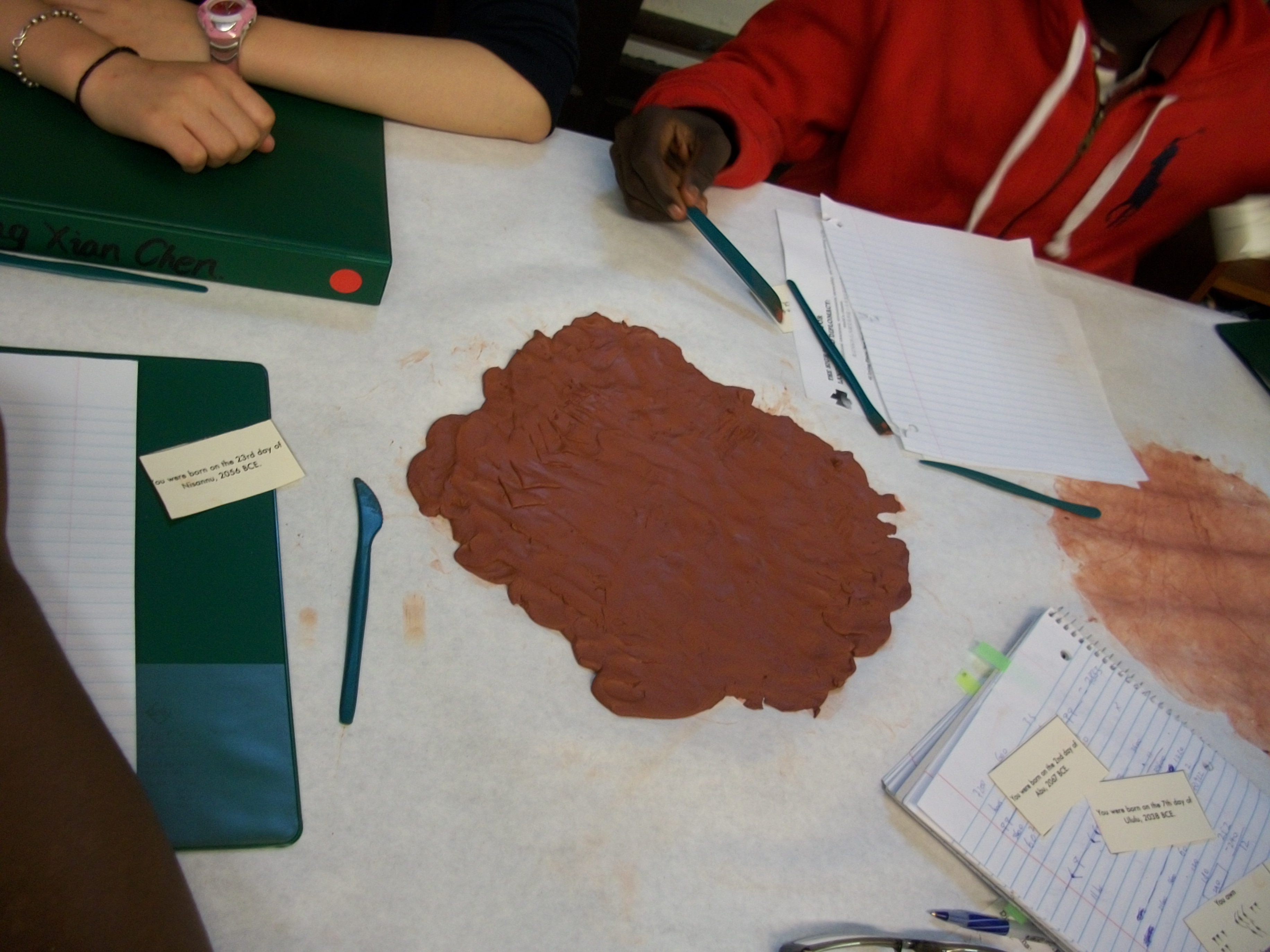
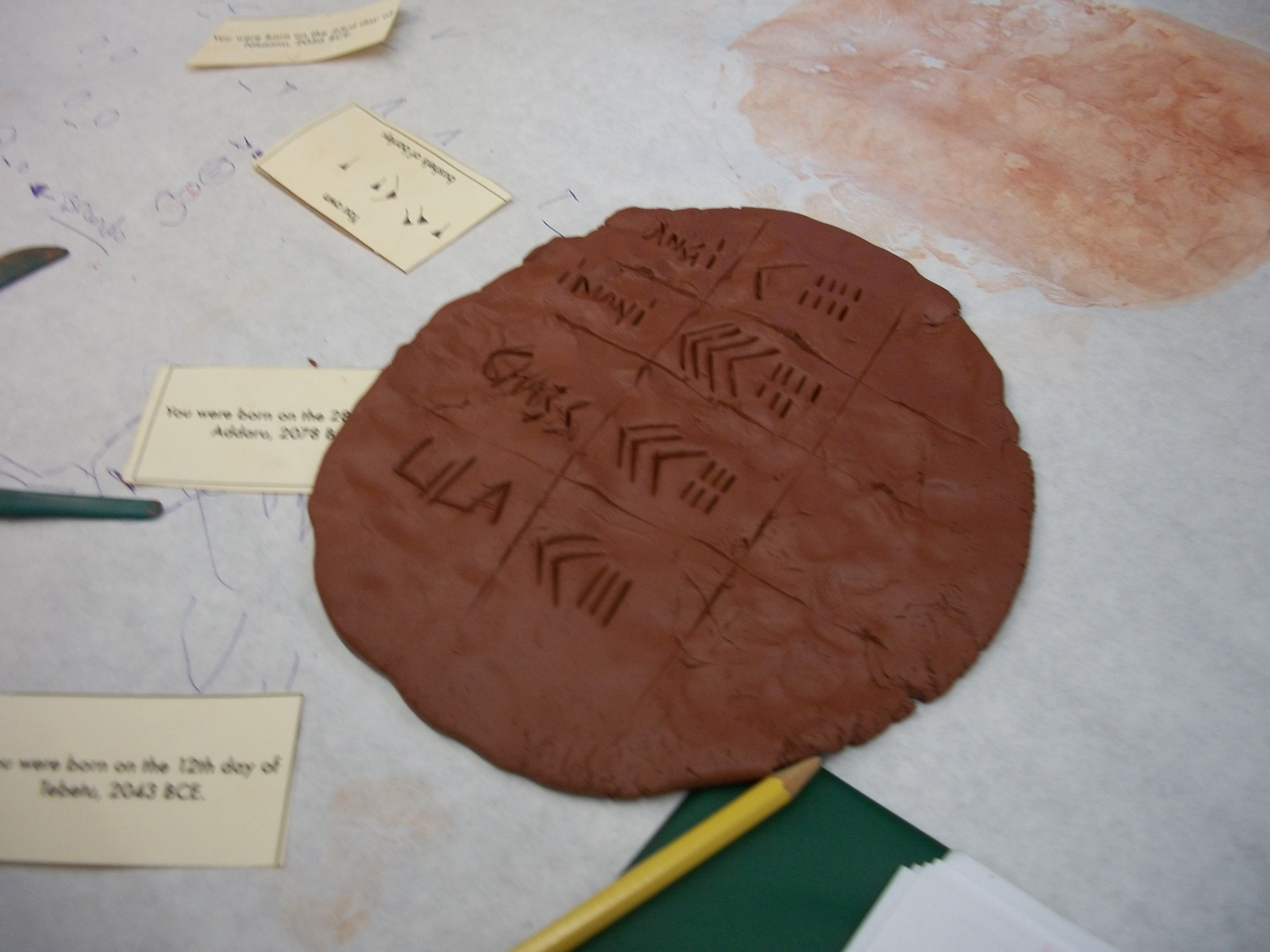
I used hours:minutes:seconds as an analog to help understand base-60, but because they got that they couldn’t move past it. I gave them numbers to translate and had them carve cuneiform tax tablets (and they learned about Babylonian taxes), but that didn’t work out too well.

And then I didn’t even get nice product to display for too long, because they were too brittle.
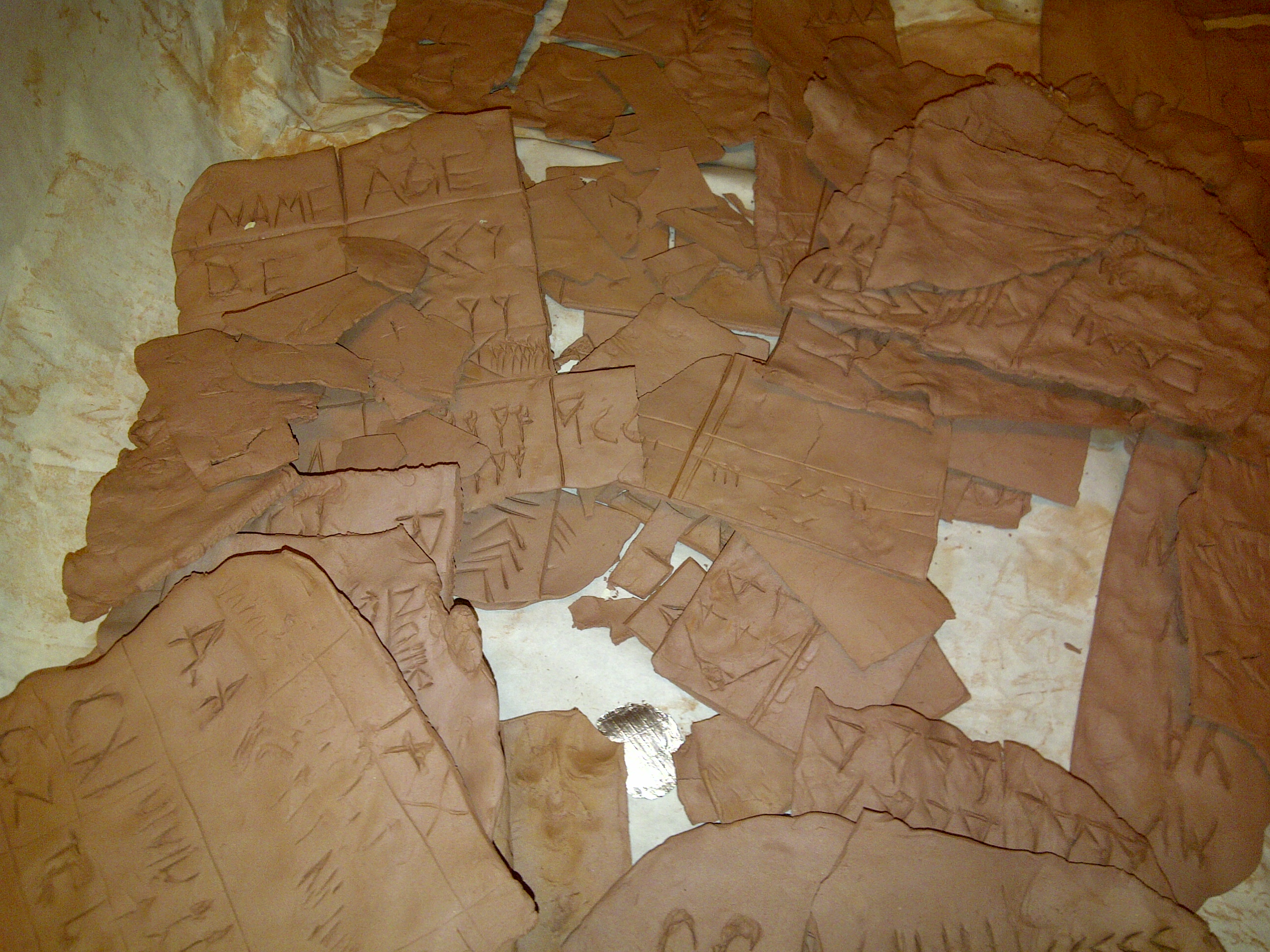

As I said. A bust. Or rather, busted.
Egyptian Fractions

As I stated earlier, I’ve been trying hard this to integrate the other subjects more into my math lessons (and the other teachers are happy to work vice versa, because I’m on a great grade team). This process is made easier by actually having a Special Ed co-teacher for one section, and she specializes in math (and sees every subject, so can comment on all of them). So my first lesson explicitly tying history to math just went off, a lesson on Egyptian Fractions.

My goal for this lesson was really to get some fraction practice in while still learning something new, while also highlighting the “symbol that represents the multiplicative inverse,” , which I’d tie in on the next lesson about exponents (aka an exponent of -1). We worried, though, that the translation process would be too tough while dealing with fractions. That’s when we came up with this:

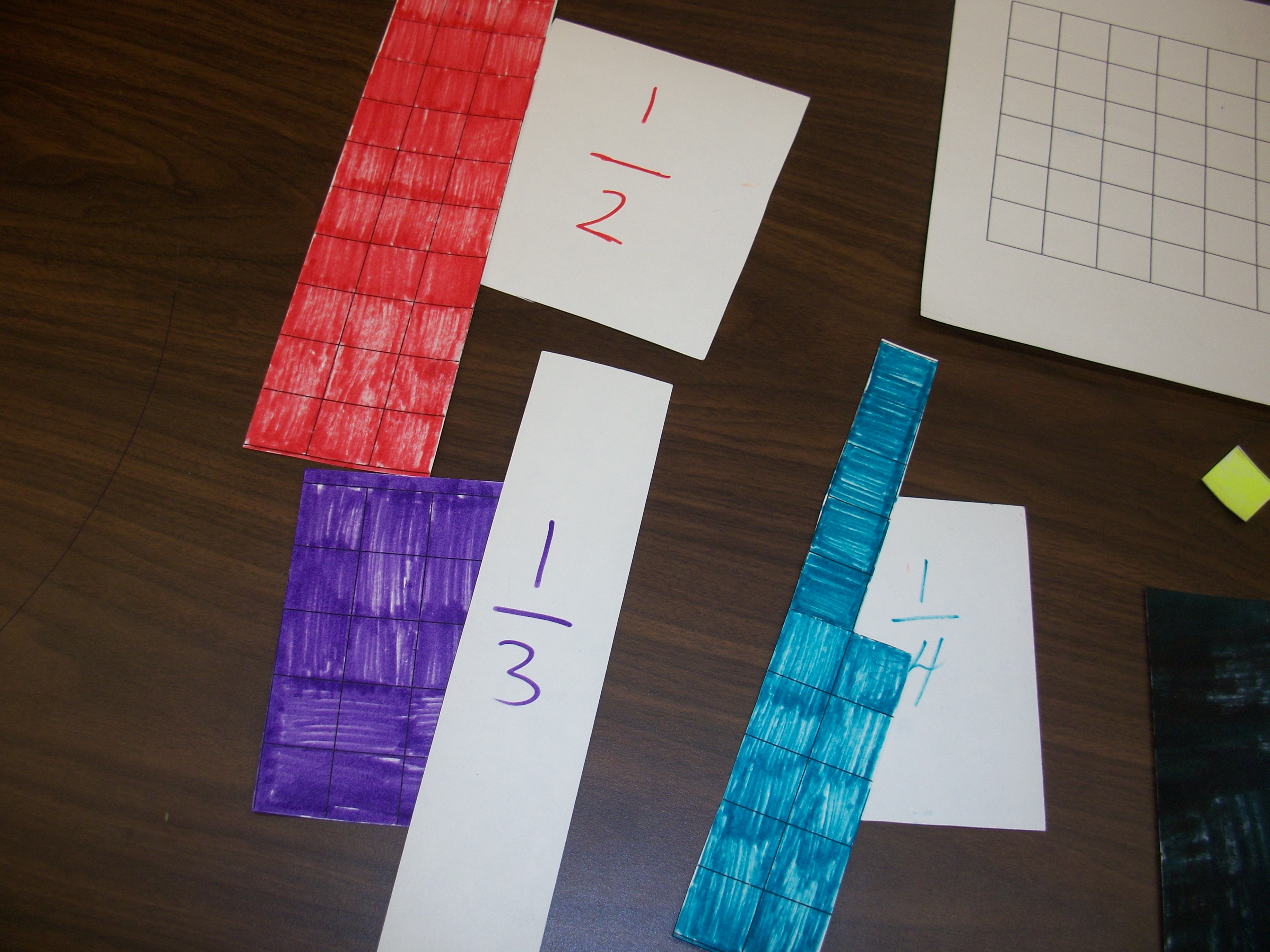
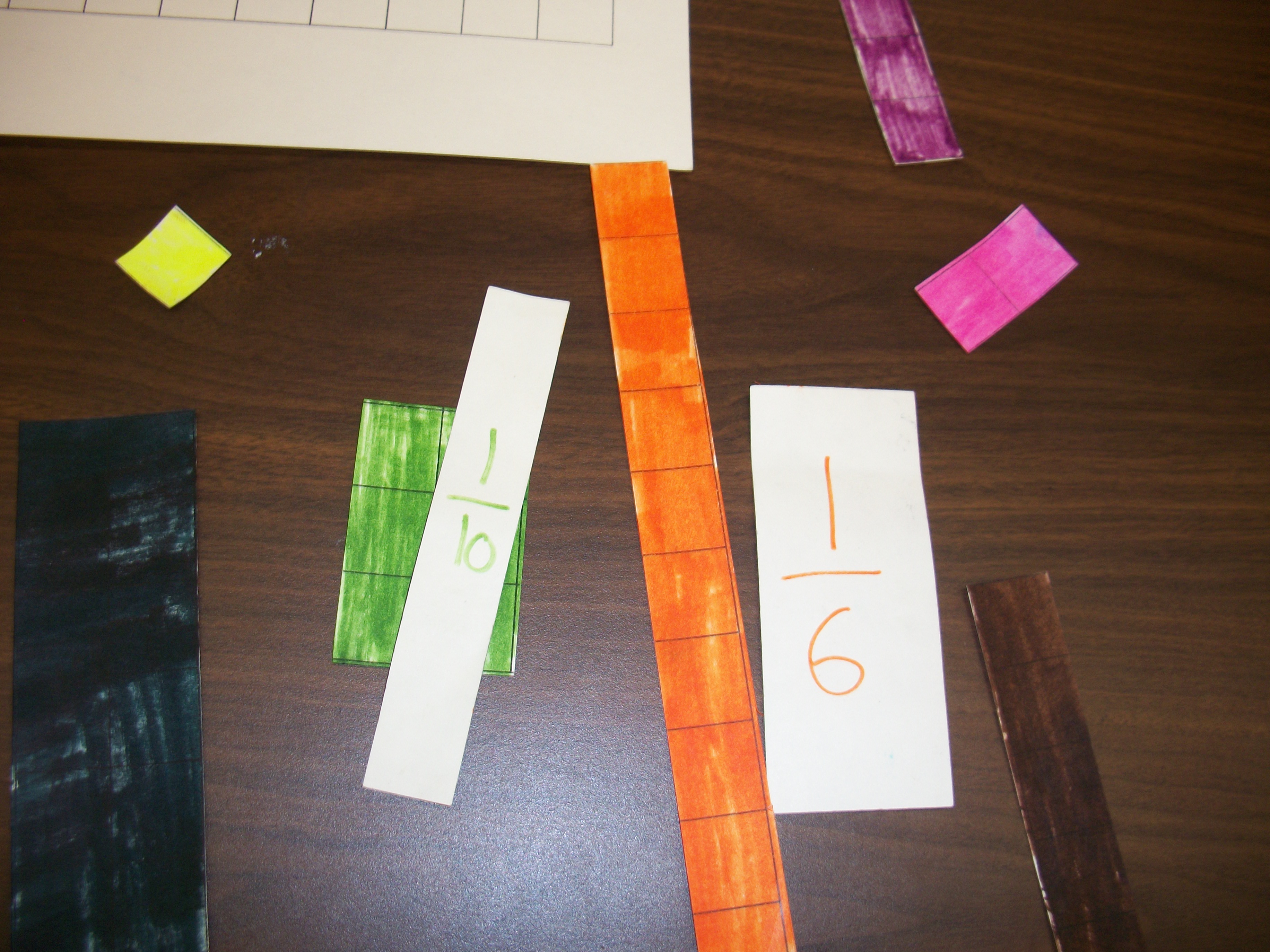
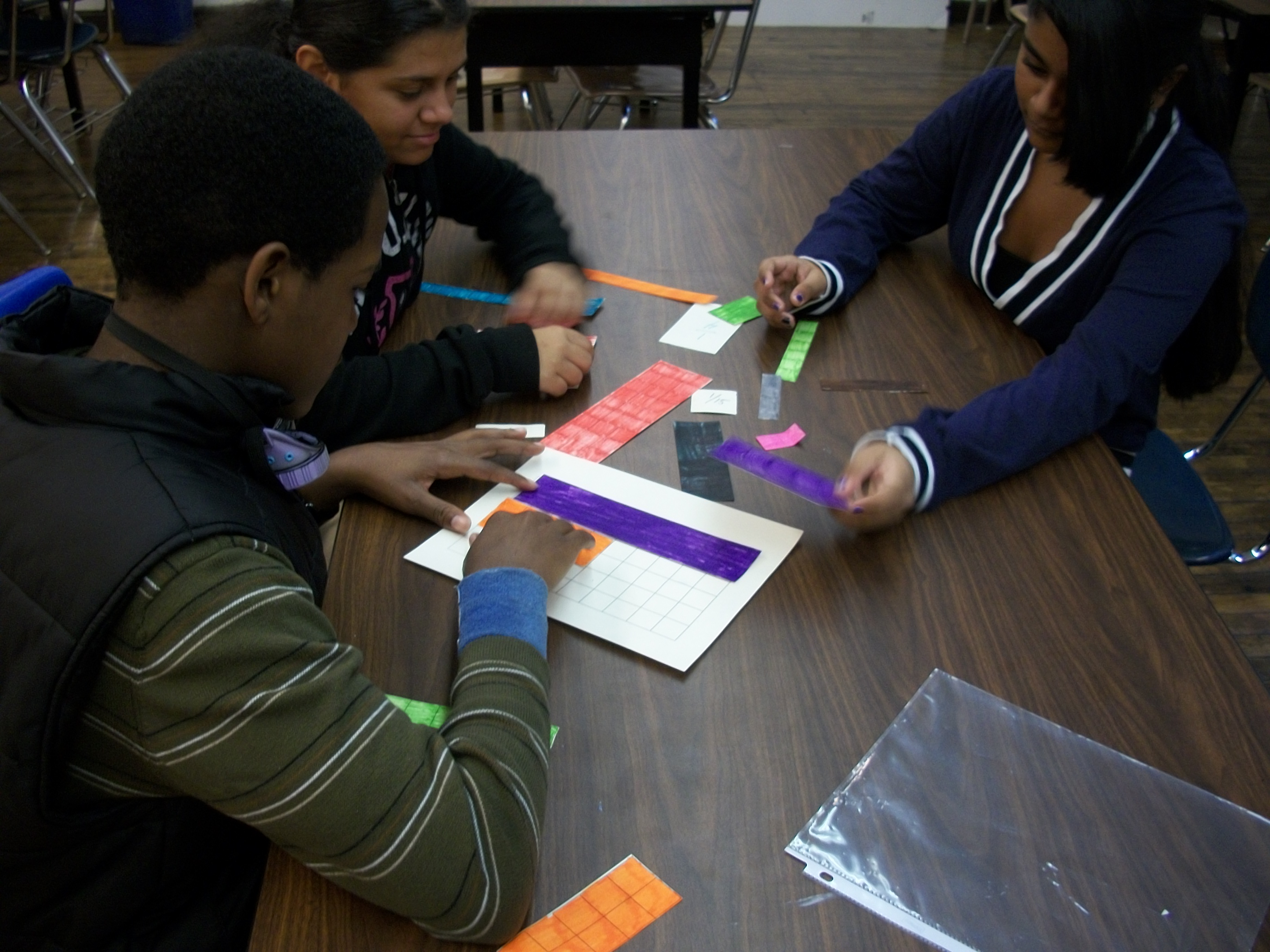
The Fraction Board has 60 square on it (which will be good reference for when I deal with sexagesimal Mesopotamian numbers soon), so each piece is cut to fit the amount of square that will cover that fraction of the board. To make the boards, I just made a 6×10 table in word as square-like as I could, printed on card stock. Then I cut the pieces out of the extra boards and had slave labor student volunteers color them in for me.

Each fraction have multiple pieces to represent the different ways you can fit them. (For example, 1/2 is 30 square, so I have a 3 x 10 piece and a 5 x 6 piece). But each fraction is also colored the same, because in Egyptian Fractions you can only use one of each unit fraction.

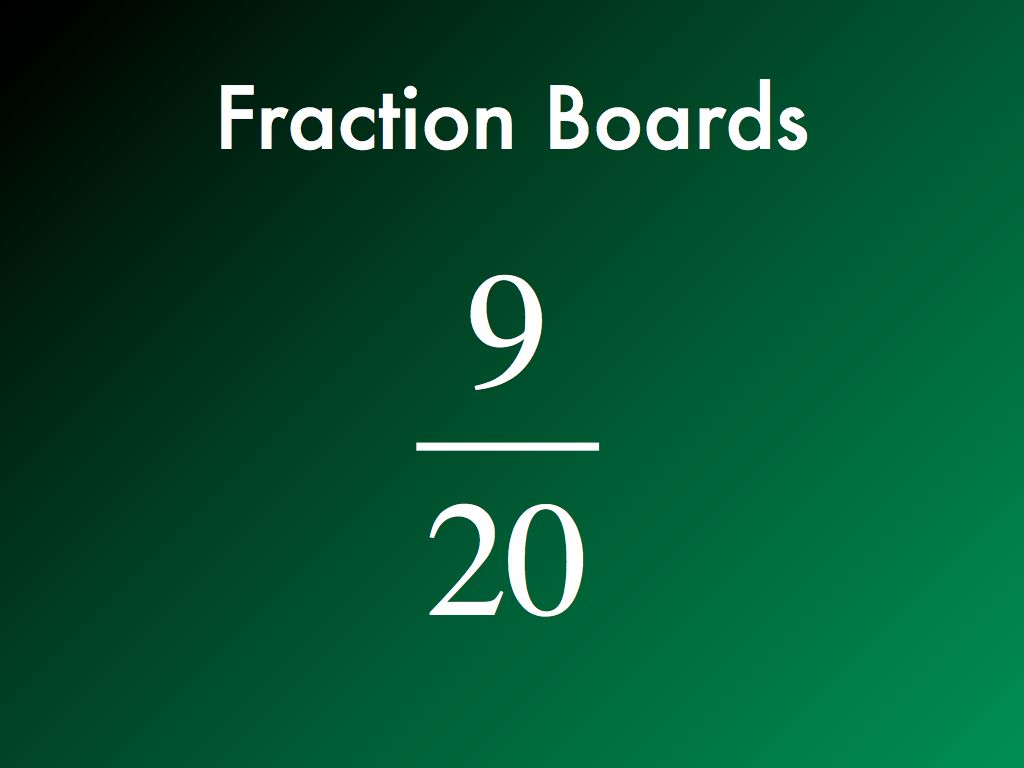
Then I would put up a slide like this on the board:

And the students would have to make that shape on their boards, with no overlapping and only using each color once. For the first one I shared a possible solution:

But I got really excited when the students could come up with multiple different solutions for each problem. And I would increase the difficulty of each one, until I would just get to a fraction with no picture:

And they still nailed it. Eventually I would move away from the boards and show the process of how to do it without the boards. We’d do some simultaneous calculation (using the greedy algorithm or more natural intuition) and checking on the board. Then we’d try with non-sexagesimal fractions. And every time we would translate our answers into hieroglyphics as well. So by the end of the lesson they could work on a worksheet where I just gave a fraction and they gave me hieroglyphics in return. (Not all of them could do this completely, but most could do some of the sheet). I think, overall, it went pretty well.

Egyptian Fraction Slides (Powerpoint)

Egyptian Fractions Slides (pdf)

(WordPress doesn’t seem like it’ll host my slides in their original Keynote form. That’s bothersome.)

It All Fits Together

One of the best things about being a math teacher, as opposed to a mathematician, is that because I have to think about how to explain a concept to people who don’t get it, I have to think about concepts in different ways than I ever have before. So I often make connections that maybe I should have already made, but hadn’t, and I see the beauty of the conventions and connections of mathematics.


Today I was musing about the use of -1 as an exponent to give us a reciprocal, because my next lesson is about Egyptian Fractions, and so their fractions are basically the number with an inverse symbol, which we still use, -1. And then I thought, well, yes, that is our inverse symbol, for functions too. Of course, that makes sense. But the clearness and uniformity of it seemed new. So often we learn about things in math in such disconnected ways, so it’s just “Here’s one use for the -1. Here’s another. That’s the way we do it.” But not why it’s the same for both.


And I get these realizations all the time. At least 5 last year. (I think another I had had to do with FOIL.) I hope I keep getting them. But the next step is, of course, to figure out how to let the students get them. Because then, I think, they won’t hate math so much.

What’s My Set?

For the past two lessons I’ve taught about sets, including set notation, union, intersections, and complements. To practice what they’ve learned, I had them play a game called What’s My Set? I originally came up with the idea because I wanted the students to get out of their seats in the middle of the double period, and so organizing themselves into the sets seemed like the way to go.

I gave them all badges as they entered class with a number on it. They got them totally interested in what the numbers were for, but I just expressed the need for patience. When it was time to use them, they were interested.

We played it twice. First to practice their ability to read Set Builder notation, write it, and translate into roster notation. I would display the sets in Set Builder on the board, giving each set a location, and they would have to move to that part of the room. But it’s up to the people in each set to make sure they have everybody that belongs there, since I would check if a whole set was correct, and so the stronger students were forced to help the lost ones to get their points. I would give a point to the first set to complete itself. The interesting thing is, because the sets change, though the points are per team, really they are individual. I didn’t give a prize, but they didn’t seem to care.

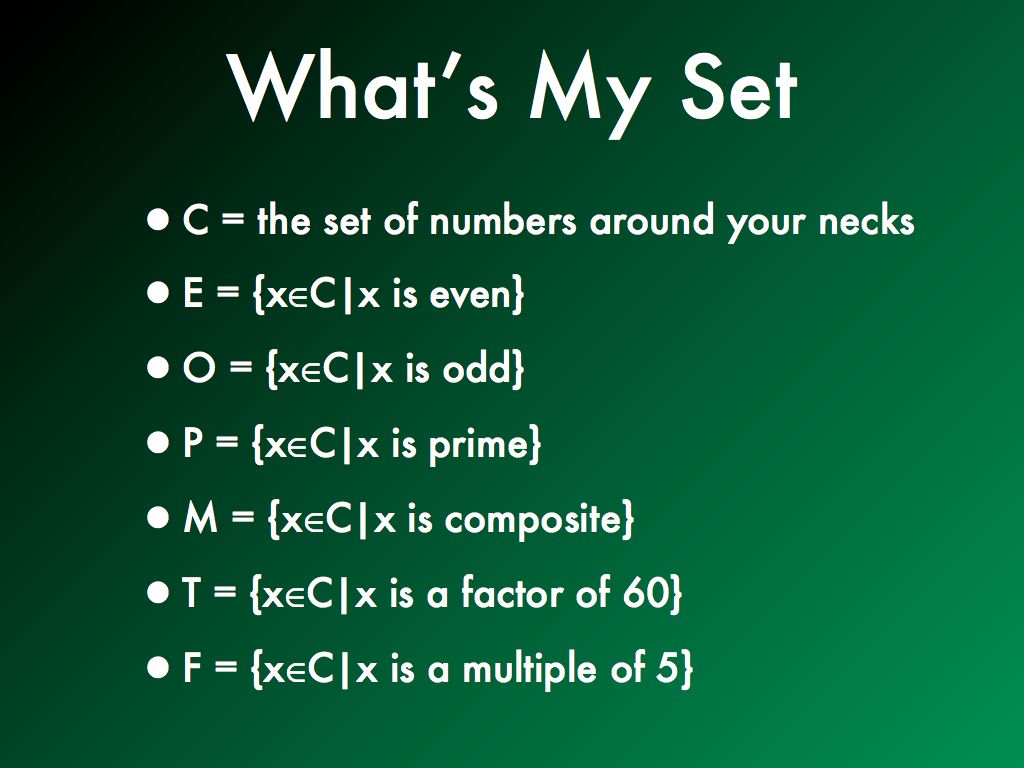
In the second part, to practice unions, intersections, and complements, I just left 6 pre-defined sets on the board:

Then for each round, I would write on the board something like O ∩ P goes to the front of the room and (O ∩ P) complement in the back, so they had to think a little bit more for this round.

Math is like…

So on the first day of math class, I gave the students this little analogy:

“Math is like cooking. You don’t need to know how to do it to live your life, but if you don’t you need to always rely on someone else to do it for you, and it will wind up costing you more money. Most people know how to do the very basics, enough to get by, but those who really understand the concept make their lives richer and more enjoyable on a daily basis.”

I also told them math was like a language, a pretty familiar analogy. But then I asked them to come up with their own, and they created a poster based on the different answers.

Here’s some they said:

“Math is like your parents: sometimes you just don’t understand them, but they’re just trying to look out for you.”

“Math is like a wave: sometimes it’s big, sometimes it’s small, but it never stops.”

“Math is like the subway: you can read the map and think you know where to go, but you don’t really know until you’re there.”

“Math is like time: there’s a new number every second.”

“Math is like climbing a mountain: it’s really hard, but you feel great when you get to the top.”

“Math is like HIV: it never goes away.”

Habits of Mind Survey

Tomorrow is the first day of actual math class, so I’m starting off with my Habits of Mind survey that I created last year at the beginning of the year. I give some statements to the students and they can determine which habit of mind they represent. Then I’ll present them the challenge of forming themselves into groups so that each habit of mind is present in someone’s highest or second highest score. With 5 students per group and 8 habits, this shouldn’t be too challenging, but we’ll see how it goes….

Habits of Mind Survey

How to Order the Topics

Not much posting recently, but hey, it’s summer. I’ve mostly done vacationing, now, and am really thinking about the new year.

I just finished reading through the first half of Merzbach’s and Boyer’s A History of Mathematics, up until the Renaissance. I took a list of topics associated with different cultures as I read through, as they may lead to some interesting lessons in the upcoming school year. I’m not really sure of the best way to integrate with the Global curriculum, but the 9th Grade Team is meeting tomorrow and I’m hoping I can talk with the history teacher about it. Obviously an ordering by mathematical sense won’t match a chronological historical ordering, or even a topical historical ordering, but I’m sure something will come out of it.

At least, I feel that, if one had to come first, it is better to have the historical context before the math, than vice versa. Here’s the list I made, though there’s not much to it.

Algebra Tiles Ancient China Counting Rods
Trigonometry Ancient India
Number Systems Ancient India
Lattice Multiplication Ancient India
Radicals Ancient India
Fractions Egypt Unit Fractions
Adding Like Terms Greece As opposed to the Babylonians
Geometric Algebra Greece
Ratios Greece Euxodus, in Plato’s Academy
Trigonometric Ratios Greece Ptolomy, using circles
Longitude and Latitude Greece
Completing the Square Islamic Empire
Number Systems Maya Bases
Systems of Equations Medieval China
Pascal’s Triangle Medieval China From the Jade Mirror
Number Systems Mesopotamia Bases
Context Clues Mesopotamia Place Value
Exponents Mesopotamia Place Value
Fibonnacci Middle Ages
Slope Middle Ages Sine and inclined planes
Proportions Pythagoreans Music
Radicals Pythagoreans The expulsion of Hippasus
Types of Numbers Pythagoreans Numerology

Crimes and Mathdemeanors

I’ve made a post about history and science, I guess now it’s time for ELA. I think ELA is, in a way, the easiest to connect to math, but that might just be my background at Bard and working with the Algebra Project. But I wanted to talk about a book I used this past year that fits the bill.

This is a book of mysteries akin to Encyclopedia Brown. but with a more mathematical twist. The protagonist, Ravi, is a 14-year-old math whiz, athlete, and son of the Chicago DA. He often runs across mysteries that he can help solve and the reader gets a change to solve, as well.

I used this book in class to, I think, great effect. Most students enjoyed the prospect of the mysteries and got into attempting solutions. It allowed them in guess at a solution (such as who the murderer is from three suspects) without necessarily having to first grasp the math involved, which worked as a hook. Some students did not get into it but that was from rejecting the very premise of reading a story in math class. Many of those students eventually got past their misgivings.

For each story (I used the book about 6 times throughout the year) I asked the students to underline or circle anything they thought might be relevant to the mystery as we read it out loud. Then we compiled what we knew as a class and discussed what we still needed to know to solve the mystery, and then they worked in groups to come up with a solution, often with some prodding (but occasionally with none, which was nice).

I’m thinking of starting with the stories earlier next year (I didn’t this year because I only received the book in December for my birthday) to set it as normal when we use it. I also hope I can find some other books that might act similarly. If anyone reads this and has suggestions, let me know.

Partnership for Global Learning – Final Day

Today was a fairly brief day to wrap up the conference, but it did have a few noteworthy elements.

The Power of Simulation – MUNSA Secretariat
Run by those same students as the Model U.N. Panel, they once again made us marvel at how they were so well spoken and prepared, sometimes more so than some adult presenters. We went through a simulation on the effects of land mines. Silently we walked from the conference room and down the hall to the atrium. Once there, we stopped and lined up horizontally. We were silently brought forward in waves to cross the atrium, but as we did, we had to pick up a card. If the card said we were alive, we crossed. If dead, we had to lie down on the floor. If maimed, we could sit or choose to crawl on to another card. If maimed twice, we had to sit as we were too injured. The imagery of the bodies sprawled across the floor was powerful, the silence was eerie, and the whole event was motivating for all of us to want to do more.

Maya Soetoro-Ng was supposed to be at the conference to speak but couldn’t make it. Instead she sent us a video message/lecture. To me it just underscored two things: video lectures are the lowest of the low in terms of engagement factor, and technical difficulties can make your lose a class and make it hard to get it back.

Partnership for Global Learning Conference – Day 2

Today was the second, main day of the PGL conference. There was a lot going on, a non-stop day of events. Let me try to break it down.

Curriculum Development for Global CompetenceHeidi Hayes Jacobs
This talk was…agitating. The speaker was sarcastic. She seems to have not adjusted her talk at all for her audience, railing against us for not doing things that we are, in fact, doing at that very conference, such as watching a film about the schools in Finland. She asked the question “Why aren’t students doing TED talks?” when they, in fact, are. It’s what TED Youth Day is all about, and we had a session about it in the ISSN conference. Her pleas for Web 2.0 tools often seemed superficial in their application (Wordle), and she seemed to have a point of view that tech was better just because it was tech. (Later in the day I had a conversation with my co-worker about how an abacus would be a great tool for improving place value numeracy.) The Clearinghouse at Curriculum 21 does seem like a great resource, though.

What’s Global in the Common Core Standards?
A good question that wasn’t really answered. This session seemed to be about how they are answering that question, but not really working on it ourselves or providing an answer.

Light-Speed Technology for the Global ClassroomAlan November
Excellent talk. While perhaps not as mind-blowing as Andreas Schleicher, I felt like Alan really had an idea of the complexity of not just using technology but knowing how to use it. He informed a lot of people of the dangers of things like the Google/Facebook filter bubble and had some lessons on how to really circumvent it. It’s important that our students learn, and thus we learn ourselves first, how to search more specifically. (His example, in trying to find how UK schools teach the American Revolution, was to focus the search only on .uk sites, specifically their version of .edu, which I forget at the moment.) Our students also need to know how to check the veracity of a site (the example of martinlutherking.org was given, but searching for academic .edu sites that link to it reveals its insidiousness). His talk also really had a much more global focus, and how we can find those different perspectives online if we know how to look.

Game Design and Gaming for Students
Great session, I came away with a lot of resources, contacts, and ideas. I think I’ll have a whole future post on gaming in the classroom, so I won’t elucidate too much. But I hadn’t really considered game design as an educational tool. Think about it, though: when you think about game design, you don’t need to just know the rules of a game, you need to know WHY those rules are the way they are. A much deeper understanding.

Teaching about the UN: Model United Nations as a Tool for Global Learning
This session was run by students and they were all really impressive. We ran through a practice MUN session ourselves, I got to ask them about how their school runs it, and I got really excited for the possibilities of our embassies in our school this year.

Tme to collapse now, one day left!