Trying to find math inside everything else

I had this same thought the last time I was here, but I feel it could be fruitful. Sometimes there is a route someolace that is “shorter,” laterally, but there are tons of up and down hills between. So is that way really shorter? I feel like you can do something with this: use the Pythagorean theorem to determine how far you are actually walking, determine different walking speeds on different inclines, and then get a topographical map and determine the speed and length of different routes, then check what Google Maps says.

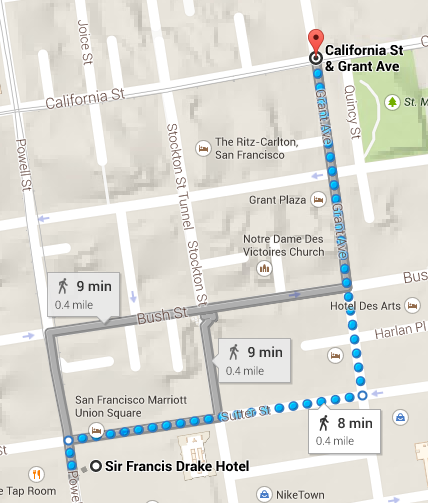
For an example of what I just experienced: because we didn’t really know where we were going, we wound up walking up the giant hill up Powell St and then down the hill on California St, but if we had gone down Sutter first and then up Grant, it would have been much flatter.

Screen Shot 2015-04-10 at 4.56.00 PMScreen Shot 2015-04-10 at 4.55.34 PM

On my flight to San Francisco today, when the pilot mentioned that we have leveled off at our cruising altitude of 32000 feet, we had just passed Scranton, according to the interactive map. This reminded me of a right-triangle trig project I did my first few years, before it was dropped from the Algebra I curriculum.

I first had the idea by doing a Dan Meyer-style textbook problem makeover. When I was looking for trig problems in the textbook I was using, I saw one that was something like this:

A pilot is flying his plane at 5 miles up and starts his descent 300 miles from his destination. What was his angle of descent?

If I were a pilot, what would I need to figure out? Most likely, I would know I need to land at a certain angle – what I would need to determine is when I should start landing my plane. So I turned the problem around. Then I thought, considering what angles we need to climb at, angles we need to land at, and how high up we need to fly, what’s the minimum distance I could get between two airports that have a connecting fight? (Assuming direct paths.) And so and made the following project:

My students had a lot of fun with this project (even if I did get countries named things like Ratchetopia). Things would get tricky sometimes with scale (I think I had them use something like 1 inch = 50 miles), but overall the process went well. However, sometimes it could be paralyzing, having so many choices of where to put the airports.

Sadly, I don’t have any pictures of the projects my students made. (Maybe on my old phone?)

About two weeks ago I watched the first three episodes of Unbreakable Kimmy Schmidt with someone, and the very next day I watched the whole rest of the season. Yesterday and today I blew through 14 episodes of House of Cards (though I think I’ll end there). This kind of consumption has always appealed to me; I’ve often told friends that I don’t want to watch some show or read some book until it’s completed, so that I can intake it all as fast as possible. When I read a book, I often stay up late into the night because I can’t put it down. This way, I’m able to just dig down deep and fulling engage myself in the material.

On the other hand, for the past few months I’ve also been listening to Welcome to Night Vale. Because I can only focus on a podcast when I’m walking and not doing something else, and because I used the other podcasts I listen to as spacers between episodes, it’s been a much more drawn out process than the binge-consumption that is typical of me.

The thing is, though the former is more typical and what I say I prefer…the latter way is much better. This was most evident for me from my time in the Harry Potter fandom. Before the 6th or 7th books came out, there are a ton of activity, most of it powered by feverish speculation and thinking about what the future could hold. After the last book came out, though, a lot of it died down. And I realize that think about what the future could hold is a lot more interesting than dissecting what happened in the past (for me).

When I first started teaching, my school, like most schools, had its classes meet every day of the week. The second semester, we tried something where we met four days a week, but one of those days was a double period. Then my second year, we switched to an alternating day block schedule, which persisted for the subsequent 2.5 years.

The introduction of the block schedule felt like such a relief to me. Finally, we could dig deep into the material: I didn’t have to cut a lesson short because of time, there’d be less wasted time on coming into class, clean-up, warm-ups, etc. And I really believed this, until one time I talked with Elizabeth Statmore about how there are time periods during a lesson that are key for learning, but during a double period we don’t actually get double the amount of those time periods. She also talked about how, when they have a class every day, the repeated reference to the content reinforced ideas better than when classes were more frequent.

When my then-new principal wanted to switch back to a daily schedule, I resisted, but mostly because she wanted to switch mid-year instead of waiting for the next year, and as the programmer I would have to figure out how. But by then I was on board. I was okay with letting a lesson end in a cliffhanger, and drawing something out over multiple days. Because I knew it was better this way. And spiraling things together, leaving little bits in each lesson and bringing it all together into a climax – well, that’s the Welcome to Night Vale way.

Those things I’ve binged on, I consumed them and then moved on. It made me happy at the time, but they didn’t really stick with me. But the things that were persistent, that I drew out over time, those were a lot more sticky. And that’s as true for learning as it is for reading and watching TV.

Meet Me Halfway?

Today I met a friend for lunch, and we decided to meet halfway between our apartments. To think about where that would be, I used MeetWays, which was useful because it can find that mid-point based on a variety of modes of transportation: car, bike, public transit, and walking.

The thing is, my friend took the train to lunch and I walked. (I based the location on the transit midpoint, but decided to walk for the exercise.) So what counts at the midpoint then? If one person drives and another doesn’t, do you include the time spent finding parking as part of your calculation? Is it based on time, or distance? If we both travel for 45 minutes, but she’s much farther from home, is that still meeting in the middle? Considering everywhere I could walk within 45 minutes and everywhere she could train in that time, is there really only one middle point, or do those rings intersect twice?

There are the things I wondered as I walked. Are there other good questions to ask? You can probably, at the least, get a decent rates question out of it.

Groceries and Gas

Here’s a topic that came up in conversation during Easter dinner tonight. I thought that there could be some interesting math involved, so I’ll present it Problem of the Week style, with no question or prompt.

At the S&S grocery store, there is also a gas station. If you buy $100 worth of groceries, you get $0.10 off of each gallon of gas. You can save those up – so, for example, if you eventually buy $300 worth of groceries, you’ll have $0.30 off each gallon.

Right now, gas costs $2.20 per gallon. You’re even allowed to bring gas cans to fill up when you buy, but the maximum is 35 gallons in a single purchase.


What do you notice? What do you wonder?

On OKCupid, one of the match questions is the following:

“Once you are intimate, how often would you and your significant other have sex?

– Every day
– About every other day
– Once or twice a week

– A few times a month or less”

On OKCupid, you choose your own answer and then pick what answer you’d like potential matches to answer. It seems straight-forward – if the other person picks the same answer as you, it’ll be fine. But will it?

Let’s make the following assumptions.

  • A person is either in the mood to have sex on a given day, or they are not. 
  • Two people only have sex if both are in the mood. 
  • If someone is in the mood and has sex, they are happy. If they are not in the mood and don’t have sex, they are happy.
  • If someone is in the mood and does not have sex, then they are unhappy.

If both people choose “Every Day,” then it will be fine; both people will be happy every day.

If both people choose “Every other day,” let’s assume they are in the mood 4/7 days of the week. So on a given day, there is a 4/7 chance of being in the mood.

It follows, then, that on any given day the chance of both people being in the mood is 16/49, or ~32.65%. And so the probability of having sex 4/7 a week is 7C4*(0.3265)^4 * (0.6735)^3 = 12.15%.

So that’s an 88% chance of not being satisfied in a given week. Well, that didn’t work out.

(Of course, the assumptions aren’t perfect – mostly because being in the mood might carry over if the itch wasn’t scratched.)

The Cold War

In my first year teaching I came up with this activity for working with quadratic-linear systems, based in the Cold War and missile defense. It didn’t work as well as I hoped, mostly because it was too complicated, but I like the core of the idea. Maybe now, with more experience and the brainstorming power of the MTBoS, we can think of a way to make it work. But first, I’ll describe what .i actually did.

Students entered the room to find the desks rearranged – four big group tables, and the room split down the middle by a wall of desks, representing the “Iron Curtain.” Each student was then randomly assigned to one of four groups: US Missile Command, US Missile Defense, USSR Missile Command, and USSR Missile Defense. (Only one student, the son of the Georgian consulate, demanded to be switched from the USSR group to the US side.)

Each student then had two roles – one of the roles was their job on the team. Treasurer, secretary, chief engineer, etc. These roles were public. Their other roles were secret – they were things like Double Agent, Handler, FBI Agent, Innocent.

The idea was that each missile team was trying to build a missile that could hit the other country, while bypassing their missile defense. And the missile defense teams were trying to shoot down the missiles. The missiles were represented by quadratic equations and the missile defense by linear functions. But the best way to find out what the other side was planning is through espionage.

Of course, the thing they’ll probably learn is that the missile defense fails and everyone dies – we all lose the cold war.

Below are the files I made way back when. What are your ideas to make this workable?

I took some photos today at the AMNH with their scales with the intention of posting them as Estimation180-type challenges. I realize as I review the photos, though, that there were some issues. The numbers fluctuated a lot when I stood on the scales, so the pictures I have vary by a huge margin (+/- 30 pounds to my Earth-weight). They didn’t fluctuate when I put my bag on, but not every scale register its existence.

Estimation #1 – Here’s my bag (laptop, iPad, book, charger, 3DS). How much does it way?

(Answer: 21 pounds.)

Then the next estimations – how much would my bag weigh on Saturn? How about on the surface of a Red Giant Star?

CAM00653CAM00655


So my portfolio idea was working out well, but I was getting overwhelmed with the written feedback. It took so long to write that sometimes my hand felt like it would fall off! I needed a new strategy. Luckily, David Wees had one for me, so I thought I’d share it with you all, since it’s worked really well.

Instead of writing all the feedback, as I go through and check an assignment and finding something I want to comment on, if I think it might be a common mistake, I type it up on a word document on my computer, numbered. Then I just put the circled number on the page itself. When I’m done I have a comprehensive list of feedback that I print out and attach to each assignment. Now every student knows both the common errors and has specific feedback on what they need to fix.

CAM00648 CAM00647 CAM00646 CAM00645

SoP Portfolios

When we learned about planning back in grad school, we were told that if something is important, you need to assess it; if you don’t assess it, then it’s not important. When the Common Core Standards came out, most math teachers were very excited about the Standards of Practice. The problem was, of course, that the Standards of Practice are hard to assess. So most standardized tests that use the Common Core don’t assess them, which of course means they don’t get implemented in the same way as the content standards. The Standards of Practice are important to me (though I frame them as the Mathematical Habits of Mind), and that means I need to find a way to assess them. But I’ve never had a really good way to test them before – I was always kind of making it up as I went along. Now, though, I think I’ve hit on something now that really works.

After seeing Ashli’s video about not putting grades on papers, I stopped doing it this year – but having the grades still be there in the online gradebook wasn’t quite what I wanted to do, and it became very hard to keep track things, especially because classwork and homework were what I used to measure the Standards of Practice. This semester I gave written feedback on all the assignments that I’ve given but recorded no grades – not even in my own gradebook – the only thing I kept track of was if something was incomplete or missing.

If we decide that every assignment is a formative assessment, we can’t possibly grade it as students are learning the material. So instead each assignment is like a first draft (or second or third) and students can read the feedback that I gave and make changes in order to improve their work. Come the end of the marking period (or eventually the end of the semester) students create a portfolio of their work. They don’t need to include everything that they’ve done but rather a representative sample that shows that they apply the Standards of Practice/Habits of Mind as they work.

The portfolio has a cover sheet (shown below) that that asks them to reflect on what habits they have used in their mathematical work this semester.

They have to find evidence of their own habits in their work and write a few sentences citing that evidence. I gave suggestions of which assignments might be easier to find evidence of those habits in. And they only had to include work that they cited as evidence as part of the portfolio.

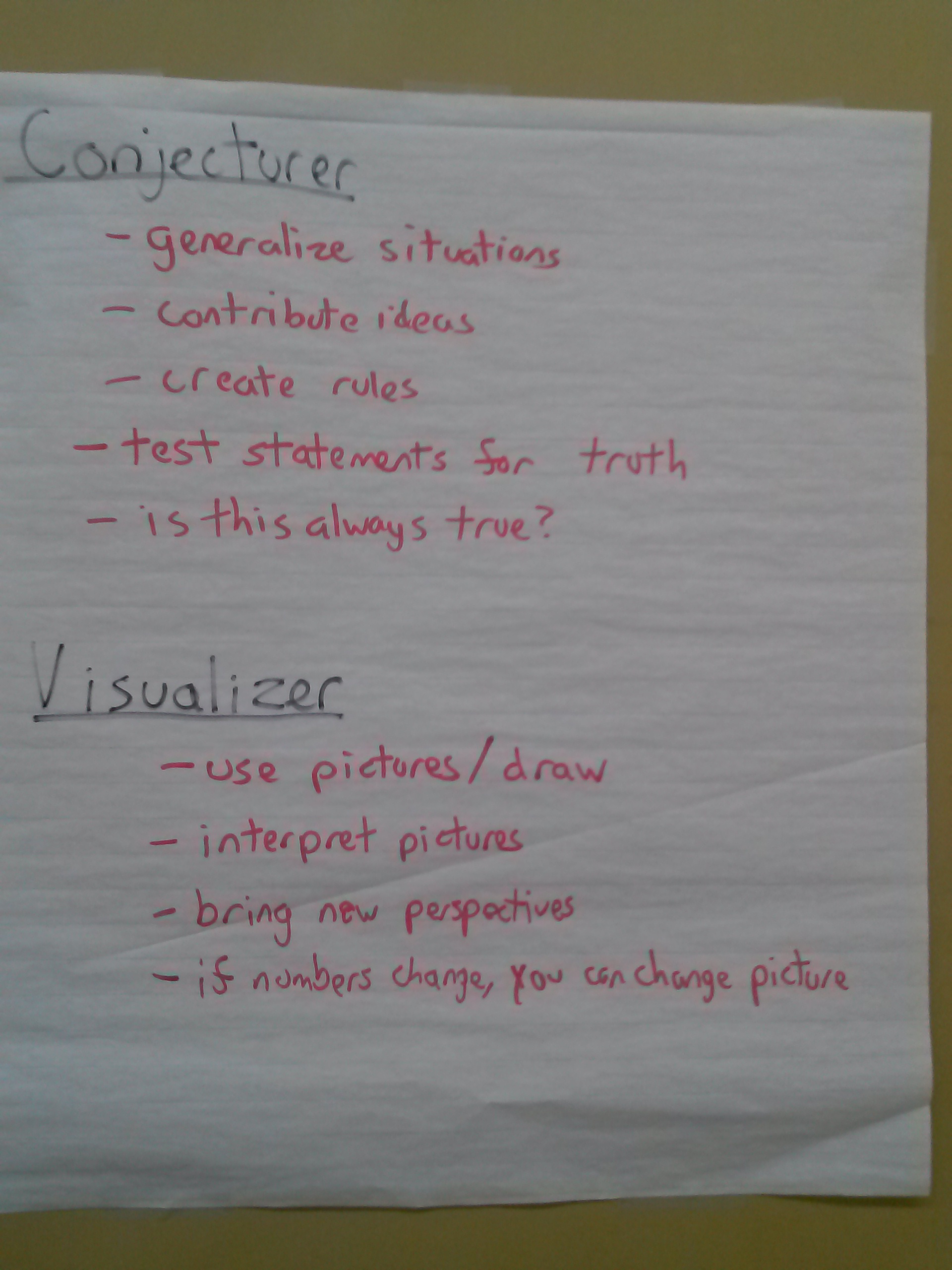
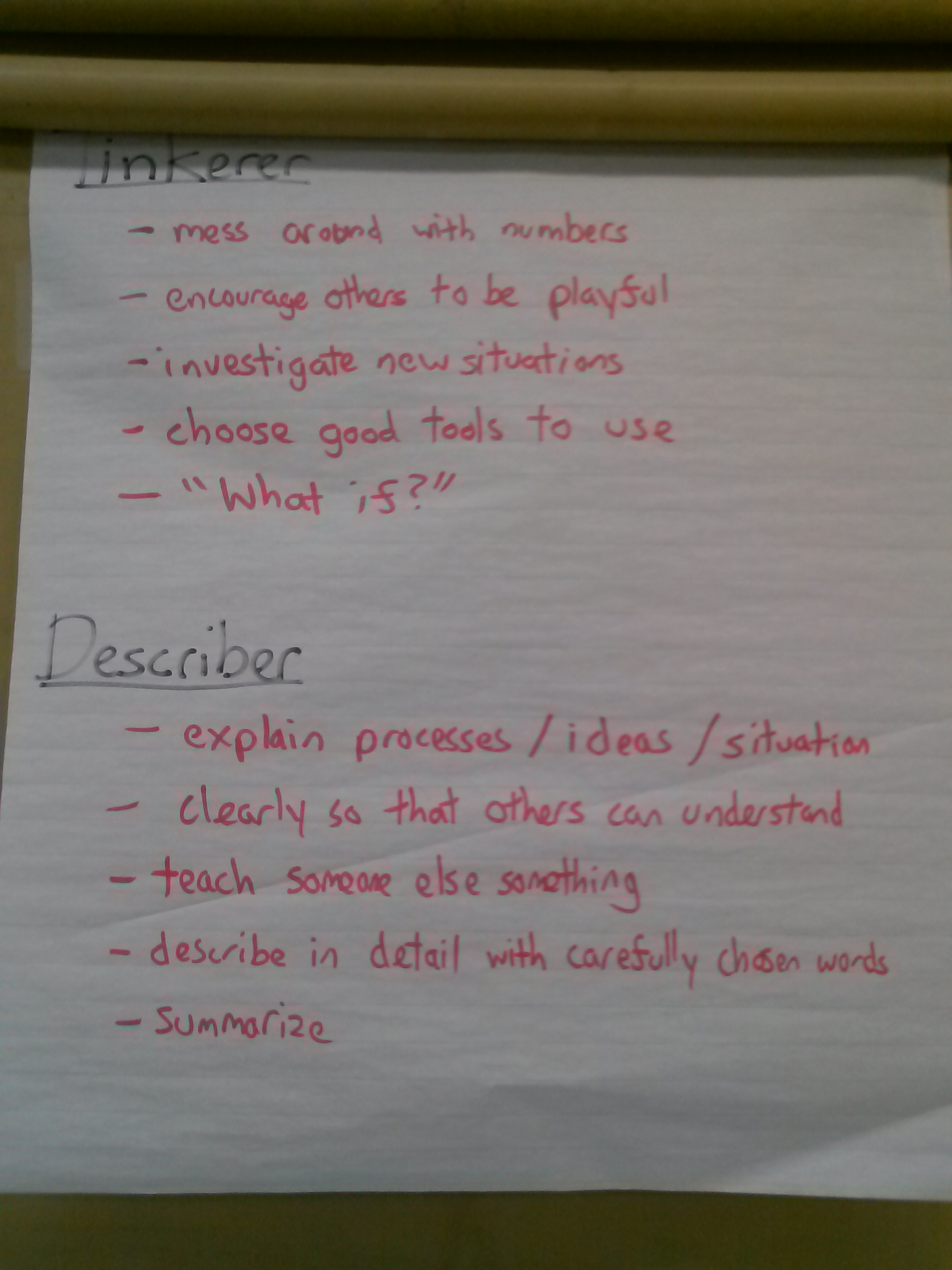
To get us started we read through the rubrics that I created for the habits and created posters of what those habits might look like when doing assignments. We have them hanging on the walls of my classroom – that way I can referr to them easily when something comes up (such as when we worked on Des-man, I tried to emphasize the tinkering nature of the process).

CAM00640CAM00641CAM00642 CAM00643

The first portfolios coming in have been graded and some of them were stellar and others need some work, but it was the first time and they are not really used to this whole reflective idea. But I have noticed that most of my students have started to use that vocabulary more and have become more aware of the kind of things that they are expected of them in the long-term, not just immediate math facts. I think if I start this from the beginning next year it’ll create a really great culture of thinking using the habits and the standards of practice.