Trying to find math inside everything else

Archive for the ‘schooling’ Category

Whiteboard Desks

After TMC14, I heard a lot of talk about Vertical Non-Permanent Surfaces (though I didn’t go to that session myself). After reading Alex Overwijk’s post about it, I wanted to use the idea in my classroom, but getting vertical boards up seemed challenging considering how long everything takes in school. The researched showed the horizontal non-permanent surfaces were the second best thing, so I decided to take matters into my own hands. I went to the hardware store, bought some whiteboard paint, and got to work.

I put the paper down to prevent drips but, of course, dripped anyway.

Overall the desks have been amazing. The students love getting the markers and working with them, especially because they hate committing things to paper when they might be wrong. (Yes, kids do doodle/play tic tac toe/etc on the desks, too, but I think that’s no different that what they’d do on paper.) Another benefit is how easy it is for me to interact with the students when I go around. Instead of having to write something on the student’s paper or notebook, which always felt intrusive, I can jot something quickly down on the table itself, leaving it to the student to work it into their own thinking. It’s worked great for tutoring (so I don’t have to get up and go to the board). The paint might not last as long as it could when the room is used by other classes who don’t know what’s up (our night school in particular, I’d say), but it’ll last the year, at least, and I’m more than happy to repaint them before next year.

The only picture of student work on desks I had that wasn’t blurry as hell. I need to work on my photography.


Suspensions

We’d been having a little bit of a suspension problem at my school. It felt like we had a secret police – students would just disappear and no one would know where they went, only to find out upon their return that they had been suspended. This breakdown of communication was bad enough, but then we would find out the reasons some students were suspended. Playing dice together in the stairwell? Yes, sure, gambling is frowned upon, but it’s not a suspension-worthy offense. It’s not even like it was a gambling ring – it was just three friends. Being suspended for being late? How does that even make sense?

As a believer in restorative justice, after I found out about this, I tweeted the following:

Screen Shot 2015-04-11 at 1.57.43 PM

My friend Abbie disagreed, and we wound up having the following discussion, which I think was enlightening on both ends.

Abbie: I disagree. I was bullied severely in school as a child. Mental abuse is scarring and should be treated just as seriously and part of the reason it went on for years was because “they never touched her.”  Bullshit. Mental attacks are violence.

James: I’m sorry you went through that. I’m not saying that mental abuse should not be taken seriously but that suspension is not the answer. In general, Restorative Justice is a more effective approach.

Abbie: I like the idea of such a program but I have serious doubts about the feasibility in many systems. Many of my problems were a failure of administrators to recognize or react at all.

James: But I guess that’s true regardless of which reaction is appropriate.

Abbie: I recognize there are many excellent admin & teachers out there. But my experience is that there are not enough.

James: Now that’s true.

Abbie: And I’m not sure, if I were in my mother’s shoes, that I’d have trusted the school to handle a public discussion. I guess my biggest frustration is that the response is to remove the victim from the situation. Maybe restorative justice can help that? If so it would be a welcome change.

James: That’s true. Even now, Safety Transfers (as per NCLB) remove victims, not perpetrators.

Abbie: It was one of my greatest frustrations with schools.

James: It must also be situational, as well – some have to deal with a reluctance to suspend or take action to support a victim, whereas I am seeing an overzealousness for suspensions in my school. I imagine there is some sweet spot in the middle.

Abbie: Hmm. Yes, that’s tough. It’s not a cure all by any means. My impulse is to always protect the victims first, but mindless suspensions won’t accomplish that. But asking the victim to relive the experience publicly makes me very uncomfortable. Either response extends the experience for them.

James: Well, publicly really depends on the situation. Restorative justice could be as small as one other person (a mediator).

Abbie: Mmmm. All depends on the mediator! If everyone’s trained and on board I could see its positives.

James: True! It’s certainly not an easy system to accomplish. That makes me amend my earlier statement that suspensions can have their place, but definitely not for victimless crimes.

Abbie: Very fair! I can easily agree with that.

Here we have two problems on opposite ends of the scale: a suburban (mostly White) school that does not take enough disciplinary action, and an urban (mostly PoC) school that takes too much. Which of course, is the story of our country.

After that, I ranted about it at the math department meeting and had the other math teachers (one of whom is a dean) bring it up in their grade team meetings, to push back against these policies. I don’t know how effective this was; I have noticed fewer suspensions since then, but correlation is not causation. However, Chancellor Fariña is pushing for a more restorative approach as well, so I have hope for the future. (At a recent meeting, one of the Deans made a comment about how we wouldn’t be happy about the upcoming changes – speak for yourself, dude!)

Binge Watching and Block Schedules

About two weeks ago I watched the first three episodes of Unbreakable Kimmy Schmidt with someone, and the very next day I watched the whole rest of the season. Yesterday and today I blew through 14 episodes of House of Cards (though I think I’ll end there). This kind of consumption has always appealed to me; I’ve often told friends that I don’t want to watch some show or read some book until it’s completed, so that I can intake it all as fast as possible. When I read a book, I often stay up late into the night because I can’t put it down. This way, I’m able to just dig down deep and fulling engage myself in the material.

On the other hand, for the past few months I’ve also been listening to Welcome to Night Vale. Because I can only focus on a podcast when I’m walking and not doing something else, and because I used the other podcasts I listen to as spacers between episodes, it’s been a much more drawn out process than the binge-consumption that is typical of me.

The thing is, though the former is more typical and what I say I prefer…the latter way is much better. This was most evident for me from my time in the Harry Potter fandom. Before the 6th or 7th books came out, there are a ton of activity, most of it powered by feverish speculation and thinking about what the future could hold. After the last book came out, though, a lot of it died down. And I realize that think about what the future could hold is a lot more interesting than dissecting what happened in the past (for me).

When I first started teaching, my school, like most schools, had its classes meet every day of the week. The second semester, we tried something where we met four days a week, but one of those days was a double period. Then my second year, we switched to an alternating day block schedule, which persisted for the subsequent 2.5 years.

The introduction of the block schedule felt like such a relief to me. Finally, we could dig deep into the material: I didn’t have to cut a lesson short because of time, there’d be less wasted time on coming into class, clean-up, warm-ups, etc. And I really believed this, until one time I talked with Elizabeth Statmore about how there are time periods during a lesson that are key for learning, but during a double period we don’t actually get double the amount of those time periods. She also talked about how, when they have a class every day, the repeated reference to the content reinforced ideas better than when classes were more frequent.

When my then-new principal wanted to switch back to a daily schedule, I resisted, but mostly because she wanted to switch mid-year instead of waiting for the next year, and as the programmer I would have to figure out how. But by then I was on board. I was okay with letting a lesson end in a cliffhanger, and drawing something out over multiple days. Because I knew it was better this way. And spiraling things together, leaving little bits in each lesson and bringing it all together into a climax – well, that’s the Welcome to Night Vale way.

Those things I’ve binged on, I consumed them and then moved on. It made me happy at the time, but they didn’t really stick with me. But the things that were persistent, that I drew out over time, those were a lot more sticky. And that’s as true for learning as it is for reading and watching TV.

Counting Circles

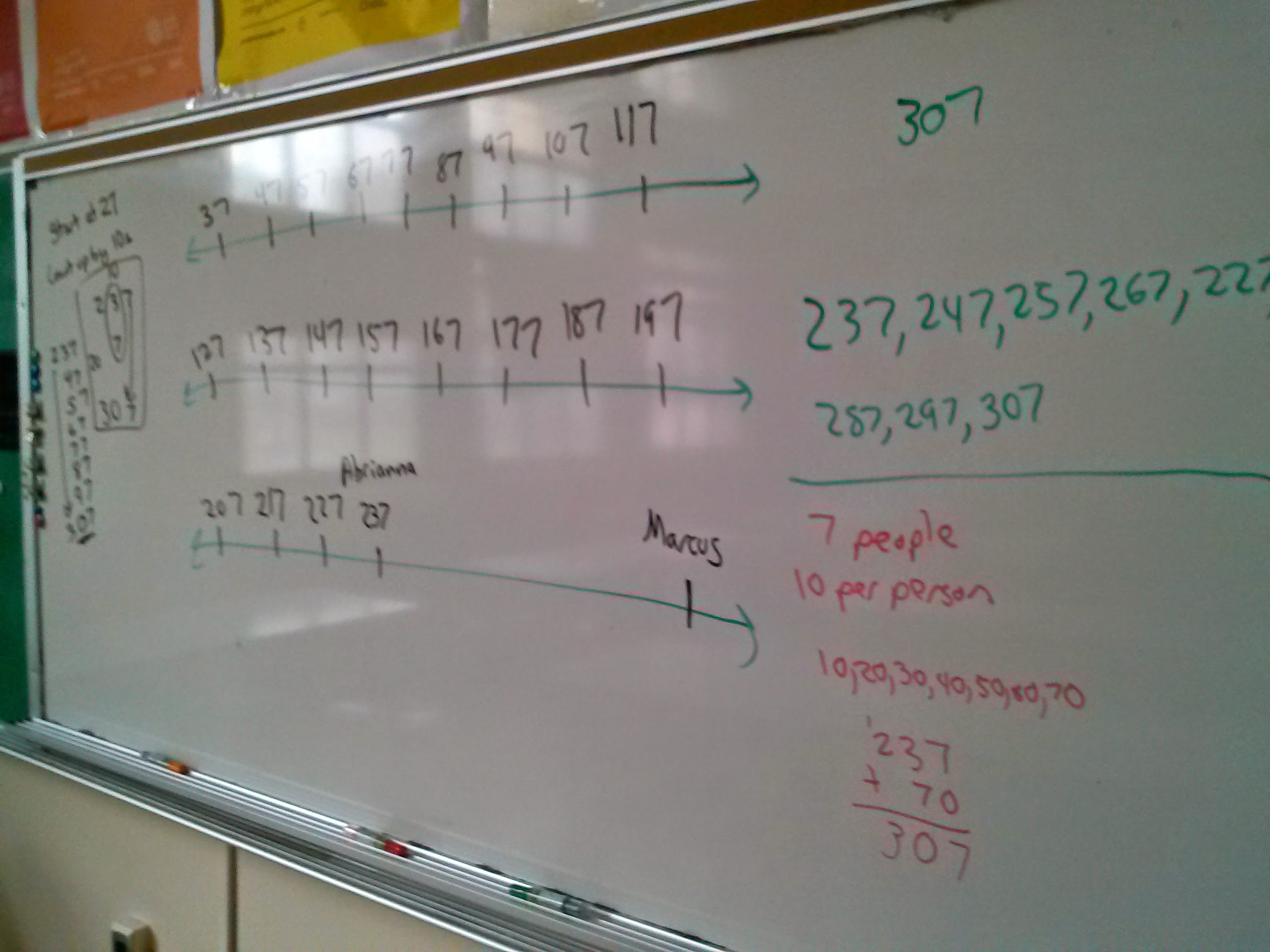
Because I had different warm-up routines I wanted to try, I’m this week ending my second go at Counting Circles, and won’t be using them again until next year. But they’ve had a great run! I think the students got a lot out of them, and I experimented with them in lots of different ways, a few of which I captured as pictures, so I wanted to share them below.

I started, as with Sadie's recommendation, with just a simple off-decade 10s, to practice the idea.

I started, as with Sadie’s recommendation, with just a simple off-decade 10s, to practice the idea.

Inequality

One of the earlier things I tried was do work with an open inequality – that can count by any amount they want, as long as they don’t go below 40.

Binomials

Later on, we counted by monomials and, then, binomials. A fun thing that tricks them up is to swap the order of the binomial. (Commutative property!) Then see how starts adding the wrong thing together, just because they were going left to right.

Binomials with Subtraction

Counting up with one term and down with another can take a few moments for some students.

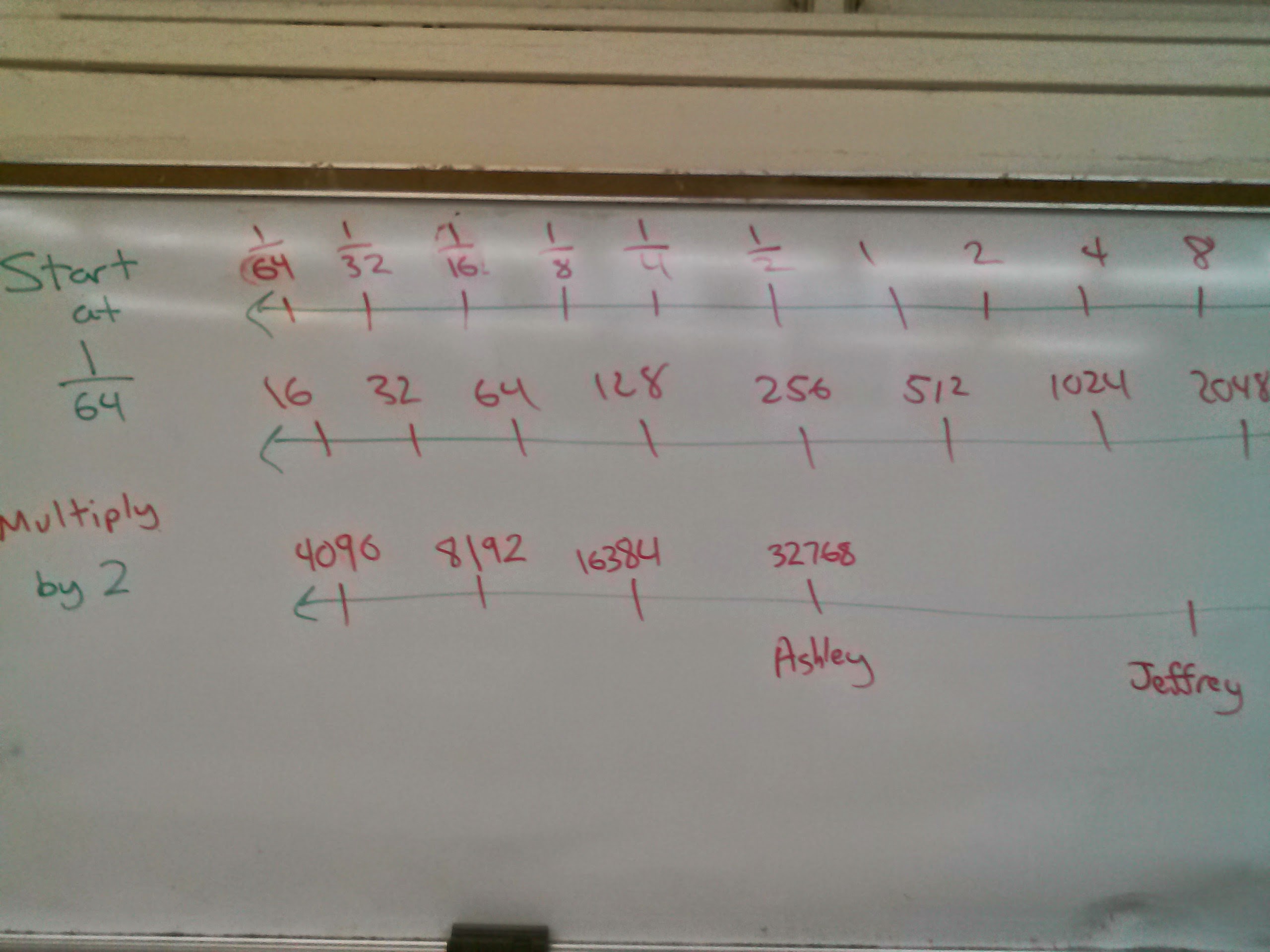
Later, after we had done exponential functions, I tried out a geometric sequence. But I had to make sure I started low enough that we could get around the class!

Later, after we had done exponential functions, I tried out a geometric sequence. But I had to make sure I started low enough that we could get around the class!

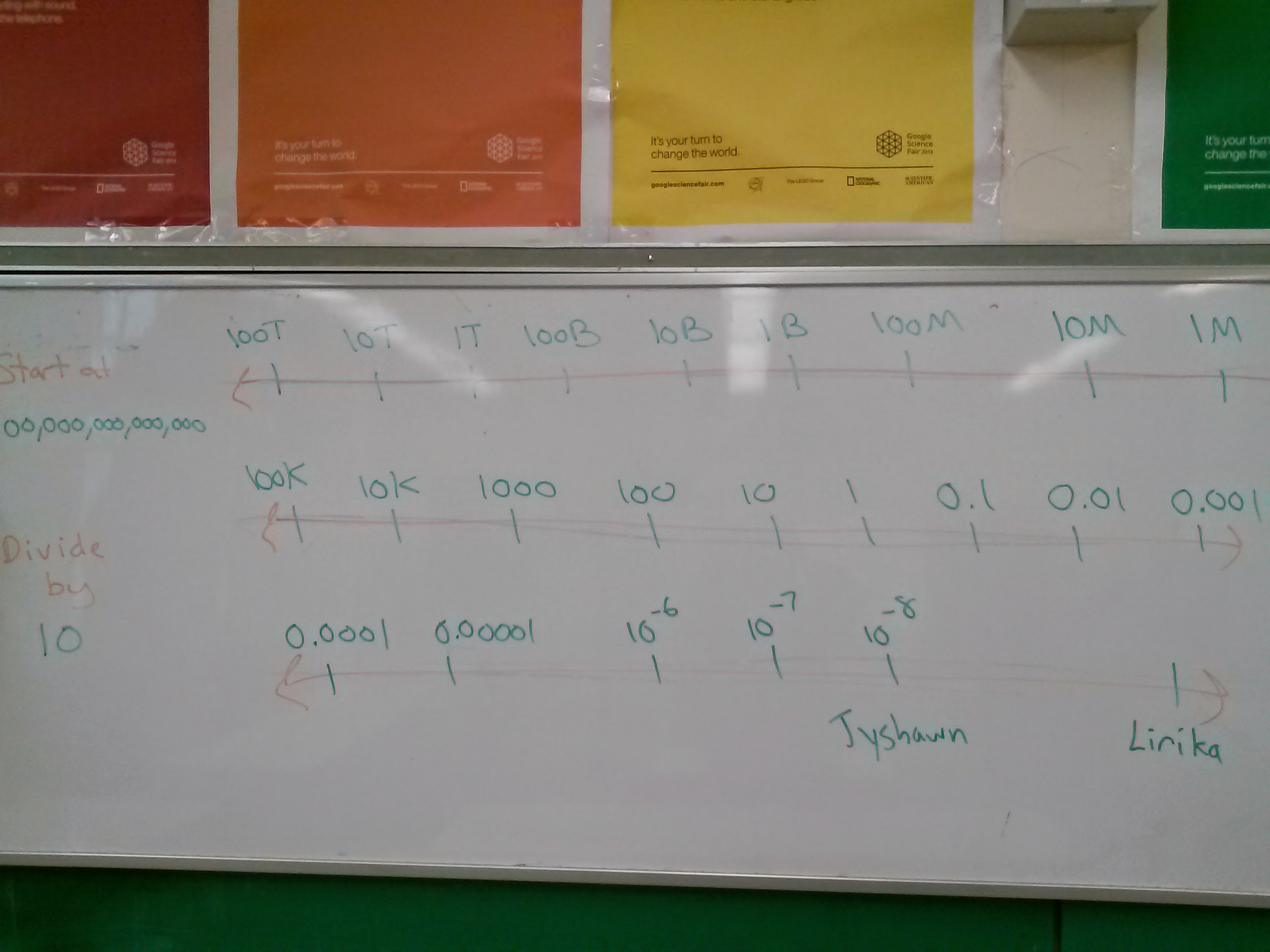
Another geometric sequence was the powers of 10. I mostly wanted to make sure they could name them all! They weren't allowed to just say digits for this one, they had to say the names.

Another geometric sequence was the powers of 10. I mostly wanted to make sure they could name them all! They weren’t allowed to just say digits for this one, they had to say the names.

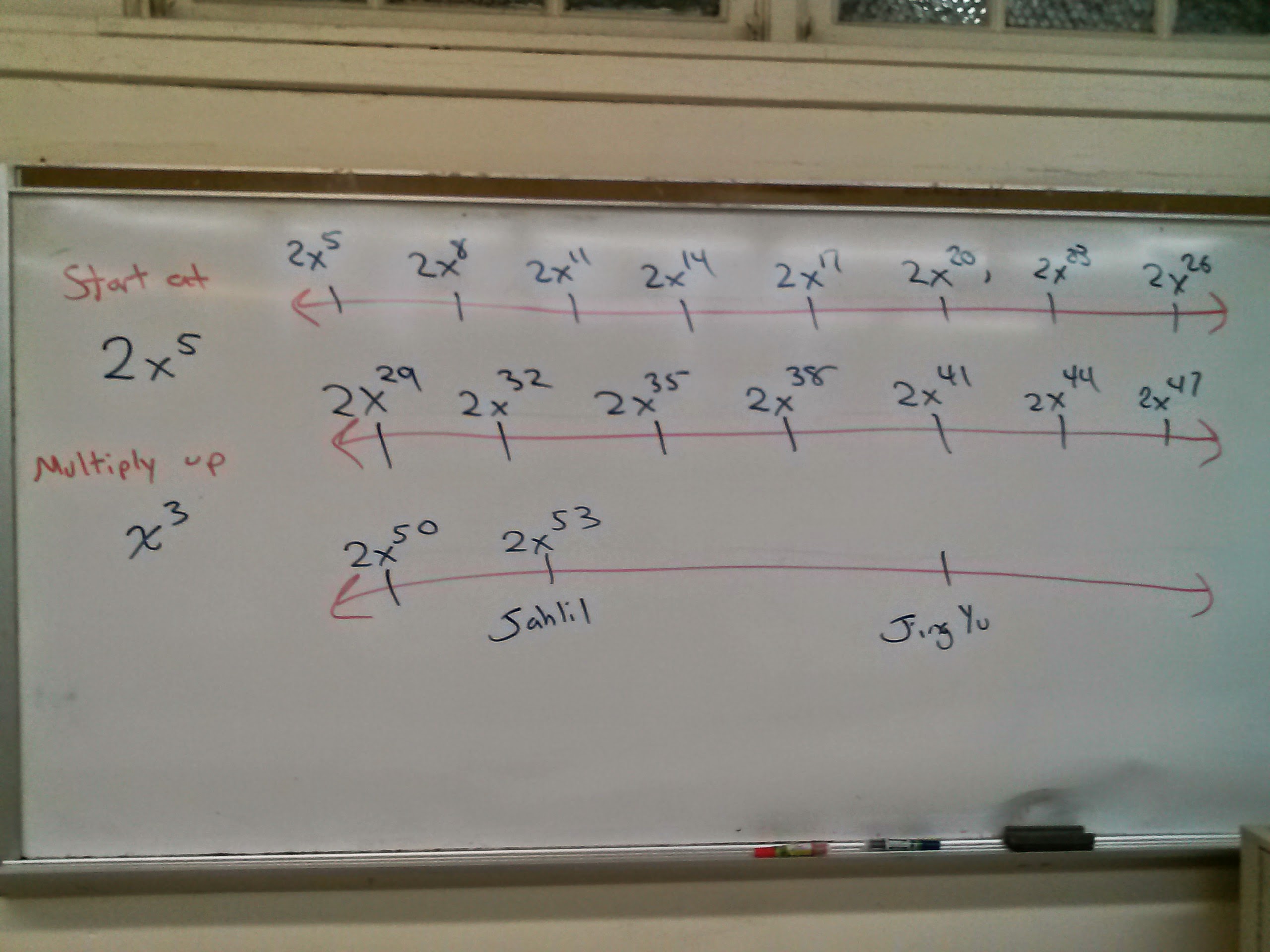
Technically this one is still geometric, though it didn't feel the same. But I also was a stickler here, too - if a kid said "2 x 26" that's what I wrote, instead of "2x^26"

Technically this one is still geometric, though it didn’t feel the same. But I also was a stickler here, too – if a kid said “2 x 26” that’s what I wrote, instead of “2x^26”

As my last thing, today we did a quadratic counting circle. Now, we haven't done quadratic functions yet - that starts next week. So this was somewhat of a preview. They also weren't expecting the perfect squares - only one students noticed that in time to help them on their turn. There was a lot more collaboration on this circle because they had to refer back explicitly to what the last person did. I'll do two more of these (triangle numbers tomorrow), and then that's it!

As my last thing, today we did a quadratic counting circle. Now, we haven’t done quadratic functions yet – that starts next week. So this was somewhat of a preview. They also weren’t expecting the perfect squares – only one students noticed that in time to help them on their turn. There was a lot more collaboration on this circle because they had to refer back explicitly to what the last person did. I’ll do two more of these (triangle numbers tomorrow), and then that’s it!

What’s a routine?

At #TMC14, I made the following tweet,

Screen shot 2014-08-22 at 10.44.14 PMwhile I was in a session about warm-ups as review. I was reminded of what Jessica posted about her warm-ups, and how she does something different each day of the week.

I was thinking of doing something similar, but I also wanted to include things like Counting Circles. But…I’m having trouble with the disparity. Something like Counting Circles is very different from Estimation180 which is very different from a Throwback Thursday review problem. How can we get used to the norms of a counting circle if we only do it once a week?

I could just commit to one of these things, but I feel they are all important, so I didn’t know what to do. But now I had the thought…what if I did these routines but, instead of once a week, I did them for, saying, a marking period, then switched to another?

This could work because many of the routines match up with certain units – Counting Circles would be very helpful for linear functions, while Visual Patterns would be useful for functions in general (or perhaps for when we do quadratics). Does this sound like a good idea?

Productive? Failure

The next chapter of Reality Is Broken starts off with this question: “No one likes to fail. So how is it that gamers can spend 80 percent of the time failing, and still love what they are doing?”

It’s an interesting question.  Many games, such as Demon’s Souls, as known for their fiendish difficulty – as that is often portrayed as a positive aspect, not a negative. Dr. McGonigal notes that in one bit of research from the M.I.N.D. Lab, the researchers found that players felt happy when they failed at playing Super Monkey Ball 2 – more so than even when they succeeded. Why would that be?

One thing they noted was that the failure itself was a kind of reward – when the players failed, the scene the played was usually funny. More importantly, though, players knew that their failure was a result of their own actions and symbolic of their own agency – they drove the ball off the course. Because everything was in their control, the players were motivated to give it “just one more try.” I know I’ve certainly had that feeling before – intense concentration on a hard task and then, “Aaaaah!” Coming just short of success, I immediately leap back into trying again.

Of course, that’s not true of every game. There are many games where failing makes me want to give up. There’s two main elements that differentiate the two – agency and hope. If failure is random and feels out of our control, it is demotivating. (Think Mario Kart when you get slammed with a slew of items right before the finish, when you were in 1st place.) But if we see that the failure was fully within our control – and another attempt shows us getting ever so slightly closer to that goal – then the hope of success can feel even better than success itself.

This feeds off of the idea that learning is inherently interesting. When you win at a game, you are successful – but then what do you do? But when you fail, you are learning how to play the game well, and that learning and the act of mastering the game’s mechanics is what is so motivating.

As math teachers, we often talk about Productive Failure – the idea that our students learn better by attempting something themselves, failing, and correcting, than by simply being instructed on the correct method ahead of time. The theory of this is matched by many of our observations (and by research) – but we often have the problem of people being shut down by failure. It ties in a lot with math anxiety and attitudes about math – if I think I am bad at math and that’s just the way it is, failure if just reinforcing that idea, not motivating me to try again.

In the book, Dr. McGonigal doesn’t talk about productive failure – she talks about fun failure. The key factors she mentions – a sense of agency and hope – are what’s so often missing from our math-phobic students. Math feels out of their control – and so any success is accidental, and any failure is predestined.

What can we do? Our main goal is to be a guide – because failure is productive for learning, we want to help the student overcome it themselves. And that means doing what we can to provide that sense of agency and hope.

For a gaming example, Rob was playing a game and was struggling against a particularly frustrating boss (Moldorm from A Link to the Past) – a single false move in the fight would knock him out of the room and he would have to start the whole thing over. Even though he had been having a lot of the fun with the game, this single frustrating experience was enough to make him consider giving up on the game altogether. I knew he would enjoy the rest of the game and wanted him to keep playing, so I stepped into action. One thing I did was provide him with the locations of some fairies – while they would not directly help him defeat the boss, they would lower the frustration of dying and having to repeat the dungeon. The second thing I did was just to watch his attempts.

After a while, when he was ready to give up, he said something to the effect of how he had tried over and over again but had gotten nowhere. But I told him that was not true – when he first tried, he would maybe get 1 hit, or perhaps none, off on the boss before being knocked off the ledge. But in later attempts, he was getting around 4 or 5. He had greatly improved in his tries – and so if he kept trying, he might succeeded. He conceded that might be true, but still took a break, frustrated and tired.

The next morning, I looked up some info and found that the boss only required 6 hits to be defeated – so that meant that in the last attempt, Rob had been very close to success! When I told him that, he was filled with hope (and well-rested), and upon loading up the game, proceeded to beat the boss on the first attempt of the day.

Our goal is productive failure, not frustration. When we are following the mantra of “be less helpful,” I think we still need to help in a different way – help dispel frustration and provide the tools for success, even if we are not telling the students the path they need to take. Be less helpful seems like a hands-off policy – but it’s quite the opposite; we need to devote even more attention to our students when we are letting them struggle on their own.

Satisfying Work

Earlier this year, Justin Aion wrote a post about how he tried to make his class boring on purpose by just giving silent independent work, to make them appreciate what he was normally doing, and how it backfired gloriously. At first, he wondered what he can do to break them of this preference for what they are used to and what is easy. About two months after that, we wrote about a similar situation, and wondered the following:

I’m beginning to wonder if my attempts to give them more engaging lessons and activities have burned them out.  I’m not giving up on the more involved activities.  I want them to be better at problem solving, but I think by trying to do it every day, I haven’t done a good job of meeting them where they are and helping to be where I want them to be.

As I read more of Reality Is Broken, though, I encountered an alternative explanation. In the book, Jane McGonigal wonders why so many people play games like World of Warcraft and other such MMORPGs where the gameplay is not, shall we say, the most thrilling. Many people find enjoyment in what other players call “grinding,” playing with the sole purpose of leveling up. In general, it’s a lot of work to level up in the game to get to what is considered the “good” part of the game, raiding in the end game.

But it’s work that people enjoy doing, and that’s because it is satisfying work. Dr. McGonigal defines satisfying work as work that has a clear goal and actionable next steps. She then goes on to say –

What if we have a clear goal, but we aren’t sure how to go about achieving it? Then it’s not work – it’s a problem. Now, there’s nothing wrong with having interesting problems to solve; it can be quite engaging. But it doesn’t necessarily lead to satisfaction. In the absence of actionable steps, our motivation to solve a problem might not be enough to make real progress. Well-designed work, on the other hand, leaves no doubt that progress will be made. There is a guarantee of productivity built in, and that’s what makes it so appealing.

Well, now, doesn’t that sound familiar? It kinda hit me in the gut when I read it. As math teachers, we are often preaching that we are trying to teach “problem solving” skills – but the thing is, people don’t like solving problems! It made make think of those poor grad students who are working towards their PhD – grad school burnout is a big issue, and one of the major contributing factors is that grad students are trying to solve problems, and so often feel like they are getting nowhere. Their work is inherently unsatisfying, which makes those that can finish a rare breed.

Our students, of course, are not all made of such stuff. But I’m not at all suggesting we drop our attempts at teaching problem solving and only give straight-forward work. Rather, I feel like we need to find a balance – for the past year, as I embraced a Problem-Based Curriculum, I may have pushed too far in the problem-solving direction, and found my students yearning for straight-forward worksheets, just as Justin did. But they also enjoyed tackling these problems, especially when they solved them, and I do think they had more independence and problem-solving skills by the end of the year.

So what should I do? Dr. McGonigal ends the chapter by noting that even high-powered CEOs take short breaks to play computer games like Solitaire or Bejeweled during the work day – it makes them less stressed and feel more productive, even if it doesn’t directly relate to what they are doing. (This reminds me of the recess debate in elementary school.) So even as I go forward with my problem-solving curriculum, I need to weave in more concrete work, and everyone will be more satisfied by it.

The Problem with Gamification in Education

(I suppose I shouldn’t say “the” problem, because there are many problems that I won’t be directly addressing, like extrinsic vs internal motivation.)

I’ve read a lot about gamification in the classroom, and while I’ve often thought about it and borrowed some elements from it, I’ve never gone whole hog. The motivation aspect is one of the reasons, but today, as I started reading Reality Is Broken: Why Games Make Us Better and How They Can Change the World, by Jane McGonigal, I realized there’s more to it.

In the first part of the book, Dr. McGonigal provides a definition of games. A game has four defining features: a goal, a set of defined rules, a feedback system, and voluntary participation. And if you think about gamification, you can easily pick out which of those elements is missing.

Because schooling is mandatory and, if you are taking a particular class, the gamification of that class is also mandatory, gamification of ed itself is not a game. If I gamify my chores by playing ChoreWars, I am choosing to take part in that game (even if the chores need to be done regardless). But if my teacher chooses to use a system of leveling up and roleplaying in my class, it is no longer a game; it is a requirement.

When I tried to think, then, about what in education would best fit these four requires, the first thing that came to mind is BIG, Shawn Cornally‘s school in Iowa. There students choose to participate in some project of their own devising, creating the goal and the voluntary participation. Then it is the school’s job to provide the feedback and the rules.

(An aside on the importance of rules – Dr. McGonigal quotes Bernard Suits who said, “Playing a game is the voluntary attempt to overcome unnecessary obstacles.” The rules are those unnecessary obstacles, and the excellent example given was golf. The goal of golf is to get the golf ball in the hole, but if we did that the most efficient way (walking up to the hole and dropping it in), we would get little enjoyment from it. But by implementing the rules of the game, we make the goal harder to achieve and thus much more fulfilling.)

So the big warning to those who want to gamify their classroom is this: if you require it, it’s not a game, no matter what game elements you include.

Aligning Vocabulary and Notation

At my math department meeting yesterday I wanted us, as a department, to get some alignment on the various ways we talk about certain topics. I often get students in the complain “But that’s not what my middle school teacher said!” And so I don’t want them to arrive in Geometry and shout “But that’s not what Mr. Cleveland said!” So I want to tighten things up vertically.

But as we sat there, it was hard to think of specific examples of things we can change. One was the “slope formula,” which could be \frac{y_2 - y_1}{x_2 - x_1} or \frac{y_1 - y_0}{x_1 - x_0} or just \frac{\Delta y}{\Delta x}. We can to the conclusion that it should be the third across the board, but that’s maybe the only agreement we made. (Glenn’s vertex form idea was also brought up, which I convinced 2 of the 3 other teachers about.)

I did bring up Nix the Tricks, and I think I convinced my principal to buy us all copies, so that we can get some uniformity that way. But I need some feedback before the next meeting – what are some things (not necessarily tricks) that we could be more consistent about? As Glenn said in that post, if we’re going to be arbitrary [about notation and wording], at least let us be arbitrary consistently.

Starting Over

One of the reasons I wanted to teach 9th grade when I first started was because I wanted to, eventually, know all the students in the school. (There were other reasons, but that’s one of them.)  So after four years, I’ve taught everyone math and really enjoy knowing all the students well. (Well, I didn’t teach everyone – the students who skipped me to go straight to Geometry, but I managed to get to know most of them in other ways.)

So, because of that, I’ve taught a new batch of students every year, and every year I can refine my routines, toss what didn’t work, keep what did, and try out new things.

But next year there’s a very good chance I’ll be teaching Algebra II – the first time I’m teaching the course (and any main math course besides Algebra I). And that means my students will be the current sophomores, who I taught last year. And I’m wondering, how does that work? What can I carry over easily? Will transferring routines and getting started be faster (not just because they know the routines but are also older)? Will it be harder to toss out routines they liked that I didn’t because they know them? Will the honeymoon period at the beginning of the year be shorter, or longer?

I don’t know, but I’m hoping some people will having some insight. What do you do when you teach the same kids again?