Trying to find math inside everything else

Author Archive

It All Fits Together

One of the best things about being a math teacher, as opposed to a mathematician, is that because I have to think about how to explain a concept to people who don’t get it, I have to think about concepts in different ways than I ever have before. So I often make connections that maybe I should have already made, but hadn’t, and I see the beauty of the conventions and connections of mathematics.


Today I was musing about the use of -1 as an exponent to give us a reciprocal, because my next lesson is about Egyptian Fractions, and so their fractions are basically the number with an inverse symbol, which we still use, -1. And then I thought, well, yes, that is our inverse symbol, for functions too. Of course, that makes sense. But the clearness and uniformity of it seemed new. So often we learn about things in math in such disconnected ways, so it’s just “Here’s one use for the -1. Here’s another. That’s the way we do it.” But not why it’s the same for both.


And I get these realizations all the time. At least 5 last year. (I think another I had had to do with FOIL.) I hope I keep getting them. But the next step is, of course, to figure out how to let the students get them. Because then, I think, they won’t hate math so much.

What’s My Set?

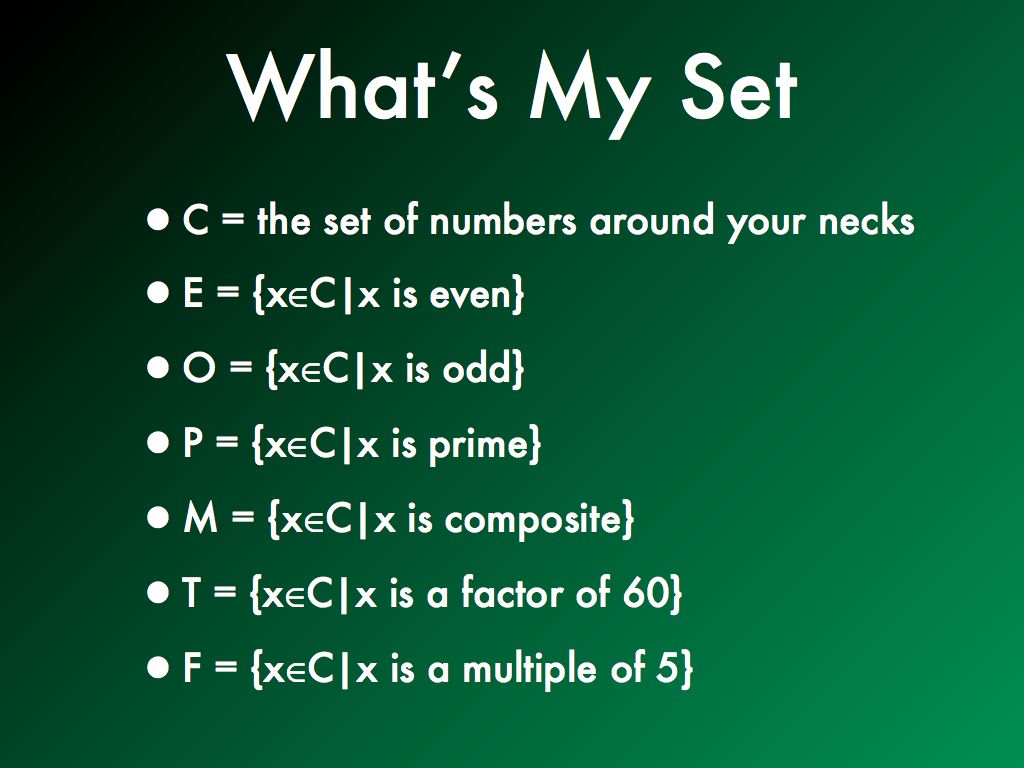
For the past two lessons I’ve taught about sets, including set notation, union, intersections, and complements. To practice what they’ve learned, I had them play a game called What’s My Set? I originally came up with the idea because I wanted the students to get out of their seats in the middle of the double period, and so organizing themselves into the sets seemed like the way to go.

I gave them all badges as they entered class with a number on it. They got them totally interested in what the numbers were for, but I just expressed the need for patience. When it was time to use them, they were interested.

We played it twice. First to practice their ability to read Set Builder notation, write it, and translate into roster notation. I would display the sets in Set Builder on the board, giving each set a location, and they would have to move to that part of the room. But it’s up to the people in each set to make sure they have everybody that belongs there, since I would check if a whole set was correct, and so the stronger students were forced to help the lost ones to get their points. I would give a point to the first set to complete itself. The interesting thing is, because the sets change, though the points are per team, really they are individual. I didn’t give a prize, but they didn’t seem to care.

In the second part, to practice unions, intersections, and complements, I just left 6 pre-defined sets on the board:

Then for each round, I would write on the board something like O ∩ P goes to the front of the room and (O ∩ P) complement in the back, so they had to think a little bit more for this round.

Math is like…

So on the first day of math class, I gave the students this little analogy:

“Math is like cooking. You don’t need to know how to do it to live your life, but if you don’t you need to always rely on someone else to do it for you, and it will wind up costing you more money. Most people know how to do the very basics, enough to get by, but those who really understand the concept make their lives richer and more enjoyable on a daily basis.”

I also told them math was like a language, a pretty familiar analogy. But then I asked them to come up with their own, and they created a poster based on the different answers.

Here’s some they said:

“Math is like your parents: sometimes you just don’t understand them, but they’re just trying to look out for you.”

“Math is like a wave: sometimes it’s big, sometimes it’s small, but it never stops.”

“Math is like the subway: you can read the map and think you know where to go, but you don’t really know until you’re there.”

“Math is like time: there’s a new number every second.”

“Math is like climbing a mountain: it’s really hard, but you feel great when you get to the top.”

“Math is like HIV: it never goes away.”

The Downside of Incorporating Student Interests…

So in my quizzes I like to include some interests of mine that also happen to be student interests. My quiz this morning involved translating sentences from English into Mathematical Symbols. So I had sentences like:

Luigi can jump higher than Mario.

The Water Bending of Katara is greater than the Water Bending of Aang.

Knuckles can stay in the air longer than Tails.


The downside, of course, is that the students want to argue with me about the content of the sentence rather than translate the structure. Which is silly, because I am always right.

Habits of Mind Survey

Tomorrow is the first day of actual math class, so I’m starting off with my Habits of Mind survey that I created last year at the beginning of the year. I give some statements to the students and they can determine which habit of mind they represent. Then I’ll present them the challenge of forming themselves into groups so that each habit of mind is present in someone’s highest or second highest score. With 5 students per group and 8 habits, this shouldn’t be too challenging, but we’ll see how it goes….

Habits of Mind Survey

The Start of the New Year

The kids come in on Thursday and, unlike last year when I felt like floundering, I’m looking forward to it, head held high. One of the major reasons is that the 9th grade team has met several times this summer and we put together an awesome project for the first two days.

That’s right! A project, right away! And it even involves a field trip!

We wanted to start this year with a launch into something meaningful, and not just paperwork. So we are having a study of perspective that will feed into each of our opening units. The idea is to take notice of what some people find important and others do not, and see how yours are different.

What started all this was a trip to the High Line. The Friends of the High Line have a map on the pamphlet they give out, and I noticed many things on the High Line weren’t on the map, and some things (like the Wildflower Field) I wouldn’t have even noticed without the map. So we’re going to bring them on Friday morning and have them walk through, taking pictures and making observations on what they see, and comparing to how that’s different from what other people see and notice.

On Thursday, they’ll need to prepare, so they’ll be visiting stations that give them the tools they need:

  • How to make observations
  • How to take good photographs
  • How to compare points of view
  • How to set up a field guide and take notes
  • How to interpret a map and make your own

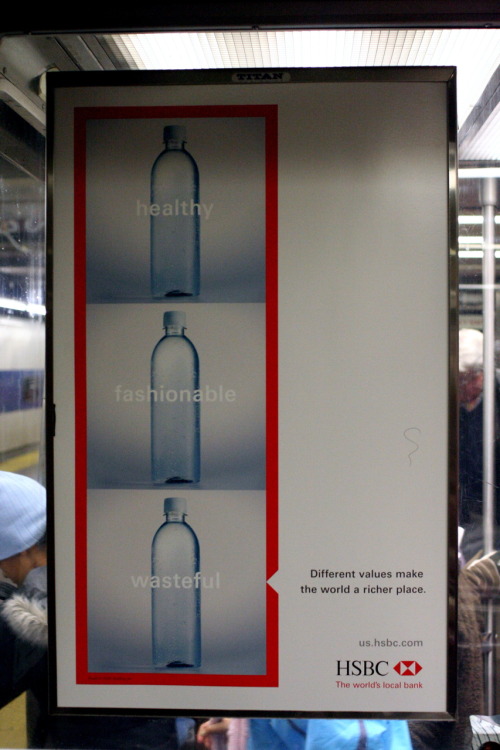
As well as some stations about perspective and point of view. (One involves examining the HSBC Different Values ad campaign, which I always loved.) On Friday we bring them to the entrance and let them go in groups of five, camera in hand, while the teachers fan out to stations along the line, every few blocks, so they have the freedom to move on their own, as long as they stop at the checkpoints along the way. (Don’t worry, the stations are by the exits to monitor them.)

We created this great field guide (mostly the work of fellow teacher Ms. Barnett for the layout) and we all hope to launch from this opening common activity. ELA to talk about identity, Science for scientific observation and experimentation, Global Studies for maps and geography, and myself into the Trip Line and benchmarks.

If the rest of the team agrees, I’ll see if I can put up the field guide here.

A potential lesson…

I saw this on a recent trip to San Francisco and it got me thinking. Take a look at the picture and the movie…any questions?

Old Style Music Disc

Musical Disc at Museé Mechanique from James Cleveland on Vimeo.

How to Order the Topics

Not much posting recently, but hey, it’s summer. I’ve mostly done vacationing, now, and am really thinking about the new year.

I just finished reading through the first half of Merzbach’s and Boyer’s A History of Mathematics, up until the Renaissance. I took a list of topics associated with different cultures as I read through, as they may lead to some interesting lessons in the upcoming school year. I’m not really sure of the best way to integrate with the Global curriculum, but the 9th Grade Team is meeting tomorrow and I’m hoping I can talk with the history teacher about it. Obviously an ordering by mathematical sense won’t match a chronological historical ordering, or even a topical historical ordering, but I’m sure something will come out of it.

At least, I feel that, if one had to come first, it is better to have the historical context before the math, than vice versa. Here’s the list I made, though there’s not much to it.

Algebra Tiles Ancient China Counting Rods
Trigonometry Ancient India
Number Systems Ancient India
Lattice Multiplication Ancient India
Radicals Ancient India
Fractions Egypt Unit Fractions
Adding Like Terms Greece As opposed to the Babylonians
Geometric Algebra Greece
Ratios Greece Euxodus, in Plato’s Academy
Trigonometric Ratios Greece Ptolomy, using circles
Longitude and Latitude Greece
Completing the Square Islamic Empire
Number Systems Maya Bases
Systems of Equations Medieval China
Pascal’s Triangle Medieval China From the Jade Mirror
Number Systems Mesopotamia Bases
Context Clues Mesopotamia Place Value
Exponents Mesopotamia Place Value
Fibonnacci Middle Ages
Slope Middle Ages Sine and inclined planes
Proportions Pythagoreans Music
Radicals Pythagoreans The expulsion of Hippasus
Types of Numbers Pythagoreans Numerology

Crimes and Mathdemeanors

I’ve made a post about history and science, I guess now it’s time for ELA. I think ELA is, in a way, the easiest to connect to math, but that might just be my background at Bard and working with the Algebra Project. But I wanted to talk about a book I used this past year that fits the bill.

This is a book of mysteries akin to Encyclopedia Brown. but with a more mathematical twist. The protagonist, Ravi, is a 14-year-old math whiz, athlete, and son of the Chicago DA. He often runs across mysteries that he can help solve and the reader gets a change to solve, as well.

I used this book in class to, I think, great effect. Most students enjoyed the prospect of the mysteries and got into attempting solutions. It allowed them in guess at a solution (such as who the murderer is from three suspects) without necessarily having to first grasp the math involved, which worked as a hook. Some students did not get into it but that was from rejecting the very premise of reading a story in math class. Many of those students eventually got past their misgivings.

For each story (I used the book about 6 times throughout the year) I asked the students to underline or circle anything they thought might be relevant to the mystery as we read it out loud. Then we compiled what we knew as a class and discussed what we still needed to know to solve the mystery, and then they worked in groups to come up with a solution, often with some prodding (but occasionally with none, which was nice).

I’m thinking of starting with the stories earlier next year (I didn’t this year because I only received the book in December for my birthday) to set it as normal when we use it. I also hope I can find some other books that might act similarly. If anyone reads this and has suggestions, let me know.

Partnership for Global Learning – Final Day

Today was a fairly brief day to wrap up the conference, but it did have a few noteworthy elements.

The Power of Simulation – MUNSA Secretariat
Run by those same students as the Model U.N. Panel, they once again made us marvel at how they were so well spoken and prepared, sometimes more so than some adult presenters. We went through a simulation on the effects of land mines. Silently we walked from the conference room and down the hall to the atrium. Once there, we stopped and lined up horizontally. We were silently brought forward in waves to cross the atrium, but as we did, we had to pick up a card. If the card said we were alive, we crossed. If dead, we had to lie down on the floor. If maimed, we could sit or choose to crawl on to another card. If maimed twice, we had to sit as we were too injured. The imagery of the bodies sprawled across the floor was powerful, the silence was eerie, and the whole event was motivating for all of us to want to do more.

Maya Soetoro-Ng was supposed to be at the conference to speak but couldn’t make it. Instead she sent us a video message/lecture. To me it just underscored two things: video lectures are the lowest of the low in terms of engagement factor, and technical difficulties can make your lose a class and make it hard to get it back.