Trying to find math inside everything else

Archive for May, 2014

Counting Circles in Algebra II

So there’s a good chance I’ll be teaching Algebra II next year (will everyone leading a morning session in TMC14 change courses before it arrives?) and so I was thinking about my future routines. My students will be (mostly) students that I taught last year, plus the current freshmen who are advanced in Geometry. Last year and this year I was big on Estimation180 but, because I was so big on it, they’ve seen a lot of it. There’s still plenty they haven’t seen, but I wanted to expand. I remember reading someone who said they used Estimation180 one day, Visual Patterns another, Counting Circles another, and I think there was a fourth but I don’t remember what. I thought it sounded like a good idea.

I was hesitant about counting circles at first because, yeah, my students do need to boost their mathematical fluency, number sense, and mental math, and that is always helpful, but it’s a lot of time to spend on stuff that is technically not part of the curriculum. But then I started to think about all the things we could count that would specifically enhance the Algebra II curriculum, and I got excited.

Things We Can Count

  • Monomials (2x, 4x, 6x, 8x…)
  • Polynomials (a + 2x, 2a + 4x, 3a + 6x…)
  • Fractions of \pi (\frac{\pi}{6}, \frac{\pi}{3}, \frac{\pi}{2}, \frac{2\pi}{3}, \frac{5\pi}{6}, etc)
  • Sin/Cos/Tan values of those values above
  • Imaginary numbers
  • Complex numbers
  • Geometric Sequences (1, 2, 4, 8….)
  • Geometric Sequences with Negative Ratios (1, -2, 4, -8….)
  • Monomials geometrically (x, x^2, x^3, x^4…)
  • Irrational numbers (\sqrt{2}, 2\sqrt{2}, 3\sqrt{2}…)

What else could we count?

Gardening

My mom loved the garden, but taking care of it as a chore was something I always hated. Weeding? No way! Now that mom’s gone, last year and this year on Mother’s Day we made up the garden for her, but despite the sentiment, I would pretty much do anything to get out of weeding.

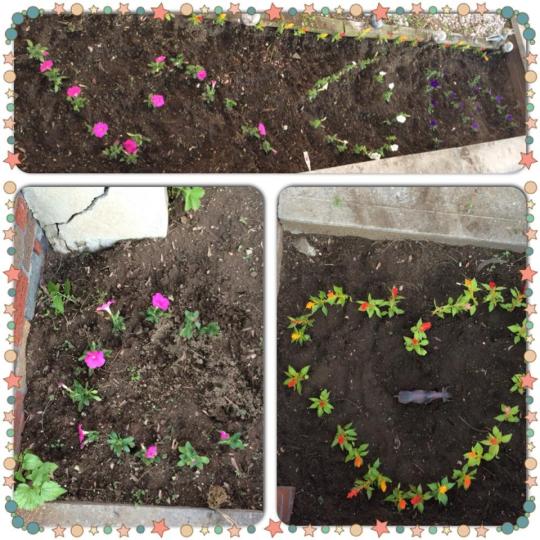
Luckily, this time, we worked smart instead of working hard. Dad has this “claw” that is used to till the soil, so I went through the garden doing that to the whole thing. Then we could just rake out the weeds, including roots of weeds we’ve probably missed for years, and it was so much easier to plant the new flowers without having to dig into hard dirt. So it was actually a pleasant experience overall.

10320467_10152406009052863_5699474737916159828_n

I also used my planning skills to design the garden, because the more time I spent on that, the less I had to spend on doing actual hard work.

(That’s it for today. If you want some math or pedagogy, please see my last post – I was very excited by it!)

The Alien Bazaar

Michael blogged and tweeted about exponentiation being numbers instead of operations, which made me think of a lesson I attempted last year. It didn’t go quite as planned, but I liked the idea, so I said I’d write about it.

At a Math for America meeting, we were working on problems with different bases. I was talking with the facilitator about how glad I was that my 4th grade teacher taught us alternate bases, as I’m sure it was pivotal in greatly improving my number sense. Later on in the session, we were talking about “real world math,” and I brought up how it’s not the real world that is important, but that the setting of the problem is authentic and internally consistent. The presenter remembered a lesson she had seen that was totally fictional, but still felt authentic: if aliens with different numbers of fingers (and thus, presumably, differently-based number systems) were at a galactic bazaar, how would they sell things to one another?

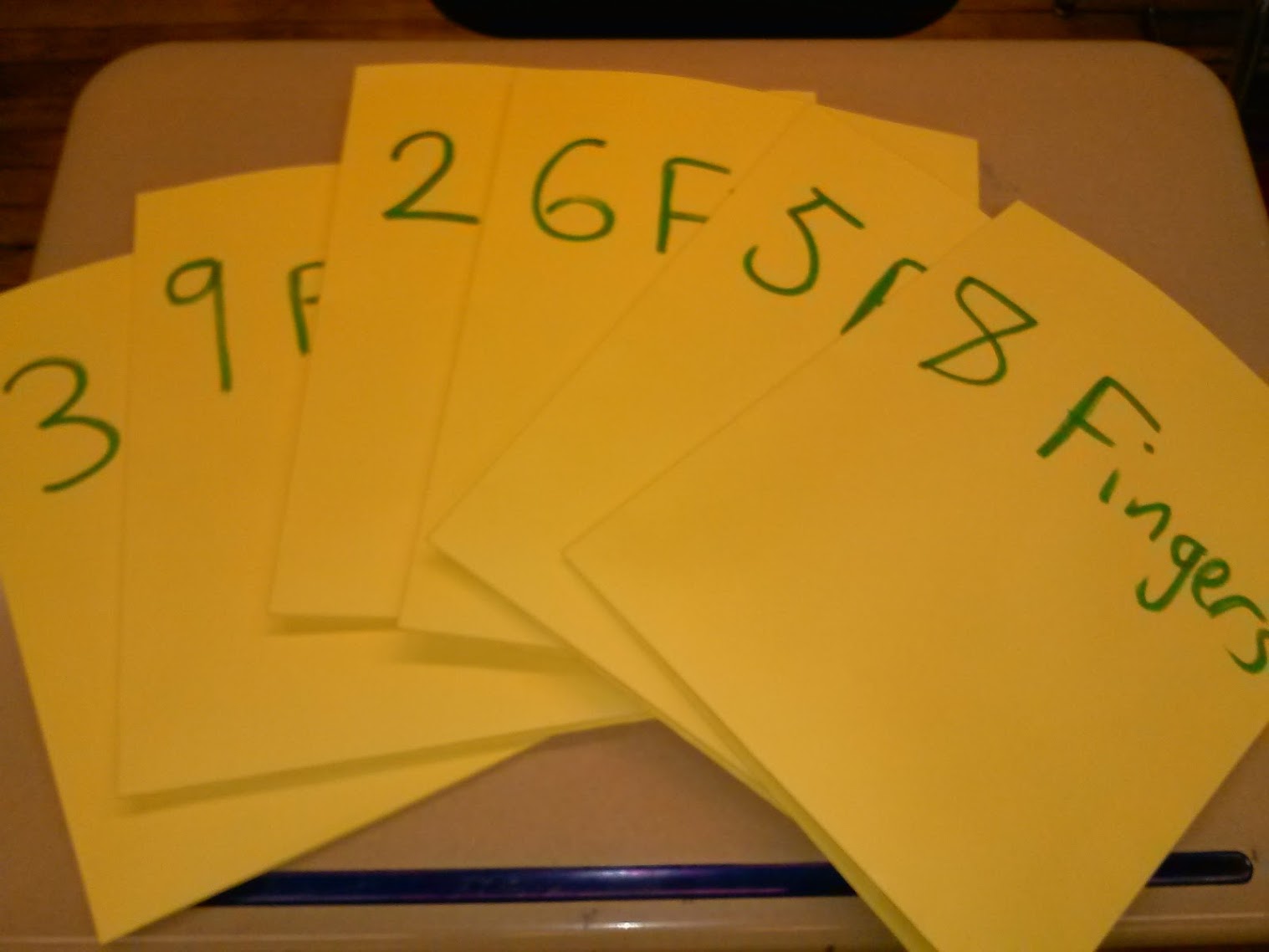
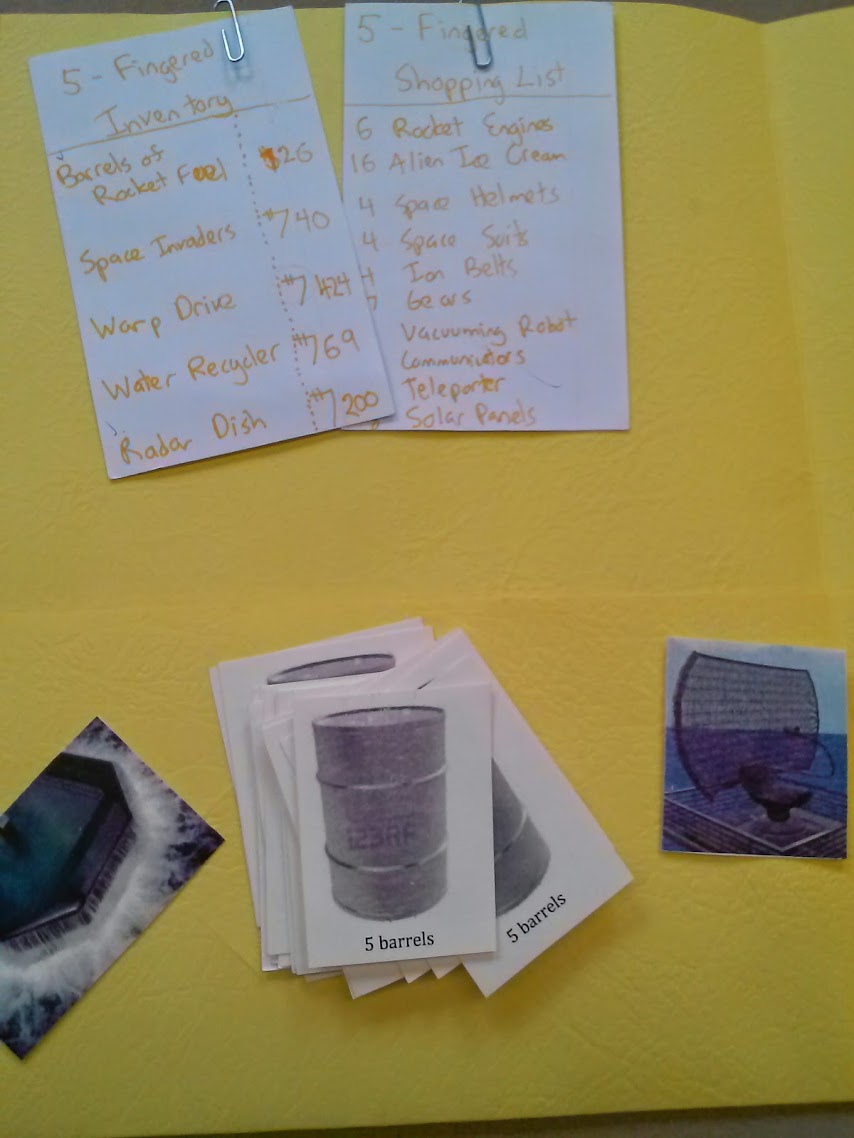
I loved the idea, and so wanted to extended it beyond the simple worksheet-based problems that it was. I wanted to have an alien bazaar right in my classroom. So I developed 6 species of aliens, each with a different number of fingers. Each species of alien brought a different set of items to the bazaar, to sell to the others. Each species also had a shopping list of items it needed to purchase before it could head back home. (I set up groups of four to be all the different races.)

Each species’s inventory was given to them in a folder containing all the items. (Each species had a monopoly on one specific item, but was in competition with the other items, and no one race had enough to satisfy all customers.) The first task was, given the prices of each item in decimal, to convert them to the number system of the group’s race and set up a shop with a display and the items spread out.

After that was complete, each group was given blank-check currency, color-coded by race. Two members of each race were to act as shoppers, going around to the other races and 1) figuring out how much their item cost, 2) figuring how much money that would be in their own number system, and 3) making sure the shopkeeper agreed with their payment.

The other two students stay behind to run the shops, checking the work of each shopper to make sure they were not ripped off. This made is more like a bazaar – both the buyer and the seller had to agree on the price being paid, which can be tough when the buyer and the seller use different number systems!

I was really excited by this idea, but it didn’t pan out quite the way I wanted. I think the main problem was that there wasn’t enough time – these are big, unfamiliar ideas and the whole process needed more time than I was willing to give it. I taught the lesson in the hopes of strengthening their ideas about exponents and scientific notation, but since those are such a small part of the 9th grade Integrated Algebra curriculum, I couldn’t really devote a lot of time to it. I hear they are big parts of the 8th grade common core standards, so this might work well in an 9th grade classroom or even earlier.

What I did do, though, to salvage the situation, is to segue the lesson into an exploration of polynomials, and this is related even more so to what Michael talked about with exponents being numbers.  When we have the number 132, that number is really 1 \cdot 10^2 + 3 \cdot 10^1 + 2 \cdot 10^0. But that’s only for us humans. If that number were written by the 5-fingered aliens, it would be 1 \cdot 5^2 + 3 \cdot 5^1 + 2 \cdot 5^0. And, in general, if we wanted to figure out what that number means for any number-fingered alien, we would use 1 \cdot x^2 + 3 \cdot x^1 + 2 \cdot x^0. So we looked at that in Desmos.


Screen shot 2014-05-10 at 4.17.01 PM

We start with x=4 because 132 doesn’t make sense as a number for a base smaller than 4. And now we can see all the different values of 132 in the different bases. As we go into numbers with more digits, we start to get more interesting polynomials, which was also fun to explore.

I’d love to hear feedback.

End of Marking Period Grading

How did I let myself get so far behind? Maybe I did it on purpose – I was so annoyed with the focus on grades that I wanted to let it sit back and push toward focusing on the content. Maybe it was my minor addiction to Civilization V. Maybe I just give out too many assignments.

I stayed until 6 today, skipping out on happy hour, to try to whittle down the pile before bringing it home, because marking period grades are due on Tuesday. However, because I was also doing notebook checks, I prioritized those and didn’t do much whittling.

CAM00290

When a student saw how much I had to grade, he said, “Wow, that’s so much. But I can see why you’re behind – you actually have to read everything and make comments and check if it’s right, not like some other teachers.”

So at least my hard work is being noticed.

Cop Out

Since it’s not even 10 and I’m falling asleep, despite all the work I need to do, even a simple blog post seems really hard right now. So I looked through photos I’ve taken on my phone, trying to find something I could just throw up as a blog post. I found this pic of an elevator in one of the museums in Luxembourg this past summer, which I appreciated for the numbering.


What was also nice was that going further down lead you further back in time, since the museum was arranged chronologically. This is way better than B1, B2, etc.

Theatre Pricing

So I’m seeing Aladdin tonight on Broadway (very exciting!) and as I wait for the show to start I thought I’d blog. Our tickets were not very expensive and, as such, we are way up in the balcony. I recently purchased tickets at a different show and noticed certain patterns in the pricing structure. For example, the center front of the mezzanine is the same price as the side of the orchestra towards the back. The price for the center orchestra changes farther back than on the side.

All of this is not news to people, but I wonder how these prices are determined? How do you decide that two disparate sections are worth equal amounts? Certainly the angles of the show and thus what you can see are different, but maybe that can be calculated.

Even better, this is the 21st century – why have the same price for a huge section of seats when the seats are obviously not of equal value? You could come up with a formula to determine the price of seats by location, surely.

Hedging Your Bets

At trivia tonight, one of the bonus round was a matching question – match the 10 movies to the character Ben Stiller plays. We (and by we I mean my teammates, as I know very little about Ben Stiller) knew 7 of the questions for sure, but had no clue for the other three.

At that point, one of my teammates asked me if it would make more sense to put the same answer for all three, rather than guessing. That way we would be guaranteed a point, as opposed to maybe getting them all wrong. It took me a minute to think it through, but I told him it didn’t matter either way and I’d rather take the chance of getting all 3 right. (We won trivia on a tie-breaker final question, so a 1 point difference would have been a big deal.)

I figured there were 6 possible ways we could write down our answer – 1 correct way (call it A B C), 3 ways that get us 1 point (A C B, C B A, and B A C) and 2 ways that get us 0 points. (B C A and C A B). Calculating that expected value gets us an EV of 1 point, the same as his suggestion – so, mathematically, they are equivalent. Then it just comes down to your willingness to take that risk, since it’s not a repeatable event.

And as we always say every week, go big or go home.

Experience

Last week our school had a Quality Review, where an outside team from the city came and reviewed documents, data, budgets, etc, as well as visited classrooms, sat in on meetings, interviewed students and parents. It’s a two-day process, and at the end of the first day, the review team saw mostly newer teachers, and then the second day saw the more experienced teachers, which included my class.

I was struck by that, falling into the “more experienced” category. I certainly didn’t last year. But by my reckoning, it’s true: last year I was in the lower half of the experience range for my school, and now I am in the upper half. (I was going to make box plots for these, but I was just guessing for some of the years, so I didn’t.) It’s strange because I’m only a 4th year teacher, and yet there it is. I’m not in the upper quartile yet – still a good number of long-timers ahead of me. But by my estimation Q3 is around 8 years for my school – I wonder if it would take me that long or if the boundary will move. (Or if I will.)

A Boss Fight?

One of the things about arranging your grading system like a game, as well as being a math game aficionado, is that it is pretty easy to combine the two. While yes, students can take quizzes or write essays to gain levels, they can also beat me in a math game. Of course, I’m not easy to beat, so winning against me would really show some mastery. (I do, though, allow them to gang up on me when the game is more than 2 players.)

The only students that really challenge me are the ones that hang out in my room at lunch, even though I’ve offered the challenge to everyone. And it’s cute because when they do lose they get even more determined, often because they may lose by a very small margin. (This is occasionally by design.)

The only game I’ve lost so far is Blokus, where the two Kevins beat me (but my score was still above the 4th player). As a reward, I gave them a level in Visualizer, as I figured that was the most applicable skill to winning the game. Planning ahead and visualizing paths in your mind is a useful skill. That same skill is the reward if they beat me in Ricochet Robots. In that game a team of Jane and Kevin tied me, so I still gave them reward, but they didn’t win.

It’s interesting trying to match games with skills. For example, the reward for winning at 24 is Tinkerer (since you need to play with numbers and try different things to succeed). It’s easy for games I made myself: if they can win at the Factor Draft (an upcoming post, I swear), they are a master of factoring. I have considered giving some points, not quite mastery, if they win against their classmates or my co-teacher, but to be a master, you gotta beat the final boss.

I’d love to have a bigger collection of games that I can use as assessment of skills, not just algebraic skills but the Standards of Practice as well. Any suggestions?

Piano Playing

I had a “Talking Math with Other People’s Kids” moment back in October that I wanted to blog about, so now is as good a time as any to pull that one out of the drafts folder.

My boyfriend’s niece and nephew have recently fallen in love with Star Wars, which, frankly, makes all of us happy. So while at the BF’s parents’ house when they were there, I decided to entertain them by playing the Star Wars theme on the piano. His nephew, Matthew (age 6), liked it and wanted to know how to play it. I thought about how I would describe it to him, so I did the following.

PIano1

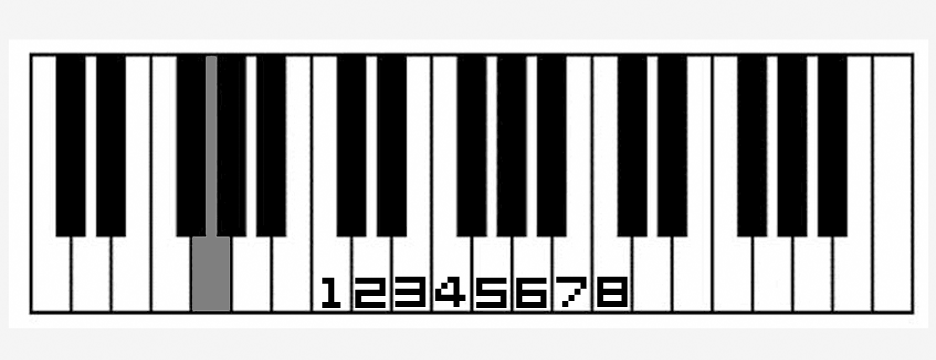
“Okay, this key here, I’m gonna call that key #1. So the one next to it is key #2, and so on. So, I’ll write down some numbers and you can know which keys to press.” And I wrote “1 5 4 3 2 8 5 4 3 2 8 5 4 3 4 1. (Then repeat)” He practiced it a few times until he got it, and we were all impressed. But then he wanted to do the next part, which dips into the octave below middle C. So I saw an opportunity.

“Well, Matthew, the next key we have to hit is this one, what should we call it?”

PIano2He told me I should call it 9, with the next notes being 10 and 11, since we already did up to 8. I asked him if he thought that might be confusing. “If I were reading it, I would think the 9 should be the one right after 8.” He agreed, so then he said we should call them letters, like a, b, c.

PIano3“Well, okay, Matthew, we could do that, but then what would you call this key [the one to the left of “A”]?”

After a moment’s thought, “D.”

“But isn’t that confusing again? Now everything’s out of order.” He agreed again, but wasn’t sure what to do about it. I made the following suggestion:

PIano4That way if we need to add more notes that go down, we can just use more letters, and if we need to add notes that go up, we can use more numbers. He thought this was a good idea, and so we moved on to playing the rest of the tune.

I admit I was thinking of a specific post I had read not long before, which I thought was a TMWYK post but now I can’t find it, where the child invents numbers smaller than 0 using *1, *2, *3, etc. That was my intention with that conversation with Matthew, but if I’ve learned anything from reading all the TMWYK posts, it’s that you don’t push it if the kid isn’t going their themselves. We had to come up with some sort of solution so we could keep playing the song, but once we got something workable, we didn’t need to keep going to talk about the whole negative number system. At the time Kathryn Freed asked me if there was a 0 key, which I said there wasn’t and so the divide between the two types of keys was a little awkward, but it worked out.

In the months since, Matthew has been taking piano lessons and learning to read actual music instead of my cockamamie scheme, which is for the best. He’s pretty good at it, too.