Trying to find math inside everything else

Posts tagged ‘Math’

The Math of Nail Clipping?

To demonstrate how I’m such a nerd (or such a math teacher, or both):

I was just clipping my nails, and started thinking about the math involved. Often when I clip I’ll only do 1 or 2 clips per nail, and they can come out really jagged, pointy, and sharp. But this time I did about five clips, closely following the curve of the nail and it came out much smoother.

Which makes sense, because I’m basically approximating the shape of my nail (a curve) with the nail clipper (a tangent line), and so the more tangent lines I used, the closer the approximation is.

Now the question just is if I can turn that into a WCYDWT, or if it’s too gross for that….

No Better Feeling

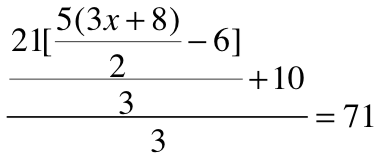
At the beginning of yesterday’s lesson, I threw up this monster of a problem:

I told my students that, by the end of the lesson, they would be able to solve it. They flipped and freaked out. “No way, Mr. Cleveland, not going to happen.”

In all 4 sections, 1 hour later, every student correctly solved the problem. And they were all so proud of themselves for doing so. There’s no better feeling than that.

Egyptian Fractions

As I stated earlier, I’ve been trying hard this to integrate the other subjects more into my math lessons (and the other teachers are happy to work vice versa, because I’m on a great grade team). This process is made easier by actually having a Special Ed co-teacher for one section, and she specializes in math (and sees every subject, so can comment on all of them). So my first lesson explicitly tying history to math just went off, a lesson on Egyptian Fractions.

My goal for this lesson was really to get some fraction practice in while still learning something new, while also highlighting the “symbol that represents the multiplicative inverse,” , which I’d tie in on the next lesson about exponents (aka an exponent of -1). We worried, though, that the translation process would be too tough while dealing with fractions. That’s when we came up with this:

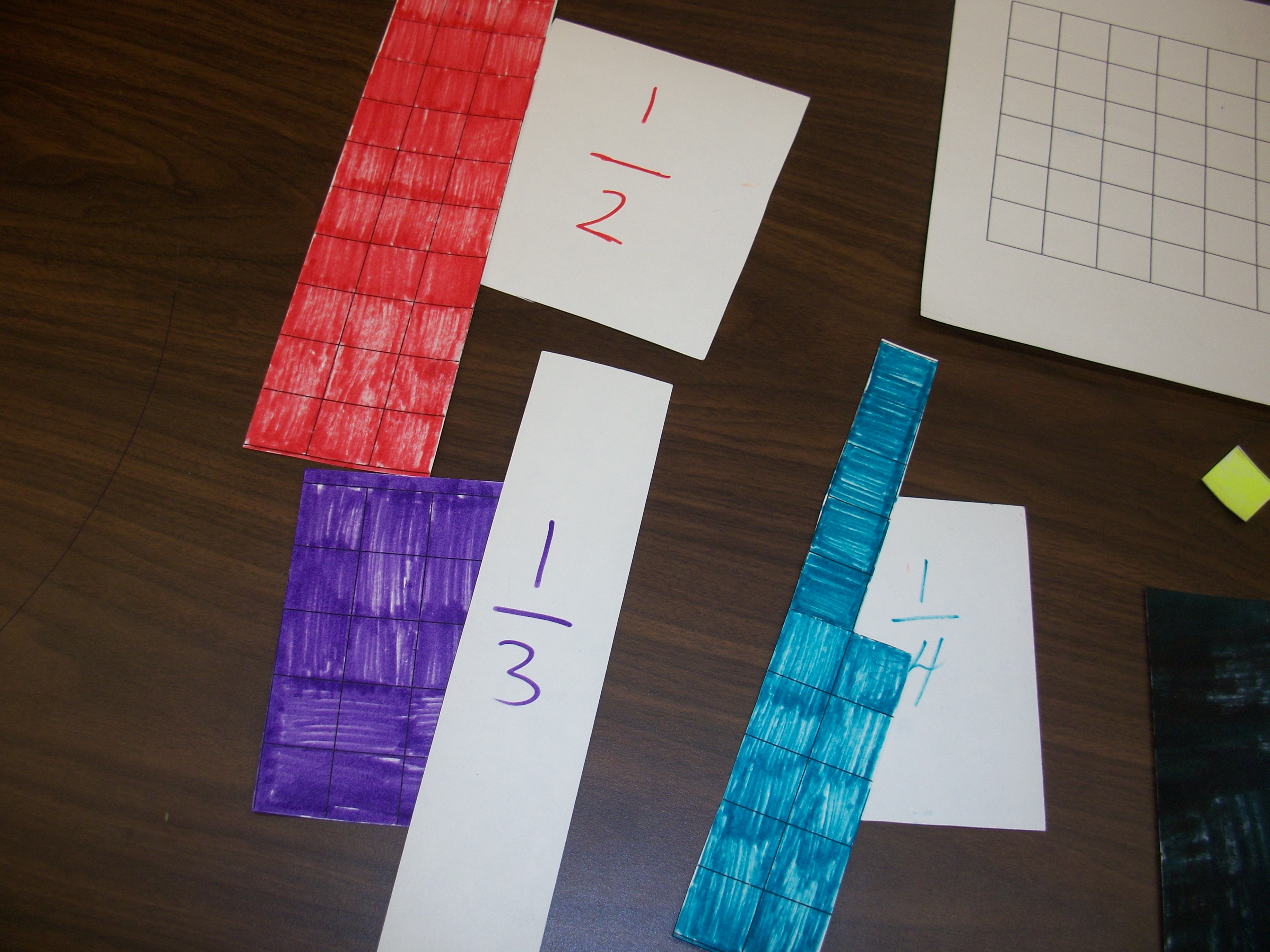
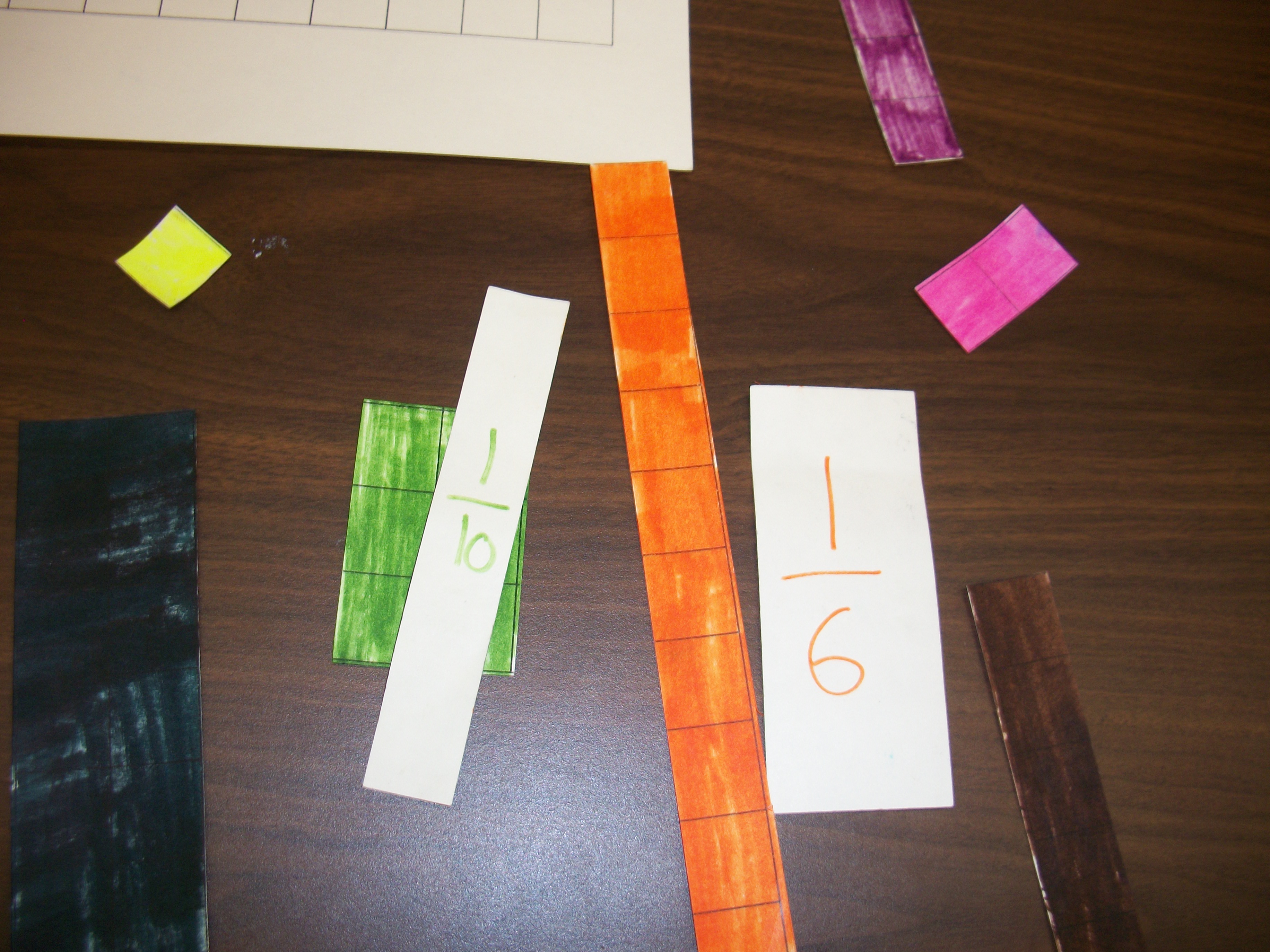
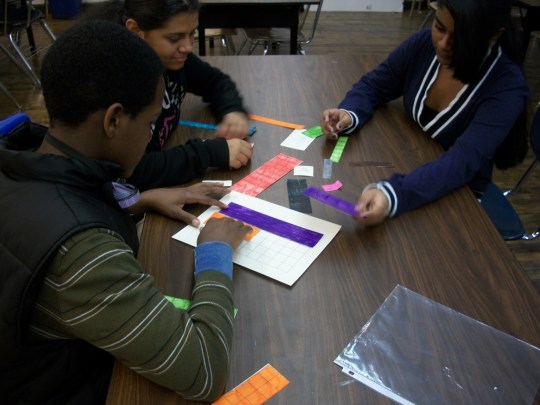
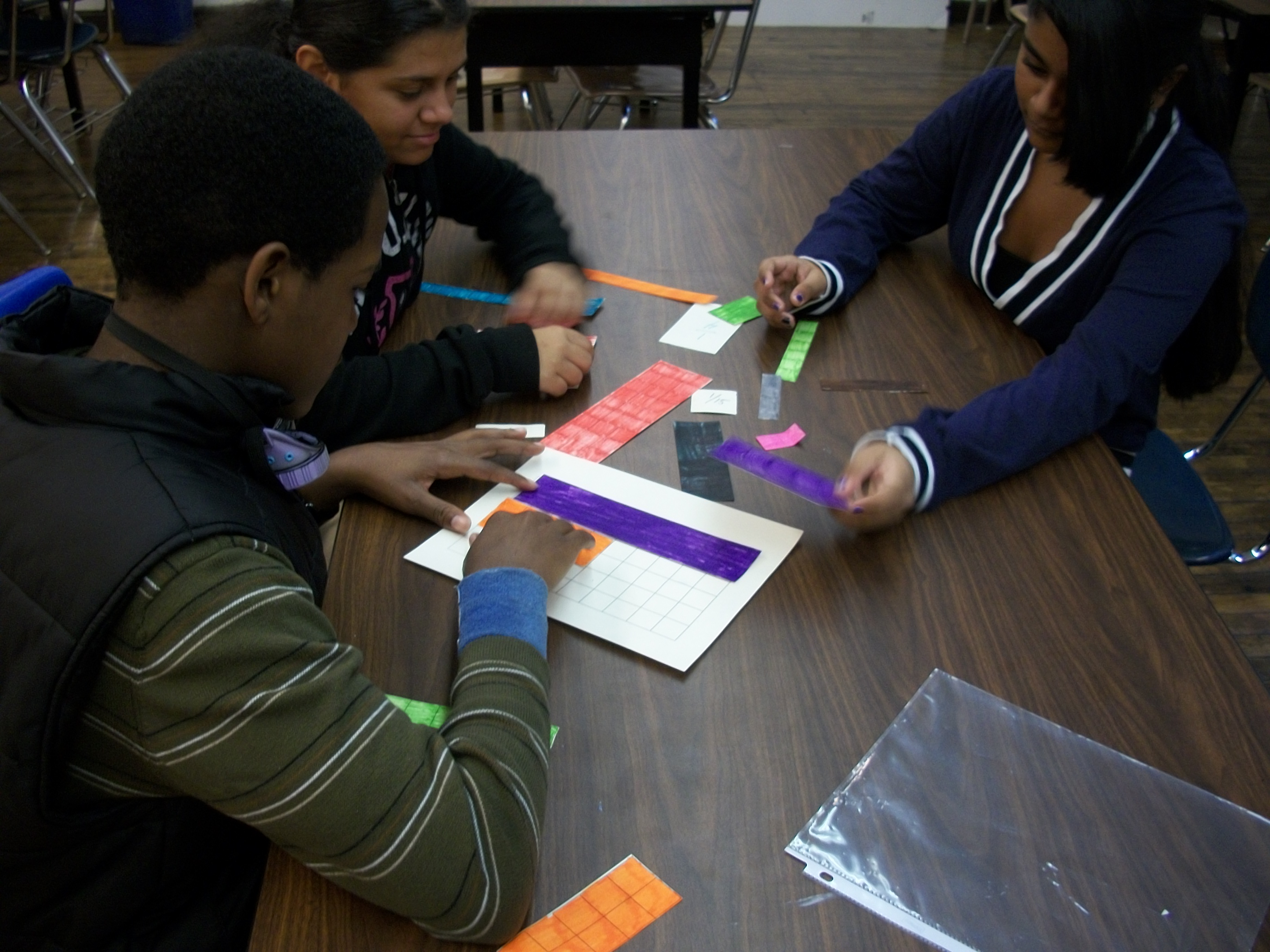
The Fraction Board has 60 square on it (which will be good reference for when I deal with sexagesimal Mesopotamian numbers soon), so each piece is cut to fit the amount of square that will cover that fraction of the board. To make the boards, I just made a 6×10 table in word as square-like as I could, printed on card stock. Then I cut the pieces out of the extra boards and had slave labor student volunteers color them in for me.

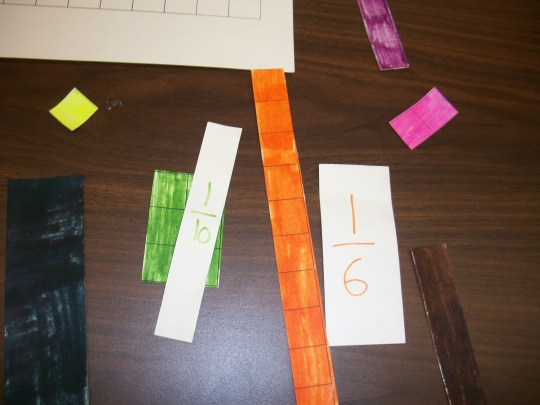
Each fraction have multiple pieces to represent the different ways you can fit them. (For example, 1/2 is 30 square, so I have a 3 x 10 piece and a 5 x 6 piece). But each fraction is also colored the same, because in Egyptian Fractions you can only use one of each unit fraction.

Then I would put up a slide like this on the board:

And the students would have to make that shape on their boards, with no overlapping and only using each color once. For the first one I shared a possible solution:
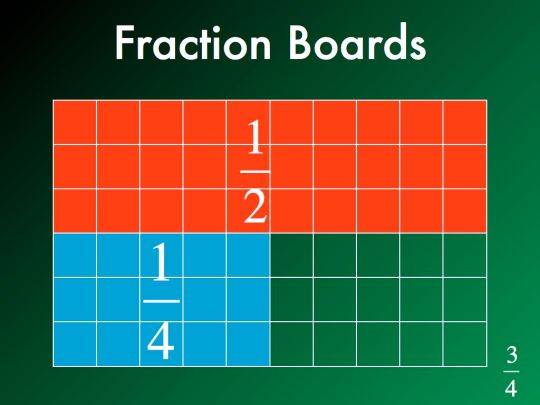
But I got really excited when the students could come up with multiple different solutions for each problem. And I would increase the difficulty of each one, until I would just get to a fraction with no picture:

And they still nailed it. Eventually I would move away from the boards and show the process of how to do it without the boards. We’d do some simultaneous calculation (using the greedy algorithm or more natural intuition) and checking on the board. Then we’d try with non-sexagesimal fractions. And every time we would translate our answers into hieroglyphics as well. So by the end of the lesson they could work on a worksheet where I just gave a fraction and they gave me hieroglyphics in return. (Not all of them could do this completely, but most could do some of the sheet). I think, overall, it went pretty well.

Egyptian Fraction Slides (Powerpoint)

Egyptian Fractions Slides (pdf)

(WordPress doesn’t seem like it’ll host my slides in their original Keynote form. That’s bothersome.)
It All Fits Together

One of the best things about being a math teacher, as opposed to a mathematician, is that because I have to think about how to explain a concept to people who don’t get it, I have to think about concepts in different ways than I ever have before. So I often make connections that maybe I should have already made, but hadn’t, and I see the beauty of the conventions and connections of mathematics.


Today I was musing about the use of -1 as an exponent to give us a reciprocal, because my next lesson is about Egyptian Fractions, and so their fractions are basically the number with an inverse symbol, which we still use, -1. And then I thought, well, yes, that is our inverse symbol, for functions too. Of course, that makes sense. But the clearness and uniformity of it seemed new. So often we learn about things in math in such disconnected ways, so it’s just “Here’s one use for the -1. Here’s another. That’s the way we do it.” But not why it’s the same for both.


And I get these realizations all the time. At least 5 last year. (I think another I had had to do with FOIL.) I hope I keep getting them. But the next step is, of course, to figure out how to let the students get them. Because then, I think, they won’t hate math so much.

What’s My Set?

For the past two lessons I’ve taught about sets, including set notation, union, intersections, and complements. To practice what they’ve learned, I had them play a game called What’s My Set? I originally came up with the idea because I wanted the students to get out of their seats in the middle of the double period, and so organizing themselves into the sets seemed like the way to go.

I gave them all badges as they entered class with a number on it. They got them totally interested in what the numbers were for, but I just expressed the need for patience. When it was time to use them, they were interested.

We played it twice. First to practice their ability to read Set Builder notation, write it, and translate into roster notation. I would display the sets in Set Builder on the board, giving each set a location, and they would have to move to that part of the room. But it’s up to the people in each set to make sure they have everybody that belongs there, since I would check if a whole set was correct, and so the stronger students were forced to help the lost ones to get their points. I would give a point to the first set to complete itself. The interesting thing is, because the sets change, though the points are per team, really they are individual. I didn’t give a prize, but they didn’t seem to care.

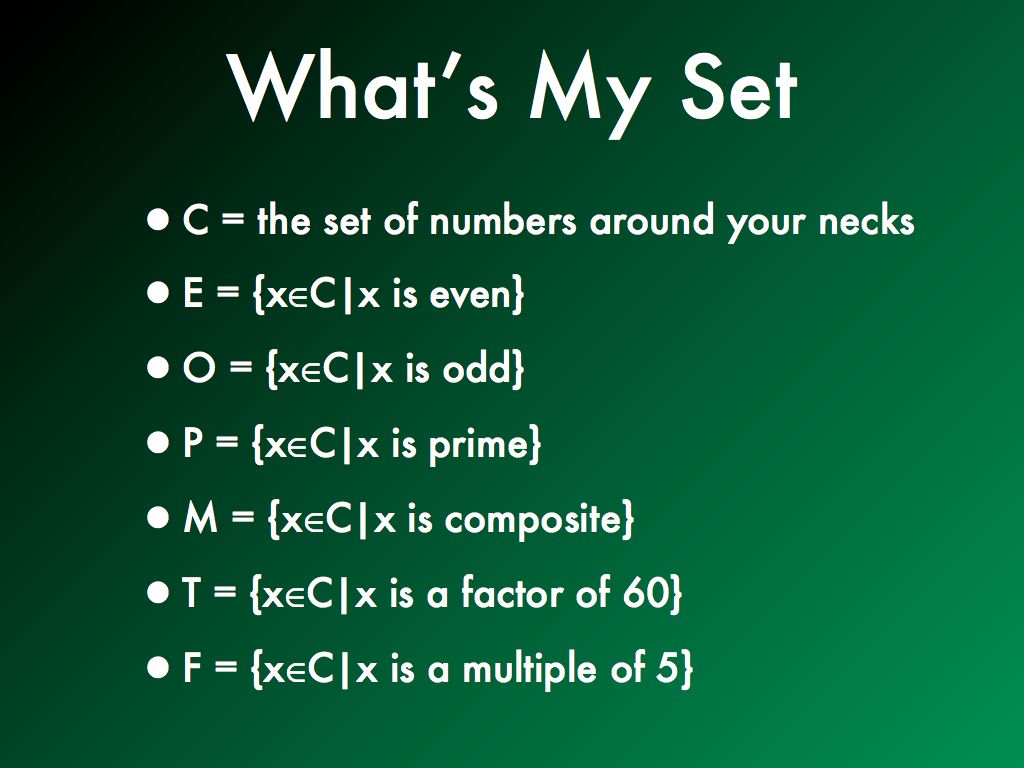
In the second part, to practice unions, intersections, and complements, I just left 6 pre-defined sets on the board:

Then for each round, I would write on the board something like O ∩ P goes to the front of the room and (O ∩ P) complement in the back, so they had to think a little bit more for this round.

Habits of Mind Survey

Tomorrow is the first day of actual math class, so I’m starting off with my Habits of Mind survey that I created last year at the beginning of the year. I give some statements to the students and they can determine which habit of mind they represent. Then I’ll present them the challenge of forming themselves into groups so that each habit of mind is present in someone’s highest or second highest score. With 5 students per group and 8 habits, this shouldn’t be too challenging, but we’ll see how it goes….

Habits of Mind Survey

Crimes and Mathdemeanors

I’ve made a post about history and science, I guess now it’s time for ELA. I think ELA is, in a way, the easiest to connect to math, but that might just be my background at Bard and working with the Algebra Project. But I wanted to talk about a book I used this past year that fits the bill.

This is a book of mysteries akin to Encyclopedia Brown. but with a more mathematical twist. The protagonist, Ravi, is a 14-year-old math whiz, athlete, and son of the Chicago DA. He often runs across mysteries that he can help solve and the reader gets a change to solve, as well.

I used this book in class to, I think, great effect. Most students enjoyed the prospect of the mysteries and got into attempting solutions. It allowed them in guess at a solution (such as who the murderer is from three suspects) without necessarily having to first grasp the math involved, which worked as a hook. Some students did not get into it but that was from rejecting the very premise of reading a story in math class. Many of those students eventually got past their misgivings.

For each story (I used the book about 6 times throughout the year) I asked the students to underline or circle anything they thought might be relevant to the mystery as we read it out loud. Then we compiled what we knew as a class and discussed what we still needed to know to solve the mystery, and then they worked in groups to come up with a solution, often with some prodding (but occasionally with none, which was nice).

I’m thinking of starting with the stories earlier next year (I didn’t this year because I only received the book in December for my birthday) to set it as normal when we use it. I also hope I can find some other books that might act similarly. If anyone reads this and has suggestions, let me know.

Scaling

Today’s Unshelved gave me an idea for a possible Living Environment-connected lesson I can do in the new year. Surprisingly, though most people think Math and Science go hand in hand, I have a much harder time connecting Living Environment to math than with ELA or History. (Maybe this XKCD comic explains why I have an easier time with Physics and Chemistry.)

During my statistics unit this past year I did a lesson on scaling and how area and volume scale proportionally to the square and cube of the length. I did it during the statistics unit because it was based on how improper scaling is used to mislead people. (My unit was based on the book “How to Lie with Statistics.”) Of course, where the lesson lies may change based on the curriculum overhaul I do this summer, but I imagine the basics will be the same.

I ran the lesson as a lab, with students building letters out of blocks and then scaling them upwards by factors of 2, 3, 4, and seeing what happens to the area of a trace and the volume (number of 1 cm^3 blocks needed). It was a fine lesson, but I wonder if I can’t improve it with a little more…wonder.

I want to see if I can find a good picture or video of a giant creature like mentioned in the Unshelved post and see if I can get students to wonder if it can exist. That sort of question can give purpose to the scaling exploration in the lab. If you read this and can offer assistance, great. Expect a post in the future based on what I find.