Trying to find math inside everything else

Posts tagged ‘Learning’

Lessons from NCTM, Part I

Oof, well, I certainly meant to write this up sooner, not almost a full month later, but it felt like it took this long just to feel caught up from having missed those three days! That’s definitely a struggle with the conference timing. Anyway, I figured I’d go through some of the sessions I went to, and my notes, as a way to debrief myself but also share any gems I picked up.

Two Students, One Device

I missed the beginning of this session because I went to two other ones first, neither of which worked out, but I knew Liz (Clark-Garvey) wouldn’t let me down (as well as Amanda Ruch and Quinn Ranahan). I’ve used the practice of two students on one device before, but I realized it was natural to do it back when I was at a school where we were using class carts of laptops/tablets, so I could just give one per pair. Now I’m at a school where everyone has their own device, so making them pair up needs to be a more intentional move, and it’s easy to default to not doing that.

So then the question is, when to do it? If students are doing practice problems on DeltaMath, that doesn’t need to be paired. This is the slide the presenters had for this:
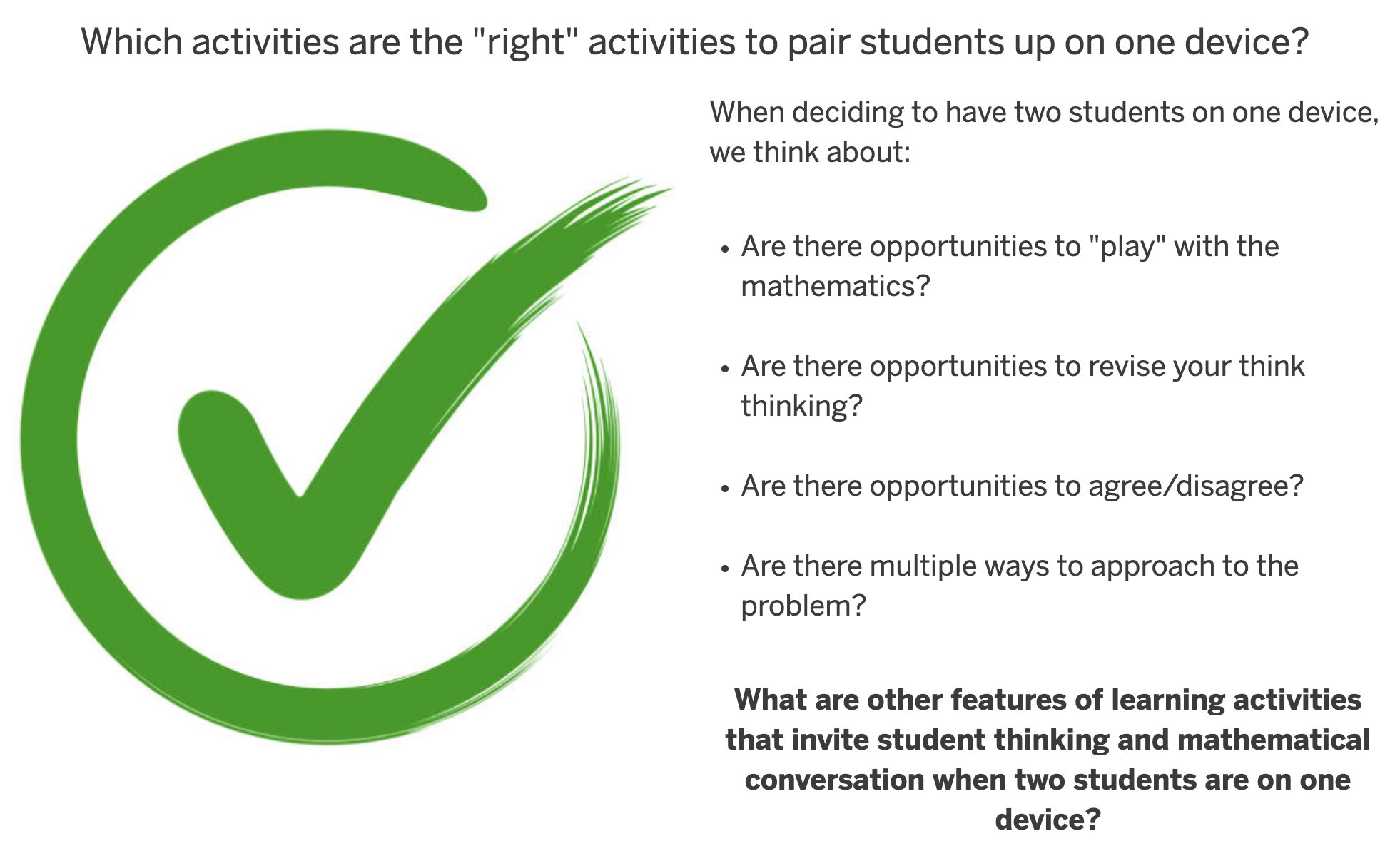
But they also talked about how just choosing the right activity isn’t enough, so other strategies are useful. For example, setting norms such as “type other people’s thoughts, not your own” or mixing up the groups and having them revise their responses.

Fawn

Sure, I could use the title, “Helping Students Become Powerful Math Learners,” but really this was the Fawn session. (Or should I say “The legendary Ms. Nguyen”?) The first quote I wrote down was “The pacing guide does one thing for me – it tells me how behind we are.”

Fawn had four maxims to follow:

  1. Ask students to seek patterns and generalize
  2. Ask students to provide reasoning
  3. Build fluency
  4. Assign non-routine tasks

One routine that stuck out was an open middle-type problem. We had to create the largest product using 5 numbers, 3-digit times 2-digits. Fawn had us all share our possibilities, and then we discussed which possibilities we could remove – someone would nominate one, explain how they knew it wasn’t the greatest (often because it was strictly less than another), and it would be removed only if there was 100% consensus. Then we could narrow it down before we ended up checking the top two choices.

Another thing of note was about the non-routine tasks and games: in particular, they should be non-curricular. This doesn’t mean not based on your curriculum at all, but rather not based on what they just did. This makes sense, as if they are always using the skill they just learned, that turns it into a routine, and thus won’t have the same benefit.

Just Civic Math

I don’t have that many notes from this session, and I don’t see any slides attached on the NCTM website. One note says “Limiting civics to just ‘social justice math’ is restricting. Dialogic math helps.” I think the idea here is similar to what I’ve used before, Ben Blum-Smith’s Math as Democracy. Jenna Laib’s Slow Reveal Graphs were mentioned, and I mentioned the similar graphs.world to the presenter. They also mentioned the book “Constitutional Calculus” which I will look into in the future.

Miscellaneous

Two notes I took on the patty paper session: use felt pens to be more visible on patty paper, and when folding, pinch from the middle and press outwards (more likely to get accurate folds on lines then).

I went to a really cool session on making art using mirrors and laser pointers from Hanan Alyami. Here’s the kite my group made in the time:

The project seemed cool and had some fun math, but I also don’t know when I could fit it in, as it’s a 3-day process.

I tried to go to John Golden’s session on games but it was full! I went to Christopher Danielson’s session on Definitions. Two things stuck out to me there: his reasoning for originally doing a hierarchy of hexagons was that it fought against status issues, since there was no pre-knowledge as with quadrilaterals; when asking if something is a vehicle, something that is so far from one, like a salad, just makes it a fun question, but something closer to an edge case, like a broken bus with no wheels, is harder and more contentious.

Okay, I was gonna keep going, but that seems like a lot – and that was all just Thursday! So maybe I’ll do separate posts for Friday & Saturday.

Thoughts on NCTM ’24

I’m on the plane Chicago right now, heading home from my first NCTM (and first conference since 2019). Here’s some top level thoughts I have.

  1. I really loved seeing some friends I haven’t seen in 5-6 years – but I don’t know how to answer “What’s new?” after that period of time. A lot! Plus I don’t know what you know from social media. And so then I’d sputter and think “Wait, do I not know how to talk to people? Have I forgotten?” But getting past those opening bits made it all work out.
  2. Sometimes I would go to sessions about things I already “knew,” but it was good to have a reminder, because 2019-2021 was such a big disruption in my teaching career that there were many things I used to do that got dropped, and I feel like I’ve been slowly piecing them back together the past few years. So it was good to go “Oh yeah, I used to do that” and commit to doing it again.
  3. On the other hand, I wish when sessions listed the intended audience, it would also be about whether it’s for beginners in that topic. The hot thing, of course, is Building Thinking Classrooms, but having learned about all of those things so long ago, I didn’t need to be pitched on how it worked in a session. Especially in a session that didn’t say it was doing that.
  4. I don’t often use an agenda in my class, but I really appreciated the speakers who did. This let me know when, if even, they would get to the meat. So many sessions would start with other things like intros, or bios, or reasons why, without any indication of what they actually did, so sometimes if it was 15-20 minutes in and we didn’t get to the point, it would be voting-with-feet time. But I could give more grace when I knew what was coming up. (Now, of course, students in school can’t vote with their feet, but what if they could? Would they still stay in your class?)
  5. One thing about the NCTM vibe, compared to other conferences I’ve been to, extends from the exhibition/vendor floor. But it’s not just the floor itself – it’s that so many people are there to output information or ideas. Every conference I’ve been to before has been bidirectional: all the speakers want to teach something, but also learn something. So having so many people talk as part of their job, without the learning part – feels icky. (I’m sure, of course, that many people who were there to speak as part of there job were also there to learn. But it didn’t feel universal.)

Oh, okay, that’s a good amount of thoughts. I do want to go into some specific things I learned and was amazed by in some of the conversations and sessions I participated in, but I think I’d need to reference my notes and such to do that, which is hard to do on this cramped tray table. Let’s just save that for next time.

Level Up! +1 to Exponents, +2 to Equations

Previously on The Roots of the Equation: You All Have “A”s, You All Have “0”s, and Grade Out of 10? This One Goes to 11.

I like games. All kinds of games: video, board, tabletop, role playing. And so I often think about how games and teaching align. One thing (good) games really do well is provide a sense of progress (especially role-playing games). You start off with not many skills, but as you advance you build them up, learn new things, and can conquer tougher tasks. By the time you reach the end of the game, those things that were hard from the beginning ain’t nothing to you now.

Games don’t usually score you on every little thing that you do. What they do is take a more holistic view and then, at some point, say that you’ve done enough to go up a level. And I say, why can’t I grade that way?

Many people have lamented that the best grading system would have no grades, just feedback that students respond to to improve their learning. But grades are required from external factors: school districts, colleges, parents, principals. But maybe there’s a way around that.

Last time, I said grades should just be a sum of the levels of the learning goals. So now I’m picturing students having a “character sheet” that looks something like this.

I maybe have created that name just so I could tell students to take out their SPELS sheet.

I maybe have created that name just so I could tell students to take out their SPELS sheet.

Student Character Sheet 2

The N/A/J/P/M are my current grading system, Novice –> Apprentice –> Journeyman –> Proficient –> Master

At the beginning of the year we can do a pre-assessment to determine their “starting stats and skills.” Then as the year moves in, we do our work in class. But none of that worked is graded in the usual sense. We would write feedback on the assignment, giving areas for improvement, but the only time a grade is mentioned is when a standard improves. Even then, we don’t focus on what they are (“You now have a 3 in Exponent Rules”), but rather in how they’ve grown (“You gained one level in Exponent Rules!”). The former just highlights that they are not the best they could be. The latter highlights their constant growth and improving.

(Then, at the end, based on what I said in the last post, their grade is literally how many boxes are shaded on the sheet. Have 75 boxes shaded? That’s a 75.)

In order to do this effectively, what we really need to have are rubrics for each standard. That way we know what counts as evidence of a certain level in a standard across all assignments, so it doesn’t matter which assignment provides the evidence. The upside to this is that you do not need to then have a rubric for each assignment! You only need your standards rubrics, because that is all you are using. (The collection of these rubrics, then, in the hands of the students, are a road map to success.)

I’m pretty excited by this idea, and can’t wait to try it next year. This is my idea from the last two posts taken to the next level, with a clear focus on growth, and not deficit. We can’t get rid of grading, and I’m not 100% convinced that we should. But we can definitely minimize the damage that it does and use it to actually promote students’ learning. All we need to do is focus on how we always get better.

Lab –> Lecture –> Assessment

Next year, the weekly schedule at my school is going to be 2 double periods for a particular class (alternating sections on an A/B day schedule) with a single period for every section on Wednesday. Because of the new schedule, I wanted to make a new structure for my class, which is the title of this post: Lab –> Lecture –> Assessment.

There are roughly 30 proper weeks of learning in the year, so I figured I would have 30 Learning Goals to cover, and do one each week. I would introduce each learning goal with a “math lab,” which may be an actual lab (like the popular M&M Lab for exponential growth/decay) or a 3 Act problem or something else that the students can really engage in before getting down to the nitty-gritty and symbolic way mathematicians deal with the problem.

The next double wouldn’t necessarily just be lecture, but it would be the abstraction of what we did the lesson before, including lecturing on technique and practicing what we’ve learned. Then assessment could be any number of things, but will almost certainly involve a targeted quiz.

Seems like a good structure, right? Problem is, while I have a lot of good labs and problems for most of the topics (and will keep improving), not all of them do. Particularly:

  1. Radicals – Simplifying & Arithmetic
  2. Unit Conversion
  3. Solving in Terms Of
  4. Box-and-Whisker Plots / Percentiles
  5. Scientific Notation
  6. Statistics Vocabulary (univariate/bivariate, etc.)


So my major goal this summer will be to develop something for each of those. The rest I can fall back on what I have, even if I don’t come up with something new/better. But these have nothing. My first task/idea is to develop a board game about radicals. That’s still under development. Any other suggestions would be appreciated.