Trying to find math inside everything else

Counting Circles

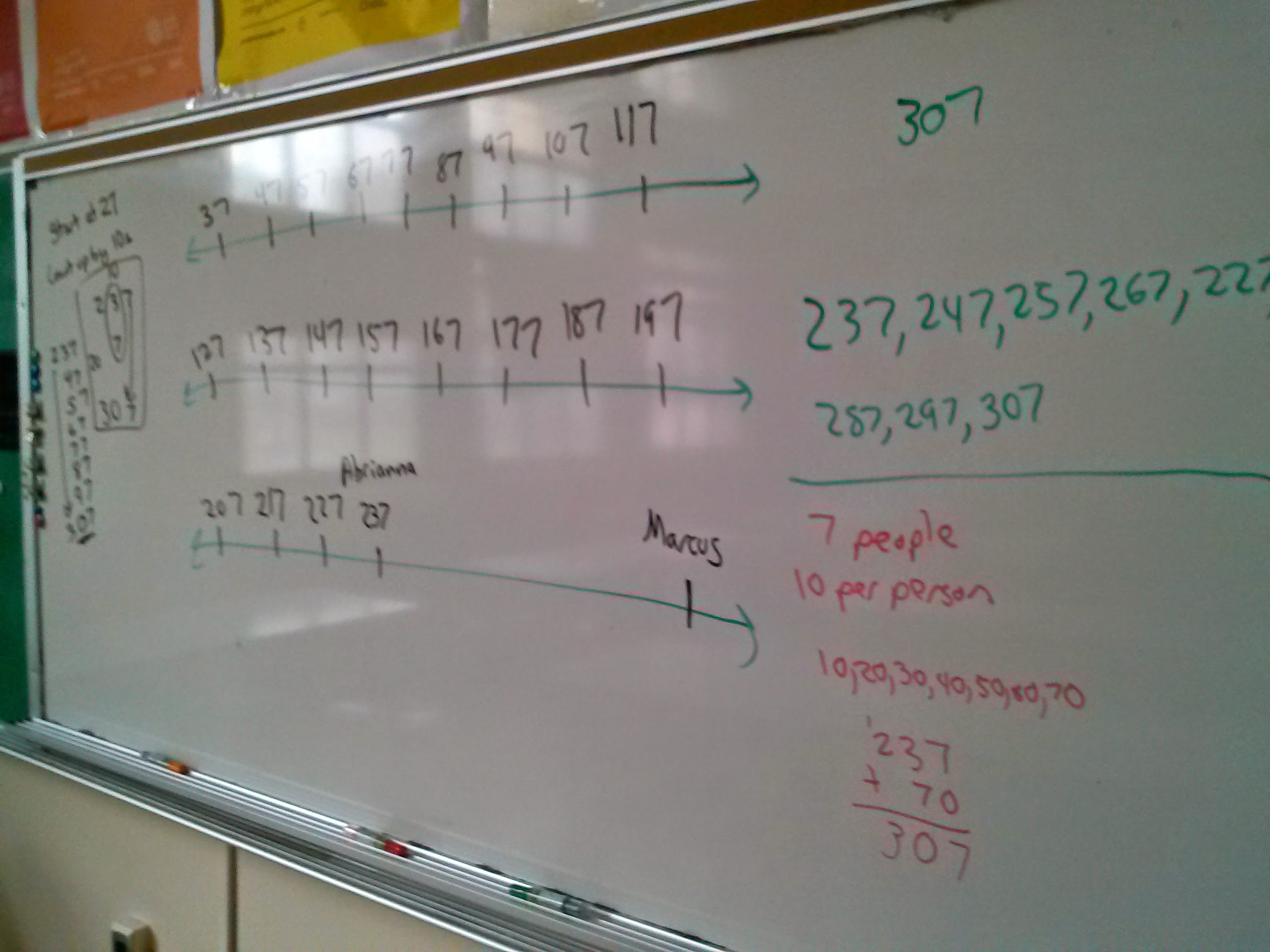
Because I had different warm-up routines I wanted to try, I’m this week ending my second go at Counting Circles, and won’t be using them again until next year. But they’ve had a great run! I think the students got a lot out of them, and I experimented with them in lots of different ways, a few of which I captured as pictures, so I wanted to share them below.

I started, as with Sadie's recommendation, with just a simple off-decade 10s, to practice the idea.

I started, as with Sadie’s recommendation, with just a simple off-decade 10s, to practice the idea.

Inequality

One of the earlier things I tried was do work with an open inequality – that can count by any amount they want, as long as they don’t go below 40.

Binomials

Later on, we counted by monomials and, then, binomials. A fun thing that tricks them up is to swap the order of the binomial. (Commutative property!) Then see how starts adding the wrong thing together, just because they were going left to right.

Binomials with Subtraction

Counting up with one term and down with another can take a few moments for some students.

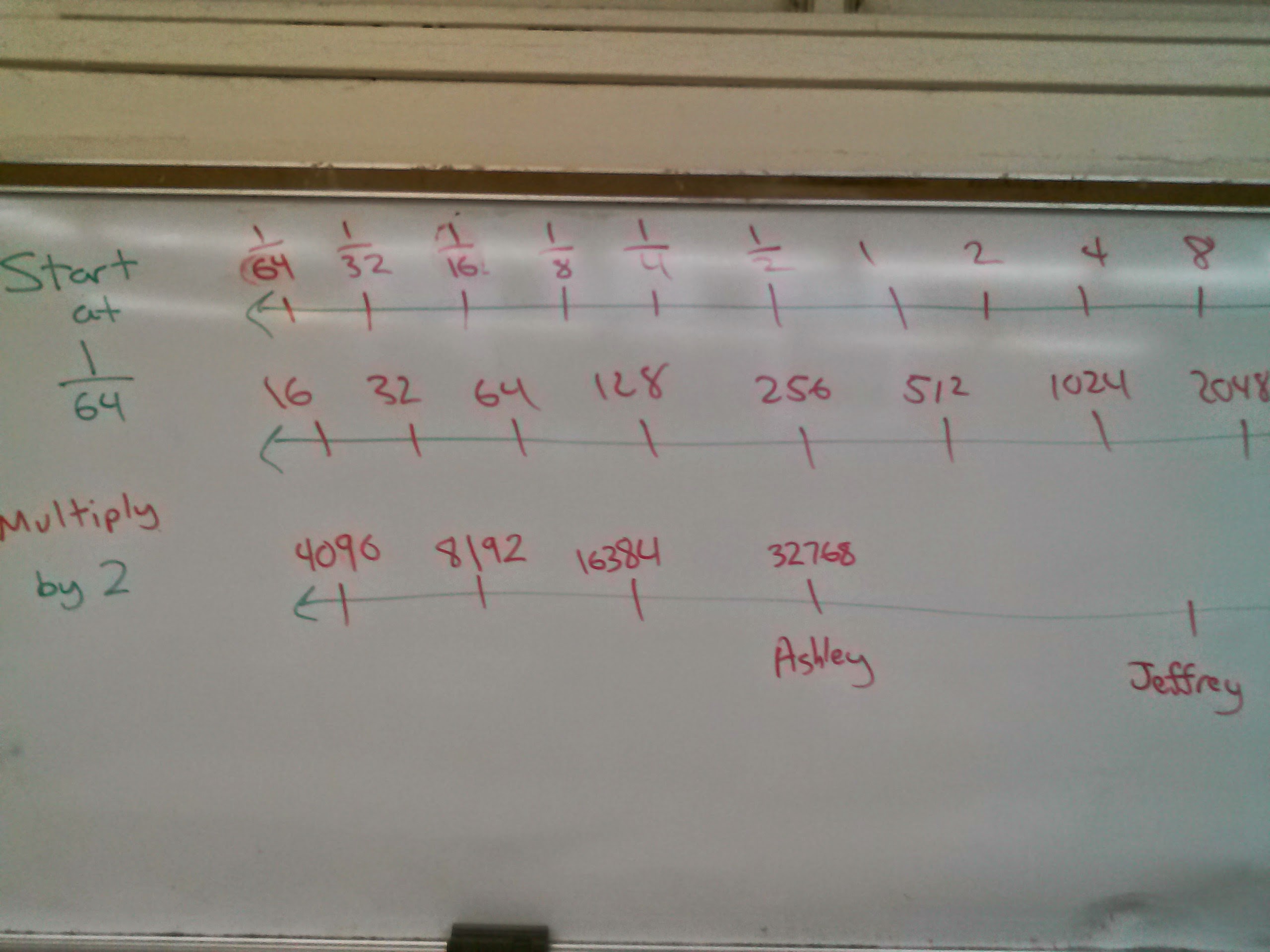
Later, after we had done exponential functions, I tried out a geometric sequence. But I had to make sure I started low enough that we could get around the class!

Later, after we had done exponential functions, I tried out a geometric sequence. But I had to make sure I started low enough that we could get around the class!

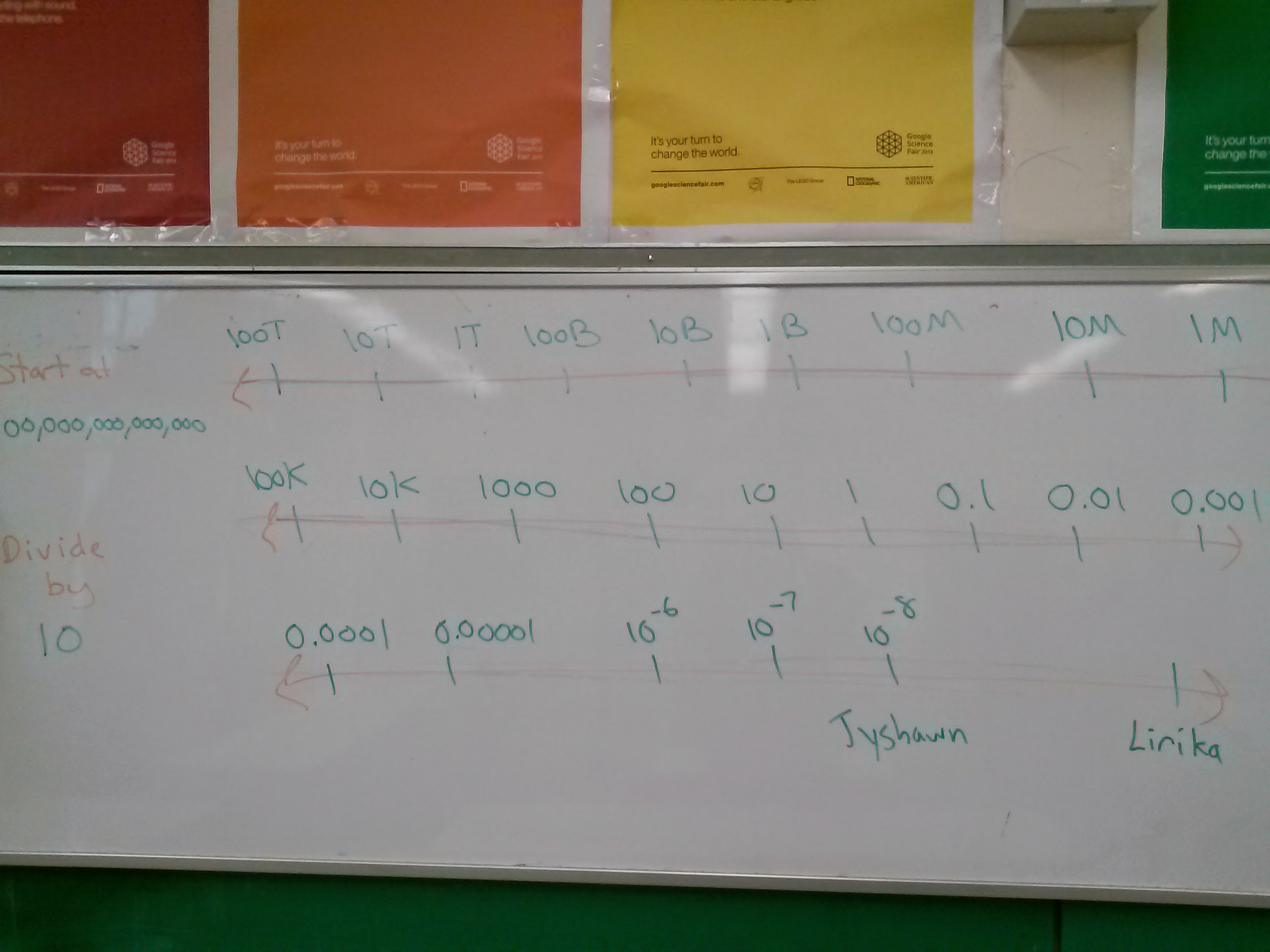
Another geometric sequence was the powers of 10. I mostly wanted to make sure they could name them all! They weren't allowed to just say digits for this one, they had to say the names.

Another geometric sequence was the powers of 10. I mostly wanted to make sure they could name them all! They weren’t allowed to just say digits for this one, they had to say the names.

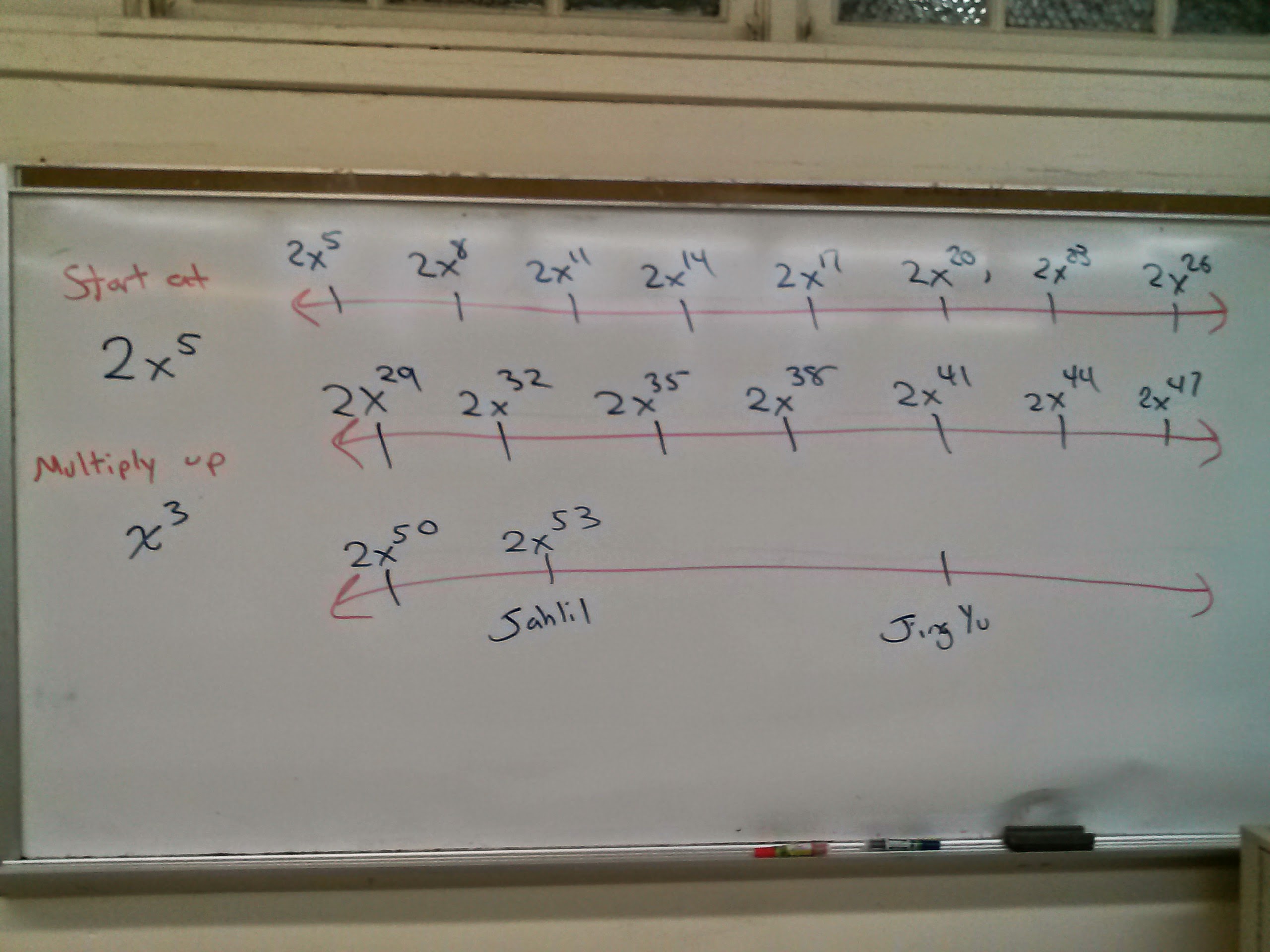
Technically this one is still geometric, though it didn't feel the same. But I also was a stickler here, too - if a kid said "2 x 26" that's what I wrote, instead of "2x^26"

Technically this one is still geometric, though it didn’t feel the same. But I also was a stickler here, too – if a kid said “2 x 26” that’s what I wrote, instead of “2x^26”

As my last thing, today we did a quadratic counting circle. Now, we haven't done quadratic functions yet - that starts next week. So this was somewhat of a preview. They also weren't expecting the perfect squares - only one students noticed that in time to help them on their turn. There was a lot more collaboration on this circle because they had to refer back explicitly to what the last person did. I'll do two more of these (triangle numbers tomorrow), and then that's it!

As my last thing, today we did a quadratic counting circle. Now, we haven’t done quadratic functions yet – that starts next week. So this was somewhat of a preview. They also weren’t expecting the perfect squares – only one students noticed that in time to help them on their turn. There was a lot more collaboration on this circle because they had to refer back explicitly to what the last person did. I’ll do two more of these (triangle numbers tomorrow), and then that’s it!

The Lottery Choice

The other day I read Carl Oliver’s post about the safe and the piggy bank. I was reminded of a lesson I did last year in my exponential unit after taking Chris Luzniak’s wonderful course on debate in math and science classrooms. I wanted to make the typical doubling penny problem more debatable. It actually only really required a small change.


“Would you rather…

a) Win $100,000 a month for 30 months, or

b) Win a penny the first month and have your total doubled every subsequent month, for 30 months.”


This seems like the same problem as the typical formulation, on the surface, but it’s not. The key difference is in the length of time. Usually, the time frame is over a month with daily payments. This is because the number 30 lends itself well to the problem. In that case is pretty unreasonable to not just wait for the full month to get more money by using the penny.

But now though the penny option gets you more money in the long run, you have to wait a really long time before you get anything of value. It takes two years just to get the same amount of money as option A gets you in one month. For some students, that’s just too long to wait. When you need money, you might gladly choose option one for more immediate relief, even if option B gets you more in the end. So it’s a nice debate and would you rather question.

The Other F Word

It’s been a few years since a student has called me a faggot.

Not that I hadn’t heard the word, of course. I do teach teenagers, after all, and it does come up. But no more than once or twice a year, because I come down hard on it. I’m pretty jovial in class, and even when I’m mad it’s a quiet mad, but that’s a time when the full-shout comes out. The student needs to leave the room and have a pretty serious talk about the power of words and hate speech. Usually it is done out of ignorance. Usually we can move past it.

Today I was walking in the hallway, having just gotten my lunch, when I heard the word, solitary, a single statement alone. “Faggot.”

It has happened before, though not, actually, that word, but rather “maricón.” That was in my first year teaching, with a student I would spar with quite frequently. When I mentioned it to my principal that year he was suitably enraged – meetings were had, parents called in, etc. And then we kept on.

There were three of us in the hall at the time, so maybe I was unclear. “Are you talking to me?” I asked.

“Who else would I be talking to?”

I told another LGBT colleague about it the next period. They were visibly upset by the news, a quiet shaking, but a deep anger. “That’s not the kind of environment I want to work in. Something needs to actually happen about this.” Referring to, of course, the habit of the school to either let slide an incident or go for a suspension, with little in between.

How did I react? Stunned silence, I suppose. That full-shout wasn’t anywhere near the surface. Why was that? Direction, intent, they matter, I suppose. When I hear it errantly in class, I am still the teacher. It is my role to teach them the error of their ways, to make clear the severity of their transgression. The anger there is a teaching tool, in its own way. It’s building on the relationship I have with the student, showing my emotion to forge a stronger connection that can avoid it in the future. Maybe the anger was gone because the relationship was broken.

When I went to the dean immediately after, the school aide immediately left to pull the student from class. But we all wondered why. The student is not in any of my classes – I have not taught them since they were a freshmen. What purpose did this serve? What’s the point?

As I spoke with my colleague, the next period, they appeared, sheepishly, at the door. “I’m sorry.” “I was just talking about some sneakers and it just came into my head to point it at you.” “I didn’t know you were going to take it personally.”

How else was I going to take it? I’m a person.

I wonder, also, if my reaction was different because I know this student so well. Did I know that it came from a place of teenage stupidity, not a place of hate? There are certainly other students where it would be much more hateful if they said it, that I know. But here, the emotion I felt the most was confusion.

My colleague felt a lot better after the apology. We both talked with the student about how hateful speech can be and how the choices we make with what we say matter. The benefits of restorative justice, I guess. No suspensions will be made, but I am okay with that, of course. We can’t suspend our way to peace. When there’s a breakdown, well, we just need to build up again.


Have you heard of Twitter Math Camp? It’s the best weekend of professional development and enthusiasm replenishment around. Don’t end up in the jealousy camp this summer! Sign up to present and you’ll get early access to registration:

We are starting our gear up for TMC15, which will be at Harvey Mudd College in Claremont, CA (outside of LA – map is here) fromJuly 23-26, 2015. We are looking forward to a great event! Part of what makes TMC special is the wonderful presentations we have from math teachers who are facing the same challenges that we all are.

To get an idea of what the community is interested in hearing about and/or learning about we set up a Google Doc (http://bit.ly/TMC15-1). It’s an open GDoc for people to list their interests and someone who might be good to present that topic. If multiple people were interested in a session idea, he/she added a “+1” after it. The doc is still open for editing, so if you have an idea of what you’d like to see someone else present as you’re writing your own proposal, feel free to add it!


This conference is by teachers, for teachers. That means we need you to present. Yes, you! In the past everyone who submitted on time was accepted, so we really, honestly and truly need you to submit/present! What can you share that you do in your classroom that others can learn from? Presentations can be anything from a strategy you use to how you organize your entire curriculum. Anything someone has ever asked you about is something worth sharing. And that thing that no one has asked about but you wish they would? That’s worth sharing too. Once you’ve decided on a topic, come up with a title and description and submit the form. The description you submit now is the one that will go into the program, so make sure it is clear and enticing.


If you have an idea for something short (between 5 and 15 minutes) to share, plan on doing a My Favorite. Those will be submitted at a later date.


The deadline for submitting your TMC Speaker Proposal is January 19, 2015 at 11:59 pm Eastern time. This is a firm deadline since we will reserve spots for all presenters before we begin to open registration on February 1st.


Thank you for your interest!


Team TMC – Lisa Henry, Lead Organizer, Mary Bourassa, Tina Cardone, James Cleveland, Cortni Kemlage, Jami Packer, Max Ray, Glenn Waddell, and Darryl Yong


P.S. Remember, the more presenters we have, the more space we will have at the conference! Everyone has something to share, so don’t be shy about signing up – I know I wasn’t. I presented at all three TMCs, even if I didn’t always feel like I had a “right” to present. You do! Do it!

I bet you have all seen the following mistake:

mathmistakes.org

mathmistakes.org

There’s a problem here, but it’s certainly an understandable problem. It comes from, dare I say, a trick that we all teach. And it’s a trick we all think isn’t one – adding the same thing on both sides of the equation.

When I did my research project in grad school, I found that many students like the elimination method of solving a system of linear equations because of the way the elements lined up and made it very clear what to do – and this was true of students who used elimination well but could not solve a linear equation normally. It was then that I realized that elimination is actually the core of what we teach about solving equations – we just gloss over it.

It all comes down to two properties of equality: the reflexive property and the additive property.

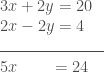
Using elimination works because we have two different equations, but we add them together, like so:

3x + 2y = 20\\2x-2y=4\\ \line(1,0){75}\\5x\hspace{24 pt}=24

But the same thing is true when we normally solve a linear equation. It’s just that one of the equations is generated using the reflexive property.

-12 + 3x = 20\\+12 \hspace{24 pt}=+12\\ \line(1,0){75}\\\indent\indent3x=32

So actually a lot of things about solving equations become clear when I use elimination, which is why I try to introduce those ideas earlier. The goal here is that if we always have two equations that we are adding together (or subtracting, or dividing), then we can eliminate those mistakes where students add the same quantity twice on the same side.

(Basically, the additive property of equality is often formulated as a = b, therefore a + c = b + c. But I think it’s better formulated as a = b, and c = d, therefore a + c = b + d. And sometimes we use c=c instead of c=d.)

But it’d be great if they were introduced even earlier than when I do it – such as in middle school. Diving deep into the properties of equality, along with rate/ratio/proportion, are probably the two most important things for preparing for algebra.

\line(1,0){400}

While we’re talking about elimination, I want to bring up how it’s actually used. Today my kids were working on my Potato 3-Act problem. When solving that problem, you create the following system of equations:

2b+5r=\$2.83

2b+3r=\$1.97

So we solved by subtracting the two equations, giving r = $0.43 (the price of one red potato). Normally, at this point in the process, to solve for b we would use substitution, something like this:

2b + 3(\$0.43)=\$1.97

2b + \$1.29=\$1.97

And then you’d solve from there. But I realized that that’s not strictly necessary. Instead, we talked about what 3 red potatoes are worth, and wrote that as an equation, too. So now we had 2 equations, again, and we could use elimination.

2b+3r=\$1.97\\\indent3r=\$1.29\\\line(1,0){75}\\2b\hspace{24 pt}=\$0.68

No substitution necessary.


ETA: Additional examples of solving linear equations using elimination, at the request of Anna Hester:

CAM00486 CAM00485 CAM00484

What’s a routine?

At #TMC14, I made the following tweet,

Screen shot 2014-08-22 at 10.44.14 PMwhile I was in a session about warm-ups as review. I was reminded of what Jessica posted about her warm-ups, and how she does something different each day of the week.

I was thinking of doing something similar, but I also wanted to include things like Counting Circles. But…I’m having trouble with the disparity. Something like Counting Circles is very different from Estimation180 which is very different from a Throwback Thursday review problem. How can we get used to the norms of a counting circle if we only do it once a week?

I could just commit to one of these things, but I feel they are all important, so I didn’t know what to do. But now I had the thought…what if I did these routines but, instead of once a week, I did them for, saying, a marking period, then switched to another?

This could work because many of the routines match up with certain units – Counting Circles would be very helpful for linear functions, while Visual Patterns would be useful for functions in general (or perhaps for when we do quadratics). Does this sound like a good idea?

Have you ever listened to Pandora and wondered what method they used to determine what songs to play for you? I did and remember writing a research paper about it back in grad school.

Pandora makes use of something called the Music Genome Project. Professional musicians will actually listen to every song in their database and tag all of the songs along different dimensions – timbre of the instruments, vocal type, volume, bpm, etc. Each song then gets a vector associated with it where each dimension is one of those categories.

Then, when you put in a seed song, Pandora will calculate the closest songs to your seed, basically using the distance formula in hundreds of dimensions. (There’s some weighting and tweaking, of course, but that’s the core premise.)

At the Sunday My Favorites session of TMC14, Bob Lochel and Megan Schmidt show us how to find our closest buddies by filling out a survey about what movies they like. Then they calculated the correlation coefficient and the people who correlated the most were the best friends of the pair.

On Saturday, I was talking with someone (I think it was Matt Baker) about how to help people get into our community. He mentioned that while there are a lot of good ideas out there, the ideas that resonate the most with him are the ones that comes from they people he most identified with – whose teaching style was most like his. I had the idea that we could somehow make a survey that a new person could fill out and it would give them a personalized output of Twitter accounts and blogs to follow – a somewhat advanced version of the category lists we made here during TMC12.

I want to make this, but I need help. What are the dimensions that we should ask about? What are important aspects of your teacher identity, and what are some of the things that make you feel on the same wavelength as another teacher in the MTBoS? Please let me know so I can start compiling these dimensions and building this.

(Also, if there is anyone more skilled in programming who is willing to help me, ping me.)

TMC14

I’m on the plane on my way back from Twitter Math Camp ’14, and it was, as it was the last two years, an amazing experience.

I’m trying to process everything – of course, a lot of that is looking through all of the resources I saw, which I can’t do on the plane. More of it is writing blog posts about specific things I want to talk about – those will come later.

But i want to write about, perhaps, not #whyMTBoS but #whyTMC. Maybe a few short vignettes:

– In my algebra morning session, we had a workshop where we created assessments/tasks for certain units (you can find those here) – when I pulled up the exam I wrote for functions last year, one person told me we could just use that as a product, they liked it so much. We didn’t – we made something even better than what I made myself.

– After Steve Leinwald’s keynote on Thursday full of spit and fire, I felt really energized, even though I had been tired just before.

– Thursday night a small group of people going to get BBQ snowballed to about 30 people, and no one was bothered by that – everyone was welcomed. The restaurant was super accomodating and even made a separate check for everyone (a theme during the trip) – though that wasn’t necessary, as the wonderful Jason covered all of those bills.

– On Friday Dan expanded all of our minds about the size of our community and how much more there is out here.

– Throughout the conference different people gave us “sneak peeks” on things they were working on, and we could get to see inside the process of making these cool things.

– On Friday night I was up until 230 having deep conversations and really connecting with people. It made me realize how much I’m affected by the negativity and positivity of others – TMC is so positive, my coworkers are sometimes negative, and I need to not accept it but work to change it, if I don’t want to absorb all that negativity.

– On Saturday I saw Mary Bourassa and Alex Overwijk present their spiraled task-based curriculum. I was amazed and wanted to be there, but I was scared about it. Alex said in the session that “When you try to make small incremental changes, it is so easy for the kids to pull you back down and flip back to what you’ve always done. But if you start with the huge change, even when you slide, some of that change remains.” I thought of people like Lisa who are worried about changing and how maybe those words might help.

– The last thing I did on Saturday was to take place in a body-scale number line exploration led by Max Ray and Malke Rosenfield I got to share my insights and experiences with number lines that others may not have had, I got to see it in other people’s eyes, and I experienced new revelations and am excited to dive into them deeply.

This last things leads me to my final thought. During our work with the number line, Malke constantly pushed back – what are we actually gaining my working with the number line using our bodies, instead of just paper and pen? It pushed us to keep developing new insights and sharing them until one moment I heard Malke make an involuntary gasp – there was a moment of breakthrough, one we never would have had without using our bodies.

So you could ask the same question – what do we gain from using our bodies to meet in person at TMC, instead of just writing to each other as we do in the MTBoS? There’s this energy that infuses all of it that you can’t feel remotely, these deep experiences and quiet moments that can’t be done publicly, this sense of connection that makes all the other work we do more powerful.

There’s a reason I am always following so many more people after TMC – I need that connection and once it’s there, I want to keep it going and make it grow. And even as there are more and more old friends I want to see at TMC and so little time, I still somehow make so many new friends. And that’s why.

Productive? Failure

The next chapter of Reality Is Broken starts off with this question: “No one likes to fail. So how is it that gamers can spend 80 percent of the time failing, and still love what they are doing?”

It’s an interesting question.  Many games, such as Demon’s Souls, as known for their fiendish difficulty – as that is often portrayed as a positive aspect, not a negative. Dr. McGonigal notes that in one bit of research from the M.I.N.D. Lab, the researchers found that players felt happy when they failed at playing Super Monkey Ball 2 – more so than even when they succeeded. Why would that be?

One thing they noted was that the failure itself was a kind of reward – when the players failed, the scene the played was usually funny. More importantly, though, players knew that their failure was a result of their own actions and symbolic of their own agency – they drove the ball off the course. Because everything was in their control, the players were motivated to give it “just one more try.” I know I’ve certainly had that feeling before – intense concentration on a hard task and then, “Aaaaah!” Coming just short of success, I immediately leap back into trying again.

Of course, that’s not true of every game. There are many games where failing makes me want to give up. There’s two main elements that differentiate the two – agency and hope. If failure is random and feels out of our control, it is demotivating. (Think Mario Kart when you get slammed with a slew of items right before the finish, when you were in 1st place.) But if we see that the failure was fully within our control – and another attempt shows us getting ever so slightly closer to that goal – then the hope of success can feel even better than success itself.

This feeds off of the idea that learning is inherently interesting. When you win at a game, you are successful – but then what do you do? But when you fail, you are learning how to play the game well, and that learning and the act of mastering the game’s mechanics is what is so motivating.

As math teachers, we often talk about Productive Failure – the idea that our students learn better by attempting something themselves, failing, and correcting, than by simply being instructed on the correct method ahead of time. The theory of this is matched by many of our observations (and by research) – but we often have the problem of people being shut down by failure. It ties in a lot with math anxiety and attitudes about math – if I think I am bad at math and that’s just the way it is, failure if just reinforcing that idea, not motivating me to try again.

In the book, Dr. McGonigal doesn’t talk about productive failure – she talks about fun failure. The key factors she mentions – a sense of agency and hope – are what’s so often missing from our math-phobic students. Math feels out of their control – and so any success is accidental, and any failure is predestined.

What can we do? Our main goal is to be a guide – because failure is productive for learning, we want to help the student overcome it themselves. And that means doing what we can to provide that sense of agency and hope.

For a gaming example, Rob was playing a game and was struggling against a particularly frustrating boss (Moldorm from A Link to the Past) – a single false move in the fight would knock him out of the room and he would have to start the whole thing over. Even though he had been having a lot of the fun with the game, this single frustrating experience was enough to make him consider giving up on the game altogether. I knew he would enjoy the rest of the game and wanted him to keep playing, so I stepped into action. One thing I did was provide him with the locations of some fairies – while they would not directly help him defeat the boss, they would lower the frustration of dying and having to repeat the dungeon. The second thing I did was just to watch his attempts.

After a while, when he was ready to give up, he said something to the effect of how he had tried over and over again but had gotten nowhere. But I told him that was not true – when he first tried, he would maybe get 1 hit, or perhaps none, off on the boss before being knocked off the ledge. But in later attempts, he was getting around 4 or 5. He had greatly improved in his tries – and so if he kept trying, he might succeeded. He conceded that might be true, but still took a break, frustrated and tired.

The next morning, I looked up some info and found that the boss only required 6 hits to be defeated – so that meant that in the last attempt, Rob had been very close to success! When I told him that, he was filled with hope (and well-rested), and upon loading up the game, proceeded to beat the boss on the first attempt of the day.

Our goal is productive failure, not frustration. When we are following the mantra of “be less helpful,” I think we still need to help in a different way – help dispel frustration and provide the tools for success, even if we are not telling the students the path they need to take. Be less helpful seems like a hands-off policy – but it’s quite the opposite; we need to devote even more attention to our students when we are letting them struggle on their own.
Satisfying Work

Earlier this year, Justin Aion wrote a post about how he tried to make his class boring on purpose by just giving silent independent work, to make them appreciate what he was normally doing, and how it backfired gloriously. At first, he wondered what he can do to break them of this preference for what they are used to and what is easy. About two months after that, we wrote about a similar situation, and wondered the following:

I’m beginning to wonder if my attempts to give them more engaging lessons and activities have burned them out.  I’m not giving up on the more involved activities.  I want them to be better at problem solving, but I think by trying to do it every day, I haven’t done a good job of meeting them where they are and helping to be where I want them to be.

As I read more of Reality Is Broken, though, I encountered an alternative explanation. In the book, Jane McGonigal wonders why so many people play games like World of Warcraft and other such MMORPGs where the gameplay is not, shall we say, the most thrilling. Many people find enjoyment in what other players call “grinding,” playing with the sole purpose of leveling up. In general, it’s a lot of work to level up in the game to get to what is considered the “good” part of the game, raiding in the end game.

But it’s work that people enjoy doing, and that’s because it is satisfying work. Dr. McGonigal defines satisfying work as work that has a clear goal and actionable next steps. She then goes on to say –

What if we have a clear goal, but we aren’t sure how to go about achieving it? Then it’s not work – it’s a problem. Now, there’s nothing wrong with having interesting problems to solve; it can be quite engaging. But it doesn’t necessarily lead to satisfaction. In the absence of actionable steps, our motivation to solve a problem might not be enough to make real progress. Well-designed work, on the other hand, leaves no doubt that progress will be made. There is a guarantee of productivity built in, and that’s what makes it so appealing.

Well, now, doesn’t that sound familiar? It kinda hit me in the gut when I read it. As math teachers, we are often preaching that we are trying to teach “problem solving” skills – but the thing is, people don’t like solving problems! It made make think of those poor grad students who are working towards their PhD – grad school burnout is a big issue, and one of the major contributing factors is that grad students are trying to solve problems, and so often feel like they are getting nowhere. Their work is inherently unsatisfying, which makes those that can finish a rare breed.

Our students, of course, are not all made of such stuff. But I’m not at all suggesting we drop our attempts at teaching problem solving and only give straight-forward work. Rather, I feel like we need to find a balance – for the past year, as I embraced a Problem-Based Curriculum, I may have pushed too far in the problem-solving direction, and found my students yearning for straight-forward worksheets, just as Justin did. But they also enjoyed tackling these problems, especially when they solved them, and I do think they had more independence and problem-solving skills by the end of the year.

So what should I do? Dr. McGonigal ends the chapter by noting that even high-powered CEOs take short breaks to play computer games like Solitaire or Bejeweled during the work day – it makes them less stressed and feel more productive, even if it doesn’t directly relate to what they are doing. (This reminds me of the recess debate in elementary school.) So even as I go forward with my problem-solving curriculum, I need to weave in more concrete work, and everyone will be more satisfied by it.