Trying to find math inside everything else

Slope

At Twitter Math Camp, Karim Kai Ani and I debated for a bit on what slope really means, and how best to teach it. Since slope is the upcoming topic for this week, I thought it would be good to reflect back on our arguments.

Karim argued that slope should always have units, and that removing the units created a contextless concept that made it difficult for students to grasp. I argued that, while that is true and units are useful in many cases, the concept of slope as a unitless ratio is an important concept, digging deep into what it means to be a ratio, so that a line with a slope of 2 could be 2 miles up, 1 mile over, or 2 cm up, 1 cm over, it didn’t matter. The differences are exemplified in two of our lessons: my “Steepest Stairs and Wacky Measurements” (soon to be updated) and his “iCost.”

(c) Mathalicious 2011

I mentioned this debate at dinner last night to my boyfriend, who is a math PhD candidate. He said what we were talking about reminded him of the difference between a rate and a ratio. He said that a ratio was a “quotient of quantities of the same unit” and a rate was a “quotient of quantities of differing units.” Further clarification was that a ratio’s units had to be the same dimension, while a rates did not.

So then, really, the question becomes, is slope a rate or a ratio?

It’s both. Karim argued for rate but that’s really just the algebraic or calculus-based definition of slope. My argument for ratio was a geometric one. Both are important, and are related, which is why they go by the same name.

But I wonder if it would be easier if the concepts had a different word. What if we only used “grade” or “gradient” for the geometric definition, and slope for the algebraic one? Or slope for the geometric, and just rate for the algebraic? The problem is they are so intertwined. For which there is only one person to blame.

Damn you Descartes!

5:30 – Alarm goes off. That is not happening.

6:20-7:00 – Wake up, shower, pack up, go. I decide to take the subway to school today, instead of biking, because I have too much to do to lose those 40 minutes.

7:00-7:07 – Walk to subway. Catch up on Twitter while walking.

7:07-7:40 – Subway to work. My train still isn’t running to my job because of Sandy, so I have to transfer. While I’m riding, I grade math labs. (Despite grading for several hours over the weekend, I didn’t finish.) I don’t finish by the time we arrive.

7:40-7:50 – Walk to work plus breakfast.

7:50-8:55 – Enter my classroom to discover 1) it’s a sauna, and 2) that the wi-fi is down in my classroom (and only my room). This is awesome, because I have a computer based lesson today. Also, the person in charge of the laptop cart doesn’t get in until later. Luckily, I am technologically proficient, so I spent this time creating an ad-hoc network and setting it up on the ancient Dell laptops (after tracking down the AP to unlock the tech room) so the students could get and give files. I also spent some of this time inputting the grading I did into the gradebook.

8:55-9:46 – Start of contracted time. Embassy class, which is our special version of advisory. We finally have a curriculum to follow, so I need to modify for my students.

9:46-11:30 – Math class, students brought in survey results to analyze. So I pass out laptops and walk them through the analysis excel file I made yesterday. Minor tech problems, so most of my time is spent fixing those and running around teaching the quirks of excel while the students do data entry and create conclusions. I explain the requirements for their project, stop a student from hacking into one of the computers, and general maintenance. We also have problems getting the files back to me, because they don’t follow directions.

11:30-11:50 – Putting away the laptops and making sure all files are saved.

11:50-12:20 – Run and get lunch, while planning the next lesson with my co-teacher. When we get back, we meet with a third teacher about two students who need resource room (since I’m the programmer, and can change it.)

12:20-1:20 – Student lunch period, so some kids come up to my classroom to work on their projects. I continue setting up laptops (since my afternoon class is larger). At 12:45, the wi-fi returns, so I switch the computers back to that instead of the ad-hoc network.

1:20-2:00 – First opportunity to use the bathroom. I run to the programming office to change a schedule. Then I go back to grading, or, more accurately, data entry.

2:05-3:45 – Another math class, this one with 4 languages spoken and no ESL support. The tech problems seem even worse at first, but balance out in the end. Unlike my morning class, which is very industrious, several pairs in this class did not come prepared and needed to do alternate work/catch up work. End of contracted time.

3:45-3:55 – I bring some of my students to the Teacher Work Room to make copies of their surveys for them, so they can catch up on their project. I get a cookie from a co-worker.

3:55-4:15 – Break and decompress, including short chats with coworkers in the hall.

4:15-4:45 – Back on the grading grind.

4:45-5:30 – I plan with my co-teacher on Thursday’s lesson, which we won’t have time to do tomorrow because of other meetings. (I’ll have a Math for America meeting in the evening.) We adjusted my Lying with Statistics Stations because they were confusing and ill-timed last year, opting this year for a looser flow. I finish grading while I do this.

5:30-5:35 – I write an e-mail to a parent because her son is way behind on the project.

5:45-6:20 – Time to head home. I grab a hot dog on the way. True to my pledge to not bring work home (even though I broke it over the weekend), I play my 3DS on the subway ride home. I almost fall asleep on the train, and my game freezes, losing all progress.

6:20-6:35 – I stop at the supermarket on the way home, to get some stuff for dinner and breakfast.

6:45-7 – I forgot the shallot. So I change my plans, because I don’t want to go back out. It’s a tough decision, I seriously thought about it for 5 minutes because I wanted the shallot but was so tired. I make more bachelor-y food.

7-7:45 – Watch Daily Show/Colbert while catching up on tweets/blogs.

8-9 – Leisure Time

9-9:20 – I try to go into the Global Math Department meeting about homework, but the audio is too messed up, so I duck out early. Now I’m going to lay down and read the news/play with my DS probably until around 11, when I’ll hit the sack.

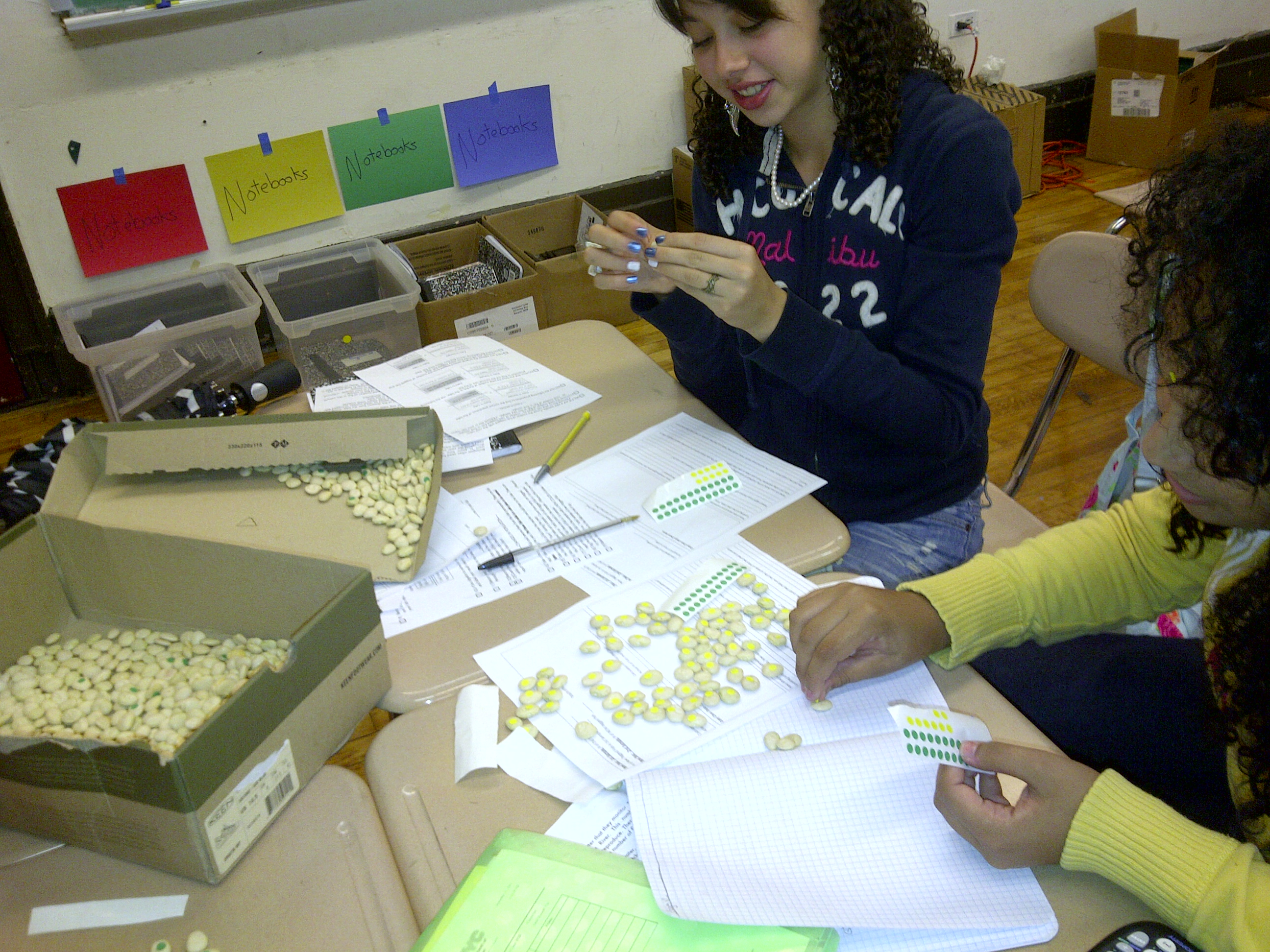
One of the labs I did back at Banana Kelly was a fish population estimation lab. You may have seen something like it before elsewhere. The idea is to explore proportions and the mark and recapture technique of population estimation.

The gist is this: students have “lakes” filled with “fish” (boxes filled with lima beans). They use a sampling tool to collect a sample of fish and tag them all with stickers. Then they release the fish, mix them up, re-sample, and use proportions to determine the population of the lake. They do it a few times and average, then they count the actual population to see how close they were.

But I was at a BBQ the week before I did this lesson, and I was talking to my friend Rachel, who is a marine biologist. I mentioned the lab, and we talked about what they use tags for. One thing is to track populations over time, so they can determine the changes in populations since each different year has a different tag. I wondered if I could change the lab to include that.

(Rachel also dug up the video that I had students watch the night before. I’ve decide to have a little “flip” in my classroom by having students watch a video before we do a lab and start asking questions, which I can then address in the next class.)
So I thought about how I could change it. It actually took a lot of thinking, jotting things down on the white board, consulting with the living environment teacher to make sure I was on the right track. But I extended it, so now they would do at least 5 different calculations in the process, instead of spending all that time on just one proportion.

Now, students do the first part the same as before. Then, a random sample of fish “die” and are removed from the lake and put side, and a bunch of new fish are “born” by taking them from the bag of beans I had. Then when they took a sample of the new lake, they tagged the new fish (not already tagged) with a different color sticker. Now they had data from both years and could figure out the new population, and the difference from the old population.

Not every group got to the extension, but I think it improved the task overall.

The Materials

Fish Lab Instructions (formatted to fit in an INB)

The Lab Report

My Classroom

Since I wasn’t in there today, why not make a long overdue blog post about my classroom? It was finally in a presentable condition thanks to Parent Teacher conferences.

@mgolding and @mseiler said this summer when they were setting up their rooms that students know they are entering a math classroom, so why not let them know who you are. So I decided to embrace that.

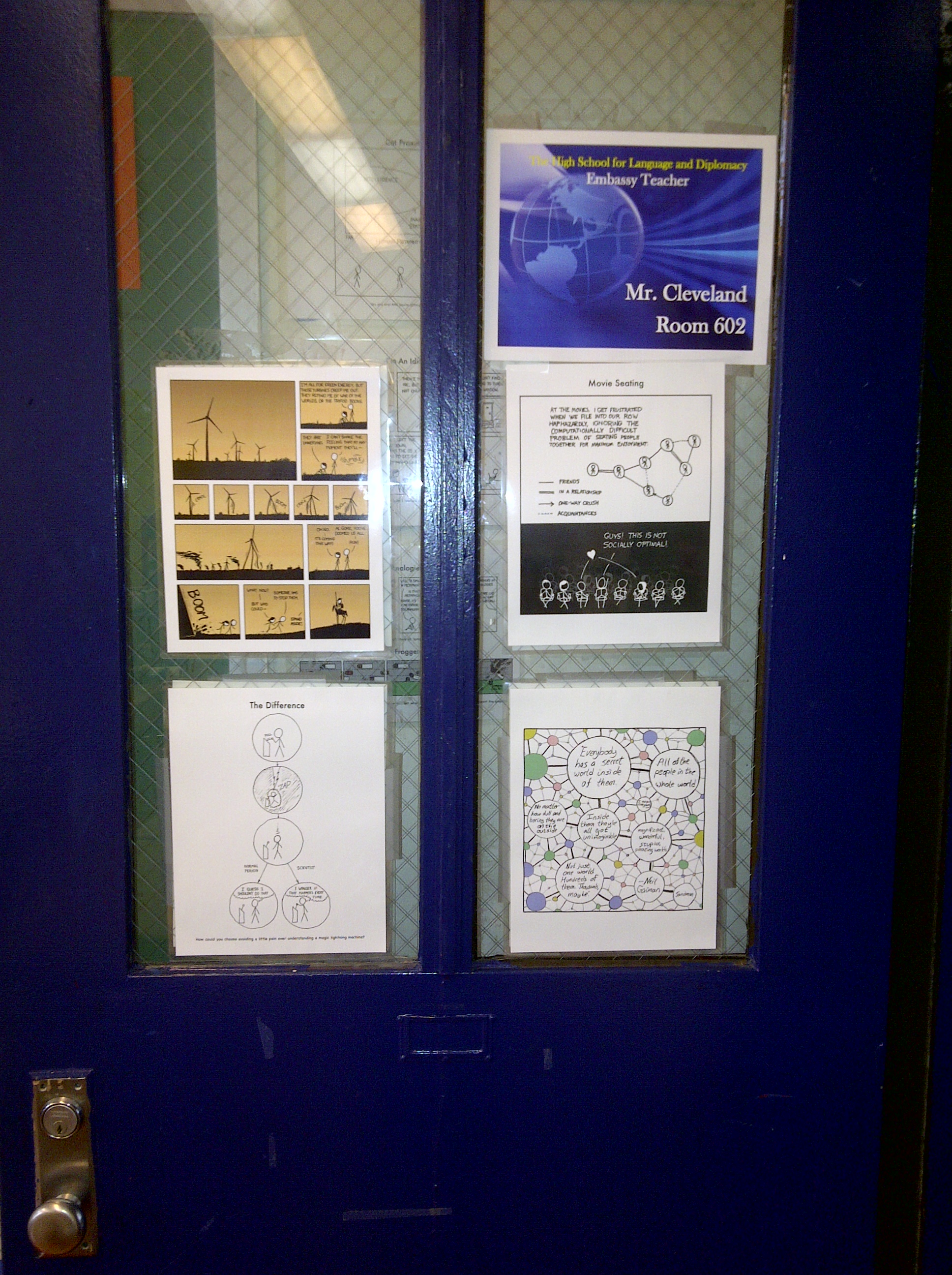
 Enter my room via this door, with some of the several XKCD posters that I made earlier this year. I have 40 different posters hanging around the room.


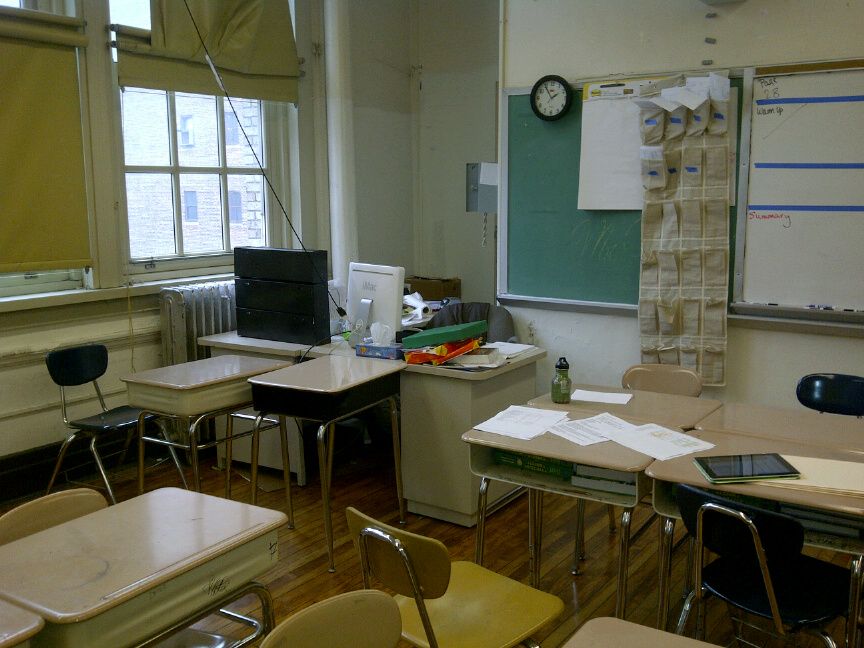
There’s my desk in the corner. I have a lovely little alcove behind it, and a shoe organizer that I use to keep quizzes for different Learning Goals.

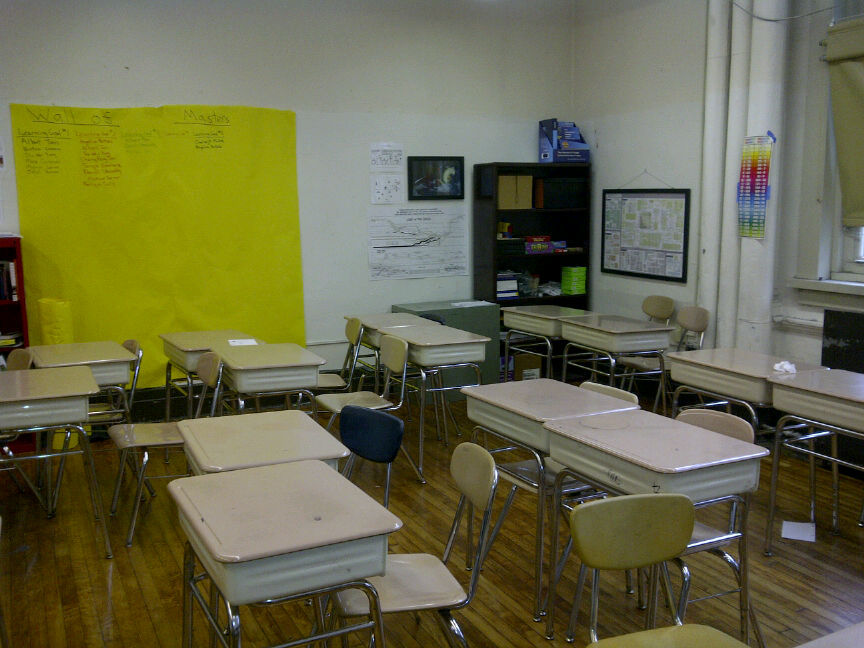
There’s the other side of the room. I’ve got two of the actual giant XKCD posters from the website (Money and Movie Timelines) as well as a Wind Waker poster I won from a Nintendo Store trivia content.


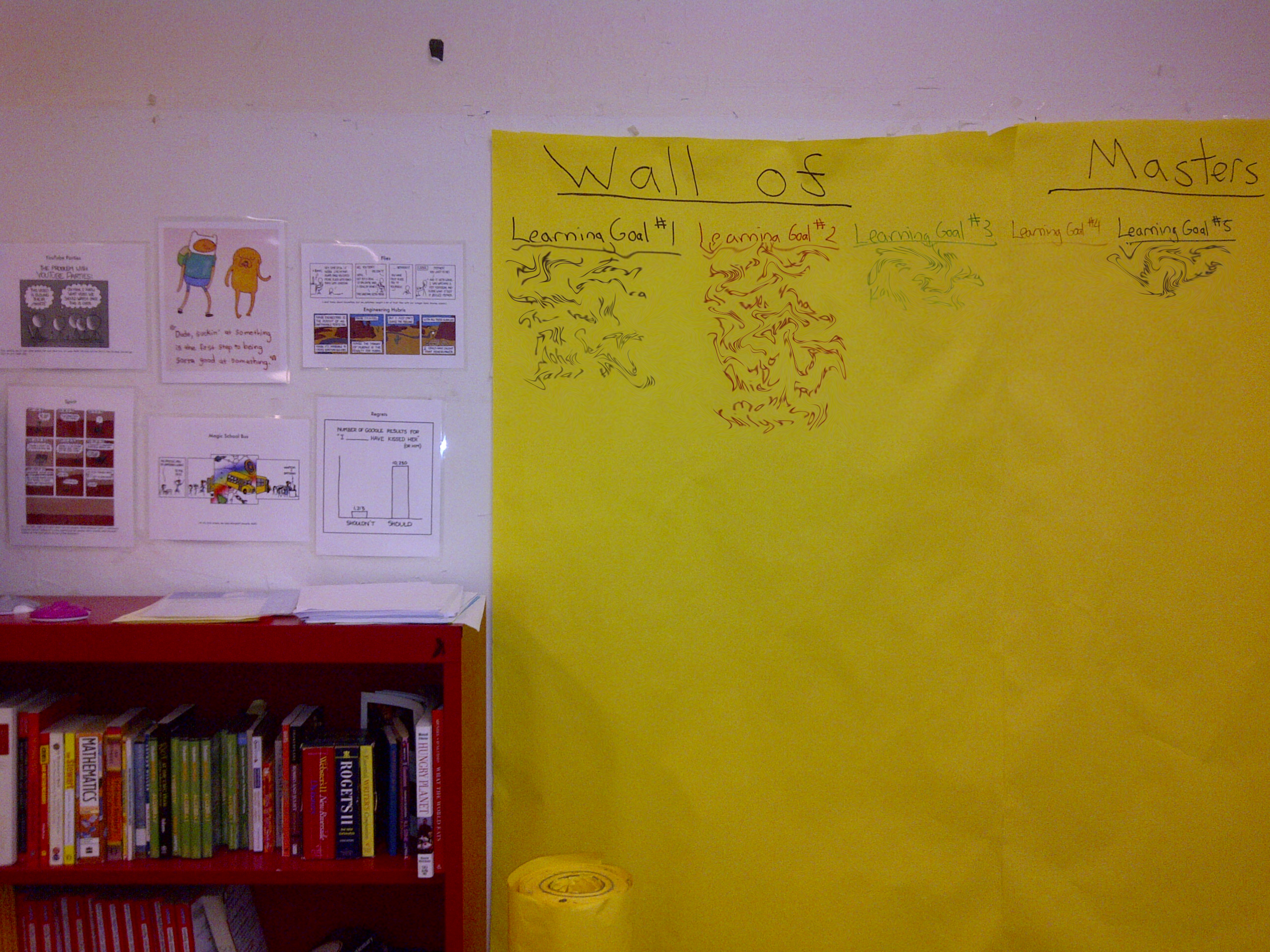
The yellow paper is the Wall of Masters, to list anyone who has achieved mastery on a particular learning goal, as opposed to merely proficient. (I also have this Adventure Time poster, which I adore.)

 My front white board, with my projector on the milk crate.

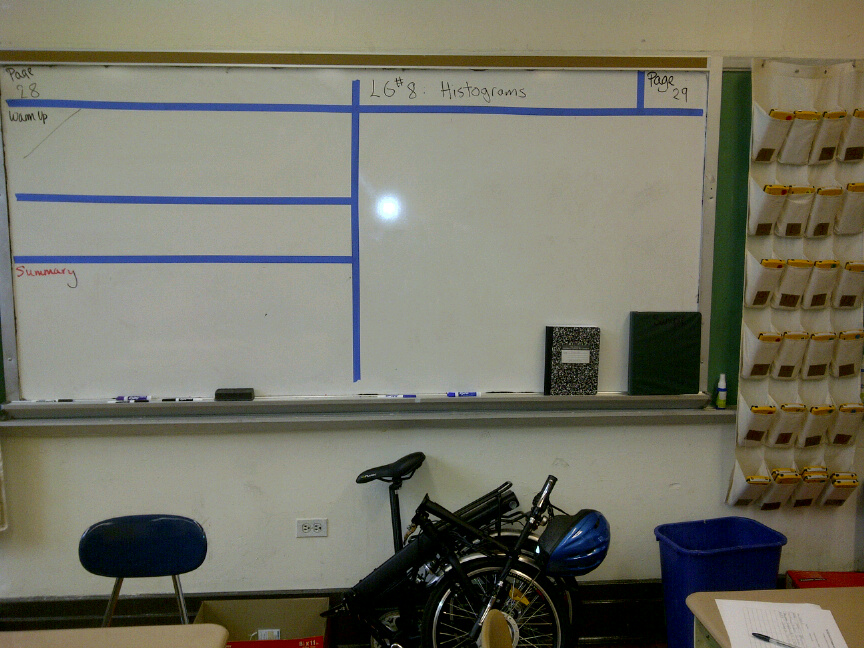
This is my favorite. My co-teacher Sarah came up with the idea of using my side whiteboard as a model version of the Interactive Notebook, showing exactly what the students should have, with the left-hand page and the right-hand page. (I also use a shoe organizer for the calculators.)


Math Labs

When I student taught at Banana Kelly High School, the 9th grade math and science teachers there used a wonderful curriculum called Thinking Math and Science, which they had been developing for about 10 years. Those classes were integrated with math and science together, and so very often the classes were doing labs. But the labs weren’t just science, they just as often had math labs. And I wanted to bring that idea into my own classroom.

I had decided last year that I wanted to introduce new topics with labs, so the students could explore an idea before getting the mathematical language that does with it. When I sat down over the summer with my co-teacher Sarah, we created a template for our math lab reports, taking the steps of the scientific method and putting a mathematical twist on it. Here’s an example of it, using the first lab we did, Pythagorean Theorem in 3D.


The beginning is much the same, asking the driving question that we want to answer. Then, instead of background research, since I want to work with a low barrier of entry and move up, we have “What do you notice?” (thanks @maxmathforum).

The next step is to construct a hypothesis. This is often still relevant with math, of course, and may go unchanged for some labs. But I thought another way we could look at a hypothesis is an estimate, since both are educated guesses, right? I set it up using Dan Meyer’s suggestion of “too low, too high, actual guess,” which gives us nice bounds, and I think this does it visually as well. Although not completely, since some students haven’t gotten it, so I wonder if I can improve on that. (I have two versions in the file: the arrow one is the one I used, and the dotted line one is a new idea I have, I’ll try it soon.)

Then we do our calculations, which is our experiment, they go hand in hand. And finally we analyze what we did with discussion questions.

I’m don’t think the format/template is perfect, but I think it’s a start.

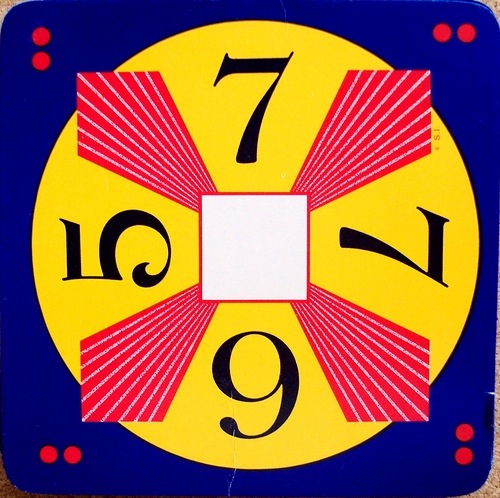
So I was in my classroom last night with my boyfriend, waiting for his phone to charge before we went to dinner. Since we had some time, we played some of the math games I have in my room. (He’s a math PhD student, so he was all for it.) We played Set, of course, and then played a bit of 24. We idly wondered if it were possible to get 24 with any combination of 4 digits. So I looked at the box, and saw it came with 192 possible configurations. Well, if we determined how many possibilities there were (maybe there were 192), that might give us an idea of the feasibility.

20121020-162604.jpg

So we tried to calculate how many configurations there were. Shouldn’t be too hard, right? Well, it kinda is, especially when you’re not already familiar with combinations with replacement. So we started using what we did know of combinations, but were stuck because we could use the same number multiple times, which made it trickier. Otherwise it would just be 9 C 4.

So, unsure how to solve, we tried to make a simpler case. What if we only had 2 digits to choose from, not 9? There’s there’s 5 possibilities. (1111, 1112, 1122, 1222, 2222.) And with 3 digits, there’s 15 (1111, 1112, 1113, 1122, 1123, 1133, 1222, 1223, 1233, 1333, 2223, 2233, 2333, 3333). We got a lot of fruitful thinking out of this, finding patterns, but didn’t really get closer to the answer. (Four digits had 35, btw. But we didn’t want to list all the ones for 5 digits and beyond.)

At this point it was time to go to dinner, so we put the whiteboard aside. But that couldn’t stop us thinking and talking about it, which we did as we walked to the restaurant and waited for out table, when we finally had a breakthrough.

Instead of trying to figure out the pattern with fewer digits but the same number of slots, let’s try to iterate up with the same number of digits, but using increasing number of slots. Let me explain, using 4 possible digits.

If we only have 1 number slot on the card, there are only 4 possibilities. (1, 2, 3, 4.) When we increase to 2 slots, we could start by putting a 1 in front of each of those possibilities. (11, 12, 13, 14). But, because order doesn’t matter, we can’t also put 2 in front of everything, because 21 is the same as 22. So we don’t use the one, and get 22, 23, 24. Same logic for 3 gives us 33, 34, and then finally 44.

This gives us a total of 10 possibilities. (4 + 3 + 2 + 1.) Now let’s think about 3 slots. In the same way, we can add a 1 in front of everything we’ve done so far. So for 3 digit possibilities there are 10 that start 1. Since we have to eliminate the four that two-digit configurations that have 1, there are 6 remaining, so that’s how many will start with 2. (3 + 2 + 1). Then three will start with 3. (2 + 1) And 1 will start with 4.

The process here is to add up all of what we had before, chopping off the start, to get the total number of new possibilities. So now, with 3 slots, we have 20 possibilities. (10 + 6 + 3 + 1.) To get for 4 slots, we use the same process: 20 start with 1, 10 start with 2 (6 + 3 + 1), 4 start with 3 (3 + 1), and 1 starts with 4, for a total of 35. Which is what we found before.

(If there were 5 slots, it would be 35 + 15 + 5 + 1, or 56.)

I don’t know of this recursive method of solving for combinations with replacements has been done before. I’m sure it is, but I haven’t found it in a very short google search. If someone knows of it, please let me know. But I wanted to share what I did. You can tell I love math, and so does my boyfriend, because we got completely distracted from a board game by solving a problem. He told me I’d make a good mathematician, because of how I tackled the problem. That may be true.

Back in 1788, James Madison wrote up 20 proposed articles to amend to the constitution. 12 of those were approved by Congress. The latter 10 were ratified by the states and became the Bill of Rights. The second was ratified over 200 years later and became the 27th Amendment. But Article the First was never ratified. Here’s what it said (corrected):

After the first enumeration required by the first article of the Constitution, there shall be one Representative for every thirty thousand, until the number shall amount to one hundred, after which the proportion shall be so regulated by Congress, that there shall be not less than one hundred Representatives, nor less than one Representative for every forty thousand persons, until the number of Representatives shall amount to two hundred; after which the proportion shall be so regulated by Congress, that there shall not be less than two hundred Representatives, nor less than one Representative for every fifty thousand persons.

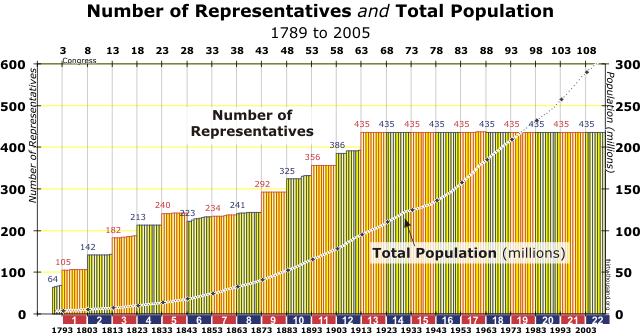
Back in 1911, Congress froze its size at 435 members of the House of Representatives, and so the amount of people representative by each representative has grown extraordinarily. (Note that this is before we even had all the states (only 46), so the Reps continued to spread thinner.) The average district size now is about 700,000 people, which is a lot of people and opinions to accurately represent. Of course, if we followed Article the First to the letter, we would now have about 6300 representatives, which seems like a lot.

Source: thirty-thousand.org

But what if the article is a formula, not meant to stop at districts of 50000? The way it is written, it seems like every 100 Representatives would prompt an increase in the size cap of districts by 10000. So how could we model that to determine how many reps we need?

Well, in general, the population divided by the number of people in the average district should give us the number of reps. So if P = U.S. Population, R = number of representatives, and D = max size of district, then R=\frac{P}{D}.

To represent Article the First, since 0-100 reps have 30000 each, 100-200 have 40000 each, 200-300 have 50000, etc, it seems like we could say R=\frac{D-20000}{100} to give a rough estimate. (Anyone have anything more precise?) So we can substitute, as well as plugging in 308,745,000 for P (according to the 2010 census), to get

\frac{D-20000}{100}=\frac{308745000}{D}, and solving for D gets us approximately 186000 people per district. Plug in for D to get 1660 representatives. (Exact amount varies by the precise district make-up.) That seems quite possible, not even four times as many as we have now.

Follow-up questions to consider:

  • Is 700000 people too many to represent? Is 190000? What would be an ideal amount?
  • How would representing 30000 people in 1790 be different from representing that many people now? How does technology change how effectively we can represent people?
  • How could we accommodate having 1700 representatives? What changes would need to be made?
  • What other representative systems could you come up with? How would it work?
  • How would having more representatives change our current representation?
  • How are representatives apportioned in other countries? What methods do they use for determining the size?

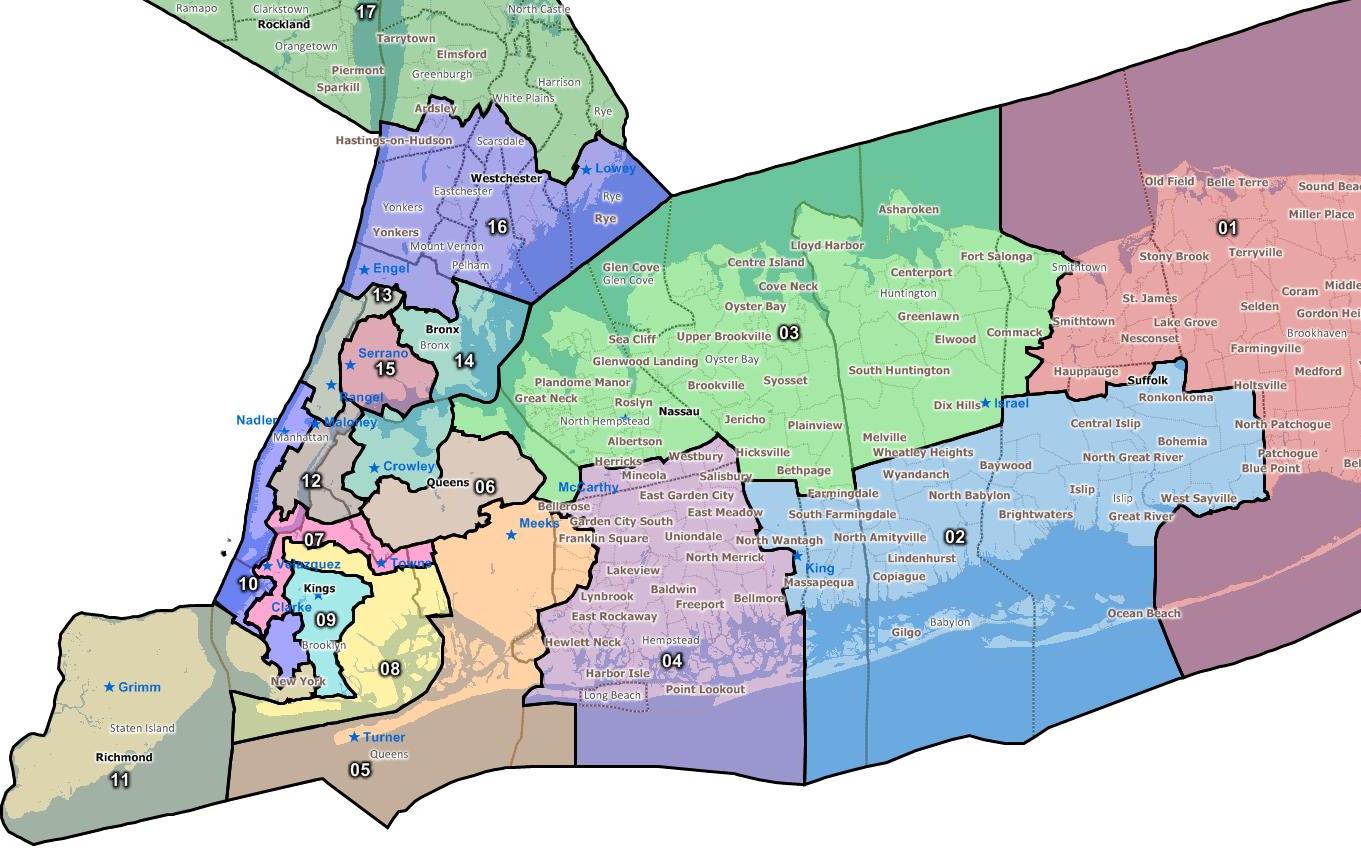
For that last one, I think it’s interesting to just look at the Congressional districts of New York City as an example.

I live in District 12. It’s easy to see that the district is half in Manhattan, in the affluent Upper East Side, and half in Queens, in Astoria/Sunnyside/Long Island City. I think it would be very easy to believe that the desires of the people on the UES don’t always line up with the desires of the Queens constituents. Yet we are represented by just one person. However, with a smaller district, they can be divvied up more logically. All of Astoria has 166,000 people, which is almost a full district, and it would be nice to have a district that is clearly where you live.

Since US History doesn’t usually line up with Algebra, this idea might be hard to implement in math. Though it could work fine in Algebra 2. And it might work even better as a history lesson with a bit of math, instead of a math lesson with a bit of history? I dunno. But I think it can definitely be food for thought for any class.

So, of course, Andrew Hacker’s article “Is Algebra Necessary?” had caused quite the stir, and the obvious answer to that question was “Yes, algebra is necessary.” But the article makes you think if all of what we learn of algebra is necessary. And I think it isn’t, but that comes from thinking about what high school is for.

Do we expect that, when a student gets to college, they can skip the lower levels of Biology because they took bio in high school? No, of course not. (Excepting AP courses, of course.) So what is our goal for learning biology in high school? It’s to provide a general foundation of the subject, that most people should know, and it prepares you for a college level course or major in Biology.

Really, all of what we learn in high school is designed to broaden our horizons, to provide experiences and content we wouldn’t see otherwise, and to provide a baseline of knowledge that we feel everyone should have.

I remember reading from someone, though I don’t recall who, that they had struggled through Algebra 2 and Pre-Calculus, slogging along, and then when they got to Calculus a light turned on. “This was why we’ve been learning everything we’ve done in the past two years! It was all for this!” Even the wikipedia page on Pre-Calc says “…precalculus does not involve calculus, but explores topics that will be applied in calculus.” It’s putting the work before the motivating problem, again.

But now thinking about the normal course sequence for a student that is not advanced: Algebra –> Geometry –> Algebra 2 –> Pre-Calculus –> Graduated from High School, so no Calc! So these students will have two whole years of math without the payoff that shows why we do it.

And as teachers we know that you need to start with the motivating factor, not have it at the end. So why don’t we have calculus first, before those two? If we consider our goal in high school is to spread ideas people might not see otherwise, I think Calculus has a lot of important ideas people should see that would improve their lives. Optimization? The very idea of it can improve how you look at all the problems in your life. Related rates, limits, the idea of changing rates and local rates, the relationships between functions, these are all good ideas to be familiar with.

Can the students learn these things without having done Algebra 2/Pre-Calc? I think so. As Bowman Dickson says, “The hardest part of calculus is algebra.” So what if we taught it in a way that didn’t rely on that? We can get the ideas across without jumping into the nitty-gritty of a lot of it. Save that for AP level classes, or for college calc. What you take in college is more in depth that high school, so it should be the same here.

Now, there would certainly be some stuff from Algebra 2/Pre-Calc that we really need first. But why not have those in Algebra 1? I accidentally taught several things from Alg 2 when I taught Alg 1 my first year, because they seemed like natural extensions of what we were doing, and I didn’t know they weren’t required until I started planning for the next year. But also, consider this. If we made Probability & Statistics one of the main courses of the math sequence, I don’t have to teach it in Algebra 1. I spent about 7 weeks on those topics last year. That’s 7 weeks of Alg 2 content I could fold in, without worrying about reviewing old stuff because we just did it.

So then the new math sequence could be Statistics –> Geometry –> Algebra –> Calculus. (And I think that might fit well with the science sequence of Biology –> Earth Science –> Chemistry –> Physics.)
Thoughts?


So my first My Fav Friday is another website I learned about recently – Duolingo, for learning new languages.

You know those Captchas we all hate? Where you have to prove you are human? Comp Sci PhD Luis von Ahn noticed how much time people around the world spent filling those out and decided to put all the work to good use. So he invented ReCaptcha, which uses the deciphering power of all those humans to digitize scans of old books and newspapers. The scan is just a picture, but 100s of people say it’s a certain word, and now we know it is. A real good use of something we’re all doing anyway.
So now Luis von Ahn is working on Duolingo, which has the same idea. Lots of people want to learn new languages. And there’s lots of websites on the Internet that need to be translated. So why not combine them and have the people learn by translating those pages? (And other lessons.) And to make sure the translations are good, people can also see others’ translations and determine if they are good or not, and vote accordingly. So eventually the crowd will agree on the best translation of an article, without needing a professional translator or wasting anyone’s time, because we’re learning anyway.


Of course, the best way to learn a new language is to use it with people, and I have plenty of students and coworkers I intend to. I’m also just brushing up, because I did take 6 years of Spanish in school and remember a decent amount of it. But it’s good to improve my vocab and other things I forgot, and then I can talk to (some of) my students a little better.


(Only some, though. They don’t have Chinese on the site, which is the other major language of my school. They do have German and French, though. And also English for Spanish speakers.)

I also like the site because each lesson has you do 4 different things: translate something written to English, translate something to Spanish, listen to Spanish and then write it (in Spanish), and say something in Spanish.

At Twitter Math Camp I gave the following talk. The abstract from the program said:

When planning interdisciplinary projects, math teachers need to take the lead in order to create cohesive and authentic projects, and to ensure that the project doesn’t just become psuedocontext for their math goals. Uses two major interdisciplinary projects developed at my school as examples of how to bring all the subjects together, so math isn’t left out in the cold.

Here’s the talk:

Math Needs to Be the Spark from James Cleveland on Vimeo.

After that I opened to questions. The one that I remember was asked by @JamiDanielle: “How can you get other teachers who might not be on board for these types of projects to join in?” And I think this process is actually how. If you go to a teacher with an idea and just dump on them to figure out how to connect it to their class, it’s not going to end well. It’s easier and less work to just not take part. But if you go to them with an idea already half-formed of how they can implement it, it is much easier to build off of that idea and will make teachers more willing to work together.

The Projects

High Line Field Guide v5 – This is the High Line field guide project mentioned in the video, and first mentioned in this blog post, “The Start of the New Year.”

Intersession Project Requirements – It would be difficult to post everything we did in the Intersession project, but the overview from the video and this packet of requirements for the product should be useful. Anyone interested in more can ask.