Trying to find math inside everything else

Have you ever been to a carnival or amusement park and seen one of those people who will try to guess your weight, height, or age? If they get within a certain range of your weight, they win and keep your money. If they are wrong, you win and get a prize. I’ve occasionally wondered how they determine what their range is. This clip from Steve Martin’s The Jerk makes me wonder, instead, how they determine which prizes they can give away.

That’s the lead-in I give the students. Steve Martin can only give away that small section of prizes because he is a terrible guesser, so he often loses. If you worked for the carnival as a guesser, what can you give away?

I have the students go around and guess the weight and height of any 10 willing participants in the class. (Any student can turn down being guessed, so students had to ask first. Also, I think my students were always worried about insulting someone, because they almost always under guessed. Also, many of your students may not know how much they weigh, so doing this lesson near when they have a fitness test and get weighed in gym is a good idea.) They record their guess, the actual amount, and the difference between the two.

Then, in groups, they try to determine a metric for figuring out who is the best guesser. We talk about how being 10 pounds off for a super thin person, child, or baby is much worse than being 10 pounds off for a very large person. We also talk about how being over or under doesn’t really change how good the guess is. After I push back on their metrics, some students pick up on the proportionality of the guess to the real amount, and lead us into relative error.

I somewhat drop the conceit at that point, mostly because I’m not sure of the best way to finish it off. But I like the start, and it’s a very natural intro to relative error, and the relative size of numbers in general.

Previously on The Roots of the Equation: You All Have “A”s, You All Have “0”s, and Grade Out of 10? This One Goes to 11.

I like games. All kinds of games: video, board, tabletop, role playing. And so I often think about how games and teaching align. One thing (good) games really do well is provide a sense of progress (especially role-playing games). You start off with not many skills, but as you advance you build them up, learn new things, and can conquer tougher tasks. By the time you reach the end of the game, those things that were hard from the beginning ain’t nothing to you now.

Games don’t usually score you on every little thing that you do. What they do is take a more holistic view and then, at some point, say that you’ve done enough to go up a level. And I say, why can’t I grade that way?

Many people have lamented that the best grading system would have no grades, just feedback that students respond to to improve their learning. But grades are required from external factors: school districts, colleges, parents, principals. But maybe there’s a way around that.

Last time, I said grades should just be a sum of the levels of the learning goals. So now I’m picturing students having a “character sheet” that looks something like this.

I maybe have created that name just so I could tell students to take out their SPELS sheet.

I maybe have created that name just so I could tell students to take out their SPELS sheet.

Student Character Sheet 2

The N/A/J/P/M are my current grading system, Novice –> Apprentice –> Journeyman –> Proficient –> Master

At the beginning of the year we can do a pre-assessment to determine their “starting stats and skills.” Then as the year moves in, we do our work in class. But none of that worked is graded in the usual sense. We would write feedback on the assignment, giving areas for improvement, but the only time a grade is mentioned is when a standard improves. Even then, we don’t focus on what they are (“You now have a 3 in Exponent Rules”), but rather in how they’ve grown (“You gained one level in Exponent Rules!”). The former just highlights that they are not the best they could be. The latter highlights their constant growth and improving.

(Then, at the end, based on what I said in the last post, their grade is literally how many boxes are shaded on the sheet. Have 75 boxes shaded? That’s a 75.)

In order to do this effectively, what we really need to have are rubrics for each standard. That way we know what counts as evidence of a certain level in a standard across all assignments, so it doesn’t matter which assignment provides the evidence. The upside to this is that you do not need to then have a rubric for each assignment! You only need your standards rubrics, because that is all you are using. (The collection of these rubrics, then, in the hands of the students, are a road map to success.)

I’m pretty excited by this idea, and can’t wait to try it next year. This is my idea from the last two posts taken to the next level, with a clear focus on growth, and not deficit. We can’t get rid of grading, and I’m not 100% convinced that we should. But we can definitely minimize the damage that it does and use it to actually promote students’ learning. All we need to do is focus on how we always get better.

Previously on The Roots of the Equation: You All Have “A”s, followed by You All Have “0”s.

I talked about how I currently grade (or, more specifically, how I tabulate grades) in my last post, but I don’t want to give the impression that I’m totally satisfied with the system. It was a great core idea, but is missing something.

When I first started student teaching, my mentor teacher’s school has just adopted a grading system called EASE (Equity and Access in Student Evaluation), essentially introducing me to SBG from the get-go, before I really knew what it was. Because the whole school used EASE (which had a 3-point scale: not yet proficient, proficient, and highly proficient), the report card could just display the list of standards and the proficiency level. But when it came time to send transcripts to colleges, they still needed to have final grades. So those were calculated based on the percentage of standards with a P or a HP.

However, you did not need to be highly proficient at every single standard in order to get a 100. That goal was achieved by earning HP for half the standards and P for the other half. But my current system (and possibly many SBG systems? Let me know) requires mastery of all learning goals for that A+. And that’s really hard to do! Why so we expect a student to be perfect at everything? No one is.

One way to deal with this is to weight mastery (5 on a 5-point scale) as worth more than it is. But that seems like a sloppy way of doing it. There must be something more elegant. And then I had the following thought:

Why average the standards, and then scale up to 100? Why not just add up the score? And then, if the problem is requiring all 5s to get to 100, why not just have more than 20 standards?

This requires thoughtful choices, but I think it has a lot of potential. Let’s walk through an example. Say I grade on a 5-point scale. If I have 20 standards, a 5 on each gets me a grade of 100. But what if I have 22 standards (sat, 8 standards of practice and 14 content)? Then someone who gets a 4 on every standard gets an 88, a B+. If then they turn half of those into 5s, that’s a 99, A+. Someone who has a 3 on everything, so some fatal flaw in all of their knowledge, but decent understanding, gets a 66, a D. This seems reasonable to me.

If you grade on a 4-point scale, you could have 28 standards. Unless your 4-point scale is 0-3 instead of 1-4, then you could have 40! The choice is yours exactly how you break it down. But I think the idea have potential. Am I totally off?

(To be clear, I’m not letting my grading system determine what standards I teach. I already break down complex standards and combine simple ones, until I find ones that fit my class best. Now I’m just having a target number of standards for that process.)

Last time, on The Roots of the Equation: You All Have “A”s.

To follow-up on my last post about grading, I wanted to talk about what I do in my class. What I do is applicable to all classrooms, whether they use SBG or not.

As I said last time, the promise of SBG is to promote a growth mindset with regards to grading: instead of being penalized by mistakes, you earn for proving you understand the standards and your grade rises. However, the responses I received belied that idea. When I asked what you would tell a student who asked their grade mid-marking period, most referred to something like a “snapshot” of their grade, simply averaging whatever they’ve done so far (whether it is standards in SBG, or test and projects and HW in more traditional grading).

If a student gets that snapshot every day, then it is quite clearly going to fluctuate and lead to some distress. Since my school uses on online gradebook, students can, in fact, check it. But I wanted my promise of rising grades to go through. So, I had to make it actually happen.

On the first day of class, I tell all my students they currently have a 0. Instead of 100 and dropping, every single thing they do in my class that is assessed will improve their grade. Even if they do terribly on an assignment say, getting a 50, that still improves their grade, because 50 is higher than 0.

That actual implementation of this, however, is hard. It means that, at the start of every marking period, I need to think ahead about what things I’m going to be assessing for the whole 6 weeks, and then enter those into the gradebook with a grade of 0. That way, everything will start at 0 and go up when actually completed. (Students can still see how they’ve done on things completed so far, and can determine their own “snapshot average” if they like, but this gives the view of the whole marking period.)
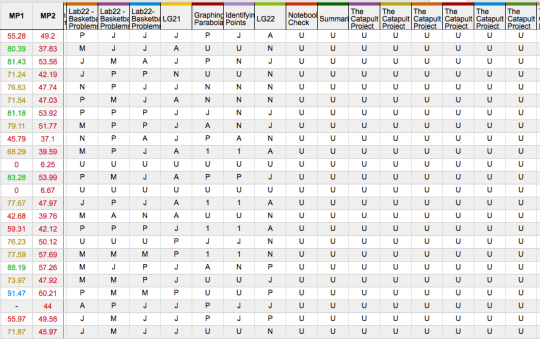
On the left, averages and assignments we have already completed. On the right, U grades mean “Unrated,” usually for assignments we have not done yet. The student who got an A- last marking period currently leads the pack with a 60.

But…thinking ahead 6 weeks about what I’m assessing…shouldn’t we be doing this anyway? Isn’t that just unit planning? My current Algebra course has 7 units, so it does work out to be almost one unit per marking period. And the process isn’t that inflexible: if I delete an assignment because I decided not to do it, or add something in, that’s a small fluctuation compared to the overall experience.

By the end of the marking period (as you see in my picture), everything will match up to the number it would have been had I gone top-down. But the way we get there is important. It is always better to grow.

ADDENDUM

After being questioned by Andrew Stadel and Chris Robinson on Twitter, I have some more explanations.

Andrew Stadel: I’d like to know more about this. Admin & parent understanding? Student response? Pros, cons, etc.

Me: Parents felt it was unclear at first, until I input marks that differentiated between “not done or graded yet” and “missing.” Then they were more on board. Students were confused by it at first, but liked it in the end. Admin supports it.

Pros include feeling like we are always improving and, a big one, it makes grading so much more enjoyable for me, because no one goes down.

Cons are that it’s hard to gauge sometimes (in terms of “snapshots”), especially when you get a big rush of grades at the end of the marking period.

Chris Robinson: James, can your “grades” go down per individual standard/learning target through the term?

Me: I’ve seen it go both ways in SBG. For me, they can’t go down in content standards, but can in practice ones. I do continuously assess but I feel like once someone has shown some understanding, they keep it, and they just need a refresher. (But I think I got that from Dan Meyer’s original “How Math Must Assess” post.)

Stadel: Thanks for explaining. What percent of students adjusted to & welcomed it? I like the premise of zero understanding and working towards mastery.

Me: Adjusted to, I would say over 95%. Welcomed, in the 80%. (Super rough estimates.)

Stadel: Do you have any materials/handouts explaining the philosophy to parents & students?

Me: I…really should.

So I was thinking about grading a little bit, and how grading works in my classroom. I tried to ask people about grading on Twitter, but perhaps the medium is not the best for talking about it, because only one person responded. (Thanks, @algebraniac.) I wanted to get a feel for how people out there calculated grades, before I wrote about it, but I figure, what the hell! Just write about it anyway! (Maybe channeling Hedge a little bit here.)

So, like, I’m imagining the typical first day of class that happens. The teacher tells all the students, “As of right now, you all have ‘A’s.” With the intention being, of course, encouragement, because despite how bad they might have done in that subject in the past, right now, they have an A.

But when you think about it a little more…it’s really kind of terrible, isn’t it? “Right now, you have an ‘A’…and the only way to go is down.” So then the grades don’t reward good work, they only penalize bad. Your grade tracks every mistake you make, every little fuck-up, dropping in a downward spiral. And we talk about students “slipping” and “dropping the ball” and “not doing as well as they used to.” The whole terminology is pretty terrible.

On the surface, it might seem like Standards-Based Grading can help with this, like it helps with so many others. Students have standards, and if they are low they reassess and go up. At the end of the marking period or term, that certainly seems like a good system. For each individual standard, it works, but as a collective whole? Let me ask you this:

It is halfway through the (quarter/marking period/term), so report card grades are not due for another few weeks. A student comes up to you and asks what their grade is. What do you tell them? What is it calculated from? And how will the future work they do affect that grade, if they do well? What about if they do poorly?

I’d really like to know. Drop a line in the comments and tell me. I’ll follow up with people’s responses and what I do in another post.


Trig without Trig

Over the summer I made a Donors Choose page in the hope of getting some clinometers, so that we can go out into the world and use them to calculate the heights of objects like trees and buildings. And we did!
I created the Clinometer Lab as an introduction to Trigonometry. As such, prior to the lab, they had not seen any trig at all. So I started off with this video as the homework from the night before.

In class, we talked about how, when the angle is the same, the ratio of the height and shadow is the same. And how, long ago, mathematicians made huge lists of all of these ratios.
So if they told me any angle, I could tell them the ratio, and then they could just set up the proportion and solve.

So we left the building and went to the park, armed with clinometers, measuring tape, calculators, and INBs, so do some calculations. I had the students get the angles from their eyes to the height of a tree, from two different spots, and the distances, so they could set up a proportion and discover the height of the tree. (When they finished, they did a nearby building. If they finished that too, the extension problem was to switch it up: given the height of a famous building, the Metlife Tower, that they could see from the park, and determine how far away they were.)

Clinometer Park Pic

It went really well, and I think they got the idea. The fact that they could choose which tree to measure and were given free range of the park, and could choose where to stand to look at the top, but always had to come back to me to get their ratio, worked seamlessly. I could check in on them easily and keep them on the right path. (Especially with my co-teacher there to keep them all wrangled, or the AP who observed/helped chaperone the classes without my co-teacher.)

The next class, I revealed to them that I was not using that crazy chart to give them their ratio, but rather they can just get it themselves from the calculator, which basically internalized the list. Then they got it, that is was just ratios and proportions, not some crazy function thing.

Trig as a topic did not go great in my class, but that is the fault of my follow-up lesson, where I tried to squeeze in too much and didn’t do any practice, not that fault of this lesson, which still sticks in their minds. Later in the year we were doing a project about utilizing unused space, so we picked empty lots but couldn’t get in. So in order to figure out how big they were, we used clinometers, and trig. Now that’s a real world application.

The Lab

Clinometer Lab Instructions

Clinometer Lab Sheet

The Archimedes Lab

I love this lab, but I’m sure it can be improved, so I’d love to hear feedback in the comments.

When I was student teaching at Banana Kelly, they had a combined math/science program that often had many lab activities, both math labs and science labs. But I noticed the Systems of Equations unit didn’t really have a lab, so I set out to make one. I created the Archimedes lab because of that.

The story of Archimedes and the Crown of Syracuse says that he was able to determine that the crown was not pure gold by using mass and volume. We start by watching a short video about the story. (I had assigned the video as homework, but no one watched it. While my video homework watching rates aren’t stellar, they’ve never been this bad. I blame the fact that it’s been a while: the last video was in December.)

Then I tell them that we can do Archimedes one better. It’s been over 2000 years since he lived and we have algebra and precise tools on our side: we can figure out exactly how much gold was stolen, not just if some was.

CAM00027

To demonstrate this, we built several Mystery Blocks out of two different materials. Back at BK, we had lots of different materials in the science closet to use. Because the students would know the type of material (brass, aluminum, wood, etc) but not the size and shape, they would have to use density to solve the problem. (But I had seeded the story throughout the whole unit.) The density kit I requested last year never arrived, though, so I had to scrounge around for something, and I found the perfect thing: Cuisinaire Rods.

I noticed that, despite what I expected, the longer Cuisinaire rods are much less dense that the small single cubes. So I used some amount of cubes and some amount of rods to make the mystery blocks. Then I simply give the kids one cube, one rod, the block, a scale, and a ruler, and ask them to figure out how many if each kind are in the block.

CAM00024

This lab was much more procedural when I first made it, but I’ve embraced the problem-solving classroom since then. And while my students were unsure of what to do, I feel like we’ve built up to this kind of unstructured problem, and most of them took to it well.

When they thought they had a solution, I would press them on it. “Why do you think it’s 5 yellow blocks and 5 cubes?” If they responded that that matches up in size to the block, I would point out any others do also, like 4 yellow and 10 cubes. I would implore them to use the tools available to them. (We also talked about mass, volume, and density in the warm-up.) If they told me some combination gave them the right mass, I would point out that their volume would be off. If they told me no combination gave them the right volume AND right mass, I would ask why. Most would identify the tape/foil/wrapping paper as the culprit.

Most importantly, if they gave me a solution that was well supported, even if incorrect, I told them there was only one way to find out if they were right: unwrap the mystery block and see. The excitement at each table when they got to that point was palpable. One student said it felt like Christmas. If they were right, they were ecstatic. If they were not, they tried to figure out where they went wrong.

CAM00025

When I first made this lab, I put it at the end of the Systems unit, thinking they would need those tools. Now I have the confidence to put it at the beginning, and let them figure it out. No one used equations explicitly to solve the problem, but they definitely grappled with the idea that two separate constraints need to both be satisfied in order to solve a problem, which is an important understanding for systems.

This post is getting a little long, so I’ll probably split off into another posts with problems I had with the lesson, things that went well, and a call for suggestions. I just wanted to get this out there. It’s been a long time since I’ve blogged, because I’ve had a lot going on in my life. So I want to get back to it.

The Lab Sheet

The Archimedes Lab

Accompanying Graph

I bought my boyfriend the game Wits and Wagers for Christmas, after seeing it on Tabletop and thinking he would enjoy it. (Feel free to watch the episode of Tabletop for a good example of how it works, though they play the Family edition, and we have the standard version.)

The basic premise of the game is that everyone is asked the same question, which always has a numerical answer (including dates). Everyone secretly writes down their guess, with the goal of being the closest without going over. Then, everyone reveals their answers and they are put in order on the board. At that point, everyone bets on which they think is the best answer. The answer is revealed, and the person who wrote the best answer and everyone who guessed it gets points.

I played it with him and some friends on New Year’s Eve, and saw some interesting results that made me think the game would be a good tool for developing number sense. In fact, one of his friends said that she wasn’t good at the game because she had no idea who was even a good range for an answer. But the game itself provides you with that sense, by consensus.

I know I read once, though I can’t remember where, about how when prompting a class for a guess, most student guesses will fall somewhere in the same order of magnitude as the first guess, even if that first guess is super ridiculous. (Like, for a guess at how tall the Eiffel Tower is, the first person guesses 6 miles. No, that can’t be right, the second person says. More like 4 miles.) The way to avoid this is to have people right down their answers ahead of time, a mechanic built into the game.

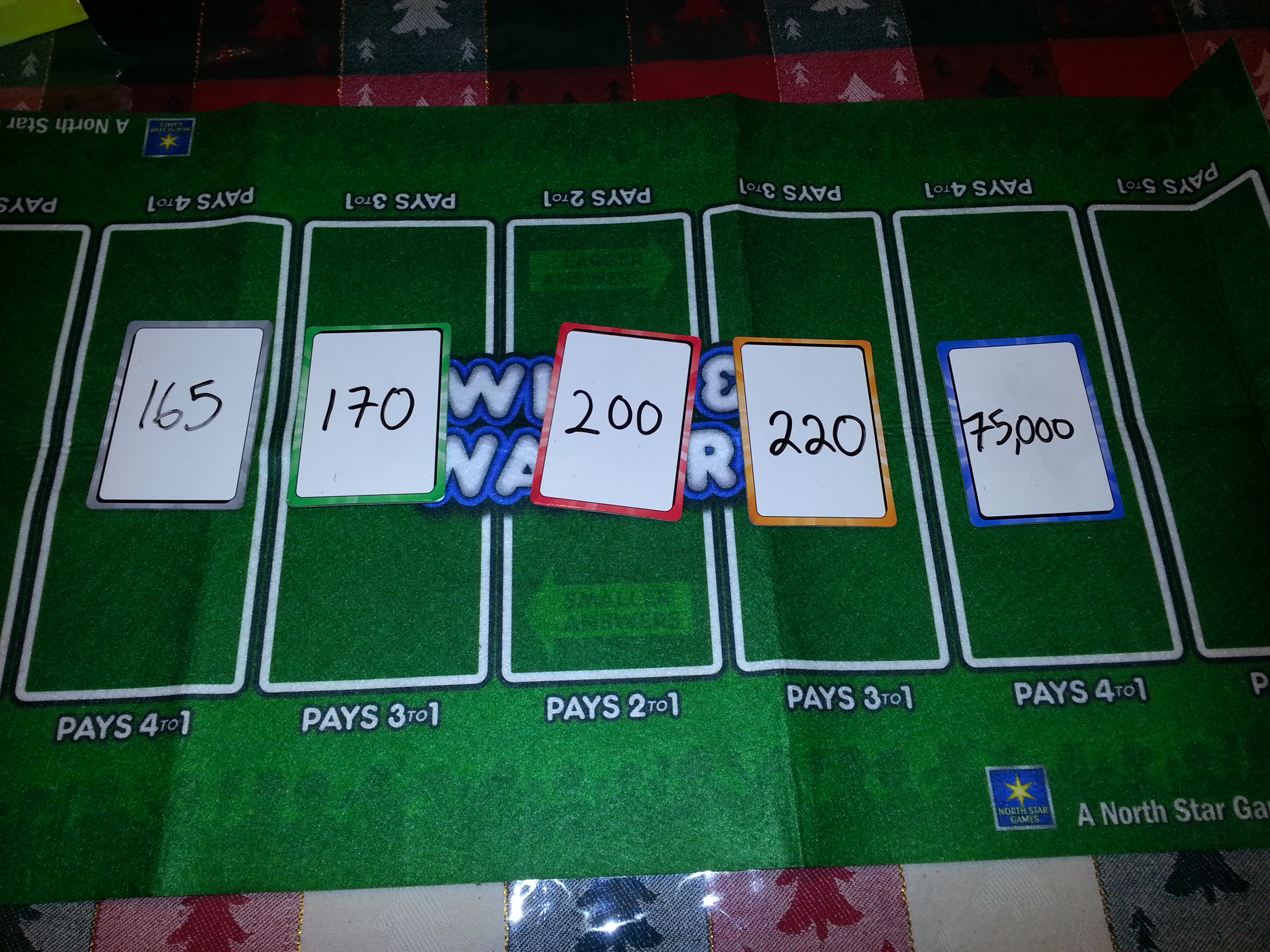
Sometimes that leads to interesting situations. One question asked how many episodes of Friends there had been, and this had been our responses:

Wits and Wagers

This almost feels like a Math Mistakes question, where did this person go wrong in their guess? But comparing their sense of answer to the consensus helps us get an idea of what’s right, and what’s misinterpreted. (In this case, the person thought it was asking how many episodes have been shown on TV ever, like in syndication and whatnot, in which her answer then makes a lot of sense. So never dismiss an answer just because it seems so far off the mark. There’s always a reason!)

A lot of questions had a historical bent as well (years), so then can help build a sense of time as well. (As long as a rogue history teacher isn’t sitting nearby shouting out answers even though he isn’t playing the game.)

In the end, I think this game could go along with something like Estimation180 for building number sense, but in a more communal gaming way. If you talk to people about how they chose their numbers, we can get a sense of their mathematical thinking. And that’s worth a lot.

Last week, my students spent 2 double periods playing Dragonbox, the iPad (and computer) game designed to teach solving linear equations, which I think it does quite well. (I agree with many of Max Ray’s opinions when he writes about it here. Which makes sense, as Max first showed me the game this past summer.)

While one of my goals was teaching solving equations, it was not my only one, which is what I wanted to talk about here. (I’ll probably review the game itself later.) I told the students that I had forgotten to make a lesson, so we were just going to play a game on the iPad today. What I did want, though, was for them to home their ability to figure out how something works. To me, this is an even more important lesson to get than just solving equations.

To this end, I talked about how websites like GameFAQs has walkthroughs for all sorts of games, but one walkthroughs were all written by regular players, who sat down with a game right when they bought it, took notes on what they did, figured things out, and shared with others. So we were going to take that role. In their Interactive Notebooks, I told them to write down every thing they could do in the game. Whenever they came across a new rule, some new ability, or a new solution to a tough puzzle, write it down. Example: “Tap the green swirl to make it disappear.”

The surprising part was, they really did it, and quite well. Hey even discovered a lot of things about the game that I didn’t know, because I always played it “perfectly,” since I knew the rules of algebra. (Example: if you have a denominator under a green swirl (aka 0) and tap it, the while thing disappears. Or a green swirl won’t disappear if it is the only thing left on its side, which was fun to talk about later.)

At the end of my first double, with about 20 minutes left, I compiled all the notes they took using Novel Ideas Only (where all students stand and share things they have written, only sitting once everything they have written down is said, either by themselves or someone else), creating a master list of actions they could refer to next time.

The next class, they came in and immediately started playing. I must say, the entire time I used it, the kids were really into it, and most of them were really persistent. Some occasionally requested help, but my intervention was minimal. This time, I had this answer several questions after they had played some more, which really dove into the meat of the game. What does this card or action in the game represent in math? Why does a certain rule in the game happen that way?

One thing I really loved is how solid the game got them on how dividing something by itself won’t make it go away. It was a tactic many of them tried in several levels and it always got them stuck. I focused on the difference between “zeroing out” and “oneing out.”

We had one major downside, technology-wise, though. Each game had four save files, which worked out, because I had four sections. So one file per student. But there is nothing to stop a student in one class from playing on, or, even worse, DELETING, another student’s file. I e-mailed the company, and they said a solution would happen in a future update.

Today was the follow-up quiz, and they mostly did well. The things they stuck on was something that wasn’t well covered in the game: the distributive property. But we’ll work on that.

Last year I made a lesson about determining the steepest stairs, using pictures my co-teacher and I took and based on an idea from Dan Meyer. It took about a period, and was mostly teacher-led. But after arguments and deep thinking about slope, I wanted to go into the lesson deeper, so I turned it into a lab.

I started the same way, throwing up the (new and improved) opening slide and asking which they thought was the steepest and which was the shallowest.

Screen shot 2012-11-26 at 1.55.16 PM

I really like this new improved one because I took a picture of the toy staircase from the board game 13 Dead End Drive (middle left). Last time, there were overall agreement on the shallowest (the Holiday Market) while there was disagreement on steepest. This time, because the toy was tiny (if not shallow), we had some disagreement there, which really let us tease out some definitions of “steeper” and “shallower.”

Once we had definitions of steeper (which usually came out to something like “closer to vertical” or “at a bigger angle”), I handed out the pictures on a sheet of paper and asked them to develop a method for determine which was steeper, or the steepest. I mentioned coming up with some sort of “steepness grade” (because I thought it would be amusing to throw the word “grade” in there).

So I let them struggle, and come up with what information they had to ask me for, which I would then provide. If I had to do it again, I would also have pictures of the width of each stair, as a distracter, because some kids asked for it. Interestingly, some also asked for the angle, because of our prior experience in the year with the clinometers. I told them I didn’t have the clinometer with me at the time. One kid called me on it, because she knew I had a clinometer app on my iPad. So I told her (truthfully) some of the pictures were taken last year, before I had it.

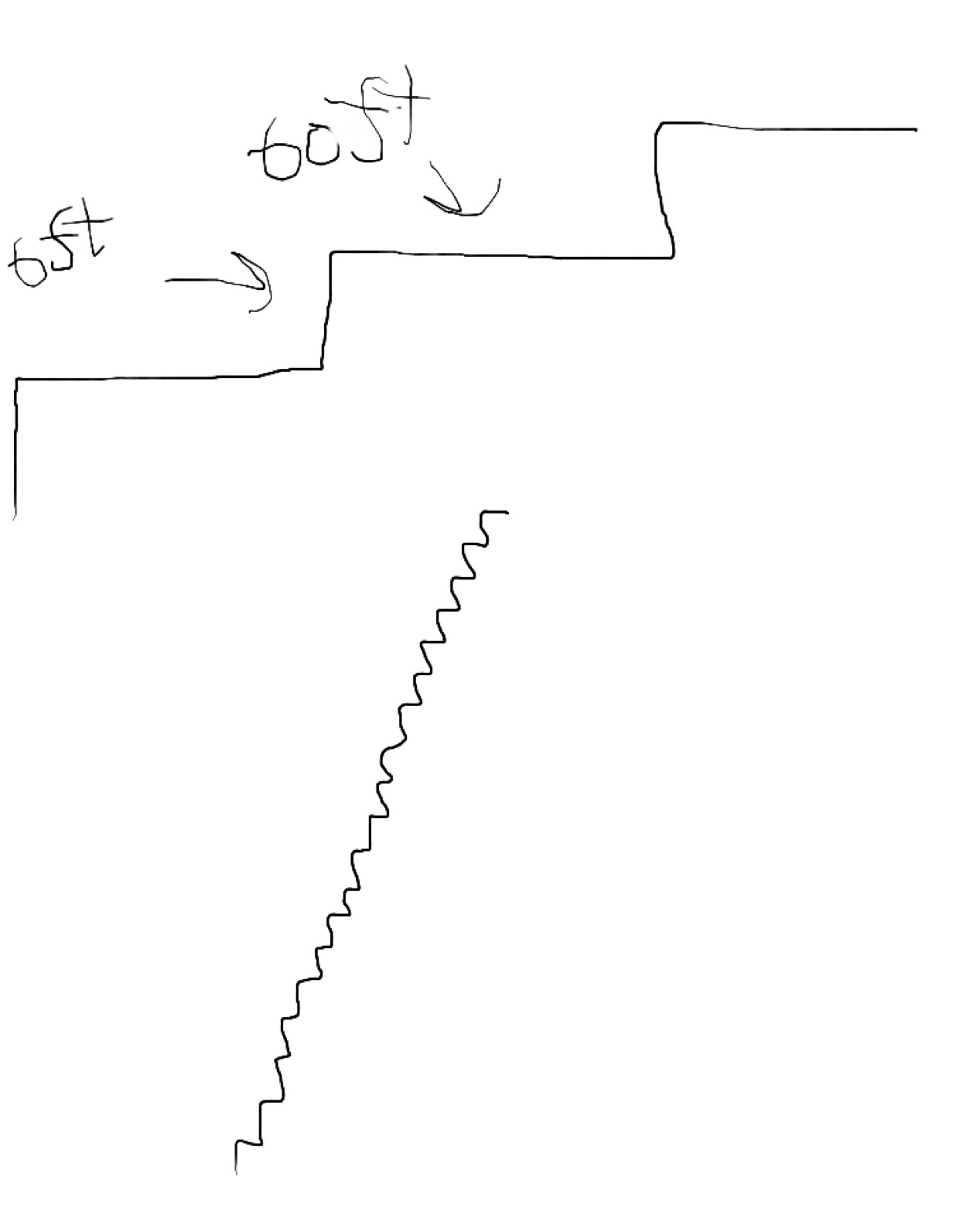
So I had them come up with their own measures. If they tried to base it off of only height or only depth, I deflected with examples of really tall, really shallow stairs, or really short, really steep stairs. TallShallow

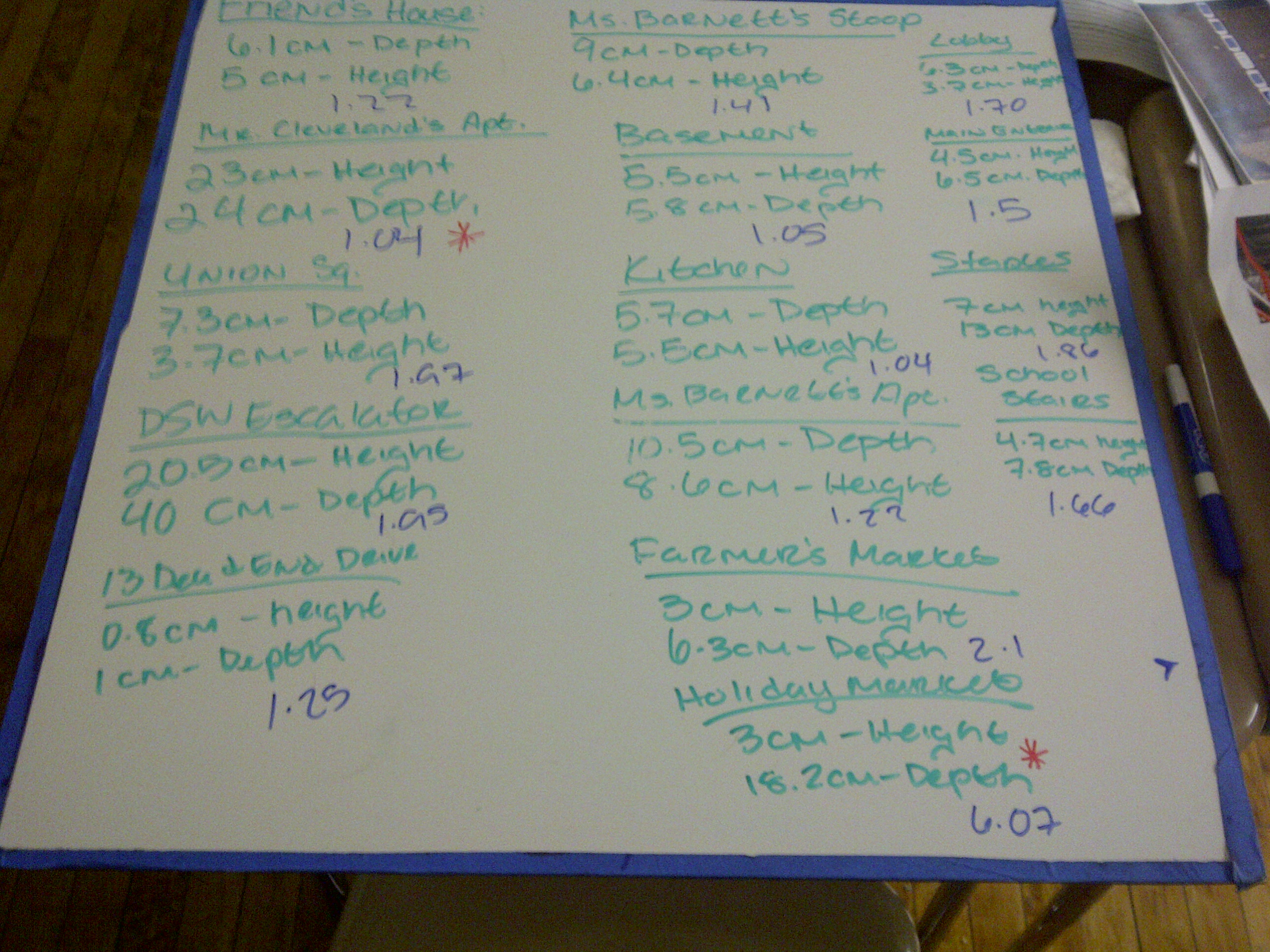
By the end of the classes, students usually came up with one of three different measures: slope, the inverse of slope (depth over height), and grade (that is, slope as a percentage).

IMG-20121127-00127IMG-20121127-00125

So they had to then reason as to why they might prefer height/depth to depth/over. (Their logic: it seems more natural to have bigger numbers be steeper stairs, rather than the other way around.) And so it was that point that I told them this “steepness” grade that they developed was often called “slope” by mathematicians.

At which point, I got a big “Ohhhhhhhhhhh.” Which always makes it worthwhile.

The Materials

Stairs – Portrait

Stairs – Landscape

Steepest Stairs Lab