Trying to find math inside everything else

Archive for the ‘math’ Category

The Carnival Guesser

Have you ever been to a carnival or amusement park and seen one of those people who will try to guess your weight, height, or age? If they get within a certain range of your weight, they win and keep your money. If they are wrong, you win and get a prize. I’ve occasionally wondered how they determine what their range is. This clip from Steve Martin’s The Jerk makes me wonder, instead, how they determine which prizes they can give away.

That’s the lead-in I give the students. Steve Martin can only give away that small section of prizes because he is a terrible guesser, so he often loses. If you worked for the carnival as a guesser, what can you give away?

I have the students go around and guess the weight and height of any 10 willing participants in the class. (Any student can turn down being guessed, so students had to ask first. Also, I think my students were always worried about insulting someone, because they almost always under guessed. Also, many of your students may not know how much they weigh, so doing this lesson near when they have a fitness test and get weighed in gym is a good idea.) They record their guess, the actual amount, and the difference between the two.

Then, in groups, they try to determine a metric for figuring out who is the best guesser. We talk about how being 10 pounds off for a super thin person, child, or baby is much worse than being 10 pounds off for a very large person. We also talk about how being over or under doesn’t really change how good the guess is. After I push back on their metrics, some students pick up on the proportionality of the guess to the real amount, and lead us into relative error.

I somewhat drop the conceit at that point, mostly because I’m not sure of the best way to finish it off. But I like the start, and it’s a very natural intro to relative error, and the relative size of numbers in general.

Trig without Trig

Over the summer I made a Donors Choose page in the hope of getting some clinometers, so that we can go out into the world and use them to calculate the heights of objects like trees and buildings. And we did!
I created the Clinometer Lab as an introduction to Trigonometry. As such, prior to the lab, they had not seen any trig at all. So I started off with this video as the homework from the night before.

In class, we talked about how, when the angle is the same, the ratio of the height and shadow is the same. And how, long ago, mathematicians made huge lists of all of these ratios.
So if they told me any angle, I could tell them the ratio, and then they could just set up the proportion and solve.

So we left the building and went to the park, armed with clinometers, measuring tape, calculators, and INBs, so do some calculations. I had the students get the angles from their eyes to the height of a tree, from two different spots, and the distances, so they could set up a proportion and discover the height of the tree. (When they finished, they did a nearby building. If they finished that too, the extension problem was to switch it up: given the height of a famous building, the Metlife Tower, that they could see from the park, and determine how far away they were.)

Clinometer Park Pic

It went really well, and I think they got the idea. The fact that they could choose which tree to measure and were given free range of the park, and could choose where to stand to look at the top, but always had to come back to me to get their ratio, worked seamlessly. I could check in on them easily and keep them on the right path. (Especially with my co-teacher there to keep them all wrangled, or the AP who observed/helped chaperone the classes without my co-teacher.)

The next class, I revealed to them that I was not using that crazy chart to give them their ratio, but rather they can just get it themselves from the calculator, which basically internalized the list. Then they got it, that is was just ratios and proportions, not some crazy function thing.

Trig as a topic did not go great in my class, but that is the fault of my follow-up lesson, where I tried to squeeze in too much and didn’t do any practice, not that fault of this lesson, which still sticks in their minds. Later in the year we were doing a project about utilizing unused space, so we picked empty lots but couldn’t get in. So in order to figure out how big they were, we used clinometers, and trig. Now that’s a real world application.

The Lab

Clinometer Lab Instructions

Clinometer Lab Sheet

The Archimedes Lab

I love this lab, but I’m sure it can be improved, so I’d love to hear feedback in the comments.

When I was student teaching at Banana Kelly, they had a combined math/science program that often had many lab activities, both math labs and science labs. But I noticed the Systems of Equations unit didn’t really have a lab, so I set out to make one. I created the Archimedes lab because of that.

The story of Archimedes and the Crown of Syracuse says that he was able to determine that the crown was not pure gold by using mass and volume. We start by watching a short video about the story. (I had assigned the video as homework, but no one watched it. While my video homework watching rates aren’t stellar, they’ve never been this bad. I blame the fact that it’s been a while: the last video was in December.)

Then I tell them that we can do Archimedes one better. It’s been over 2000 years since he lived and we have algebra and precise tools on our side: we can figure out exactly how much gold was stolen, not just if some was.

CAM00027

To demonstrate this, we built several Mystery Blocks out of two different materials. Back at BK, we had lots of different materials in the science closet to use. Because the students would know the type of material (brass, aluminum, wood, etc) but not the size and shape, they would have to use density to solve the problem. (But I had seeded the story throughout the whole unit.) The density kit I requested last year never arrived, though, so I had to scrounge around for something, and I found the perfect thing: Cuisinaire Rods.

I noticed that, despite what I expected, the longer Cuisinaire rods are much less dense that the small single cubes. So I used some amount of cubes and some amount of rods to make the mystery blocks. Then I simply give the kids one cube, one rod, the block, a scale, and a ruler, and ask them to figure out how many if each kind are in the block.

CAM00024

This lab was much more procedural when I first made it, but I’ve embraced the problem-solving classroom since then. And while my students were unsure of what to do, I feel like we’ve built up to this kind of unstructured problem, and most of them took to it well.

When they thought they had a solution, I would press them on it. “Why do you think it’s 5 yellow blocks and 5 cubes?” If they responded that that matches up in size to the block, I would point out any others do also, like 4 yellow and 10 cubes. I would implore them to use the tools available to them. (We also talked about mass, volume, and density in the warm-up.) If they told me some combination gave them the right mass, I would point out that their volume would be off. If they told me no combination gave them the right volume AND right mass, I would ask why. Most would identify the tape/foil/wrapping paper as the culprit.

Most importantly, if they gave me a solution that was well supported, even if incorrect, I told them there was only one way to find out if they were right: unwrap the mystery block and see. The excitement at each table when they got to that point was palpable. One student said it felt like Christmas. If they were right, they were ecstatic. If they were not, they tried to figure out where they went wrong.

CAM00025

When I first made this lab, I put it at the end of the Systems unit, thinking they would need those tools. Now I have the confidence to put it at the beginning, and let them figure it out. No one used equations explicitly to solve the problem, but they definitely grappled with the idea that two separate constraints need to both be satisfied in order to solve a problem, which is an important understanding for systems.

This post is getting a little long, so I’ll probably split off into another posts with problems I had with the lesson, things that went well, and a call for suggestions. I just wanted to get this out there. It’s been a long time since I’ve blogged, because I’ve had a lot going on in my life. So I want to get back to it.

The Lab Sheet

The Archimedes Lab

Accompanying Graph

Wits and Wagers and Number Sense

I bought my boyfriend the game Wits and Wagers for Christmas, after seeing it on Tabletop and thinking he would enjoy it. (Feel free to watch the episode of Tabletop for a good example of how it works, though they play the Family edition, and we have the standard version.)

The basic premise of the game is that everyone is asked the same question, which always has a numerical answer (including dates). Everyone secretly writes down their guess, with the goal of being the closest without going over. Then, everyone reveals their answers and they are put in order on the board. At that point, everyone bets on which they think is the best answer. The answer is revealed, and the person who wrote the best answer and everyone who guessed it gets points.

I played it with him and some friends on New Year’s Eve, and saw some interesting results that made me think the game would be a good tool for developing number sense. In fact, one of his friends said that she wasn’t good at the game because she had no idea who was even a good range for an answer. But the game itself provides you with that sense, by consensus.

I know I read once, though I can’t remember where, about how when prompting a class for a guess, most student guesses will fall somewhere in the same order of magnitude as the first guess, even if that first guess is super ridiculous. (Like, for a guess at how tall the Eiffel Tower is, the first person guesses 6 miles. No, that can’t be right, the second person says. More like 4 miles.) The way to avoid this is to have people right down their answers ahead of time, a mechanic built into the game.

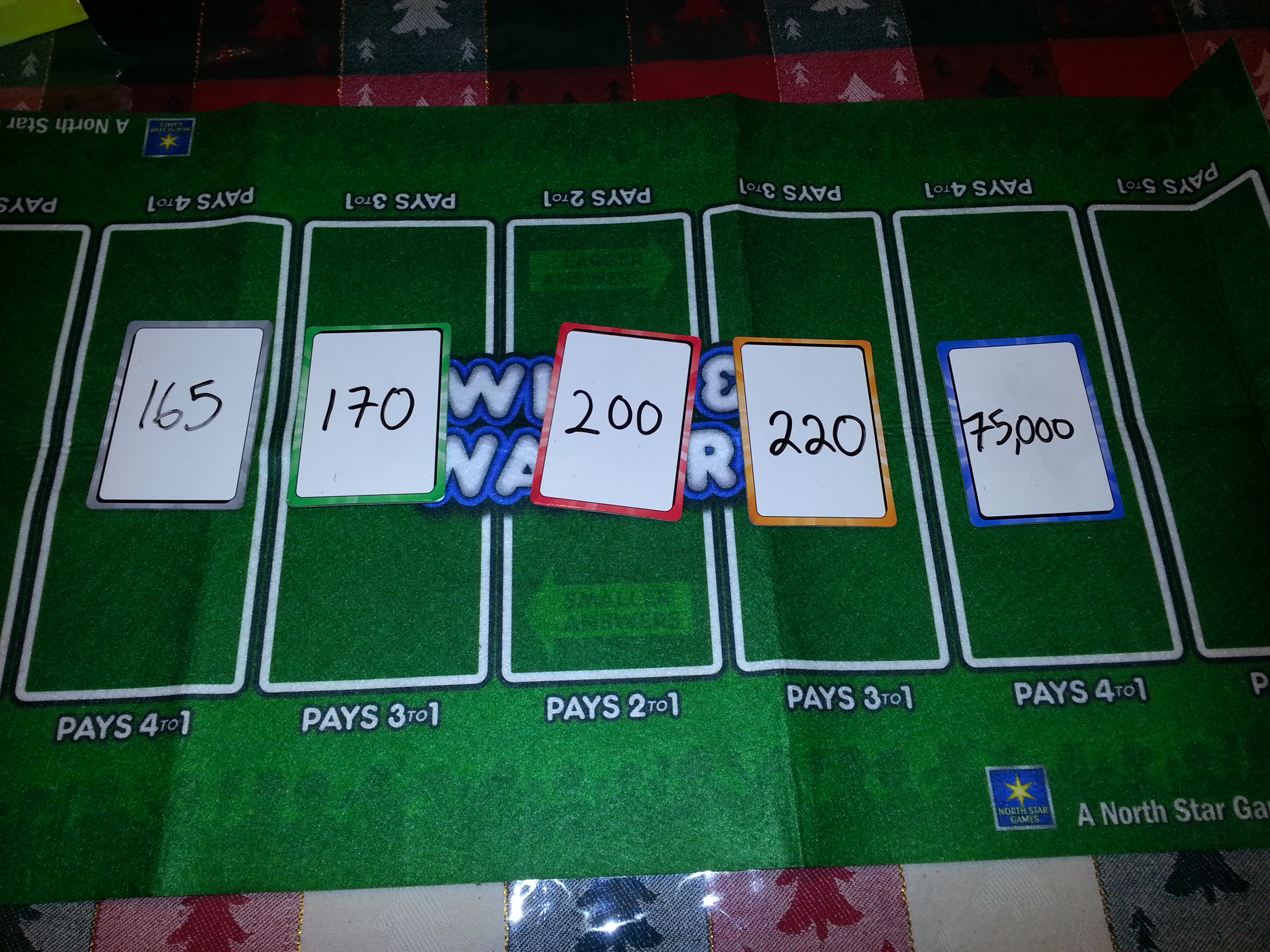
Sometimes that leads to interesting situations. One question asked how many episodes of Friends there had been, and this had been our responses:

Wits and Wagers

This almost feels like a Math Mistakes question, where did this person go wrong in their guess? But comparing their sense of answer to the consensus helps us get an idea of what’s right, and what’s misinterpreted. (In this case, the person thought it was asking how many episodes have been shown on TV ever, like in syndication and whatnot, in which her answer then makes a lot of sense. So never dismiss an answer just because it seems so far off the mark. There’s always a reason!)

A lot of questions had a historical bent as well (years), so then can help build a sense of time as well. (As long as a rogue history teacher isn’t sitting nearby shouting out answers even though he isn’t playing the game.)

In the end, I think this game could go along with something like Estimation180 for building number sense, but in a more communal gaming way. If you talk to people about how they chose their numbers, we can get a sense of their mathematical thinking. And that’s worth a lot.

Steepest Stairs Redux

Last year I made a lesson about determining the steepest stairs, using pictures my co-teacher and I took and based on an idea from Dan Meyer. It took about a period, and was mostly teacher-led. But after arguments and deep thinking about slope, I wanted to go into the lesson deeper, so I turned it into a lab.

I started the same way, throwing up the (new and improved) opening slide and asking which they thought was the steepest and which was the shallowest.

Screen shot 2012-11-26 at 1.55.16 PM

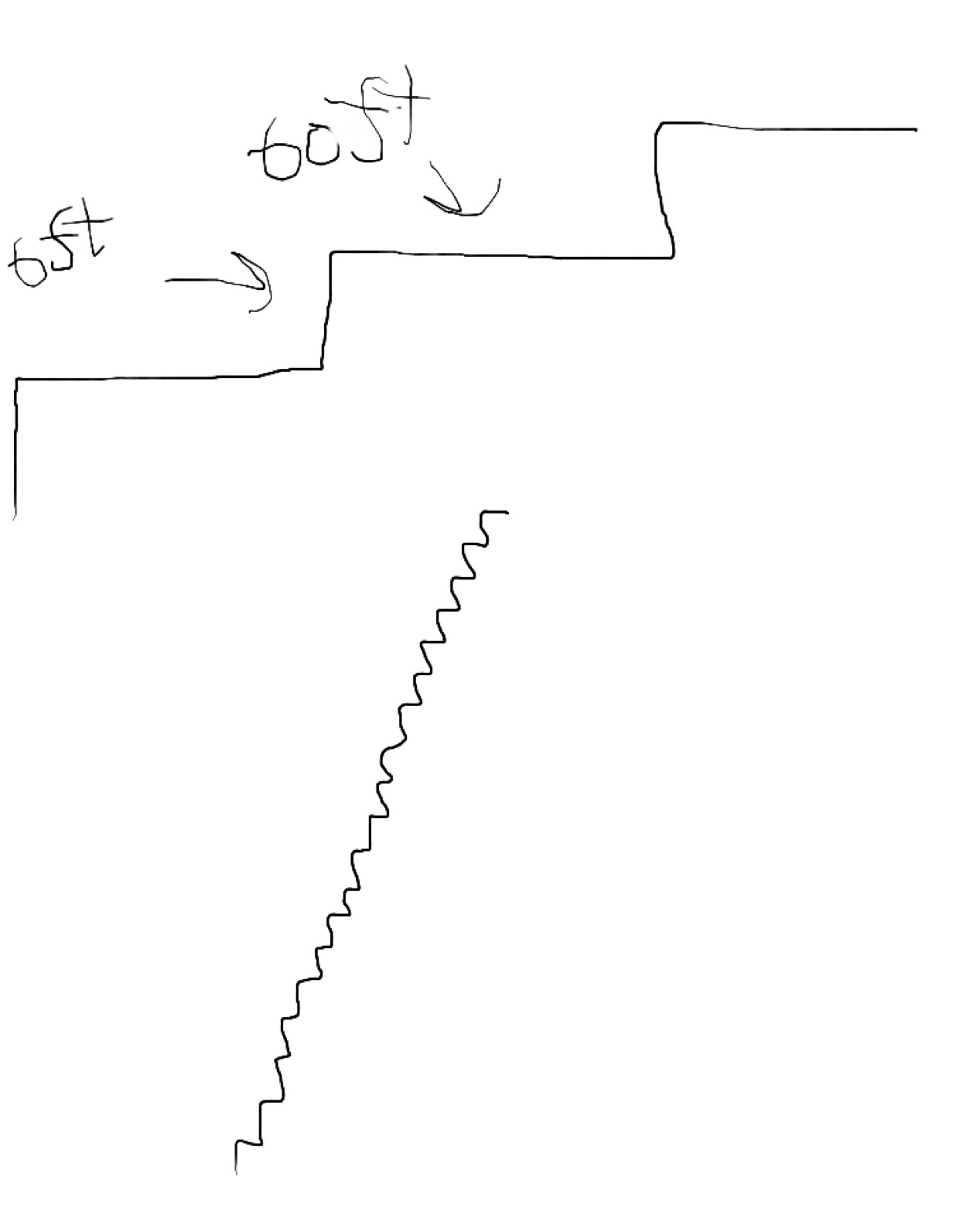
I really like this new improved one because I took a picture of the toy staircase from the board game 13 Dead End Drive (middle left). Last time, there were overall agreement on the shallowest (the Holiday Market) while there was disagreement on steepest. This time, because the toy was tiny (if not shallow), we had some disagreement there, which really let us tease out some definitions of “steeper” and “shallower.”

Once we had definitions of steeper (which usually came out to something like “closer to vertical” or “at a bigger angle”), I handed out the pictures on a sheet of paper and asked them to develop a method for determine which was steeper, or the steepest. I mentioned coming up with some sort of “steepness grade” (because I thought it would be amusing to throw the word “grade” in there).

So I let them struggle, and come up with what information they had to ask me for, which I would then provide. If I had to do it again, I would also have pictures of the width of each stair, as a distracter, because some kids asked for it. Interestingly, some also asked for the angle, because of our prior experience in the year with the clinometers. I told them I didn’t have the clinometer with me at the time. One kid called me on it, because she knew I had a clinometer app on my iPad. So I told her (truthfully) some of the pictures were taken last year, before I had it.

So I had them come up with their own measures. If they tried to base it off of only height or only depth, I deflected with examples of really tall, really shallow stairs, or really short, really steep stairs. TallShallow

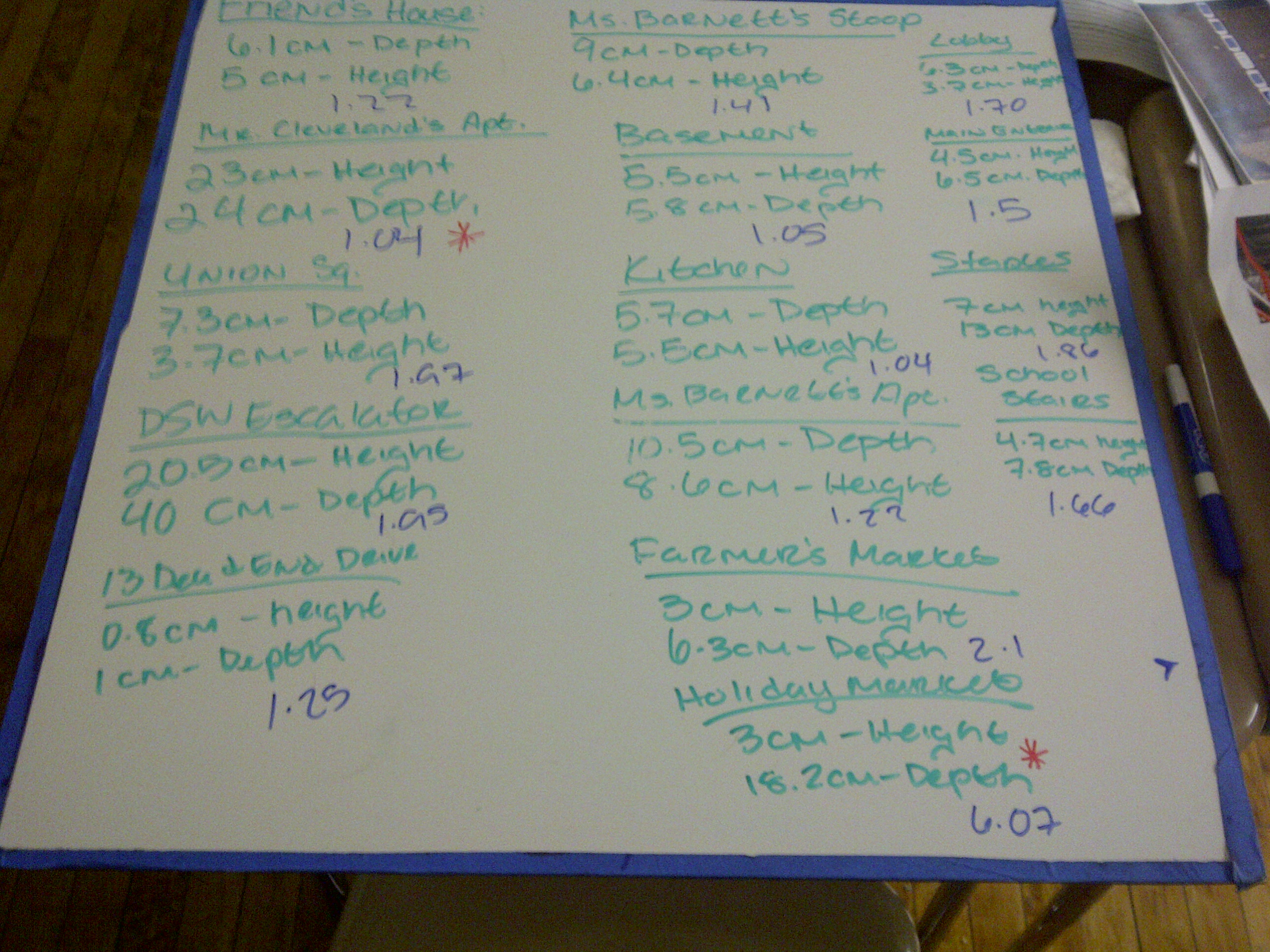
By the end of the classes, students usually came up with one of three different measures: slope, the inverse of slope (depth over height), and grade (that is, slope as a percentage).

IMG-20121127-00127IMG-20121127-00125

So they had to then reason as to why they might prefer height/depth to depth/over. (Their logic: it seems more natural to have bigger numbers be steeper stairs, rather than the other way around.) And so it was that point that I told them this “steepness” grade that they developed was often called “slope” by mathematicians.

At which point, I got a big “Ohhhhhhhhhhh.” Which always makes it worthwhile.

The Materials

Stairs – Portrait

Stairs – Landscape

Steepest Stairs Lab

Slope

At Twitter Math Camp, Karim Kai Ani and I debated for a bit on what slope really means, and how best to teach it. Since slope is the upcoming topic for this week, I thought it would be good to reflect back on our arguments.

Karim argued that slope should always have units, and that removing the units created a contextless concept that made it difficult for students to grasp. I argued that, while that is true and units are useful in many cases, the concept of slope as a unitless ratio is an important concept, digging deep into what it means to be a ratio, so that a line with a slope of 2 could be 2 miles up, 1 mile over, or 2 cm up, 1 cm over, it didn’t matter. The differences are exemplified in two of our lessons: my “Steepest Stairs and Wacky Measurements” (soon to be updated) and his “iCost.”

(c) Mathalicious 2011

I mentioned this debate at dinner last night to my boyfriend, who is a math PhD candidate. He said what we were talking about reminded him of the difference between a rate and a ratio. He said that a ratio was a “quotient of quantities of the same unit” and a rate was a “quotient of quantities of differing units.” Further clarification was that a ratio’s units had to be the same dimension, while a rates did not.

So then, really, the question becomes, is slope a rate or a ratio?

It’s both. Karim argued for rate but that’s really just the algebraic or calculus-based definition of slope. My argument for ratio was a geometric one. Both are important, and are related, which is why they go by the same name.

But I wonder if it would be easier if the concepts had a different word. What if we only used “grade” or “gradient” for the geometric definition, and slope for the algebraic one? Or slope for the geometric, and just rate for the algebraic? The problem is they are so intertwined. For which there is only one person to blame.

Damn you Descartes!

Math Labs

When I student taught at Banana Kelly High School, the 9th grade math and science teachers there used a wonderful curriculum called Thinking Math and Science, which they had been developing for about 10 years. Those classes were integrated with math and science together, and so very often the classes were doing labs. But the labs weren’t just science, they just as often had math labs. And I wanted to bring that idea into my own classroom.

I had decided last year that I wanted to introduce new topics with labs, so the students could explore an idea before getting the mathematical language that does with it. When I sat down over the summer with my co-teacher Sarah, we created a template for our math lab reports, taking the steps of the scientific method and putting a mathematical twist on it. Here’s an example of it, using the first lab we did, Pythagorean Theorem in 3D.


The beginning is much the same, asking the driving question that we want to answer. Then, instead of background research, since I want to work with a low barrier of entry and move up, we have “What do you notice?” (thanks @maxmathforum).

The next step is to construct a hypothesis. This is often still relevant with math, of course, and may go unchanged for some labs. But I thought another way we could look at a hypothesis is an estimate, since both are educated guesses, right? I set it up using Dan Meyer’s suggestion of “too low, too high, actual guess,” which gives us nice bounds, and I think this does it visually as well. Although not completely, since some students haven’t gotten it, so I wonder if I can improve on that. (I have two versions in the file: the arrow one is the one I used, and the dotted line one is a new idea I have, I’ll try it soon.)

Then we do our calculations, which is our experiment, they go hand in hand. And finally we analyze what we did with discussion questions.

I’m don’t think the format/template is perfect, but I think it’s a start.

Recursive Combinations with Replacement

So I was in my classroom last night with my boyfriend, waiting for his phone to charge before we went to dinner. Since we had some time, we played some of the math games I have in my room. (He’s a math PhD student, so he was all for it.) We played Set, of course, and then played a bit of 24. We idly wondered if it were possible to get 24 with any combination of 4 digits. So I looked at the box, and saw it came with 192 possible configurations. Well, if we determined how many possibilities there were (maybe there were 192), that might give us an idea of the feasibility.

20121020-162604.jpg

So we tried to calculate how many configurations there were. Shouldn’t be too hard, right? Well, it kinda is, especially when you’re not already familiar with combinations with replacement. So we started using what we did know of combinations, but were stuck because we could use the same number multiple times, which made it trickier. Otherwise it would just be 9 C 4.

So, unsure how to solve, we tried to make a simpler case. What if we only had 2 digits to choose from, not 9? There’s there’s 5 possibilities. (1111, 1112, 1122, 1222, 2222.) And with 3 digits, there’s 15 (1111, 1112, 1113, 1122, 1123, 1133, 1222, 1223, 1233, 1333, 2223, 2233, 2333, 3333). We got a lot of fruitful thinking out of this, finding patterns, but didn’t really get closer to the answer. (Four digits had 35, btw. But we didn’t want to list all the ones for 5 digits and beyond.)

At this point it was time to go to dinner, so we put the whiteboard aside. But that couldn’t stop us thinking and talking about it, which we did as we walked to the restaurant and waited for out table, when we finally had a breakthrough.

Instead of trying to figure out the pattern with fewer digits but the same number of slots, let’s try to iterate up with the same number of digits, but using increasing number of slots. Let me explain, using 4 possible digits.

If we only have 1 number slot on the card, there are only 4 possibilities. (1, 2, 3, 4.) When we increase to 2 slots, we could start by putting a 1 in front of each of those possibilities. (11, 12, 13, 14). But, because order doesn’t matter, we can’t also put 2 in front of everything, because 21 is the same as 22. So we don’t use the one, and get 22, 23, 24. Same logic for 3 gives us 33, 34, and then finally 44.

This gives us a total of 10 possibilities. (4 + 3 + 2 + 1.) Now let’s think about 3 slots. In the same way, we can add a 1 in front of everything we’ve done so far. So for 3 digit possibilities there are 10 that start 1. Since we have to eliminate the four that two-digit configurations that have 1, there are 6 remaining, so that’s how many will start with 2. (3 + 2 + 1). Then three will start with 3. (2 + 1) And 1 will start with 4.

The process here is to add up all of what we had before, chopping off the start, to get the total number of new possibilities. So now, with 3 slots, we have 20 possibilities. (10 + 6 + 3 + 1.) To get for 4 slots, we use the same process: 20 start with 1, 10 start with 2 (6 + 3 + 1), 4 start with 3 (3 + 1), and 1 starts with 4, for a total of 35. Which is what we found before.

(If there were 5 slots, it would be 35 + 15 + 5 + 1, or 56.)

I don’t know of this recursive method of solving for combinations with replacements has been done before. I’m sure it is, but I haven’t found it in a very short google search. If someone knows of it, please let me know. But I wanted to share what I did. You can tell I love math, and so does my boyfriend, because we got completely distracted from a board game by solving a problem. He told me I’d make a good mathematician, because of how I tackled the problem. That may be true.

Is Algebra 2 Necessary?

So, of course, Andrew Hacker’s article “Is Algebra Necessary?” had caused quite the stir, and the obvious answer to that question was “Yes, algebra is necessary.” But the article makes you think if all of what we learn of algebra is necessary. And I think it isn’t, but that comes from thinking about what high school is for.

Do we expect that, when a student gets to college, they can skip the lower levels of Biology because they took bio in high school? No, of course not. (Excepting AP courses, of course.) So what is our goal for learning biology in high school? It’s to provide a general foundation of the subject, that most people should know, and it prepares you for a college level course or major in Biology.

Really, all of what we learn in high school is designed to broaden our horizons, to provide experiences and content we wouldn’t see otherwise, and to provide a baseline of knowledge that we feel everyone should have.

I remember reading from someone, though I don’t recall who, that they had struggled through Algebra 2 and Pre-Calculus, slogging along, and then when they got to Calculus a light turned on. “This was why we’ve been learning everything we’ve done in the past two years! It was all for this!” Even the wikipedia page on Pre-Calc says “…precalculus does not involve calculus, but explores topics that will be applied in calculus.” It’s putting the work before the motivating problem, again.

But now thinking about the normal course sequence for a student that is not advanced: Algebra –> Geometry –> Algebra 2 –> Pre-Calculus –> Graduated from High School, so no Calc! So these students will have two whole years of math without the payoff that shows why we do it.

And as teachers we know that you need to start with the motivating factor, not have it at the end. So why don’t we have calculus first, before those two? If we consider our goal in high school is to spread ideas people might not see otherwise, I think Calculus has a lot of important ideas people should see that would improve their lives. Optimization? The very idea of it can improve how you look at all the problems in your life. Related rates, limits, the idea of changing rates and local rates, the relationships between functions, these are all good ideas to be familiar with.

Can the students learn these things without having done Algebra 2/Pre-Calc? I think so. As Bowman Dickson says, “The hardest part of calculus is algebra.” So what if we taught it in a way that didn’t rely on that? We can get the ideas across without jumping into the nitty-gritty of a lot of it. Save that for AP level classes, or for college calc. What you take in college is more in depth that high school, so it should be the same here.

Now, there would certainly be some stuff from Algebra 2/Pre-Calc that we really need first. But why not have those in Algebra 1? I accidentally taught several things from Alg 2 when I taught Alg 1 my first year, because they seemed like natural extensions of what we were doing, and I didn’t know they weren’t required until I started planning for the next year. But also, consider this. If we made Probability & Statistics one of the main courses of the math sequence, I don’t have to teach it in Algebra 1. I spent about 7 weeks on those topics last year. That’s 7 weeks of Alg 2 content I could fold in, without worrying about reviewing old stuff because we just did it.

So then the new math sequence could be Statistics –> Geometry –> Algebra –> Calculus. (And I think that might fit well with the science sequence of Biology –> Earth Science –> Chemistry –> Physics.)
Thoughts?

Math Needs to Be the Spark

At Twitter Math Camp I gave the following talk. The abstract from the program said:

When planning interdisciplinary projects, math teachers need to take the lead in order to create cohesive and authentic projects, and to ensure that the project doesn’t just become psuedocontext for their math goals. Uses two major interdisciplinary projects developed at my school as examples of how to bring all the subjects together, so math isn’t left out in the cold.

Here’s the talk:

Math Needs to Be the Spark from James Cleveland on Vimeo.

After that I opened to questions. The one that I remember was asked by @JamiDanielle: “How can you get other teachers who might not be on board for these types of projects to join in?” And I think this process is actually how. If you go to a teacher with an idea and just dump on them to figure out how to connect it to their class, it’s not going to end well. It’s easier and less work to just not take part. But if you go to them with an idea already half-formed of how they can implement it, it is much easier to build off of that idea and will make teachers more willing to work together.

The Projects

High Line Field Guide v5 – This is the High Line field guide project mentioned in the video, and first mentioned in this blog post, “The Start of the New Year.”

Intersession Project Requirements – It would be difficult to post everything we did in the Intersession project, but the overview from the video and this packet of requirements for the product should be useful. Anyone interested in more can ask.