Set Building Game
(For Explore MTBoS Mission #1)
So I came up with this semi-game last year, based on Frank Noschese’s Subversive Lab Grouping activity. My students had already done that activity at the beginning of the year, so they were familiar with the cards and the idea that the groups were not always what they appeared.
This time, I gave each student a badge that had two words on it: one word on the front, and one word on the back. I asked the students to create groups of 3-4 students using either of their two words. After they formed a group, they had to come up with a description of their group that applied to ALL of their members but ONLY to their members.
This was tricky because of the set of words that I chose, which I had displayed at the front of the room. 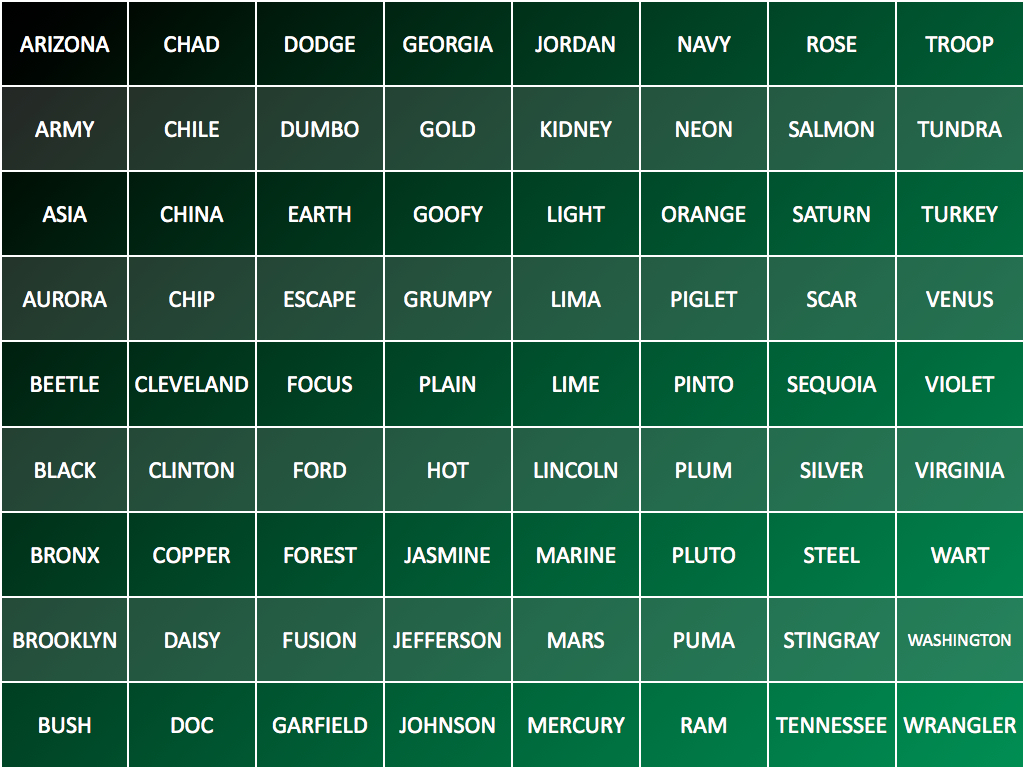
Almost any group of 4 you could create would have some errant fifth member that would fit. And I was VERY adamant that they could not have more than 4 people in a group, no matter how much they asked. So the students needed to use set operations to include or exclude other words. For example, if the students were {Arizona, Brooklyn, Georgia, Virginia} they might say “Our group is the set of x such that x is a girl’s name AND x is a location AND x is NOT Asian.”
Often students would give sentences that weren’t quite precise enough, so I (and later other students in the class) would push back. “Wait! China is a girl’s name and a location.” “Okay, so we’ll add ‘AND x is not Asian.” This caused them to think deeply about what the actual definitions of their group were, and to be careful with being precise. If they weren’t precise enough, they would let other words into their group.
After we got the gist, the groups would then either come up with a description and see if the other students could guess their members OR list their members and see if the other students could figure our their description.
Each round, I had the groups write down on an accompanying sheet their group in Roster Notation, Set Builder Notation, and draw a Venn Diagram where they shaded in where their group lies. So through this I introduce the different notation we use, intersections, and complements. (That left only unions and interval notation for the next day.) I also included pictures of 4-way and 5-way Venn diagrams, in case they needed it.

 James Cleveland-Tran
 The Roots of the Equation