Trying to find math inside everything else

Posts tagged ‘MTBoS’

Discrete Math & Democracy, Weeks 5-6

This time I did purposefully combine two weeks – we had 3 days of no class between them, with the PSAT, a PD day, and a holiday.

We started week 5 with another quiz – they asked for this one to be on paper instead of on the computer, and who was I to go against the will of the people? So below is the quiz I gave:

At this point we wanted to finish off our chart of Methods vs Criteria (except for IIA).

We were able to explain the whether most of the methods passed or failed Condorcet and Anti-Condorcet logically or with a counterexample, but the proof that the Borda Count passes Anti-Condorcet is a little more subtle, and a little more algebraic, so I broke that out into a worksheet.

This led to a good combinatorics connection for me. The standard way to calculate the Borda Count is to assign points based on how many candidates you beat, so if you look at it from the point of view of a ballot, in an election of 5 candidates, e.g., a single ballot gives out 4 + 3 + 2 +1 + 0 = 10 points. But another way to view the Borda Count is that you earn a point from a candidate (as opposed to from the voter/ballot) every time you beat them in a 1v1 match. Well, with 5 candidates, how many possible 1v1 matches are there? 5C2 = 10. Oh wait, that’s the same as before! And shows why the C2 column of the Arithmetic Triangle (sometimes known as Pascal’s) is the Triangle Numbers.

Speaking of combinatorics, the next part was fun. First, we considered how many different ways there are to seed an 8 person tournament. There’s lots of ways to represent this number – my first conception of it involved double factorials!! (Sam was shocked I had found a natural use for double factorials.) Thought the final conception was came up with (n! / 2^k, where k is the number of symmetries in the bracket) was easier to calculate and made more sense.

But the real fun part was thinking, well, if there’s 315 different ways to seed the bracket, is there a way to seed it such that every person can win? So I challenged them to seed the tournament so that A wins, and then so that C wins. (Some candidates couldn’t win, like B and D, because they had fewer wins than the number of matches in the tournament. A and C were possible but harder because they had few paths to victory.)

After this I introduced the concept of a Condorcet method, which tournaments are, despite their manipulability flaw. So I expanded our chart to include the methods we’d be doing soon: Copeland’s, Minimax, Nanson, and Ranked Pairs.

Finally, we had another quiz:

Discrete Math & Democracy, Weeks 3-4

I totally purposefully combined these two weeks because they were short due to holidays, and not because I forgot about week 3. Yep.

First was our first quiz on what we covered in the first 7 days. (My quizzes are always slightly lagging, in all of my classes.) It was…longer than I anticipated. I think my usual metric for how long students need for work doesn’t apply to this class, because it’s so new to them. It was also testing some spreadsheet commands they needed to learn, so I made it an online quiz. I did it by sharing it through Google Classroom, highlighting cells they needed to fill in, and having them turn off their Wi-Fi once they opened the quiz. See below:

https://docs.google.com/spreadsheets/d/1qyLIkmBhQqvS-Zk4VsEivnQuTDUsYn_-BPJbXpW5iFw/edit?usp=sharing

We started off my returning to some of the criteria we looked at for two-candidate systems, now applied to the multi-candidate systems. We started filling out the chart in the first slide below.

We worked through counterexamples for why IRV/et al fails monotonicity, and why Borda and Survivor fail majority. I also discovered this website that both calculates winners and has a bunch of example elections, which has been very handy: https://rob-legrand.github.io/ranked-ballot-voting-calculator/

We also read this argument about why IRV failing monotonicity doesn’t matter: https://archive3.fairvote.org/reforms/instant-runoff-voting/irv-and-the-status-quo/how-instant-runoff-voting-compares-to-alternative-reforms/monotonicity-and-instant-runoff-voting/

Then we got to Condorcet, which took the bulk of our time. We learned how to make pairwise comparison matrices both by hand and using spreadsheets, which we see in the Pairwise Matrices tab of my example spreadsheet: https://docs.google.com/spreadsheets/d/11XoeRwnayoBUOO6psc2n4fGoKtOrDIDmWzkNwLCMKGE/edit?usp=sharing

This took the bulk of the time, and also I realized I needed to give more practice so we did more for the RCV election systems and the matrices.

The last thing we covered was using the pairwise matrix to find the Condorcet winner, loser, and also to resolve the results of a tournament/pairwise agenda election. We hinted at the idea that the person who sets the agenda/seeds the tournament has a lot of power to determine the winner, but that’s an idea we’ll dig into more this week.

Derivative Clicker

I was looking for a derivative-based game to play in Calculus as we were just closing out our first unit on derivatives and the semester was ending. That’s when I found Derivative Clicker:

https://gzgreg.github.io/DerivativeClicker/

It hit the spot with my students. I explained the game and had them all start playing simultaneously, and then saw who had earned the most money in 20-25 minutes. Yes, it’s a little addictive and “brain rot” (as one student said, but, like, it was a positive review) but they had a lot of fun.

The thing about math games, though, is that the real power is not in the game itself but in the debrief. Just the lesson before this was my students’ first exposure to the idea of higher order derivatives. They asked “But what does a second derivative actually tell us about the function” and I explained, but it still felt ungrounded to them. So I thought this would help them feel the power of derivatives viscerally.

Then we filled out some tables: what if I just had a single 1st derivative (or, in other words, f'(t) = 1), how much money would I have after time? What if instead f”(t) = 1? f”'(t) = 1? This helped build up the idea of increasing rate and how the rates grew polynomially.

They also had debate question about strategy – in the game, with $500, you can buy 1 second derivative or 65 1st derivatives. Which is better? (There’s no a clear answer here – if you were to buy the second derivative and then walk away, it’ll probably be better for you by the time you get back. But if you buy the 65 1st derivatives, you’ll have enough money to buy a second derivative way before buying a second derivative will get you 65 1sts.)

Below is the debrief sheet we did today.

Lessons from NCTM, Part I

Oof, well, I certainly meant to write this up sooner, not almost a full month later, but it felt like it took this long just to feel caught up from having missed those three days! That’s definitely a struggle with the conference timing. Anyway, I figured I’d go through some of the sessions I went to, and my notes, as a way to debrief myself but also share any gems I picked up.

Two Students, One Device

I missed the beginning of this session because I went to two other ones first, neither of which worked out, but I knew Liz (Clark-Garvey) wouldn’t let me down (as well as Amanda Ruch and Quinn Ranahan). I’ve used the practice of two students on one device before, but I realized it was natural to do it back when I was at a school where we were using class carts of laptops/tablets, so I could just give one per pair. Now I’m at a school where everyone has their own device, so making them pair up needs to be a more intentional move, and it’s easy to default to not doing that.

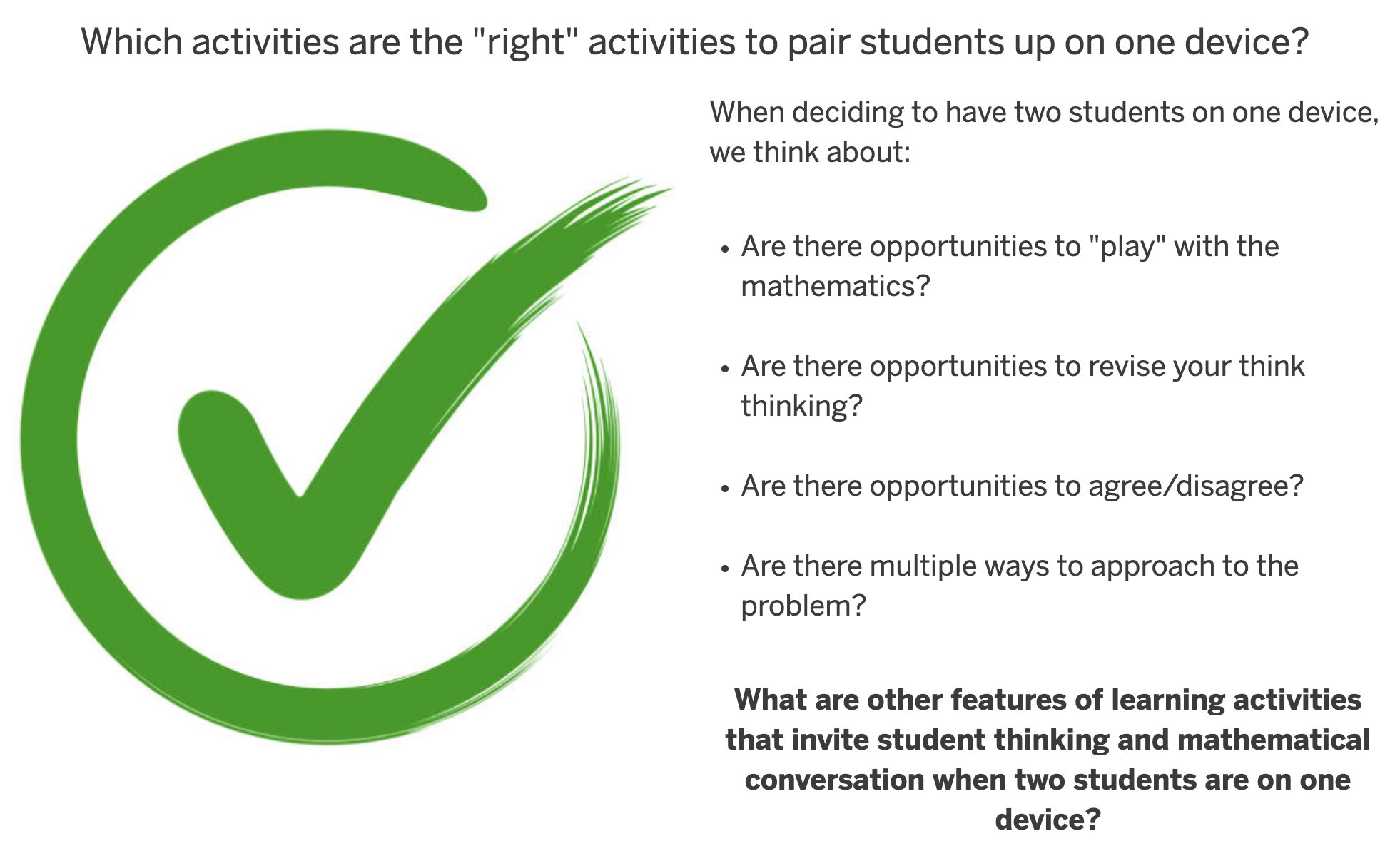
So then the question is, when to do it? If students are doing practice problems on DeltaMath, that doesn’t need to be paired. This is the slide the presenters had for this:

But they also talked about how just choosing the right activity isn’t enough, so other strategies are useful. For example, setting norms such as “type other people’s thoughts, not your own” or mixing up the groups and having them revise their responses.

Fawn

Sure, I could use the title, “Helping Students Become Powerful Math Learners,” but really this was the Fawn session. (Or should I say “The legendary Ms. Nguyen”?) The first quote I wrote down was “The pacing guide does one thing for me – it tells me how behind we are.”

Fawn had four maxims to follow:

  1. Ask students to seek patterns and generalize
  2. Ask students to provide reasoning
  3. Build fluency
  4. Assign non-routine tasks

One routine that stuck out was an open middle-type problem. We had to create the largest product using 5 numbers, 3-digit times 2-digits. Fawn had us all share our possibilities, and then we discussed which possibilities we could remove – someone would nominate one, explain how they knew it wasn’t the greatest (often because it was strictly less than another), and it would be removed only if there was 100% consensus. Then we could narrow it down before we ended up checking the top two choices.

Another thing of note was about the non-routine tasks and games: in particular, they should be non-curricular. This doesn’t mean not based on your curriculum at all, but rather not based on what they just did. This makes sense, as if they are always using the skill they just learned, that turns it into a routine, and thus won’t have the same benefit.

Just Civic Math

I don’t have that many notes from this session, and I don’t see any slides attached on the NCTM website. One note says “Limiting civics to just ‘social justice math’ is restricting. Dialogic math helps.” I think the idea here is similar to what I’ve used before, Ben Blum-Smith’s Math as Democracy. Jenna Laib’s Slow Reveal Graphs were mentioned, and I mentioned the similar graphs.world to the presenter. They also mentioned the book “Constitutional Calculus” which I will look into in the future.

Miscellaneous

Two notes I took on the patty paper session: use felt pens to be more visible on patty paper, and when folding, pinch from the middle and press outwards (more likely to get accurate folds on lines then).

I went to a really cool session on making art using mirrors and laser pointers from Hanan Alyami. Here’s the kite my group made in the time:

The project seemed cool and had some fun math, but I also don’t know when I could fit it in, as it’s a 3-day process.

I tried to go to John Golden’s session on games but it was full! I went to Christopher Danielson’s session on Definitions. Two things stuck out to me there: his reasoning for originally doing a hierarchy of hexagons was that it fought against status issues, since there was no pre-knowledge as with quadrilaterals; when asking if something is a vehicle, something that is so far from one, like a salad, just makes it a fun question, but something closer to an edge case, like a broken bus with no wheels, is harder and more contentious.

Okay, I was gonna keep going, but that seems like a lot – and that was all just Thursday! So maybe I’ll do separate posts for Friday & Saturday.

Integral Limit Game

This year when I was in my intro to integrals unit, I tried to look back at this blog for the second integral game I know I played (besides this one), and saw I hadn’t blogged about it. I had tweeted about it, but now I’m thinking, you know, I should, uh, archive things that I only tweeted about in a more permanent place, in guess Twitter doesn’t last much longer.

Anyway, this game is based on The Product Game, with the same structure of turns – players take turns moving a token on the bottom rows, that then determine which square in the top section, where the first player to get 4 in a row is the winner. (I usually have students play in teams of 2, but I’ll keep saying “player” go forward.)

The idea here is that the bottom rows represent the limits of a definite integral. One player plays as the Upper Limit, and the other as the Lower Limit. Once both limits are placed, the player who most recently went calculates the value of the definite integral on the accompanying graph, then covers the square in the top section with the area. (Remember that if the lower limit is greater than the upper limit, the sign is switched!)

Making the function that would give a variety of answers was a fun challenge. After coming up with a graph I thought looked good, I wound up making an excel sheet to calculate all the possible definite integrals to see how balanced it was, and adjusted.

I’ll include that excel sheet as well, as it’s useful for checking answers (as a teacher), although of course each team should be checking each other. After doing a bunch of different integrals on the same function, students often realize they can use their previous work to help them find new answers, reinforcing the cumulative nature of integrals.

Files

BYORF

One of the other games I made this year was during our rational functions unit: BYORF, which stands for Build Your Own Rational Function. (This was originally a placeholder name, but it kinda grew on me.)

BYORF is a drafting game, a la Sushi Go or 7 Wonders. You play over 2 rounds (because that fit best in our 45 minute period – 3 rounds might be better with more time?), drafting linear factor cards to build into rational functions that match certain criteria. Here’s an example of a round between two players.

In this example, the left player used only 4 of their linear factors (as you don’t need to use all 6). Then we can compare each of the 5 goal cards, which are randomized each round. L has 0 VA left of the y-axis, while R has 2, so that is 3 points to R. L has a hole at (-2, 1/3) while R has a hole at (-1, -2), so L gets 5 pts. They both have a HA at y=-1, so both score those 4. Then we have the two sign analysis cards, which score points if you have that formation somewhere in your sign analysis. R has the first one (around x=3) and both have the second one (L around x=1 and R around x=-3). So after one round, both players are tied with 11 points.

I hope that gets the idea across. The fact that students need to check each other’s work to make sure the points are being allocated correctly builds in a lot of good practice. After we played the game, I did a follow-up assignment to ask some conceptual questions (which is where the above example comes from). I’ve also attached that here.

I hope you have some fun with BYORF!

Letter Scramble

In our combinatorics unit in pre-Calculus, we tend to look at every problem as a letter rearrangement problem. This lets us move beyond permutations and combinations to model any problem involving duplicates. I wanted to build a game that had the students quickly calculate the number of arrangements for a given set of letters, so I came up with Letter Scramble.

The idea behind the game is that students have a set of goal cards with the number of arrangements they want to reach, and a hand of letter cards. On each player’s turn they can play a letter card to change the arrangement, and thus change the total possible number of arrangements. (They can also skip their turn to draw more goal cards, a la Ticket to Ride.)

I calculated all the possible answers you could get using 7 different letters and up to 8 slots, including if some of those slots are blank (and thus make disjoint groups), then determined which of those answers repeat at least once, and assigned them scores based on that.

Possible numbers of arrangements on the left, how many times they repeat in the second column, and the points I assigned them in the third.

One interesting thing about the gameplay is it promoted relational thinking. Instead of calculating each problem from scratch, you can based it on the previous answer you calculated. (So, for example, if the board read AABBCD, that would be 6!/(2!2!) = 180. But if you change that to AABBBD, one of the denominator’s 2! changes to 3!, which is the same as dividing by 3, so it’s equal to 60. No need to calculate 6!/(2!3!) directly.

Some examples of scored goals:

1! * 3!/2! = 3
5!/(2!3!) = 10

The Integral Struggle

I had an extra day to fill for one of my sections of calculus, thanks to the PSAT, so I set about thinking up a game I could play. I gotta tell you, as much as there is a paucity of good content-related math games out there, it’s extra so as you move up the years in high school. I can still find a good amount of algebra and geometry games online, but Algebra 2? Precalc? Calc? Fuhgeddaboutit. Well, I’m teaching both Pre-Calc and Calc this year, so I guess I’ll just have to make them myself. (I brainstormed two more during said PSAT, so those might happen soon enough.)

Starting layout for The Integral Struggle

We just covered function transformations and how they affected integrals, so this game hits on that topic. (Yeah, we’re doing integrals first.) Here’s how it works: there are 3 functions/graphs, each of which has a total area of 0 on the interval [–10,10]. One team is Team Positive, and the other is Team Negative. Teams take turns placing numbers from –9 to 9 that transform the function and therefore transform the area. Most importantly, they also place the numbers in the limits of integration, so they can just look at a specific part of the graph.

With three functions, it becomes a matter of best of 3 – if the final integral evaluates to a positive number, Team Positive gets a point, and vice versa. If it’s a tie at the end of the game, because one or more of the integrals evaluated to 0 or were undefined, then redo those specific integrals. (I discussed with the students whether it would be better to have it be the total value of all 3 integrals instead of best of 3, but I think that makes the vertical stretch too powerful.)

That’s it! Let me know what you think. Materials below.

Remote Teaching Math Games

I love playing math games with my students, but it’s been hard with remote teaching because so many games require physical objects. I’ve been able to play a bunch using a shared whiteboard, but there’s a limit to how many work in that method. I just discovered http://playingcards.io, though, which is a platform for playing card games online with anyone. They have built in games, but you can customize your own. I’ve taken several from the #MTBoS and my own blog and made them.

To use these files, first create a custom room. Then enter edit mode:

In the Room Options Menu, you can import a file. So download the file you want from here and import it there and the game is ready to go. You can then share the room code with students, and you can even make multiple rooms for different groups of students and jump between them.

For each game, click the image to go to the original blog post, and the title for the pcio file.

Games

Factor Draft

Math Taboo

Fraction Catch

Trig War, Log War, Inverse Trig War

Integer Deck

This last one isn’t a game so much as a resource for many other math games. It’s an integer deck, consisting of cards from -12 to 12 of each suit (and an extra 0 for each.) I colored the suits using a colorblind-friendly color palette, on top of the symbols. You can easily edit the deck (enter edit mode, then click on the deck) to remove cards from the deck or change the particular cards. It can be used for a lot of games – and helps avoid the problem of kids wondering what J, Q, and K mean. It would be a good deck to use for, say, Fighting for the Center or these Integer Games.

Things I’ve Changed This Year

When I think back on my first five years of teaching, I can identify big initiatives that I took and tried each year.

  • My first year – well, it was my first year, everything was new. But I was implementing stnadards-based grading as sorta my big thing.
  • My second year, I was very focused on interdisciplinary work, creating cross-curricular lessons with my colleagues, and implementing all this new 3-Act and other stuff I had just started to find on the internet.
  • My third year, I structured my class around math labs and introduce the interactive notebook after I learned about it at TMC12.
  • My fourth year, I overhauled my grading system.
  • My fifth year, I introduced the Standards of Practice portfolios as a way to grade on those standards and, thus, have them be valued in my class. To go along with that, I had a new way to give feedback, instead of writing grades on assignments.

And this year? My big initiative? I don’t have one. It’s felt weird. Every year these big things I was trying and perfecting felt like steps I was taking towards becoming a better teacher. And if I didn’t have one this year, was I stagnating?

No. (I say it confidently now, but it took a lot of reminding myself.) First of all, my big initiative this year was teaching Calculus and Geometry for the first time. I had taught Algebra I for the whole first 5 years of my career, and the bulk of my student teaching as well. Despite the switch to the Common Core curriculum, I was still very familiar with the ins and outs of the material, and that let me focus on other things. But teaching a new course is a lot! And two, twice as much!

But, even with that…I still tried new things, tuned things, had small initiatives. And these things matter! So I’m writing a list of new things I’ve done, to remind myself. And also to keep looking forward, for new initiatives – as Black Widow says, “There is no mastery, only constant improvement.”

  • I greet my students at the door every day with a high five.
  • With the other hand, I have them pick a card so they can find their seat with their visibly random grouping.
  • I put up new boards on my walls to have even more surfaces for the students, and designed lessons around using them, facilitating group collaboration more than usual.
  • Instead of saying “Ladies and Gentlemen” to address the class, I now say “Mathematicians” (or “Computer Scientists”), to keep a gender neutral term.
  • I swapped out the Name spot on my assignments for one that says Mathematician.
  • I had up a “Good Questions” bulletin board, after going to Rachel’s session on better questioning (couldn’t find a link for this one) for a while during the year.
  • And I’ve continued the initiatives from the last two years, which were raw in idea but are now becoming fully realized structures, as I find better and more sustainable ways to do them.

I bet you’ve done a lot this year, too. More than you realize.