Trying to find math inside everything else

Posts tagged ‘civics’

Discrete Math & Democracy, Weeks 5-6

This time I did purposefully combine two weeks – we had 3 days of no class between them, with the PSAT, a PD day, and a holiday.

We started week 5 with another quiz – they asked for this one to be on paper instead of on the computer, and who was I to go against the will of the people? So below is the quiz I gave:

At this point we wanted to finish off our chart of Methods vs Criteria (except for IIA).

We were able to explain the whether most of the methods passed or failed Condorcet and Anti-Condorcet logically or with a counterexample, but the proof that the Borda Count passes Anti-Condorcet is a little more subtle, and a little more algebraic, so I broke that out into a worksheet.

This led to a good combinatorics connection for me. The standard way to calculate the Borda Count is to assign points based on how many candidates you beat, so if you look at it from the point of view of a ballot, in an election of 5 candidates, e.g., a single ballot gives out 4 + 3 + 2 +1 + 0 = 10 points. But another way to view the Borda Count is that you earn a point from a candidate (as opposed to from the voter/ballot) every time you beat them in a 1v1 match. Well, with 5 candidates, how many possible 1v1 matches are there? 5C2 = 10. Oh wait, that’s the same as before! And shows why the C2 column of the Arithmetic Triangle (sometimes known as Pascal’s) is the Triangle Numbers.

Speaking of combinatorics, the next part was fun. First, we considered how many different ways there are to seed an 8 person tournament. There’s lots of ways to represent this number – my first conception of it involved double factorials!! (Sam was shocked I had found a natural use for double factorials.) Thought the final conception was came up with (n! / 2^k, where k is the number of symmetries in the bracket) was easier to calculate and made more sense.

But the real fun part was thinking, well, if there’s 315 different ways to seed the bracket, is there a way to seed it such that every person can win? So I challenged them to seed the tournament so that A wins, and then so that C wins. (Some candidates couldn’t win, like B and D, because they had fewer wins than the number of matches in the tournament. A and C were possible but harder because they had few paths to victory.)

After this I introduced the concept of a Condorcet method, which tournaments are, despite their manipulability flaw. So I expanded our chart to include the methods we’d be doing soon: Copeland’s, Minimax, Nanson, and Ranked Pairs.

Finally, we had another quiz:
Discrete Math & Democracy, Weeks 3-4

I totally purposefully combined these two weeks because they were short due to holidays, and not because I forgot about week 3. Yep.

First was our first quiz on what we covered in the first 7 days. (My quizzes are always slightly lagging, in all of my classes.) It was…longer than I anticipated. I think my usual metric for how long students need for work doesn’t apply to this class, because it’s so new to them. It was also testing some spreadsheet commands they needed to learn, so I made it an online quiz. I did it by sharing it through Google Classroom, highlighting cells they needed to fill in, and having them turn off their Wi-Fi once they opened the quiz. See below:

https://docs.google.com/spreadsheets/d/1qyLIkmBhQqvS-Zk4VsEivnQuTDUsYn_-BPJbXpW5iFw/edit?usp=sharing

We started off my returning to some of the criteria we looked at for two-candidate systems, now applied to the multi-candidate systems. We started filling out the chart in the first slide below.

We worked through counterexamples for why IRV/et al fails monotonicity, and why Borda and Survivor fail majority. I also discovered this website that both calculates winners and has a bunch of example elections, which has been very handy: https://rob-legrand.github.io/ranked-ballot-voting-calculator/

We also read this argument about why IRV failing monotonicity doesn’t matter: https://archive3.fairvote.org/reforms/instant-runoff-voting/irv-and-the-status-quo/how-instant-runoff-voting-compares-to-alternative-reforms/monotonicity-and-instant-runoff-voting/

Then we got to Condorcet, which took the bulk of our time. We learned how to make pairwise comparison matrices both by hand and using spreadsheets, which we see in the Pairwise Matrices tab of my example spreadsheet: https://docs.google.com/spreadsheets/d/11XoeRwnayoBUOO6psc2n4fGoKtOrDIDmWzkNwLCMKGE/edit?usp=sharing

This took the bulk of the time, and also I realized I needed to give more practice so we did more for the RCV election systems and the matrices.

The last thing we covered was using the pairwise matrix to find the Condorcet winner, loser, and also to resolve the results of a tournament/pairwise agenda election. We hinted at the idea that the person who sets the agenda/seeds the tournament has a lot of power to determine the winner, but that’s an idea we’ll dig into more this week.

Discrete Math and Democracy, Week 2

So we ended the first week with a proof of May’s Theorem, but really only in the case of an even number of votes. I assigned the proof with an odd number for homework, and none of them where able to quite get it on their own but a majority got close.

(As an aside, here’s the chart I mentioned that we did in the previous post, but filled in.)

Then we started talking about voting systems with three or more candidates. In particular, not only how to tabulate the winner by hand, but how to tabulate automatically using spreadsheets. First, the slides:

When I first worked on these problems over the summer, my spreadsheet solutions were definitely…inelegant, let’s say. Compare what I did then vs. what I did this week with the students.

Summer: https://docs.google.com/spreadsheets/d/1Z0s_cQ9vAUZRDTXB_8BFCNlbjrrjVo8aoW8fjm9XH7Y/edit?gid=2074741057#gid=2074741057

Better: https://docs.google.com/spreadsheets/d/11XoeRwnayoBUOO6psc2n4fGoKtOrDIDmWzkNwLCMKGE/edit?gid=0#gid=0

What’s especially nice about the newer version is how it displays who wins or is eliminated in a particular round – learning the XLOOKUP command was pretty hand.

Anyway, going through those methods and implementing them in spreadsheets took the whole week, on top of additional practice with the second election preference schedule. (We did the Apple one as a class and then I assigned them the Alli/Bell/Choi/Diaz one to do on their own.)

Discrete Math & Democracy, Week 1

This year I’m teaching a new class called Discrete Math and Democracy, which is a course I’ve wanted to teach for a long time, ever since I helped my ex prepare to teach a similar course at his university. I spent a lot of time learning things and gathering materials over the summer, including ones I got from previous workshops at Math for America. I thought about doing a Blog180 to document my time teaching the course, but that’s not the kind of blog this is, so I figure I’ll debrief somewhere more private and then do weekly updates here, along with any materials I use. (Hopefully I can still squeeze in some other posts on other topics in the meantime.)

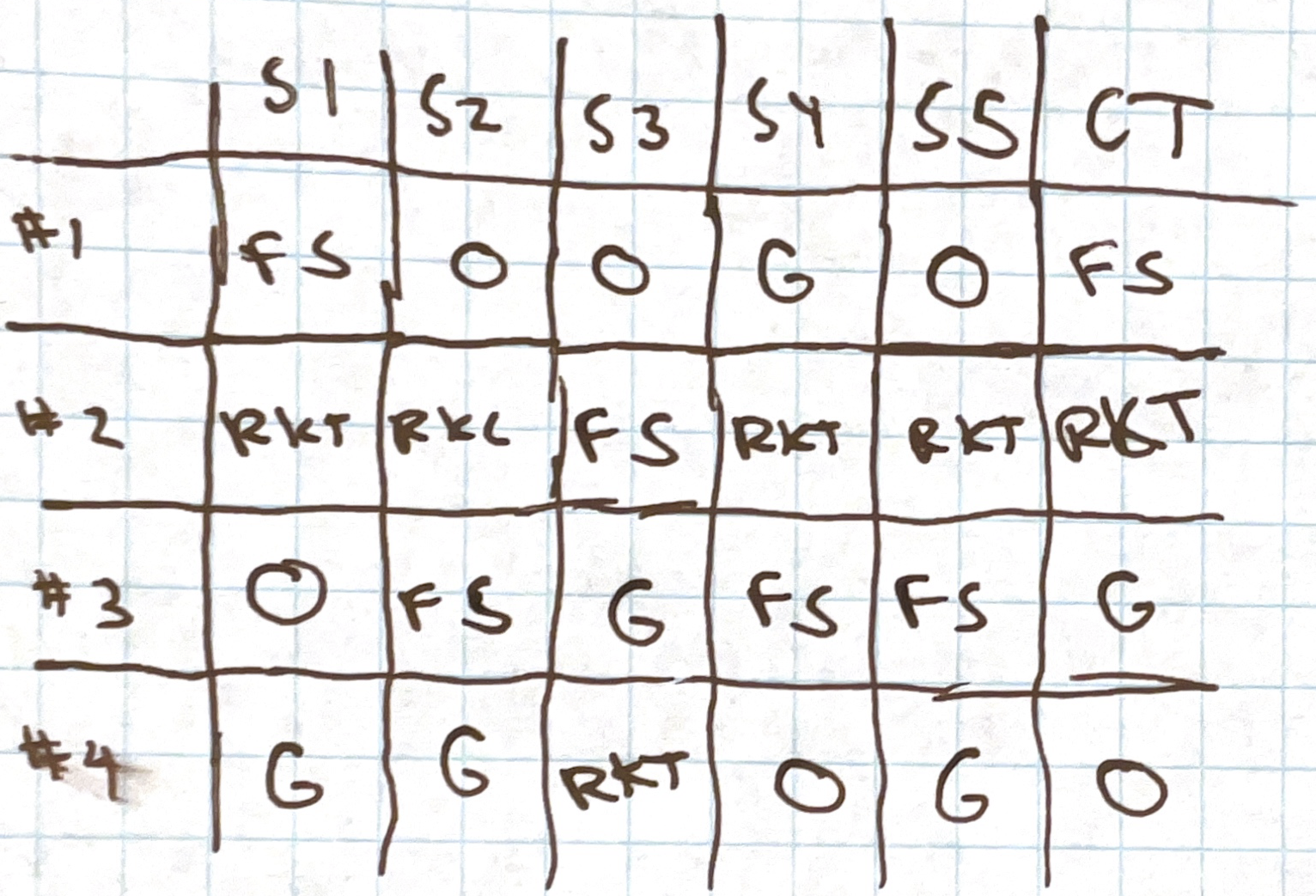
The first day I started off asking the students to think of a process for choosing a snack. They suggested each person suggesting a snack and then we’d decide, so we got straight to the idea of nominating candidates. At first three people were going to make the same nomination (Oreos) so it seemed like that might be the winner, but then I had them make preference ballots for our four candidates. The voting profile for those are below.

It became clear that while Oreos were the plurality winner, Rice Krispies Treats were more of the consensus choice, so we right away had a tension between what they might have expected for a voting system and what might be “right,” so that couldn’t have worked out better. I then had them read this article on different kinds of distributive justice by Matt Bruenig to help get at the idea that there are different ways to structure society that all have merit, and a similar thing applies to electoral systems as well. We need to know what our goals are before we can decide on a best system.

The next day, Rice Krispies Treats in hand, we looked at a tabulated voting profile and I gave them the challenge of coming up with a reasonable way to count the votes such that each candidate can be the winner. (This is adapted from a material I got from a workshop so long ago I don’t remember which, although it was probably led by Kate Belin.) I turned it into the worksheet below:

The students were able to come up with equivalents to plurality and Borda count on their own, as well as a system where they counted all #1 & #2 votes (which I guess could be equivalent to a kind of approval voting). They needed a little hint to get Edamame and Bagels to win. (Spoiler: it’s IRV and Top Two Runoff.)

After that I had them learn some basics of spreadsheets, as we’ll be doing a lot of work with them, using this wonderful tutorial by Jed Williams.

Next, I pared it back to two-candidate election systems and we looked at various kinds and what properties they have.

I was reminded of the important of having examples and, even better, non-examples. An important social choice theorem is May’s Theorem that states that the only two-candidate system that is anonymous (treats all voters equally), neutral (treats all candidates equally), monotone (you can’t lose by gaining more votes), and nearly decisive (always has a victor unless the candidates have the same number of votes) is a simple majority.

But simple majority is such a basic and obvious system that it’s hard to see why this theorem is a big deal, and often the only counterexamples given in textbooks are dictatorship and monarchy, which are obviously antidemocratic. But I found a new book (A Mathematical Look at Politics) that gives a few more examples of systems that are reasonably democratic but don’t have all of those properties, which helped clarify it.

They are supermajority (you need a higher threshold to win, like 2/3 of states to pass an amendment), status quo (if a challenger doesn’t get a certain number of votes, the status quo wins – this is how the filibuster works), and probabilistic (a winner is chosen at random, with more votes increasing odds).

Filling out the chart was a good exercise, though how to determine the properties of probabilistic systems was a little tricky.

Lastly, we worked on another sheet where we worked out the winner with several systems, and then proved May’s Theorem with a few fill-in-the-blanks.

The proof actually went quite well! It took me a while to wrap my head around it when I read it myself, but I think the blanks helped us consider the various properties and how it works. (This proof is for an even number of voters, so I had them do the other case, with odd, for homework.)

Off to a good start!