Trying to find math inside everything else

I feel like anyone who reads my blog will have seen this elsewhere, but the more the better!

We are starting our gear up for TMC14, which will be at Jenks High School in Jenks, OK (outside of Tulsa – map is here) from Thursday, July 24 through Sunday, July 27, 2014. We are looking forward to a great event. Part of what makes TMC special is the wonderful presentations we have from math teachers who are facing the same challenges that we all are.


To get an idea of what the community is interested in hearing about and/or learning about we set up a Google Doc (http://bit.ly/TMC14-1). It’s an open GDoc for people to list their interests and someone who might be good to present that topic. If multiple people were interested in a session idea, he/she added a “+1” after it. The doc is still open for editing, so if you have an idea of what you’d like to see someone else present as you’re writing your own proposal, feel free to add it!


This conference is by teachers, for teachers. That means we need you to present. Yes, you! What can you share that you do in your classroom that others can learn from? Presentations can be anything from a strategy you use to how you organize your entire curriculum. Anything someone has ever asked you about is something worth sharing. And that thing that no one has asked about but you wish they would? That’s worth sharing too. Once you’ve decided on a topic, come up with a title and description and submit the form.


If you have an idea for something short (between 5 and 15 minutes) to share, plan on doing a My Favorite. Those will be submitted at a later date.


The deadline for submitting your TMC Speaker Proposal is January 20, 2014. This is a firm deadline since we will reserve spots for all presenters before we begin to open registration on February 1, 2014.


Thank you for your interest!

Team TMC – Lisa Henry, Lead Organizer, Shelli Temple, Justin Aion, Mary Bourassa, Tina Cardone, James Cleveland, Cortni Kemlage, Jami Packer, Anthony Rossetti, and Glenn Waddell

So since I first had my students play DragonBox last year, We Want to Know came out with a sequel, DragonBox 2. They are now branded as 5+ and 12+, as the original DragonBox is intended to introduce the idea of algebra and solving equations to someone unfamiliar with it, while DragonBox 2 is meant to deepen the equation-solving toolbox of someone already familiar with solving equations, allowing them to deal with more complex equations.

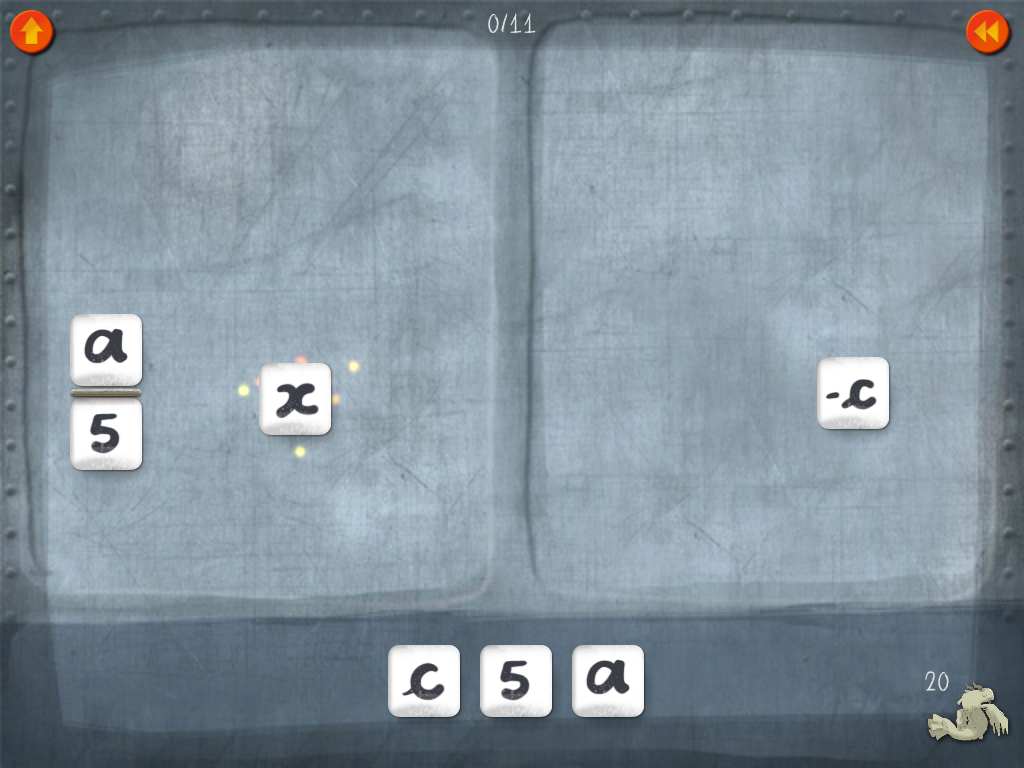
I was trying to decide which one to use with my class this year. It seemed like DragonBox2 would be better at first glance, because I teach high schoolers: we have seen basic equations, and now we need to kick it up a notch. But I wound up going with DragonBox 1, saving the sequel for a handful of students who blazed through it and were advanced. I know I made the right choice because of situations like I tweeted about:

5-18

There were several students who could solve the first level (one of the hardest in the game), but not the second, which came later. This showed me that there was something about the structure of an equation that wasn’t getting through and that we needed to work on it.

In DragonBox 1, you only really have four abilities: you can combine inverses into 0, you can divide a card by itself to get 1, you can add a card from the deck to the game (one on each side), and you can attach a card from the deck to another (multiplication/division), as long as you do it to every card in the level. In DragonBox 2, you can do new things like flip a card from one side to the other, divide a night version by a day version (leaving negative 1), combine like terms, factor out common terms, and treat complex expressions as single units to multiply/divide by.

Those are all good things to do, and someone proficient in algebra should be able to do those things. But I backed away from using it in class because it lacked the why. At the end of the first DragonBox lesson, I compile the notes students took while playing to make a comprehensive list of rules and abilities you have in the game. The one student who played DragonBox2 insisted that, in the game, you can slide a card from one side to the other. No matter how much I pressed him, he didn’t see that the card wasn’t sliding over, it was flipping/inverting.

And that’s what I was afraid of by using DragonBox2. These tools are important, but they have to be earned by understanding them. DragonBox2 gives them to you by completing previous levels, not necessarily by understanding how. At the least, in DragonBox 1, because you are stuck with the basics, you have to grapple with where the solutions come from. They can’t magically appear.

So while DragonBox2 is rated as 12+, I wouldn’t give it to any student who didn’t already have a firm grasp on the concept of equality. Maybe post-Algebra 1. Or at least not until much later in the year.

Set Building Game

(For Explore MTBoS Mission #1)

So I came up with this semi-game last year, based on Frank Noschese’s Subversive Lab Grouping activity. My students had already done that activity at the beginning of the year, so they were familiar with the cards and the idea that the groups were not always what they appeared.

This time, I gave each student a badge that had two words on it: one word on the front, and one word on the back. I asked the students to create groups of 3-4 students using either of their two words. After they formed a group, they had to come up with a description of their group that applied to ALL of their members but ONLY to their members.

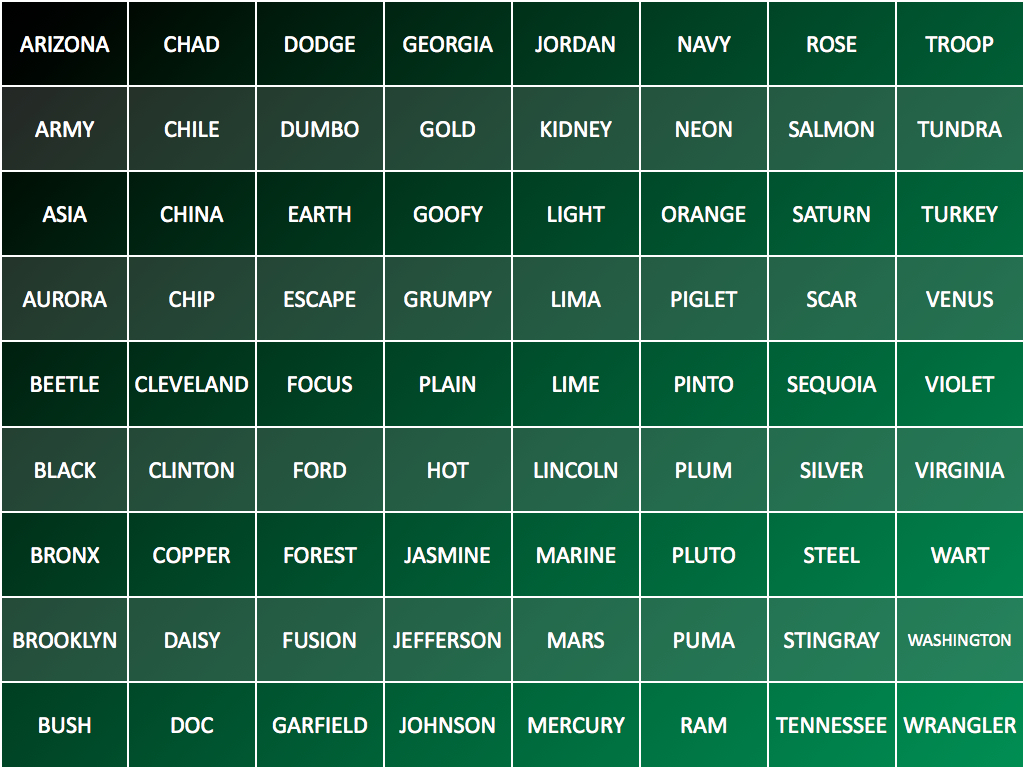
This was tricky because of the set of words that I chose, which I had displayed at the front of the room. Set Game List.007

Almost any group of 4 you could create would have some errant fifth member that would fit. And I was VERY adamant that they could not have more than 4 people in a group, no matter how much they asked. So the students needed to use set operations to include or exclude other words. For example, if the students were {Arizona, Brooklyn, Georgia, Virginia} they might say “Our group is the set of x such that x is a girl’s name AND x is a location AND x is NOT Asian.”

Often students would give sentences that weren’t quite precise enough, so I (and later other students in the class) would push back. “Wait! China is a girl’s name and a location.” “Okay, so we’ll add ‘AND x is not Asian.” This caused them to think deeply about what the actual definitions of their group were, and to be careful with being precise. If they weren’t precise enough, they would let other words into their group.

After we got the gist, the groups would then either come up with a description and see if the other students could guess their members OR list their members and see if the other students could figure our their description.

Each round, I had the groups write down on an accompanying sheet their group in Roster Notation, Set Builder Notation, and draw a Venn Diagram where they shaded in where their group lies. So through this I introduce the different notation we use, intersections, and complements. (That left only unions and interval notation for the next day.) I also included pictures of 4-way and 5-way Venn diagrams, in case they needed it.

Stuff

Set Cards (pdf – formatted for name-tag size)

Set Game Worksheet (pdf)

Set Game Worksheet (pages)

So my grading experiment has been going on for a month now, and so far I think it’s going well. But I was pretty stressed about getting it up and running, because a lot of the work was front-loaded. The thing I was particularly working to get done was my mega-rubric. I wanted to make a rubric that showed what exactly students needed to prove they understand to move up a level in a particular learning goal.

So here’s what I made (I call it the SPELS Book to go along with the students’ SPELS sheet):

I started by making the proficient categories, and for the first 8 (The Habits of Mind/Standards of Practice) it was pretty easy to scale them down to Novice, and then to add an additional high-level habit to become masters.

I was stuck, though, on the more Skill-Based Standards. I had all the things I wanted the students to show in each category, but how do I denote if they “sometimes” show me they can graph a linear equation? If I was doing quizzes all the time, like in the past, I could say something like “70% correct shows Apprentice levels.” But I wasn’t, and it seemed like a nightmare to keep track of across varying assignments.

So instead, my co-teacher had the idea that, if each topic had 4 sub-skills that I wanted them to know, we could rank them from easiest to hardest and just have that be the levels. So my system inadvertently became a binary SBG system, but still with the SBG and Level Up shell. Now if a student shows they understand a sub-skill, they level up. If they don’t, I write a comment on their assignment giving advice on what they should do in the future. What remains to be seen is how much they take me up on that advice. We’ll see.

Also, I’d LOVE any feedback you have on the rubric, and how I can improve it. Thanks!

Downloads

SPELS Book (pdf)

Updated Student Character Sheet (pdf)

Updated Student Character Sheet (pages)

Slow Rollout

This year has been weird so far. In the past the first week with actual students has never been a full week, usually just 1 or 2 days. So we’ll have some intro days, do intro stuff, and then head full steam into math class the next week. Last year September was so disjointed because of the Jewish holidays that we couldn’t even really get started.

This year, we started with a full week, and have 5 weeks straight of 5-day weeks before the first day off. So because we didn’t have weird intro days and odd days around holidays, I didn’t have a day introducing my class and systems, and instead went straight into math. I also have a lot more systems and routines now then I did in the past. So what I’ve wound up doing was introducing basically one new overarching idea or routine each class.

First class, Habits of Mind survey, then we did the Broken Calculator. (I’ve decided to loosely follow Geoff Krall’s PBL curriculum.) Next class, I introduce my new grading system (hope it works!) and then had to give them a stupid baseline assessment the city demanded. Next time, we set up our Interactive Notebooks, then did the Mullet Ratio. Today, I handed out the rubrics I’m going to be use to grade them (more on that next post), as well as introducing them to Estimation 180, and then we finished with day 2 of the Mullet Ratio. So every class has been a little routine, a little math. But I kind like it. We’ve been building up how the class works, layering it on. By the end of the month, we should be full steam ahead.

For the past three years, I’ve loosely organized my classroom around the Mathematical Habits of Mind which I first read about in grad school at Bard. I would give the students a survey to determine which habits are their strengths and which are their weaknesses, group them so each group have many strengths, and go from there. Last year I even used the habits as the names of some of my learning goals in my grading.

As I was planning for this year and the transition to the Common Core, I was thinking about how to assess and promote the Standards of Practice. And I realized that they are very similar to what I was already doing with the Habits of Mind. In fact, having a habit of mind would often lead to performing a certain practice! In that way, the SoP are actually the benchmarks by which I can determine if the habits of mind are being used.

Let me demonstrate:

Students should be pattern sniffers. This one is fairly straight-forward. SoP7 demands that students look for and make use of structure. What else is structure but patterns? Those patterns are the very fabric of what we explore when we do math, and discovering them is what leads to even greater conclusions.

Students should be experimenters. The article mentions that students should try large or small numbers, vary parameters, record results, etc. But now think about SoP1 – Make Sense of Problems and Persevere in Solving Them. How else do you do that except by experimenting? Especially if we are talking about a real problem and not just an exercise, mathematicians make things concrete and try out things to they can find patterns and make conjectures. It’s only after they have done that that they can move forward with solving a problem. And if they are stuck…they try something else! Experimenting is the best way to persevere.

Students should be describers. There are many ways mathematicians describe what they do, but one of the most is to Attend to Precision (as evidenced in things like the Peanut Butter & Jelly activity, depending on how you do it.) Students should practice saying what they mean in a way that is understandable to everyone listening. Precision is important for a good describer so that everyone listening or reading thinks the same thing. How else to properly share your mathematical thinking?

Students should be tinkerers. Okay, this one is my weakest connection, mostly because I did the other 7 first and these two were left. But maybe that’s mostly because I don’t think SoP5 is all that great. Being a tinkerer, however, is at the heart of mathematics itself. It is the question “What happens when I do this?” Using Tools Strategically is related in that it helps us lever that situation, helping us find out the answer so that we can move on to experimenting and conjecturing.

Students should be inventors. When we tinker and experiment, we discover interesting facts. But those facts remain nothing but interesting until the inventor comes up with a way to use them. Once a student notices a pattern about, saying, what happens whenever they multiply out two terms with the same base but different exponents, they can create a better, faster way of doing it. This is exactly what SoP8 asks.

Students should be visualizers. The article takes care to distinguish between visualizing things that are inherently visual (such as picturing your house) to visualizing a process by creating a visual analog that to process ideas and to clarify their meaning. This process is central to Modeling with Mathematics (SoP4). It is very difficult to model a process algebraically if you cannot see what is going on as variables change. To model, one must first visualize.

Students should be conjecturers. Students need to make conjectures not just from data but from a deeper understanding of the processes involved. SoP3 asks students to construct viable arguments (conjectures) and critique the reasoning of others. Notable, the habit of mind asks that students be able to critique their own reasoning, in order to push it further.

Students should be guessers. Of course, when we talk about guessing as math teachers, we really mean estimating. The difference between the two is a level of reasonableness. We always want to ask “What is too high? What is too low? Take a guess between.” Those guesses give use a great starting point for a problem. But how do you know what is too high? By Reasoning Abstractly and Quantitatively, SoP2. Building that number sense of a reasonable range strengthens our mathematical ability. We need to consider what units are involved and know what the numbers actually mean to do this.

What we do, or practice, as mathematicians is important, but what’s more important is how we go about things, and why. A common problem found in the math class is students not knowing where to begin. But if a student can develop these habits of mind, through practice, that should never be a problem.

Yesterday was my best friend’s birthday and his wife got him the game We Didn’t Playtest This At All, which is a very silly game that was tons of fun. (We probably played it about 15 times.) The point of the game is to win or, barring that, to make everyone else lose. And that’s all the rules there are, other than Draw 1, Play 1. Everything else is in the cards.

One set of cards in the game has players all throw out 1 to 5 fingers on the count of three:

Huh, I just noticed that it's a Star Card, so you actually know if that's the one the person is playing!

Since you don’t know what card they are playing, even and odd really don’t matter. But winning on a prime…that’s interesting.

As I was leaving, I started to wonder if there was a best number you could throw out to maximize your chances of winnings (or, alternately, stopping to person who played the card from winning). Talking about it with another math teacher who was there, I hypothesized that, because of the lower density of prime numbers as numbers get larger, you’d want to throw smaller numbers to increase your chances of getting a prime.

But, of course, I couldn’t just leave that conjecture. I had to test it! For the purposes of this, I assumed all other players besides yourself throw out a random number of fingers, essentially becoming 5-sided dice.

It’s pretty simple to compute for two players:

  • If I throw out a 1, it’ll be prime if my opponent throws 1, 2, or 4.
  • If I throw 2, she needs to throw 1, 3, or 5.
  • If I throw 3, she needs to throw 2 or 4.
  • If I throw 4, she needs to throw a 1 or 3.
  • If I throw a 5, she needs to throw a 2.

This supports my hypothesis: throwing a 1 or 2 increase the odds of a prime, and a 5 radically decreases them. (Of course, then we can get all game theoretical — if I know you’re gonna throw 5, I should throw 2. But then, if you know that, you should throw 4, etc.)

What about for more than 2 players? The game box says we can have up to 10. I worked it out somewhat in my notebook on my train ride home, but then I had the power of Excel. (It actually took me longer than I would like to admit to re-figure out how to find the probabilities of, say, getting a total of 12 when 3 people throw out. I was counting up all the possibilities for a while until I realized the recursive method for calculating those probabilities. And if Wolfram-Alpha hadn’t been so hard to use in this regard, I might not have figured it out myself.)

Three to Five Players

On the left are the probabilities that you opponents’ total will be a certain number. On the right is the number of ways you can get prime if you throw out that number.

 For three players, 1 is still the champ is terms of getting you a prime, but surprisingly, 5 is second place! What had been the worst number to throw out to get primes for 2 players is now the second best with 3 players. And for 4 players, 1 and 5 are actually the worst (though only slightly), with 2, 3, and 4 coming out on top. But at this point, it’s pretty balanced. 5 players is almost equally likely no matter what you throw. It’s almost as if they playtested this?

But now, the pattern emerges.

But now, the pattern emerges.

When I extended to 6 or 7 players, though, it became clear that 1 really was the true winner and 5 the worst. Once we were out of the weeds of the prime-heavy teens, the hypothesis seems more true. (It also holds for 8 players.) Of course, I haven’t proven that it will always be true for 6+ players…but I leave that as an exercise to the reader.


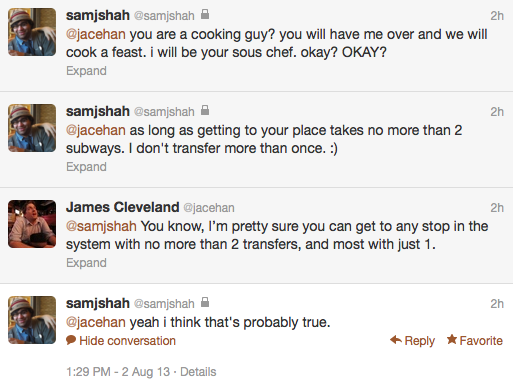
I was talking with Sam Shah and had the following exchange: Screen shot 2013-08-02 at 4.04.11 PM

Of course, after I said that…I had to find out if it was actually true. So I pulled up a map of the subway system and started analyzing.

I realized the best way to analyze the system would be to create a matrix of connections: if I can transfer directly between two lines (or the walking transfer from 59th St/Lex to 63rd/Lex, since you don’t need to pay again), then put a 1 and make the cell green. If not, put a 0 and leave the cell white. That’ll show a chart of all the places you can get to on a single transfer.

One Transfer

Most of the lines have direct transfers, with a few being tricky. Breakout stars are the A, which connects with all but the 6, and the F, N, and R, which only miss some or all of the shuttles. Particularly difficult train lines are the G, the J, and the 6.

So this answers the question of where you can get with only 1 transfer. But what about two transfers? For that, we can multiply this matrix by itself. This is the result:

Two Transfers

What do these numbers mean? Well, to explain, let’s look at the G –> 6, which I have highlighted in blue. The number there is 8. This means that there are 8 ways to get from the G to the 6 with two transfers:

G –> 7 –> 6
G –> D –> 6
G –> E –> 6
G –> F –> 6
G –> L –> 6
G –> M –> 6
G –> N –> 6
G –> R –> 6

So this chart shows that you can get from any line to any other with at most two transfers*, with one exception: the Rockaway Shuttle to the 6. However! Those stops aren’t solely serviced by the S. (The only stop in the system solely serviced by an S train is Park Pl, on the Franklin Ave Shuttle.)

A Service

Because of that, I can amend my statement to the following, which I have proven true:

During rush hour, you can get from any stop on the subway to any other with a maximum of two transfers.

But then, that gets me wondering further…this chart was just made if the connections exist, but they weren’t time-sensitive. For example, the M does not run at my stop at nights or on weekends. How would that change this chart? Especially when you consider that the E, which does not normally go to my stop, DOES at night. I leave that problem open.

———————–

* Of course, fewer transfers doesn't always mean better. If I wanted to get 
from Astoria to Greenpoint, sure, I could take the N to the G, but that 
requires going all the way through Manhattan, way down into Brooklyn, and 
then back up. Instead, a quick hop from the N to the 7 to the G is much 
more sensible, even if it is an extra transfer.

Excel File - Subway Analysis

Twitter Math Camp has come and gone, and once again it was truly amazing. The energy of all these other exuberant math teachers just recharges my batteries and gets me ready to go again. (Ironically I go on vacation in exactly one week, but I think this will be a productive week!)

I don’t feel that I learned as much at #TMC13 as I did at #TMC12, but that makes sense to me. Before last year I was only at the edge of the #MTBoS. I had only discovered Dan the summer before and was only following a handful of people by the time TMC12 came around. But after that, I dove in with full force, and absorbed so much great teaching. So this year, when TMC13 came about, I was more up to date and had less to learn.

What I did notice instead was that TMC13 was much more collaborative in nature. Last year, there was a focus on sharing things we knew, and exploring new math (the Exeter problems) together. That was still present this year, but so many sessions I went to focused on creating things together. I look forward to many of those projects coming to fruition (and have a lot of work to do on my half to make that happen).

It makes me wonder at the direction TMC will take next year. I have no idea, and that’s exciting.


Math Games

Back in January I participated in a panel on Math Games over at the Global Math. I meant to write this follow-up post shortly after, but January was a hell of a month for me and it slipped to the wayside. See my talk here, at the 2:55 mark.

I sorta hit the same point over and over, using six different games as examples, but that’s because I truly believe it is the most important point in both designing math games as well as choosing which games to use in your classroom. If the math action required is separate from the game action performed, then it will seem forced and lead students to believe that math is useless.

Global Math - Math Games.003This can be fine if you want. Maybe you want to play a trivia game, where the knowledge action is separate from the game action. But if you pretend that they are the same, then you have problems.

This is the same essential argument as the one against psuedocontext. It may seem like you could say “It’s just a game,” but students see it as a shallow way to spice something up that can’t stand on its own. (I’m not saying review games and trivia games don’t have their place, but they can’t expand beyond their place.)

Below are the six examples I gave, with the breakdown of their game action and math action. I hope to use what I learned in this process to have us make a new, better math game in the summer, during Twitter Math Camp.

Example 1 – Math Man

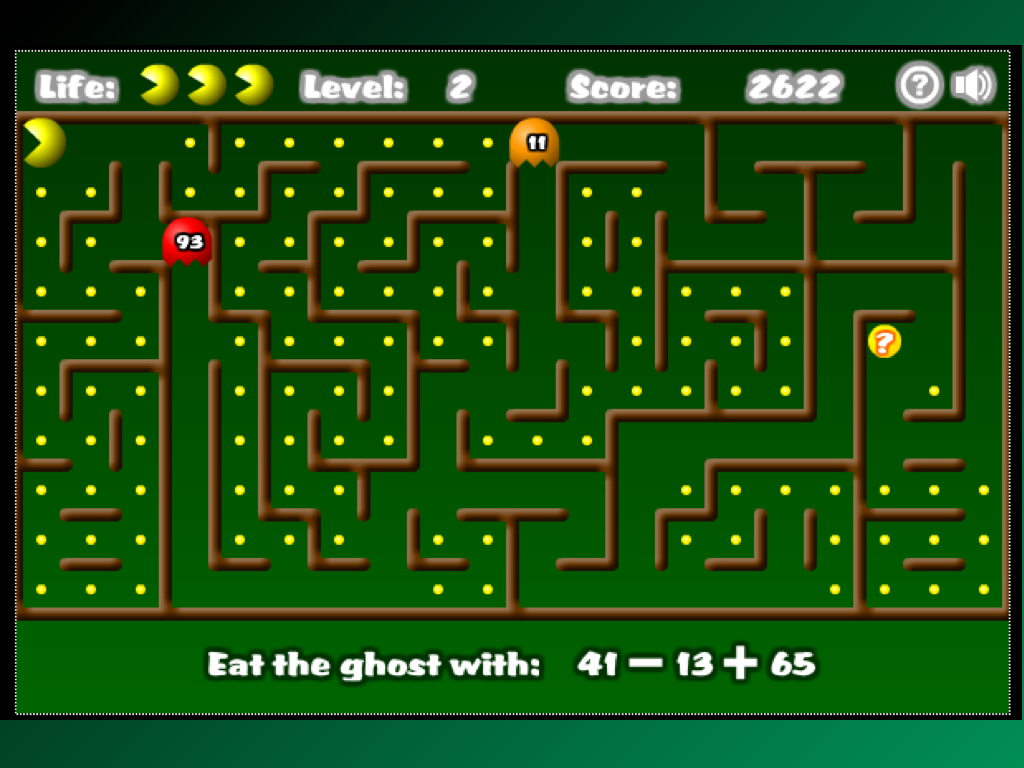
A Pac-Man game where you can only eat a certain ghost, depending on the solution to an equation.

Global Math - Math Games.005

If we apply the metric above and think about what is the math action and what is the game action? Here, the math actions are simplifying expressions and adding/subtracting, but the game actions are navigating the maze and avoiding ghosts. If I’m a student playing this game, I want to play Pac-Man. The math here is preventing me from playing the game, not aiding me, which makes me resentful towards that math.

Verdict: Bad

Example 2: Ice Ice Maybe

Global Math - Math Games.008In this game, you help penguins cross a shark filled expanse by placing a platform for them to bounce over. Because of a time limit, you can’t calculate precisely where the platform needs to go, so you need to estimate. That skill is both the math action and the game action, so that alignment means that this game accomplishes its goal.

Verdict: Good

Example 3: Penguin Jump

Global Math - Math Games.011Here you pick a penguin, color them, and then race other people online jumping from iceberg to iceberg. The problem is that the math action is multiplying, which is not at all the same. The game gets worse, though, because AS the multiplying is preventing you from getting to the next iceberg, because maybe you are not good at it yet, you visibly see the other players pulling ahead, solidifying in your mind that you are bad at math, at exactly the point when you need the most support. A good math game should be easing you into the learning, not penalizing you when you are at your most vulnerable point, the beginning of your learning.

Verdict: Terrible

Example 4: FactortrisGlobal Math - Math Games.014

This is a game that seems like it has potential: given a number, factor that number into a rectangle (shout-out to Fawn Nguyen here in my talk), then drop the block you created by factoring to play Tetris.

Again, the math action is factoring whole numbers and creating visual representations, which are good actions. But the game action is dropping blocks into a space to fill up lines. As Megan called it, though, we have a carrot and stick layout here, and often in many games. Do the math, and you get to play a game afterwards. (Also, the Tetris part doesn’t really pan out, because all the blocks are rectangles, which is the most boring game of Tetris ever.)

Verdict: Bad

Example 5: DragonboxGlobal Math - Math Games.017

I’ve written about Dragonbox before, so I won’t write about it too much here. The goal of Dragonbox is to isolate the Dragon Box by removing extraneous monsters and cards. The math actions include combining inverses to zero-out or one-out, or to isolate variables. The game action is to combine day/night cards to swirl them out, or isolate the dragon box. The game action is in perfect alignment with the math action, which makes the game very engaging and very instructive.

Verdict: Good

Example 6: Totally RadicalPlaying the Root

The board game I created last year (and you can also make your own free following instructions here, or buy at the above link). In this game, the game actions were designed to match up with math actions. Simplifying a radical by moving a root outside the radical sign, as in the picture above, is done by playing the root card outside and removing the square from the inside (and keeping it as points).Global Math - Math Games.021 You also need to identify when a radical is fully simplified, which you do in game actions by slapping the board (because everything is better with slapping) and keeping the cards there as points.

Verdict: Good

Final Note

One of the real challenges of finding good math games, as a teacher, is curriculum. Most math teachers know of several good math games, like Set or Blokus. While these games are great and very mathematical, they’re not the math content that we usually need to teach in our classes. So the challenge falls on us to create our own games, but making good math games is hard. (Making bad ones is pretty easy.) On that note, if you know of some good math games (that meet the criteria mentioned in this post), drop a line in the comments!