Trying to find math inside everything else

A Boss Fight?

One of the things about arranging your grading system like a game, as well as being a math game aficionado, is that it is pretty easy to combine the two. While yes, students can take quizzes or write essays to gain levels, they can also beat me in a math game. Of course, I’m not easy to beat, so winning against me would really show some mastery. (I do, though, allow them to gang up on me when the game is more than 2 players.)

The only students that really challenge me are the ones that hang out in my room at lunch, even though I’ve offered the challenge to everyone. And it’s cute because when they do lose they get even more determined, often because they may lose by a very small margin. (This is occasionally by design.)

The only game I’ve lost so far is Blokus, where the two Kevins beat me (but my score was still above the 4th player). As a reward, I gave them a level in Visualizer, as I figured that was the most applicable skill to winning the game. Planning ahead and visualizing paths in your mind is a useful skill. That same skill is the reward if they beat me in Ricochet Robots. In that game a team of Jane and Kevin tied me, so I still gave them reward, but they didn’t win.

It’s interesting trying to match games with skills. For example, the reward for winning at 24 is Tinkerer (since you need to play with numbers and try different things to succeed). It’s easy for games I made myself: if they can win at the Factor Draft (an upcoming post, I swear), they are a master of factoring. I have considered giving some points, not quite mastery, if they win against their classmates or my co-teacher, but to be a master, you gotta beat the final boss.

I’d love to have a bigger collection of games that I can use as assessment of skills, not just algebraic skills but the Standards of Practice as well. Any suggestions?

Piano Playing

I had a “Talking Math with Other People’s Kids” moment back in October that I wanted to blog about, so now is as good a time as any to pull that one out of the drafts folder.

My boyfriend’s niece and nephew have recently fallen in love with Star Wars, which, frankly, makes all of us happy. So while at the BF’s parents’ house when they were there, I decided to entertain them by playing the Star Wars theme on the piano. His nephew, Matthew (age 6), liked it and wanted to know how to play it. I thought about how I would describe it to him, so I did the following.

PIano1

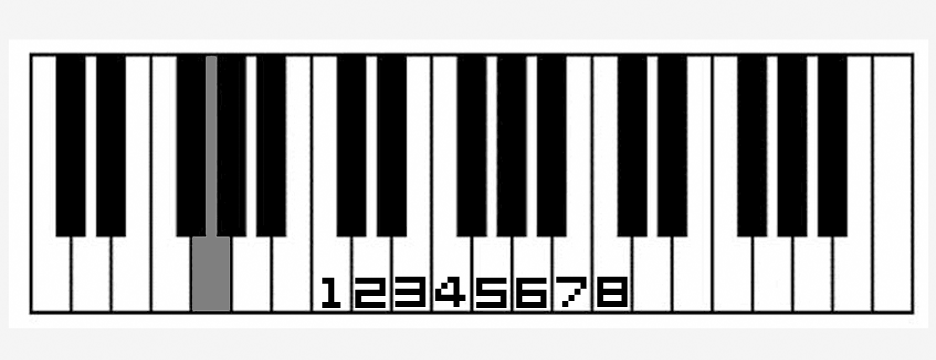
“Okay, this key here, I’m gonna call that key #1. So the one next to it is key #2, and so on. So, I’ll write down some numbers and you can know which keys to press.” And I wrote “1 5 4 3 2 8 5 4 3 2 8 5 4 3 4 1. (Then repeat)” He practiced it a few times until he got it, and we were all impressed. But then he wanted to do the next part, which dips into the octave below middle C. So I saw an opportunity.

“Well, Matthew, the next key we have to hit is this one, what should we call it?”

PIano2He told me I should call it 9, with the next notes being 10 and 11, since we already did up to 8. I asked him if he thought that might be confusing. “If I were reading it, I would think the 9 should be the one right after 8.” He agreed, so then he said we should call them letters, like a, b, c.

PIano3“Well, okay, Matthew, we could do that, but then what would you call this key [the one to the left of “A”]?”

After a moment’s thought, “D.”

“But isn’t that confusing again? Now everything’s out of order.” He agreed again, but wasn’t sure what to do about it. I made the following suggestion:

PIano4That way if we need to add more notes that go down, we can just use more letters, and if we need to add notes that go up, we can use more numbers. He thought this was a good idea, and so we moved on to playing the rest of the tune.

I admit I was thinking of a specific post I had read not long before, which I thought was a TMWYK post but now I can’t find it, where the child invents numbers smaller than 0 using *1, *2, *3, etc. That was my intention with that conversation with Matthew, but if I’ve learned anything from reading all the TMWYK posts, it’s that you don’t push it if the kid isn’t going their themselves. We had to come up with some sort of solution so we could keep playing the song, but once we got something workable, we didn’t need to keep going to talk about the whole negative number system. At the time Kathryn Freed asked me if there was a 0 key, which I said there wasn’t and so the divide between the two types of keys was a little awkward, but it worked out.

In the months since, Matthew has been taking piano lessons and learning to read actual music instead of my cockamamie scheme, which is for the best. He’s pretty good at it, too.

Legacy

I was talking to some of the senior teachers today and I found out that two of my former students are going to Manhattan College, where my boyfriend is a professor. I don’t know why, but this is really exciting to me. I guess I’m just somewhat attached to my them as they were my first class and now they are graduating, but maybe somehow I can still keep tabs on them and help them out if they need it. (I told them if they take his class that I have access to his gradebook, wink wink.)

My boyfriend, on the other hand, said he would grade their exams right in front of me so he knows who to blame when they can’t do algebra. He can write on their tests, “Looks like Mr. Cleveland didn’t do a good job!”

But I’m sure they’ll do great. I’m pretty proud of them all.

Throwback Thursday

In previous years I had my statistics unit towards the beginning of the year, thinking that it could serve as a nice foundation when we work with messy problems later in the year. It never really worked out that way.

This year, I decided to move the stats unit to the end of the year, with the intention of using it as a kind of review. Today’s lesson exemplified that. The goal of the lesson was to take a data set and find a regression function for it using the calculator. That part was easy, but the trick was to determine what kind of function it was. So I decided that, for the data sets, I’d use ones we used previously in class, such as from Stacking Cups, The Skittles Lab, World Population, and The Showdown. Back then when we did them we would do things like average the data to make a function, or try to fit a graph on the points using Desmos. Now the calculator unlocked the secrets of precise graphs! (Luckily, no one complained that I didn’t show them before.)

My warm-up was also a matching activity that was on their first exam back in October, so these two things combined caused a student to exclaim that it was Throwback Thursday.

Morning Person

Out of curiosity, how much of the work you do outside class gets done in the morning, in the afternoon after school, in the evening, at night?

Today was the first time I left school fully prepared for the next day in weeks. I try to do things in the afternoon while I’m still at school but I’m just so beat, it doesn’t happen. I’ll usually get a little done at night, but I get the bulk of my work done in the morning. I’d rather wake up an hour early and be very productive than try to slog through something in the afternoon when I’m tired (and it’ll probably take twice as long because I can’t focus). And yeah, maybe there’s a little of that old procrastinator in me, but I think I just like the mornings. Heaven knows if I didn’t being a teacher would be even harder than it is.

Today I did the How I Met Your Mother hot/crazy scale lesson, which was strange this year. The past two years I did my statistics unit in October/November, so this lesson fell pretty early in the year. So I had a lot of fun because I was able to play with students’ expectations by using the androgynous names, the fact that the year is still new and they don’t know me as well and as less blatant about asking things, made for an overall enjoyable experience.

It’s funny because I don’t come out with intention every year, but it can sorta happen at times. I feel like this year my students still don’t really know across the board. And if they don’t know about me yet, they definitely don’t know about the other 3 gay male teachers. [4 out of  11 male faculty members seems like a lot. (The joke is that my old principal only hired either attractive young female teachers or male teachers that weren’t competition for the ladies’ attention.)] So I’m wondering if I played the game too well this year.

When I think about last year, there’s three moments that stood out. First was this lesson, which could plant suspicions but nothing confirmed. Then in December I did a lesson about the definition of a function. At one point, I ask for examples of functions that would map from the domain of people. Things like age and weight are examples, whereas race and hair color do not, since you can be more than one race or have more than one hair color. Then they say eye color, and I say it’s not, because someone could have two differently colored eyes. “In fact, my boyfriend has two differently colored eyes – one brown and one blue.” But if no one says eye color, it might not come up. And sometimes students jump in and mention that fact themselves. The third moment is when a student asked me who my Valentine was, with my response of “my boyfriend.”

For the current seniors and juniors, I feel like word spread quickly. The current sophomores a little more slowly, but by Feb 14 everyone knew. But this year it’s been somehow different. Partly it is due to the Common Core. I moved function definitions to the very beginning of the year, and so, I don’t know why, I said “I know somebody who has two different colored eyes” instead of specifying. Maybe I thought it was too early in the year? But then this lesson shifted later, so those two natural moments didn’t occur.

I mean, this didn’t stop individual students for talking about it. Most of my lunch gang knew because we’ve just had many more conversations and it came up. But my answer to “Do you have a wife/girlfriend?” Is always no, and the conversation often ends there. I won’t push it if they don’t, because we have math to do.

But because it wasn’t across the board acknowledged, somehow today was weirder. Maybe I’ll address it tomorrow.

This was longer than I thought – leave it to #MTBoS30 to make me ramble. I’m not sure what the thesis of this post was, other than “This can be surprisingly difficult to navigate, even if you aren’t trying to make it difficult or trying to navigate it at all.”

No Sane Person…

So today I did Dan Meyer’s Red Dot lesson, which is still one of my favorites for that great reveal. In his post, he writes:

It was only important to me that the students experience a hand which they absolutely should fold, a hand which a sane person would only hold onto if he could see his opponent’s cards.

If I’ve had one problem with this lesson in the past few years, it’s that, well…teenagers are not sane. Today I had a total of 6 boys (and it’s always boys) who would definitely bet on that last hand, even though everyone else agreed they shouldn’t. I even changed the hand to make it one pair, and still they would bet. Maybe I should make it high card only when I try it next time. I’m not sure if even then that will deter them.

I just submitted my application to be a Math for America Master Teacher. For the personal statement, it asks me to write about how I am continuing to grow into the mathematics teacher I want to be. Of course, my main answer was #MTBoS, because, well, we else am I going to experience so much great math teaching? (Besides at MfA itself, of course, but there’s a lot of overlap, naturally!) I even had a problem when I had to submit a lesson plan, because so many lessons I’ve done this year either started with an idea from someone else’s blog or was improved by someone else. So what lesson plan can I really call mine?

Eh, I’ll just post what I wrote:


When I think about what type of mathematics teacher I want to be, I think about all of the wonderful mathematics teachers I communicate with regularly through Twitter. I proudly consider myself to be a member of the Math TwitterBlogosphere, or MTBoS. Every day I read the blogs and thoughts of a wide variety of teachers from across the country (and a handful of international ones). I take the ideas that I like, I give input of my own through comments and tweets.

More than just passive reading, though, is the collaboration I take part in. I have my own blog where I reflect on things that I have done in my classroom. I can get feedback on the things that I do so I can improve them. On top of that, every summer I attend Twitter Math Camp. (In fact, since last year I have been on the planning committee for the conference.) At this conference, Iʼve hosted sessions on making interdisciplinary topics and making educational math games. Iʼve co-created lessons with these teachers that are then spread to others beyond the conference.

Through this network I also often read many articles that can help improve myself as a teacher. Some of these articles are research – looking more deeply into how people learn mathematics. The blog of Christopher Danielson is usually very fruitful in this regard – digging down into number sense helps build a foundation that supports other mathematical learning. I also read articles pertaining to social justice issues – how race and gender have effects in both schools and the world at large, and steps I can take to make my classroom a safer place.

Math for America itself also provides many of those contacts that help me improve. I often sign up for more than one PLT a month because I get so many good ideas out of them.    I love having the opportunity to talk to other teachers about what they do. Teaching can often be an isolated experience, and just a window into another classroom can do a lot to improve someone.

This year Iʼve also tried new things to bring myself closer to my ideal as a teacher. I implemented a new grading system that focuses on growth instead of a static level – this way, even a student who is far behind can feel like they are making a lot of progress, and pushes those students on the top for more, beyond what they already did to get to the top. I am also using a new Problem-based Learning Curriculum. Mastery of procedures is not sufficient for learning mathematics – they need to build habits of mind and problem solving skills. Having a PrBL curriculum helps me get at those skills and find new ways.

Iʼm also often studying new math as well. Iʼm dating a PhD in math and I often have conversations about the new math he is studying or what he is teaching in his courses. We occasionally work out problems together that interest us, and that usually leads to a better understanding of topics I teach that I only thought I understood fully before.

That sums up my overall strategy on how to continue growing: look to exemplars, find what I like about what they do, question myself about why I donʼt like things they do, so as to not allow myself to get complacent, and always keep pushing boundaries.

Scrabble Variant

(inspired to post by Anne’s 30-Day Blog Challenge)

So I was playing Scrabble last night (I lost – it’s one of those board games I’m not the best at) when we talked about how, when you are playing with good competent players, the board often winds up with knots of small words close together.

From gamerush.net

Kinda like this one.

So we talked about how we could promote long and fun words instead of those same short words all the time, and thought you could have a variant where you get bonus points based on how long your word is, regardless of which letters you use or where you place it.

Such a bonus somewhat already exists – you get a 50 point bonus if you use all 7 of your tiles. So we thought we could add other bonuses for other lengths. We agreed we should keep the 50 point bonus for 7, and that you shouldn’t get a bonus for only using 1 letter. As well, we thought a 2 tile go should get 1 point as a bonus. So I said I could definitely model it from there.

I tried to feed those data points into Wolfram Alpha for a fit but they provided linear, logarithmic, and period fits, all of which were terrible. I then forced them on a quadratic fit (after all, 3 points make a parabola), which was alright, although maybe too many points for a 6 tile play. Then I did an exponential one (though I had to use (1,0.1) since Wolfram didn’t like using (1,0) in an exponential fit, as if we couldn’t shift the curve down.) Then I just fed them into Desmos and rounded.

Below are the graphs and the tables for each fit. What do you think of this variant? Which point spread would be better? Of course, we’d have to play it to see….

Screen shot 2014-04-26 at 12.17.04 PM


So as I was getting ready to teach absolute value graphs a little while ago, I came across this post from Kate Nowak about a lesson she did with it. I liked the idea but…I didn’t like the idea of having to “get my butt into overdrive” to collect data from staff and students about such a thing. I wanted a lesson for the next day, so I didn’t really have time for that.Screen shot 2014-03-26 at 6.52.24 PM

But then I thought, well, my students have been doing Estimation180 all year long. Maybe there’s a way I can use that? I even tweeted Kate about it, but was left to my own devices. (Though I suppose this is finally the write up I promised.)


I thought about what was different between what we’ve done with Estimation180 and Kate’s task, and then it hit me – Kate’s lesson is all about one guessing event, but we have loads of different ones. At that point we have done ~30 estimations. What if we could do some comparisons?


My premise was this – Mr. Stadel, who runs the Estimation180 site, wants to implement a ranking system where all the estimations are listed as “easy” “medium” “hard” etc. But how can he tell when one is hard or not? He knows all the answers, so he can’t used himself to judge. So I told Mr. Stadel that we have lots of data from our class and we could probably use it to come up with a system.

[Aside – this was the 3rd or 4th day of the new semester, and to complete the task I asked students to use the estimation sheets from the previous semester. They revolted, because they claimed I had told them they could throw those out! Which I vowed I didn’t…though, to be honest, it’s possible I did, since I hadn’t thought of this lesson yet. Luckily enough students had not thrown them out so that it could still work.]

So I reviewed what the estimations we did were and I told each group that they have to pick one estimation that they wanted to evaluate. Then they had to collect data from their classmates (and from the binders of other classes, through me) – the estimate each person made and what their error was. Once they have collected enough data, they have to make an Error vs Estimate graph and see what happens. Then I had them make some analysis on whether this counted as a difficult task or not. I didn’t have them compare graphs at the time, but I totally should have.

I think it worked pretty well and many of the students understood why it should be a V-shaped graph. They were at first surprised about where the vertex was, but then it made sense, especially comparing many different error graphs.

Estimation Difficulty Rating (Word format)