Trying to find math inside everything else

Archive for the ‘schooling’ Category

Legacy

I was talking to some of the senior teachers today and I found out that two of my former students are going to Manhattan College, where my boyfriend is a professor. I don’t know why, but this is really exciting to me. I guess I’m just somewhat attached to my them as they were my first class and now they are graduating, but maybe somehow I can still keep tabs on them and help them out if they need it. (I told them if they take his class that I have access to his gradebook, wink wink.)

My boyfriend, on the other hand, said he would grade their exams right in front of me so he knows who to blame when they can’t do algebra. He can write on their tests, “Looks like Mr. Cleveland didn’t do a good job!”

But I’m sure they’ll do great. I’m pretty proud of them all.

Slow Rollout

This year has been weird so far. In the past the first week with actual students has never been a full week, usually just 1 or 2 days. So we’ll have some intro days, do intro stuff, and then head full steam into math class the next week. Last year September was so disjointed because of the Jewish holidays that we couldn’t even really get started.

This year, we started with a full week, and have 5 weeks straight of 5-day weeks before the first day off. So because we didn’t have weird intro days and odd days around holidays, I didn’t have a day introducing my class and systems, and instead went straight into math. I also have a lot more systems and routines now then I did in the past. So what I’ve wound up doing was introducing basically one new overarching idea or routine each class.

First class, Habits of Mind survey, then we did the Broken Calculator. (I’ve decided to loosely follow Geoff Krall’s PBL curriculum.) Next class, I introduce my new grading system (hope it works!) and then had to give them a stupid baseline assessment the city demanded. Next time, we set up our Interactive Notebooks, then did the Mullet Ratio. Today, I handed out the rubrics I’m going to be use to grade them (more on that next post), as well as introducing them to Estimation 180, and then we finished with day 2 of the Mullet Ratio. So every class has been a little routine, a little math. But I kind like it. We’ve been building up how the class works, layering it on. By the end of the month, we should be full steam ahead.

Habits of Mind, Standards of Practice

For the past three years, I’ve loosely organized my classroom around the Mathematical Habits of Mind which I first read about in grad school at Bard. I would give the students a survey to determine which habits are their strengths and which are their weaknesses, group them so each group have many strengths, and go from there. Last year I even used the habits as the names of some of my learning goals in my grading.

As I was planning for this year and the transition to the Common Core, I was thinking about how to assess and promote the Standards of Practice. And I realized that they are very similar to what I was already doing with the Habits of Mind. In fact, having a habit of mind would often lead to performing a certain practice! In that way, the SoP are actually the benchmarks by which I can determine if the habits of mind are being used.

Let me demonstrate:

Students should be pattern sniffers. This one is fairly straight-forward. SoP7 demands that students look for and make use of structure. What else is structure but patterns? Those patterns are the very fabric of what we explore when we do math, and discovering them is what leads to even greater conclusions.

Students should be experimenters. The article mentions that students should try large or small numbers, vary parameters, record results, etc. But now think about SoP1 – Make Sense of Problems and Persevere in Solving Them. How else do you do that except by experimenting? Especially if we are talking about a real problem and not just an exercise, mathematicians make things concrete and try out things to they can find patterns and make conjectures. It’s only after they have done that that they can move forward with solving a problem. And if they are stuck…they try something else! Experimenting is the best way to persevere.

Students should be describers. There are many ways mathematicians describe what they do, but one of the most is to Attend to Precision (as evidenced in things like the Peanut Butter & Jelly activity, depending on how you do it.) Students should practice saying what they mean in a way that is understandable to everyone listening. Precision is important for a good describer so that everyone listening or reading thinks the same thing. How else to properly share your mathematical thinking?

Students should be tinkerers. Okay, this one is my weakest connection, mostly because I did the other 7 first and these two were left. But maybe that’s mostly because I don’t think SoP5 is all that great. Being a tinkerer, however, is at the heart of mathematics itself. It is the question “What happens when I do this?” Using Tools Strategically is related in that it helps us lever that situation, helping us find out the answer so that we can move on to experimenting and conjecturing.

Students should be inventors. When we tinker and experiment, we discover interesting facts. But those facts remain nothing but interesting until the inventor comes up with a way to use them. Once a student notices a pattern about, saying, what happens whenever they multiply out two terms with the same base but different exponents, they can create a better, faster way of doing it. This is exactly what SoP8 asks.

Students should be visualizers. The article takes care to distinguish between visualizing things that are inherently visual (such as picturing your house) to visualizing a process by creating a visual analog that to process ideas and to clarify their meaning. This process is central to Modeling with Mathematics (SoP4). It is very difficult to model a process algebraically if you cannot see what is going on as variables change. To model, one must first visualize.

Students should be conjecturers. Students need to make conjectures not just from data but from a deeper understanding of the processes involved. SoP3 asks students to construct viable arguments (conjectures) and critique the reasoning of others. Notable, the habit of mind asks that students be able to critique their own reasoning, in order to push it further.

Students should be guessers. Of course, when we talk about guessing as math teachers, we really mean estimating. The difference between the two is a level of reasonableness. We always want to ask “What is too high? What is too low? Take a guess between.” Those guesses give use a great starting point for a problem. But how do you know what is too high? By Reasoning Abstractly and Quantitatively, SoP2. Building that number sense of a reasonable range strengthens our mathematical ability. We need to consider what units are involved and know what the numbers actually mean to do this.

What we do, or practice, as mathematicians is important, but what’s more important is how we go about things, and why. A common problem found in the math class is students not knowing where to begin. But if a student can develop these habits of mind, through practice, that should never be a problem.

Today’s Roles: IT Department, Programmer, Lecturer, Assessor, Tutor, Co-ordinator….

5:30 – Alarm goes off. That is not happening.

6:20-7:00 – Wake up, shower, pack up, go. I decide to take the subway to school today, instead of biking, because I have too much to do to lose those 40 minutes.

7:00-7:07 – Walk to subway. Catch up on Twitter while walking.

7:07-7:40 – Subway to work. My train still isn’t running to my job because of Sandy, so I have to transfer. While I’m riding, I grade math labs. (Despite grading for several hours over the weekend, I didn’t finish.) I don’t finish by the time we arrive.

7:40-7:50 – Walk to work plus breakfast.

7:50-8:55 – Enter my classroom to discover 1) it’s a sauna, and 2) that the wi-fi is down in my classroom (and only my room). This is awesome, because I have a computer based lesson today. Also, the person in charge of the laptop cart doesn’t get in until later. Luckily, I am technologically proficient, so I spent this time creating an ad-hoc network and setting it up on the ancient Dell laptops (after tracking down the AP to unlock the tech room) so the students could get and give files. I also spent some of this time inputting the grading I did into the gradebook.

8:55-9:46 – Start of contracted time. Embassy class, which is our special version of advisory. We finally have a curriculum to follow, so I need to modify for my students.

9:46-11:30 – Math class, students brought in survey results to analyze. So I pass out laptops and walk them through the analysis excel file I made yesterday. Minor tech problems, so most of my time is spent fixing those and running around teaching the quirks of excel while the students do data entry and create conclusions. I explain the requirements for their project, stop a student from hacking into one of the computers, and general maintenance. We also have problems getting the files back to me, because they don’t follow directions.

11:30-11:50 – Putting away the laptops and making sure all files are saved.

11:50-12:20 – Run and get lunch, while planning the next lesson with my co-teacher. When we get back, we meet with a third teacher about two students who need resource room (since I’m the programmer, and can change it.)

12:20-1:20 – Student lunch period, so some kids come up to my classroom to work on their projects. I continue setting up laptops (since my afternoon class is larger). At 12:45, the wi-fi returns, so I switch the computers back to that instead of the ad-hoc network.

1:20-2:00 – First opportunity to use the bathroom. I run to the programming office to change a schedule. Then I go back to grading, or, more accurately, data entry.

2:05-3:45 – Another math class, this one with 4 languages spoken and no ESL support. The tech problems seem even worse at first, but balance out in the end. Unlike my morning class, which is very industrious, several pairs in this class did not come prepared and needed to do alternate work/catch up work. End of contracted time.

3:45-3:55 – I bring some of my students to the Teacher Work Room to make copies of their surveys for them, so they can catch up on their project. I get a cookie from a co-worker.

3:55-4:15 – Break and decompress, including short chats with coworkers in the hall.

4:15-4:45 – Back on the grading grind.

4:45-5:30 – I plan with my co-teacher on Thursday’s lesson, which we won’t have time to do tomorrow because of other meetings. (I’ll have a Math for America meeting in the evening.) We adjusted my Lying with Statistics Stations because they were confusing and ill-timed last year, opting this year for a looser flow. I finish grading while I do this.

5:30-5:35 – I write an e-mail to a parent because her son is way behind on the project.

5:45-6:20 – Time to head home. I grab a hot dog on the way. True to my pledge to not bring work home (even though I broke it over the weekend), I play my 3DS on the subway ride home. I almost fall asleep on the train, and my game freezes, losing all progress.

6:20-6:35 – I stop at the supermarket on the way home, to get some stuff for dinner and breakfast.

6:45-7 – I forgot the shallot. So I change my plans, because I don’t want to go back out. It’s a tough decision, I seriously thought about it for 5 minutes because I wanted the shallot but was so tired. I make more bachelor-y food.

7-7:45 – Watch Daily Show/Colbert while catching up on tweets/blogs.

8-9 – Leisure Time

9-9:20 – I try to go into the Global Math Department meeting about homework, but the audio is too messed up, so I duck out early. Now I’m going to lay down and read the news/play with my DS probably until around 11, when I’ll hit the sack.
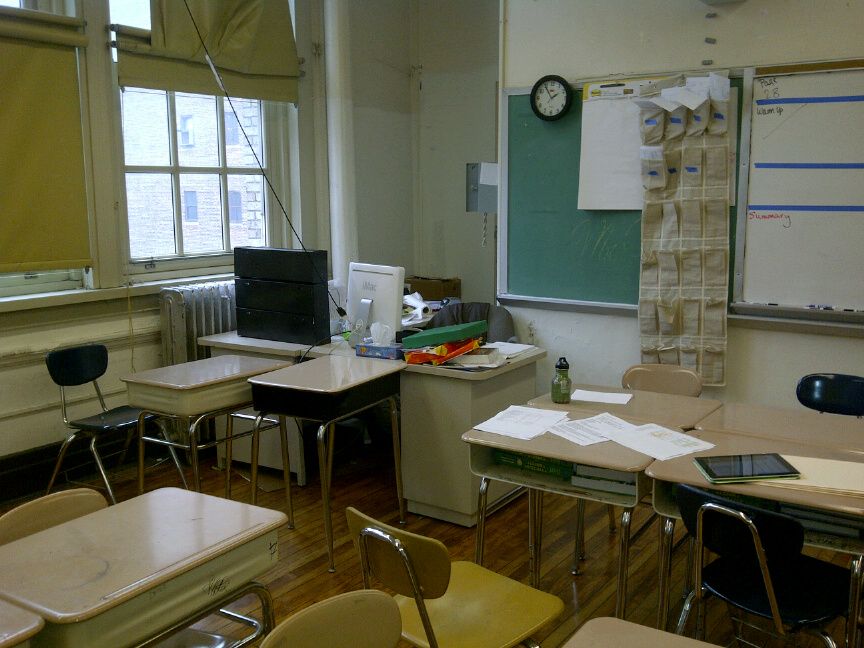
My Classroom

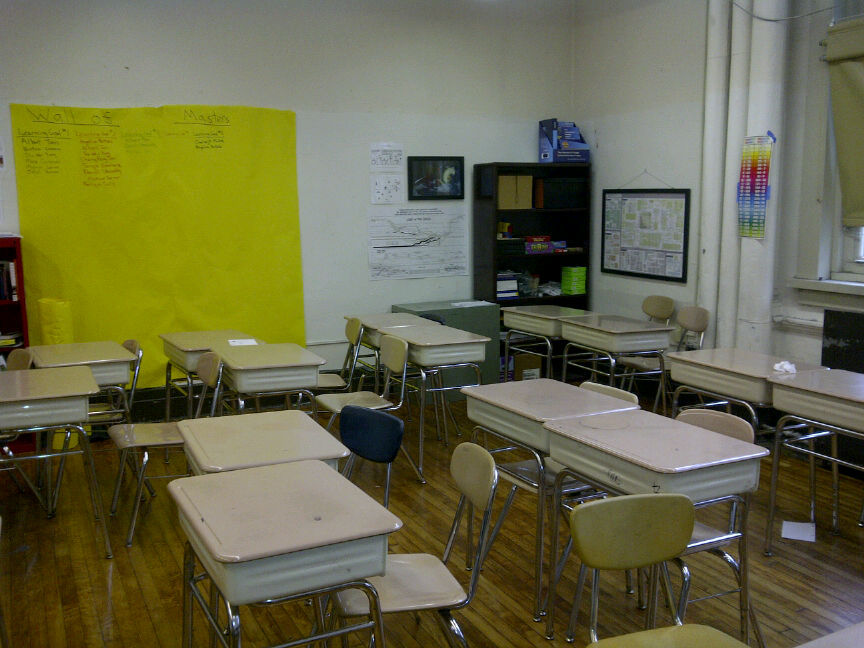
Since I wasn’t in there today, why not make a long overdue blog post about my classroom? It was finally in a presentable condition thanks to Parent Teacher conferences.

@mgolding and @mseiler said this summer when they were setting up their rooms that students know they are entering a math classroom, so why not let them know who you are. So I decided to embrace that.

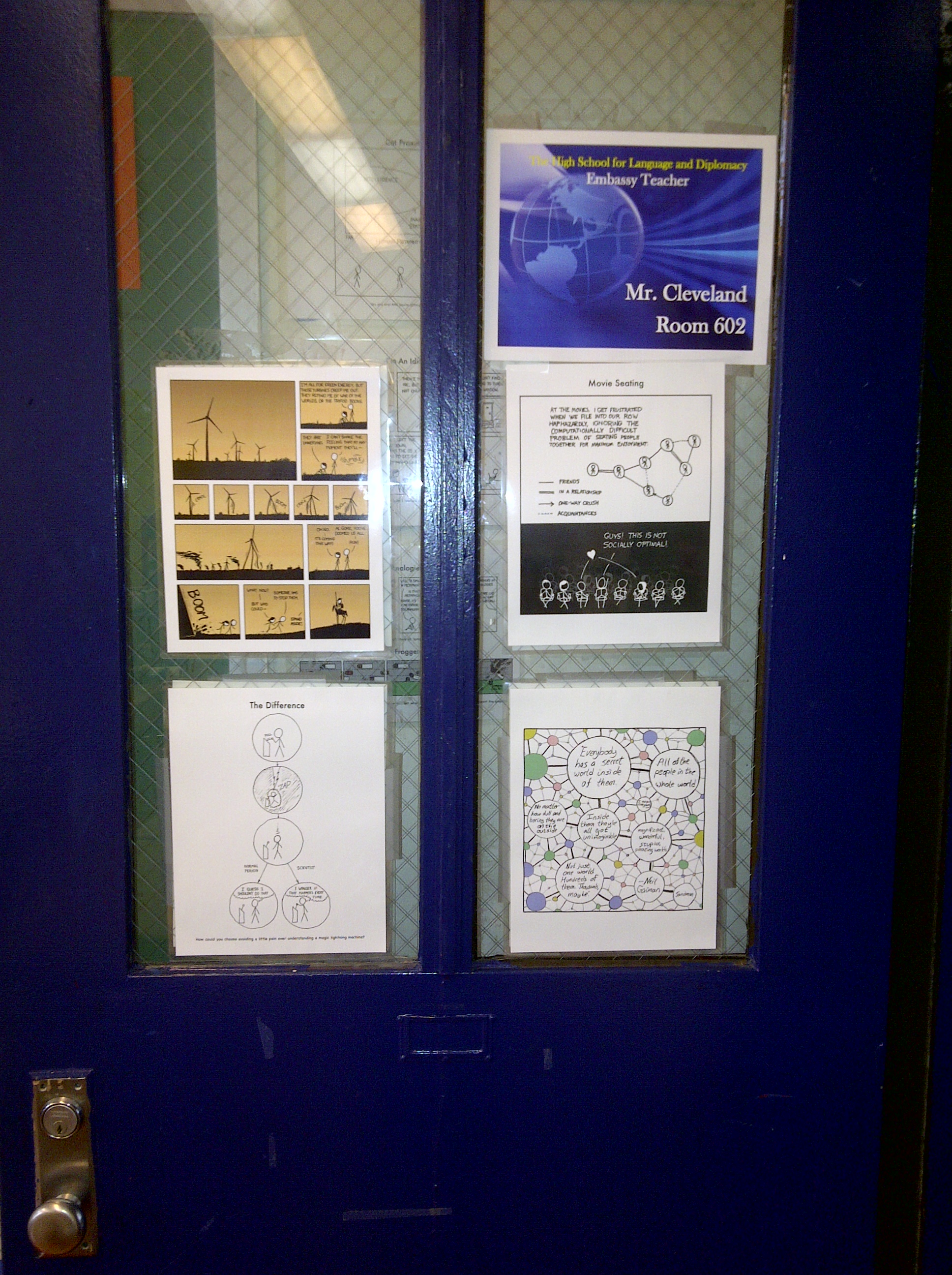
 Enter my room via this door, with some of the several XKCD posters that I made earlier this year. I have 40 different posters hanging around the room.


There’s my desk in the corner. I have a lovely little alcove behind it, and a shoe organizer that I use to keep quizzes for different Learning Goals.

There’s the other side of the room. I’ve got two of the actual giant XKCD posters from the website (Money and Movie Timelines) as well as a Wind Waker poster I won from a Nintendo Store trivia content.


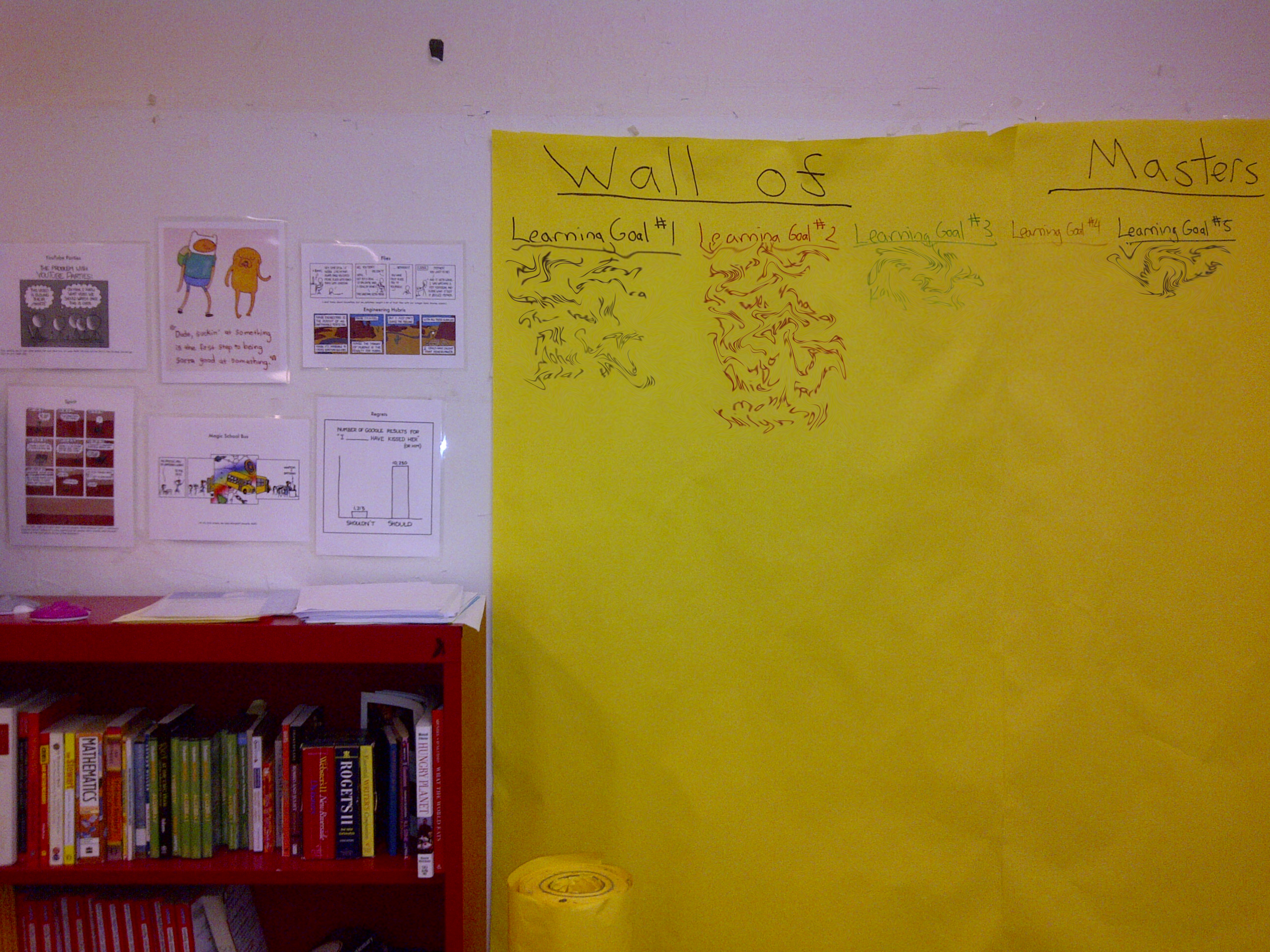
The yellow paper is the Wall of Masters, to list anyone who has achieved mastery on a particular learning goal, as opposed to merely proficient. (I also have this Adventure Time poster, which I adore.)

 My front white board, with my projector on the milk crate.

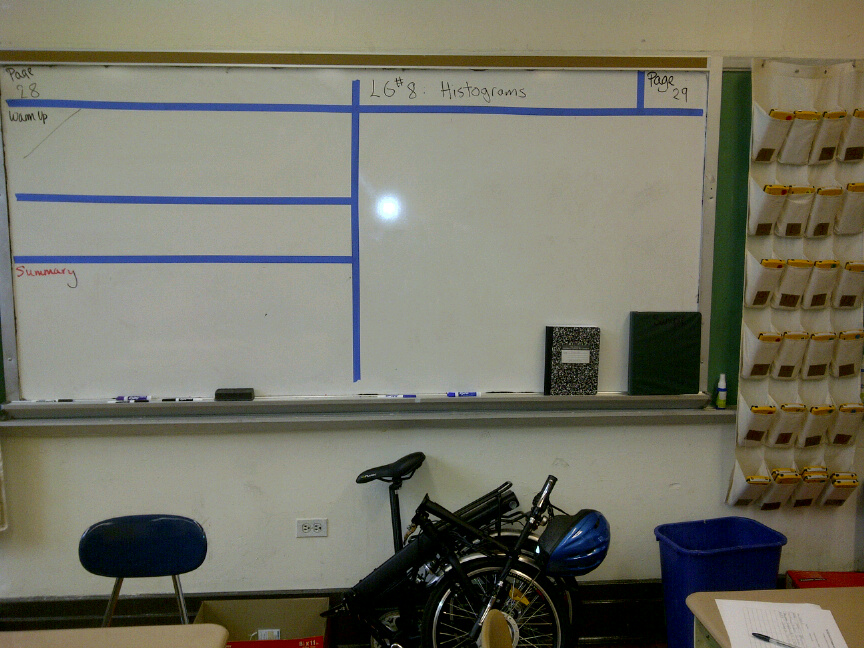
This is my favorite. My co-teacher Sarah came up with the idea of using my side whiteboard as a model version of the Interactive Notebook, showing exactly what the students should have, with the left-hand page and the right-hand page. (I also use a shoe organizer for the calculators.)


Is Algebra 2 Necessary?

So, of course, Andrew Hacker’s article “Is Algebra Necessary?” had caused quite the stir, and the obvious answer to that question was “Yes, algebra is necessary.” But the article makes you think if all of what we learn of algebra is necessary. And I think it isn’t, but that comes from thinking about what high school is for.

Do we expect that, when a student gets to college, they can skip the lower levels of Biology because they took bio in high school? No, of course not. (Excepting AP courses, of course.) So what is our goal for learning biology in high school? It’s to provide a general foundation of the subject, that most people should know, and it prepares you for a college level course or major in Biology.

Really, all of what we learn in high school is designed to broaden our horizons, to provide experiences and content we wouldn’t see otherwise, and to provide a baseline of knowledge that we feel everyone should have.

I remember reading from someone, though I don’t recall who, that they had struggled through Algebra 2 and Pre-Calculus, slogging along, and then when they got to Calculus a light turned on. “This was why we’ve been learning everything we’ve done in the past two years! It was all for this!” Even the wikipedia page on Pre-Calc says “…precalculus does not involve calculus, but explores topics that will be applied in calculus.” It’s putting the work before the motivating problem, again.

But now thinking about the normal course sequence for a student that is not advanced: Algebra –> Geometry –> Algebra 2 –> Pre-Calculus –> Graduated from High School, so no Calc! So these students will have two whole years of math without the payoff that shows why we do it.

And as teachers we know that you need to start with the motivating factor, not have it at the end. So why don’t we have calculus first, before those two? If we consider our goal in high school is to spread ideas people might not see otherwise, I think Calculus has a lot of important ideas people should see that would improve their lives. Optimization? The very idea of it can improve how you look at all the problems in your life. Related rates, limits, the idea of changing rates and local rates, the relationships between functions, these are all good ideas to be familiar with.

Can the students learn these things without having done Algebra 2/Pre-Calc? I think so. As Bowman Dickson says, “The hardest part of calculus is algebra.” So what if we taught it in a way that didn’t rely on that? We can get the ideas across without jumping into the nitty-gritty of a lot of it. Save that for AP level classes, or for college calc. What you take in college is more in depth that high school, so it should be the same here.

Now, there would certainly be some stuff from Algebra 2/Pre-Calc that we really need first. But why not have those in Algebra 1? I accidentally taught several things from Alg 2 when I taught Alg 1 my first year, because they seemed like natural extensions of what we were doing, and I didn’t know they weren’t required until I started planning for the next year. But also, consider this. If we made Probability & Statistics one of the main courses of the math sequence, I don’t have to teach it in Algebra 1. I spent about 7 weeks on those topics last year. That’s 7 weeks of Alg 2 content I could fold in, without worrying about reviewing old stuff because we just did it.

So then the new math sequence could be Statistics –> Geometry –> Algebra –> Calculus. (And I think that might fit well with the science sequence of Biology –> Earth Science –> Chemistry –> Physics.)
Thoughts?