Trying to find math inside everything else

Archive for the ‘math’ Category

Circles, Lines, and Angles

My math coach gave me this idea as we were planning my Circles unit. I think it went fairly well, so I’ll share it here. The idea is that we have, essentially, three basic objects that we’ve combined in different ways in geometry: circles, lines (including segments), and angles. So, as an opening activity to the unit, the task was this:

“Think of as many ways as possible to combine those three objects.”

First they brainstormed individually, as I reminded them that they can use multiple lines or angles or circles if they wanted. Then they went up to groups and made a master list per pair or group, eliminating ones that were “pretty  much” the same. I gave them some vocabulary based on what I saw they drew, and they had to use that vocabulary to describe what each drawing had. Finally, they chose one example and created one neat, fully correct example, in color that we combined into class posters. (I approved what they chose, to ensure a variety of possible layouts.)

20160414_144226_HDR 20160415_075653_HDR

Between my two classes, they came up with almost every scenario I could think of that we would learn in the unit, with the exception of Tangent Line & Radius, which I drew and put in myself. Now they are hanging in the classroom, acting as a guide for our journey into circles.

Natural Circle Measures

Yesterday I introduce radians to my students for the first time. I started out by asking why they thought a circle had 360°. There were a few good answers – four right angles makes a circle, so 4*90 is 360; a degree is some object they measured in ancient Greece, and so a circle was made of 360 of them; something to do with the number of days in the year. All good answered, but I told them it was completely arbitrary based on the Babylonian number system.

Once we decided that it was arbitrary, I asked them to come up with their own method of measuring a circle. I would classify their responses into three categories

  1. Divide the circle up into 200 “degrees” (most common)
  2. Divide the circle up into 100 “degrees”
  3. Divide the circle up into 2 “degrees” (least common)

I was expecting 100 “degrees” to be the most common, so I was very surprised to see that most of the students want to split the circle into two sections, each with 100 parts.

I have been a proponent of tau for a while, as I thought it was natural to think of radians as pieces of a whole circle, but my students were clearly thinking of the circle as two semicircles right off the bat.

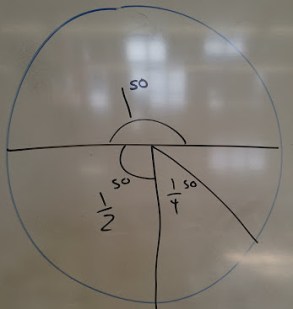
I pushed the students who came up with the third way in a whole class discussion. If this whole semicircle is one student-name-degree, what would you call this section? And so we got to using fractions of those degrees.

20160412_152234_HDR.jpg

That made a pretty easy transition into radians. I went a little into the history; instead of using a degree, some mathematicians decided to use names based on the arc length – and so that semicircle’s angle was 1 π radians, instead of 1 student-name-degree. And the fractions we used were the same.

This almost made me doubt my tau ways – maybe π was more natural. But then, as we started converting angles from degrees to radians, some students kept complaining that, for example, 90° was 1/2 π instead of 1/4, since it was clearly a quarter-circle – so maybe I can stay a tau-ist.

Angle Chasing

On Friday our school was supposed to have a Quality Review, but it was canceled at the last minute. (That’s a whole ‘nother story.) But that pushed me to do a lesson that I probably wouldn’t’ve done otherwise, so that’s good. I actually think it went pretty well.

I noticed in our last exam that I should probably explicitly teach angle chasing as a problem solving strategy, so I asked the MTBoS for some good problems. Justin Lanier came through in the most wonderful way. So I picked out some problems into a nice sequence that would use a bunch of the theorems we’ve already done.

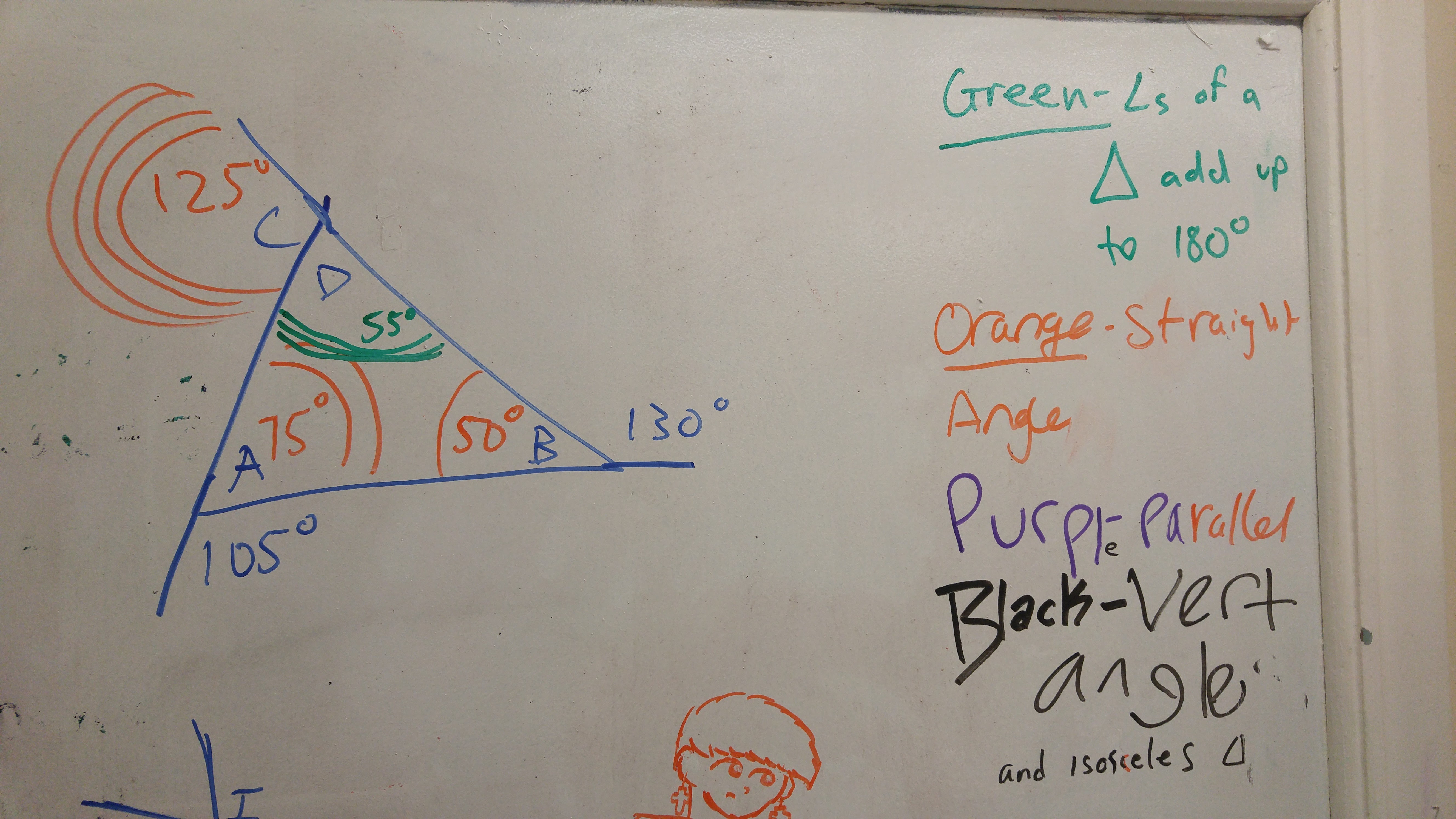
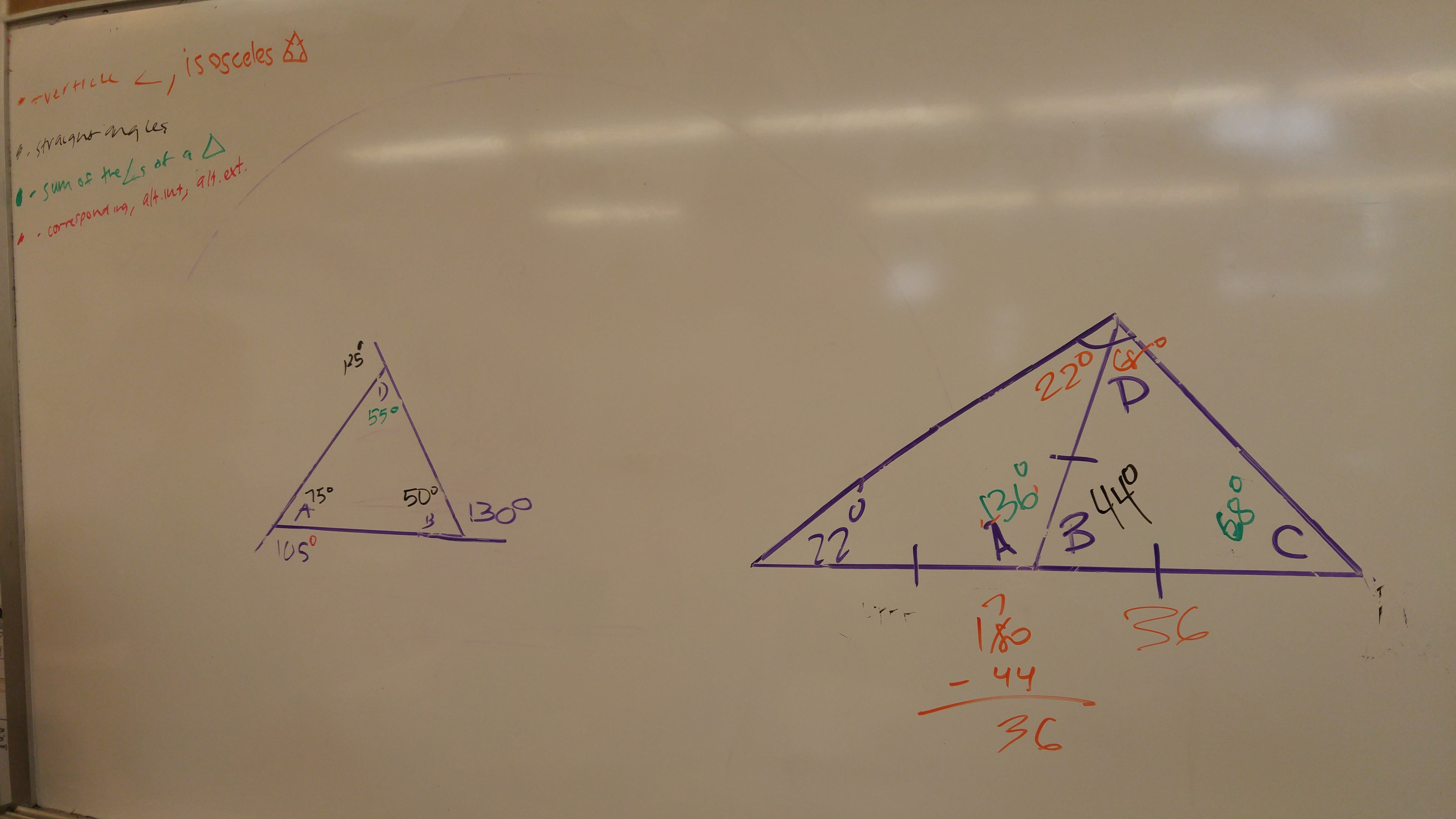
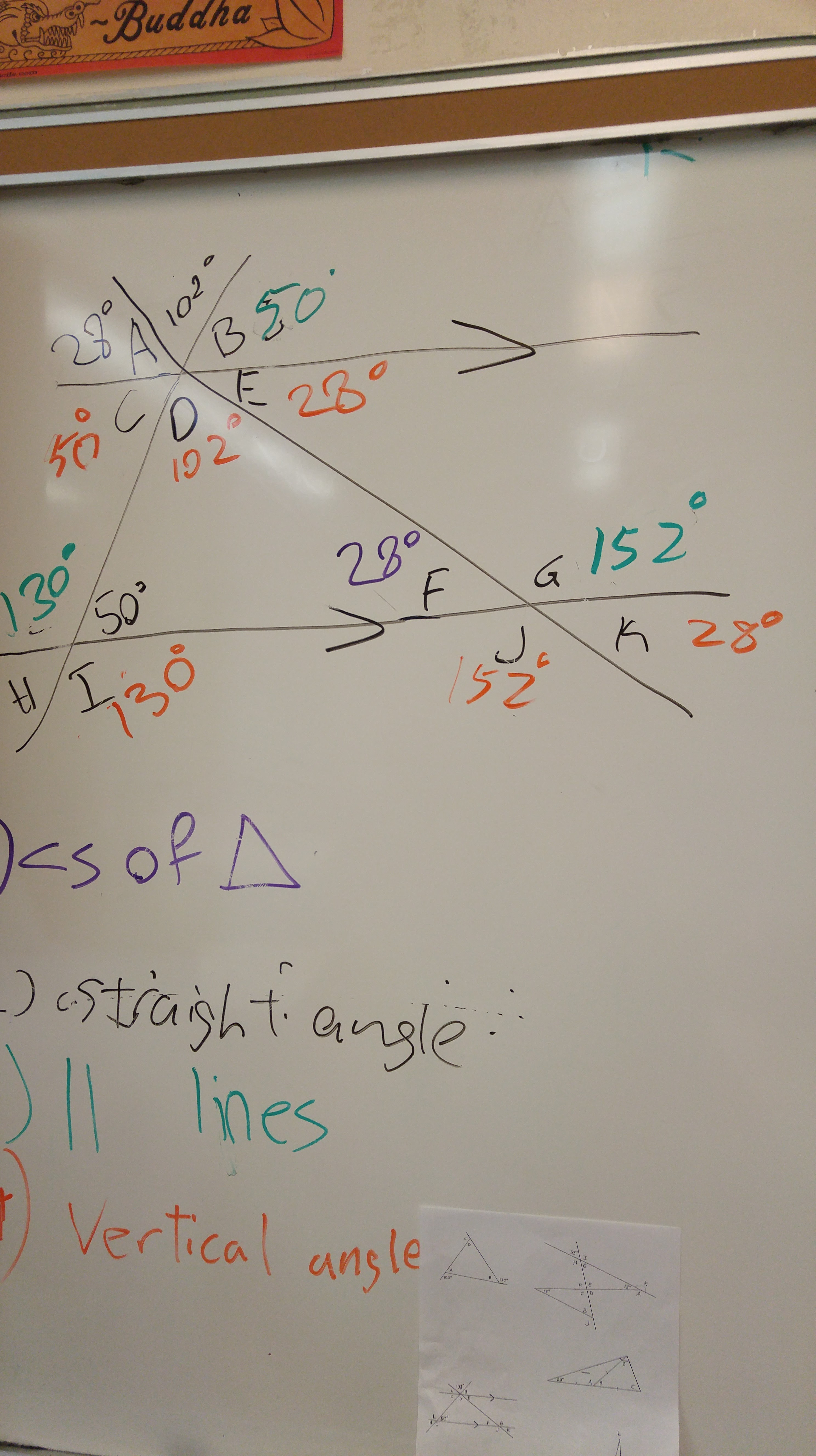
I wanted the students to work as a group up on the whiteboards, so I gave each person in each group a different color marker. I then had the students write a key in the corner. Each student’s color represented 1-3 of the theorems that they would have to use to solve the problems. Then they would draw up the diagram of the problem. As they went through, each person was only allowed to write when their theorem was used to deduce the measure of the angle. That way, with the colors, I could actually trace through the thought processes they used to solve the problem, which was really nice. (I wonder if I can use that as an assessment some how, having students trace through the same process. Maybe as a warm-up, once I get my smartboard working again.)

Here’s some pics of their great work.

20151211_133820 20151211_134150 20151211_134918 20151211_135139

Quadrilateral Congruence

Stressful as it is, I am loving teaching new courses. When I first start teaching, I felt like I was learning new stuff all the time, stuff about algebra (and how it connects to other courses) that I didn’t know I didn’t know, and now it keeps happening with geometry, especially with the more transformational tinge CC geometry has.

One of the things that struck me was, last week, when I used this Illustrative Mathematics task as a follow-up to my lesson about the diagonals of quadrilaterals. I feel like the understanding I had internalized that you can prove triangles congruent with less information because they are rigid structures, but quadrilaterals are not, so there are no quadrilateral congruence theorems. But I realized that’s not true.

Last time, we constructed all of the special quadrilaterals by taking a triangle and applying a rigid motion transformation. That meant that every special quadrilateral can be split into two congruent triangles. Therefore, if you had enough information to prove one pair of triangles is congruent, you could prove the whole quadrilaterals are congruent.

Parallelogram SSSS

So if we’re looking at SSSS in terms of the triangles, we really only know two sides of the triangles. Since that’s not information to prove the triangles congruent, then it’s not enough for the parallelograms. But SAS is enough for the triangles, so it’s enough for the parallelograms.

Isosceles Trapezoid SSA

Here’s a non-parallelogram example. Here are two isosceles trapezoids with the same diagonals, same legs, and the same angle between the diagonals and one of the bases, but the trapezoids are not congruent. But that’s because, when you look at the triangles, we have Angle-Side-Side, which we all know is not a congruence theorem. If, instead, we had had SSS (a leg, a base, and a diagonal), then they would be congruent.

Potluck Math

I was talking to one of my co-workers about a “Friendsgiving” she is holding, and how the food bill is getting up there as more people are invited. But some of those people are also bringing food – and everyone is worried about having enough.

I realized this is a very common problem with potluck meals. Everyone wants to make sure they have enough food, so the more guests, the more they make. But think about this –

At a 4-person meal, each person makes a dish that feeds 4. (4 servings). So each person then eats 4 servings of food. (Which seems like a normal amount.)

Now it’s a 20 person meal, and each person makes a dish that feeds 20. So now each person eats 20 servings? That seems unlikely – it’s much more likely that people eat 3-6 servings, for 60-120 servings eaten, leaving 80 servings of food left over.

The problem here is that each attendee is treating the problem linearly, when it would better be modeled quadratically. Of course, this is complicated by the one hit dish that every eats a full serving of, and that other dish that no one eats, and everyone wanting to try a little of everything, so figuring out how much to cook can get complicated pretty quickly.

Building Quadrilaterals and Their Diagonals

I wanted a lesson to explore the properties of the diagonals of different types of quadrilaterals, but the curriculum map I was following just lead to Khan Academy, and that’s not really my speed. And some scanning through MTBoS resources didn’t find me what I wanted, but chatting out my half-formed ideas with Jasmine in the morning focused the idea into what I did in class today.

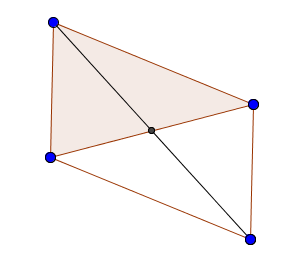
I started by having the students draw 6 triangles: 3 scalene, non-right triangles; 1 isosceles non-right triangle; 1 scalene right triangle; and 1 isosceles right triangle. Then we used each of those figures to create a quadrilateral by making some sort of diagonal. Each time, I asked them to identify the quadrilateral and what they noticed about the diagonals.

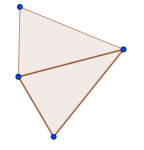
Screen Shot 2015-11-23 at 9.29.43 PMScreen Shot 2015-11-23 at 9.30.35 PM


Screen Shot 2015-11-23 at 9.51.13 PM


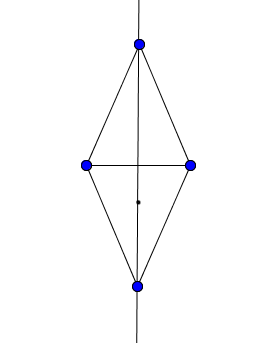
First, take one of the scalene triangles and reflect it over one of its sides. Thus we created a kite – which we know because the reflection creates the congruent adjacent sides. Then we can use the properties of isosceles triangles – we know the line of reflection is the median of the isosceles triangles because of the reflection, so it is also the altitude, meaning the diagonals are perpendicular.
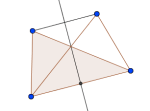
 

Screen Shot 2015-11-23 at 9.29.43 PM

Screen Shot 2015-11-23 at 9.33.33 PM


Then, take another scalene triangle and reflect is over the perpendicular bisector of one of the sides. This makes an isosceles trapezoid – we know the top base is parallel to the bottom base because they are both perpendicular to the same line, and it’s isosceles because of the reflected side of the triangle. Then we notice the diagonals are also made of a reflected side of the triangle – and so we can conclude that the diagonals of an isosceles trapezoid are congruent.

Screen Shot 2015-11-23 at 9.29.43 PM Screen Shot 2015-11-23 at 9.34.33 PM


For the third one, I asked them to draw a median and then rotate the triangle 180°. The trickiest bit here is to prove that this is a parallelogram – previously we had classified the quadrilaterals by their symmetries, so using the symmetry definition we could say any quad with 180° rotational symmetry is a parallelogram. Or we can use the congruent angles to prove the sides are parallel. Once we did that, we saw that, because we used the median, that the intersection of the diagonals is the midpoint of both – and thus the diagonals bisect each other.

I then tasked them to figure out how to make a rhombus, rectangle, and square out of the remaining triangles using the triangles. Because we proved the facts about the diagonals of the parent figures, we could then determine the properties of the diagonals of the child figures.
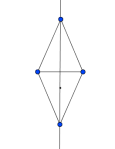
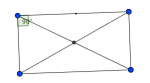
Screen Shot 2015-11-23 at 10.20.00 PM Screen Shot 2015-11-23 at 9.40.37 PM Screen Shot 2015-11-23 at 9.41.27 PM


I think it went pretty well – the students performed the transformations and easily saw the connections between the diagonals. Tomorrow I think we’ll do something about whether or not those diagonal properties are reversible – if every quad with perpendicular diagonals is a kite, for example.

Crossing the Transverse

Oh my god, I haven’t blogged since August! This has been a hell of a year, let me tell you. But maybe I’ll tell you in another post, because this one is about the new game I made in my Geometry class. (My first non-Algebra game!)

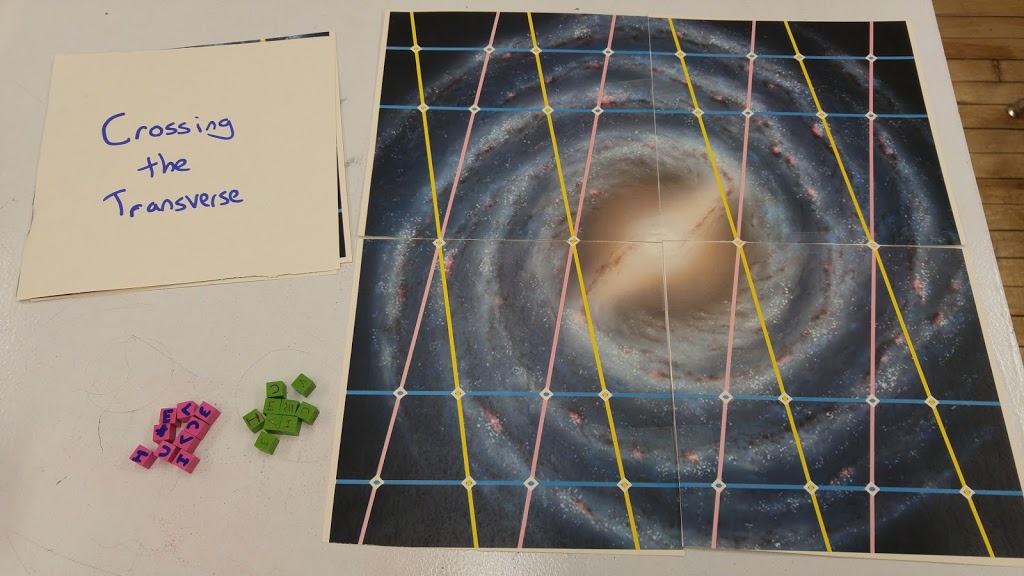
So the game is called Crossing the Transverse. The goal of the game (pedagogically) is to help identify the pairs of angles formed by lines cut by a transversal, even in the most complex of diagrams. The goal of the game (play-wise) is to capture your enemy’s flagship.

Here’s the gameboard:

Crossing the Transverse Map

I printed out the board in fourths, on four different pieces of card stocked, and taped them together to make a nice quad-fold board. Then I made the fleet of ships out of centimeter cubes I had, by writing in permanent marker on the pieces the letter for each ship.

Quad Fold Board

Here’s the rules.

In the game, each type of ship moves a different way, which makes it feel a lot like chess – trying to lay a trap for the enemy flagship without being captured yourself.  Many of my students really enjoyed it when we played it yesterday. Today, though, to solidify, I followed up with this worksheet where they had to analyze the angles of a diagram much like on the game board. They did pretty well on it, so I’m satisfied!

Materials

Crossing the Transverse Rules

Printable Map (Prints on 4 pages)

No Stars Printable Map (If printing the background galaxy is not for you, here’s a more barebones version.)

Zip File with Everything, including Pages, Doc, and GGB files

Airport Planning Project

On my flight to San Francisco today, when the pilot mentioned that we have leveled off at our cruising altitude of 32000 feet, we had just passed Scranton, according to the interactive map. This reminded me of a right-triangle trig project I did my first few years, before it was dropped from the Algebra I curriculum.

I first had the idea by doing a Dan Meyer-style textbook problem makeover. When I was looking for trig problems in the textbook I was using, I saw one that was something like this:

A pilot is flying his plane at 5 miles up and starts his descent 300 miles from his destination. What was his angle of descent?

If I were a pilot, what would I need to figure out? Most likely, I would know I need to land at a certain angle – what I would need to determine is when I should start landing my plane. So I turned the problem around. Then I thought, considering what angles we need to climb at, angles we need to land at, and how high up we need to fly, what’s the minimum distance I could get between two airports that have a connecting fight? (Assuming direct paths.) And so and made the following project:

My students had a lot of fun with this project (even if I did get countries named things like Ratchetopia). Things would get tricky sometimes with scale (I think I had them use something like 1 inch = 50 miles), but overall the process went well. However, sometimes it could be paralyzing, having so many choices of where to put the airports.

Sadly, I don’t have any pictures of the projects my students made. (Maybe on my old phone?)

Meet Me Halfway?

Today I met a friend for lunch, and we decided to meet halfway between our apartments. To think about where that would be, I used MeetWays, which was useful because it can find that mid-point based on a variety of modes of transportation: car, bike, public transit, and walking.

The thing is, my friend took the train to lunch and I walked. (I based the location on the transit midpoint, but decided to walk for the exercise.) So what counts at the midpoint then? If one person drives and another doesn’t, do you include the time spent finding parking as part of your calculation? Is it based on time, or distance? If we both travel for 45 minutes, but she’s much farther from home, is that still meeting in the middle? Considering everywhere I could walk within 45 minutes and everywhere she could train in that time, is there really only one middle point, or do those rings intersect twice?

There are the things I wondered as I walked. Are there other good questions to ask? You can probably, at the least, get a decent rates question out of it.

Groceries and Gas

Here’s a topic that came up in conversation during Easter dinner tonight. I thought that there could be some interesting math involved, so I’ll present it Problem of the Week style, with no question or prompt.

At the S&S grocery store, there is also a gas station. If you buy $100 worth of groceries, you get $0.10 off of each gallon of gas. You can save those up – so, for example, if you eventually buy $300 worth of groceries, you’ll have $0.30 off each gallon.

Right now, gas costs $2.20 per gallon. You’re even allowed to bring gas cans to fill up when you buy, but the maximum is 35 gallons in a single purchase.


What do you notice? What do you wonder?