Trying to find math inside everything else

Archive for the ‘lessons’ Category

Discrete Math & Democracy, Weeks 5-6

This time I did purposefully combine two weeks – we had 3 days of no class between them, with the PSAT, a PD day, and a holiday.

We started week 5 with another quiz – they asked for this one to be on paper instead of on the computer, and who was I to go against the will of the people? So below is the quiz I gave:

At this point we wanted to finish off our chart of Methods vs Criteria (except for IIA).

We were able to explain the whether most of the methods passed or failed Condorcet and Anti-Condorcet logically or with a counterexample, but the proof that the Borda Count passes Anti-Condorcet is a little more subtle, and a little more algebraic, so I broke that out into a worksheet.

This led to a good combinatorics connection for me. The standard way to calculate the Borda Count is to assign points based on how many candidates you beat, so if you look at it from the point of view of a ballot, in an election of 5 candidates, e.g., a single ballot gives out 4 + 3 + 2 +1 + 0 = 10 points. But another way to view the Borda Count is that you earn a point from a candidate (as opposed to from the voter/ballot) every time you beat them in a 1v1 match. Well, with 5 candidates, how many possible 1v1 matches are there? 5C2 = 10. Oh wait, that’s the same as before! And shows why the C2 column of the Arithmetic Triangle (sometimes known as Pascal’s) is the Triangle Numbers.

Speaking of combinatorics, the next part was fun. First, we considered how many different ways there are to seed an 8 person tournament. There’s lots of ways to represent this number – my first conception of it involved double factorials!! (Sam was shocked I had found a natural use for double factorials.) Thought the final conception was came up with (n! / 2^k, where k is the number of symmetries in the bracket) was easier to calculate and made more sense.

But the real fun part was thinking, well, if there’s 315 different ways to seed the bracket, is there a way to seed it such that every person can win? So I challenged them to seed the tournament so that A wins, and then so that C wins. (Some candidates couldn’t win, like B and D, because they had fewer wins than the number of matches in the tournament. A and C were possible but harder because they had few paths to victory.)

After this I introduced the concept of a Condorcet method, which tournaments are, despite their manipulability flaw. So I expanded our chart to include the methods we’d be doing soon: Copeland’s, Minimax, Nanson, and Ranked Pairs.

Finally, we had another quiz:
Discrete Math and Democracy, Week 2

So we ended the first week with a proof of May’s Theorem, but really only in the case of an even number of votes. I assigned the proof with an odd number for homework, and none of them where able to quite get it on their own but a majority got close.

(As an aside, here’s the chart I mentioned that we did in the previous post, but filled in.)

Then we started talking about voting systems with three or more candidates. In particular, not only how to tabulate the winner by hand, but how to tabulate automatically using spreadsheets. First, the slides:

When I first worked on these problems over the summer, my spreadsheet solutions were definitely…inelegant, let’s say. Compare what I did then vs. what I did this week with the students.

Summer: https://docs.google.com/spreadsheets/d/1Z0s_cQ9vAUZRDTXB_8BFCNlbjrrjVo8aoW8fjm9XH7Y/edit?gid=2074741057#gid=2074741057

Better: https://docs.google.com/spreadsheets/d/11XoeRwnayoBUOO6psc2n4fGoKtOrDIDmWzkNwLCMKGE/edit?gid=0#gid=0

What’s especially nice about the newer version is how it displays who wins or is eliminated in a particular round – learning the XLOOKUP command was pretty hand.

Anyway, going through those methods and implementing them in spreadsheets took the whole week, on top of additional practice with the second election preference schedule. (We did the Apple one as a class and then I assigned them the Alli/Bell/Choi/Diaz one to do on their own.)

Discrete Math & Democracy, Week 1

This year I’m teaching a new class called Discrete Math and Democracy, which is a course I’ve wanted to teach for a long time, ever since I helped my ex prepare to teach a similar course at his university. I spent a lot of time learning things and gathering materials over the summer, including ones I got from previous workshops at Math for America. I thought about doing a Blog180 to document my time teaching the course, but that’s not the kind of blog this is, so I figure I’ll debrief somewhere more private and then do weekly updates here, along with any materials I use. (Hopefully I can still squeeze in some other posts on other topics in the meantime.)

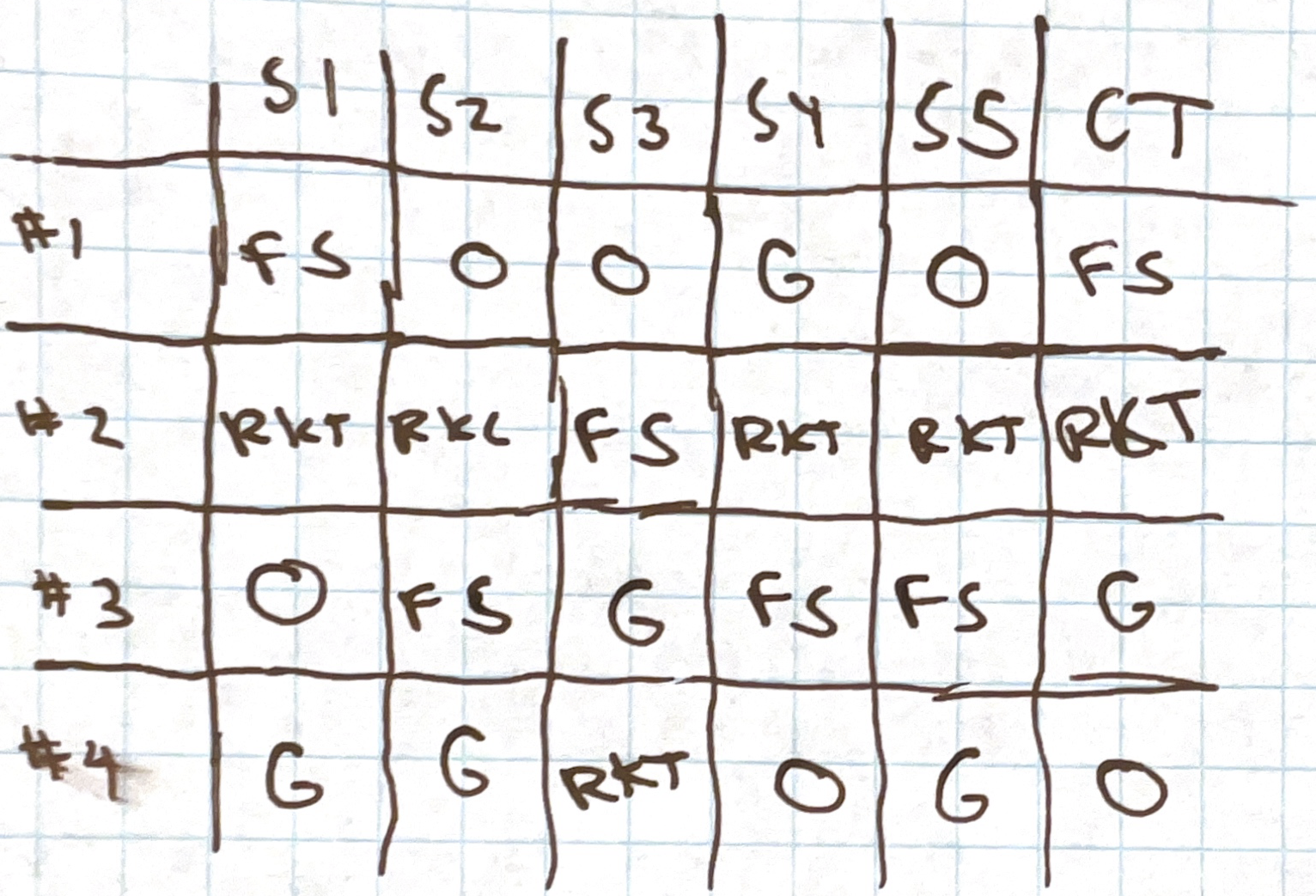
The first day I started off asking the students to think of a process for choosing a snack. They suggested each person suggesting a snack and then we’d decide, so we got straight to the idea of nominating candidates. At first three people were going to make the same nomination (Oreos) so it seemed like that might be the winner, but then I had them make preference ballots for our four candidates. The voting profile for those are below.

It became clear that while Oreos were the plurality winner, Rice Krispies Treats were more of the consensus choice, so we right away had a tension between what they might have expected for a voting system and what might be “right,” so that couldn’t have worked out better. I then had them read this article on different kinds of distributive justice by Matt Bruenig to help get at the idea that there are different ways to structure society that all have merit, and a similar thing applies to electoral systems as well. We need to know what our goals are before we can decide on a best system.

The next day, Rice Krispies Treats in hand, we looked at a tabulated voting profile and I gave them the challenge of coming up with a reasonable way to count the votes such that each candidate can be the winner. (This is adapted from a material I got from a workshop so long ago I don’t remember which, although it was probably led by Kate Belin.) I turned it into the worksheet below:

The students were able to come up with equivalents to plurality and Borda count on their own, as well as a system where they counted all #1 & #2 votes (which I guess could be equivalent to a kind of approval voting). They needed a little hint to get Edamame and Bagels to win. (Spoiler: it’s IRV and Top Two Runoff.)

After that I had them learn some basics of spreadsheets, as we’ll be doing a lot of work with them, using this wonderful tutorial by Jed Williams.

Next, I pared it back to two-candidate election systems and we looked at various kinds and what properties they have.

I was reminded of the important of having examples and, even better, non-examples. An important social choice theorem is May’s Theorem that states that the only two-candidate system that is anonymous (treats all voters equally), neutral (treats all candidates equally), monotone (you can’t lose by gaining more votes), and nearly decisive (always has a victor unless the candidates have the same number of votes) is a simple majority.

But simple majority is such a basic and obvious system that it’s hard to see why this theorem is a big deal, and often the only counterexamples given in textbooks are dictatorship and monarchy, which are obviously antidemocratic. But I found a new book (A Mathematical Look at Politics) that gives a few more examples of systems that are reasonably democratic but don’t have all of those properties, which helped clarify it.

They are supermajority (you need a higher threshold to win, like 2/3 of states to pass an amendment), status quo (if a challenger doesn’t get a certain number of votes, the status quo wins – this is how the filibuster works), and probabilistic (a winner is chosen at random, with more votes increasing odds).

Filling out the chart was a good exercise, though how to determine the properties of probabilistic systems was a little tricky.

Lastly, we worked on another sheet where we worked out the winner with several systems, and then proved May’s Theorem with a few fill-in-the-blanks.

The proof actually went quite well! It took me a while to wrap my head around it when I read it myself, but I think the blanks helped us consider the various properties and how it works. (This proof is for an even number of voters, so I had them do the other case, with odd, for homework.)

Off to a good start!

Derivative Clicker

I was looking for a derivative-based game to play in Calculus as we were just closing out our first unit on derivatives and the semester was ending. That’s when I found Derivative Clicker:

https://gzgreg.github.io/DerivativeClicker/

It hit the spot with my students. I explained the game and had them all start playing simultaneously, and then saw who had earned the most money in 20-25 minutes. Yes, it’s a little addictive and “brain rot” (as one student said, but, like, it was a positive review) but they had a lot of fun.

The thing about math games, though, is that the real power is not in the game itself but in the debrief. Just the lesson before this was my students’ first exposure to the idea of higher order derivatives. They asked “But what does a second derivative actually tell us about the function” and I explained, but it still felt ungrounded to them. So I thought this would help them feel the power of derivatives viscerally.

Then we filled out some tables: what if I just had a single 1st derivative (or, in other words, f'(t) = 1), how much money would I have after time? What if instead f”(t) = 1? f”'(t) = 1? This helped build up the idea of increasing rate and how the rates grew polynomially.

They also had debate question about strategy – in the game, with $500, you can buy 1 second derivative or 65 1st derivatives. Which is better? (There’s no a clear answer here – if you were to buy the second derivative and then walk away, it’ll probably be better for you by the time you get back. But if you buy the 65 1st derivatives, you’ll have enough money to buy a second derivative way before buying a second derivative will get you 65 1sts.)

Below is the debrief sheet we did today.

Vimes’ Theory of Socioeconomic Injustice

As I was planning my linear functions unit, I noticed a problem about someone choosing between two electric companies, with the standard idea of one having a larger start-up cost but a lower monthly rate. I realized these problems are very common, and they reminded me of of a quotation from my favorite author, Terry Pratchett:

The reason that the rich were so rich, Vimes reasoned, was because they managed to spend less money.

Take boots, for example. He earned thirty-eight dollars a month plus allowances. A really good pair of leather boots cost fifty dollars. But an affordable pair of boots, which were sort of OK for a season or two and then leaked like hell when the cardboard gave out, cost about ten dollars. Those were the kind of boots Vimes always bought, and wore until the soles were so thin that he could tell where he was in Ankh-Morpork on a foggy night by the feel of the cobbles.

But the thing was that good boots lasted for years and years. A man who could afford fifty dollars had a pair of boots that’d still be keeping his feet dry in ten years’ time, while the poor man who could only afford cheap boots would have spent a hundred dollars on boots in the same time and would still have wet feet.

This was the Captain Samuel Vimes ‘Boots’ theory of socioeconomic unfairness.

– Men at Arms

I wanted to share this concept with my class, so I looked for problems. One thing I realized, though, was that many of these problems involved one person choosing between two things. This makes it so there is one clearly correct answer.

But oftentimes, in the real world, people don’t have a choice. One person can afford the upfront cost to pay less in the long run, but another person can’t, and winds up paying more overall, as in the Pratchett quote above. So I decided to reframe the problems as comparisons between two people, to highlight that injustice.

The lesson started with a model problem, then I gave each group a different problem from the set below.

(I went through this page of unisex names to make all of the problems gender-neutral.)

Each table worked on a different problem (with some differentiation on which group worked on which), then they jigsawed and, in their new groups, they shared out their problems and how they solved them. Then, most importantly, they looked for similarities and differences between the problems.

We then read the Pratchett quote and discussed its meaning, and students had to agree or disagree (making a claim and warrant for each). We had a good discussion on whether it really applied to today’s world or not.

The Secret of the Chormagons

(Doesn’t that title sound like it should be a YA fantasy book?)

I shared this Desmos Activity Builder I made on Twitter, but never wrote a post about it. Oops! Let’s do that now.

First, here’s the activity.

This activity is basically adapted from Sam’s Blermions post that I had helped him think about but he did all the hard work of creating questions and sequencing them. I’ve used the blermion lesson in the past and it went well, but that last part lacked the punch I was hoping for, having to work with analog points and compiling them together myself. But then I thought – wait, Desmos AB does overlays that will do this beautifully, if I can just figure out how to get the Computation Layer to do what I want. So I set to it.

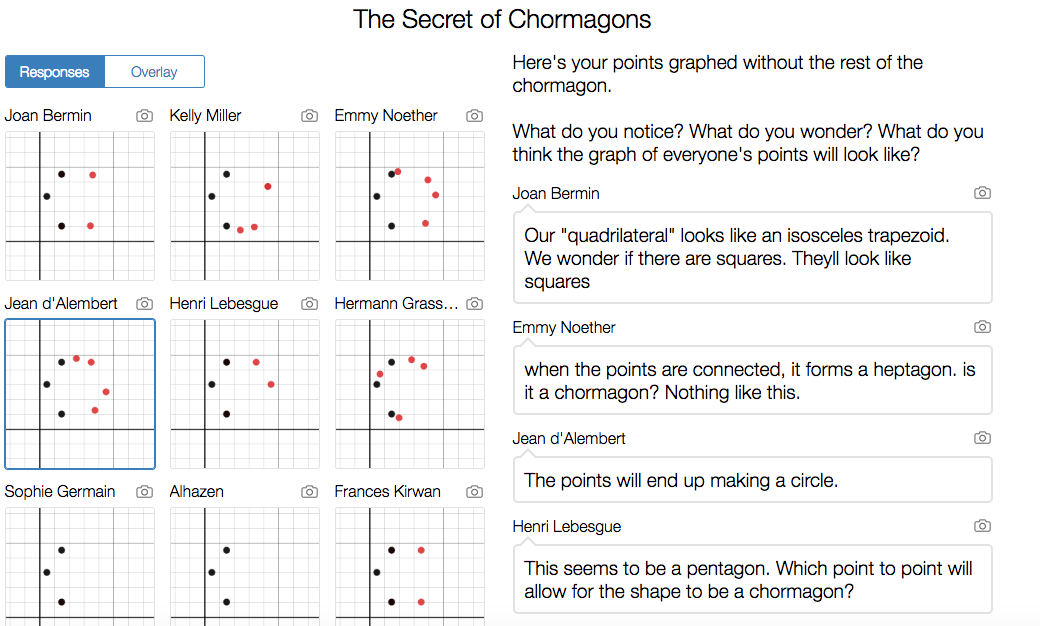
The pacing helped pause things to conjecture about what chormagons are – I stopped them at slide 5 so they can make those conjectures. I then advanced the pacing to 6 for the “surprise,” and 7-8 to make further conjectures. Look at some of theirs below.

Screen Shot 2018-08-02 at 12.30.13 PM

Even showing them everyone’s, I tended to get conjectures about the shape their points make – a trapezoid, a pentagon, a heptagon, etc. (One person seemed to guess the truth, but that was uncommon.)

Then I showed them the overlay.

Screen Shot 2018-08-02 at 12.31.05 PM

I saw at least one jaw literally drop, which totally made my day. We talked about why it might be a circle, and what that means for these shapes, then I introduce the proper terminology “cyclic quadrilaterals.” (I taught this lesson as an interstitial between my Quads unit and my Circles unit.)

Speaking of proper terminology, you may notice I called them Chormagons here, as opposed to Blermions. That’s important – Blermions is very google-able, it leads right to Sam’s post! But Chormagons led them nowhere. (And they were so mad about that!)

Now Chormagons will lead right here. So this is an important tip if you use this DAB: make sure you change the name of the shape!

Circles, Lines, and Angles

My math coach gave me this idea as we were planning my Circles unit. I think it went fairly well, so I’ll share it here. The idea is that we have, essentially, three basic objects that we’ve combined in different ways in geometry: circles, lines (including segments), and angles. So, as an opening activity to the unit, the task was this:

“Think of as many ways as possible to combine those three objects.”

First they brainstormed individually, as I reminded them that they can use multiple lines or angles or circles if they wanted. Then they went up to groups and made a master list per pair or group, eliminating ones that were “pretty  much” the same. I gave them some vocabulary based on what I saw they drew, and they had to use that vocabulary to describe what each drawing had. Finally, they chose one example and created one neat, fully correct example, in color that we combined into class posters. (I approved what they chose, to ensure a variety of possible layouts.)

20160414_144226_HDR 20160415_075653_HDR

Between my two classes, they came up with almost every scenario I could think of that we would learn in the unit, with the exception of Tangent Line & Radius, which I drew and put in myself. Now they are hanging in the classroom, acting as a guide for our journey into circles.

Natural Circle Measures

Yesterday I introduce radians to my students for the first time. I started out by asking why they thought a circle had 360°. There were a few good answers – four right angles makes a circle, so 4*90 is 360; a degree is some object they measured in ancient Greece, and so a circle was made of 360 of them; something to do with the number of days in the year. All good answered, but I told them it was completely arbitrary based on the Babylonian number system.

Once we decided that it was arbitrary, I asked them to come up with their own method of measuring a circle. I would classify their responses into three categories

  1. Divide the circle up into 200 “degrees” (most common)
  2. Divide the circle up into 100 “degrees”
  3. Divide the circle up into 2 “degrees” (least common)

I was expecting 100 “degrees” to be the most common, so I was very surprised to see that most of the students want to split the circle into two sections, each with 100 parts.

I have been a proponent of tau for a while, as I thought it was natural to think of radians as pieces of a whole circle, but my students were clearly thinking of the circle as two semicircles right off the bat.

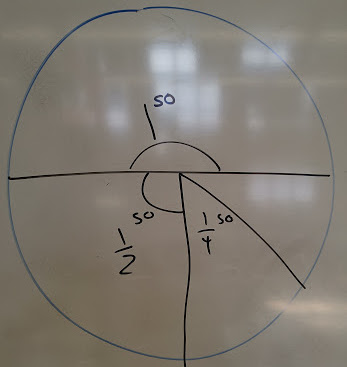
I pushed the students who came up with the third way in a whole class discussion. If this whole semicircle is one student-name-degree, what would you call this section? And so we got to using fractions of those degrees.

20160412_152234_HDR.jpg

That made a pretty easy transition into radians. I went a little into the history; instead of using a degree, some mathematicians decided to use names based on the arc length – and so that semicircle’s angle was 1 π radians, instead of 1 student-name-degree. And the fractions we used were the same.

This almost made me doubt my tau ways – maybe π was more natural. But then, as we started converting angles from degrees to radians, some students kept complaining that, for example, 90° was 1/2 π instead of 1/4, since it was clearly a quarter-circle – so maybe I can stay a tau-ist.

Angle Chasing

On Friday our school was supposed to have a Quality Review, but it was canceled at the last minute. (That’s a whole ‘nother story.) But that pushed me to do a lesson that I probably wouldn’t’ve done otherwise, so that’s good. I actually think it went pretty well.

I noticed in our last exam that I should probably explicitly teach angle chasing as a problem solving strategy, so I asked the MTBoS for some good problems. Justin Lanier came through in the most wonderful way. So I picked out some problems into a nice sequence that would use a bunch of the theorems we’ve already done.

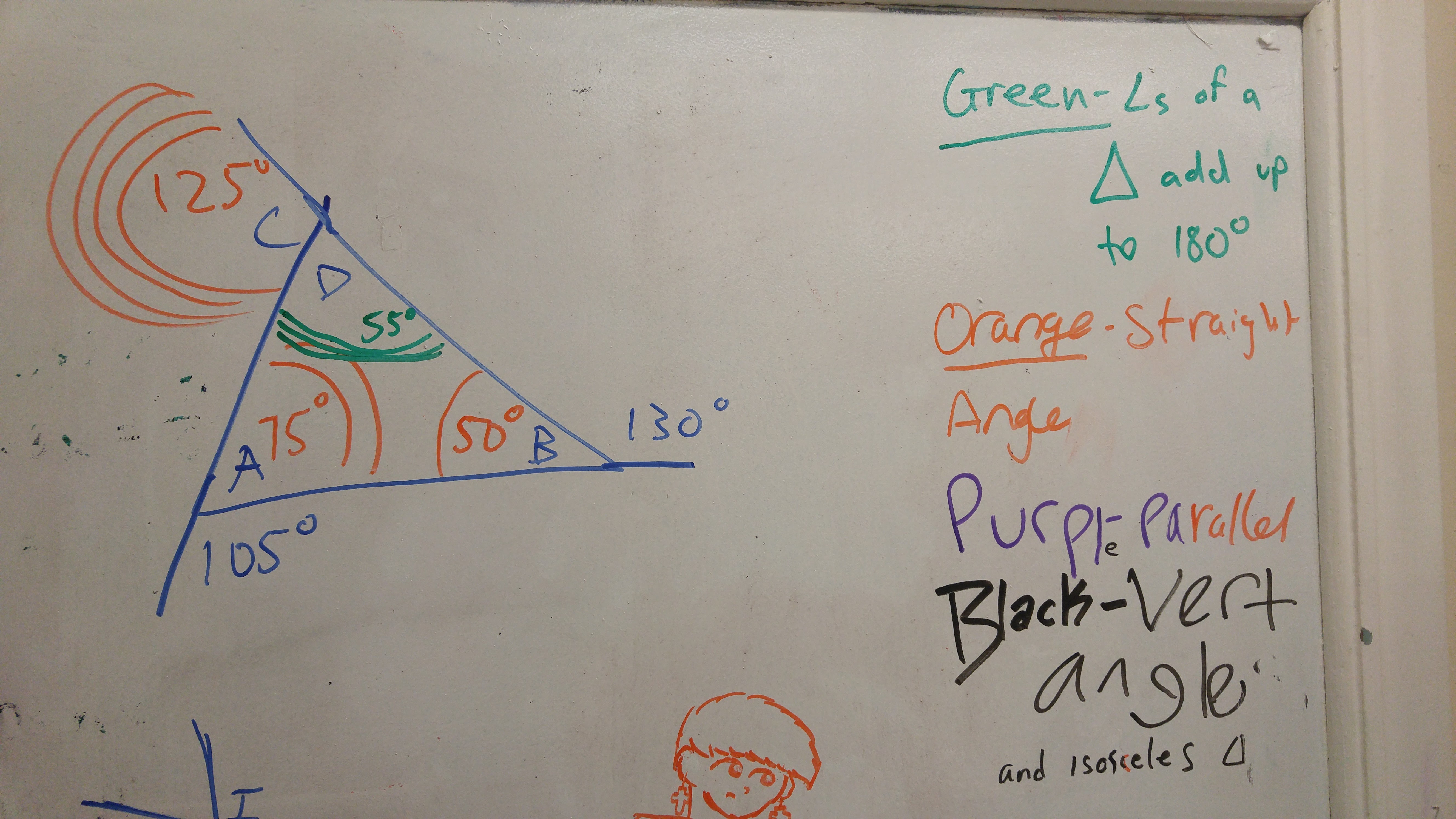
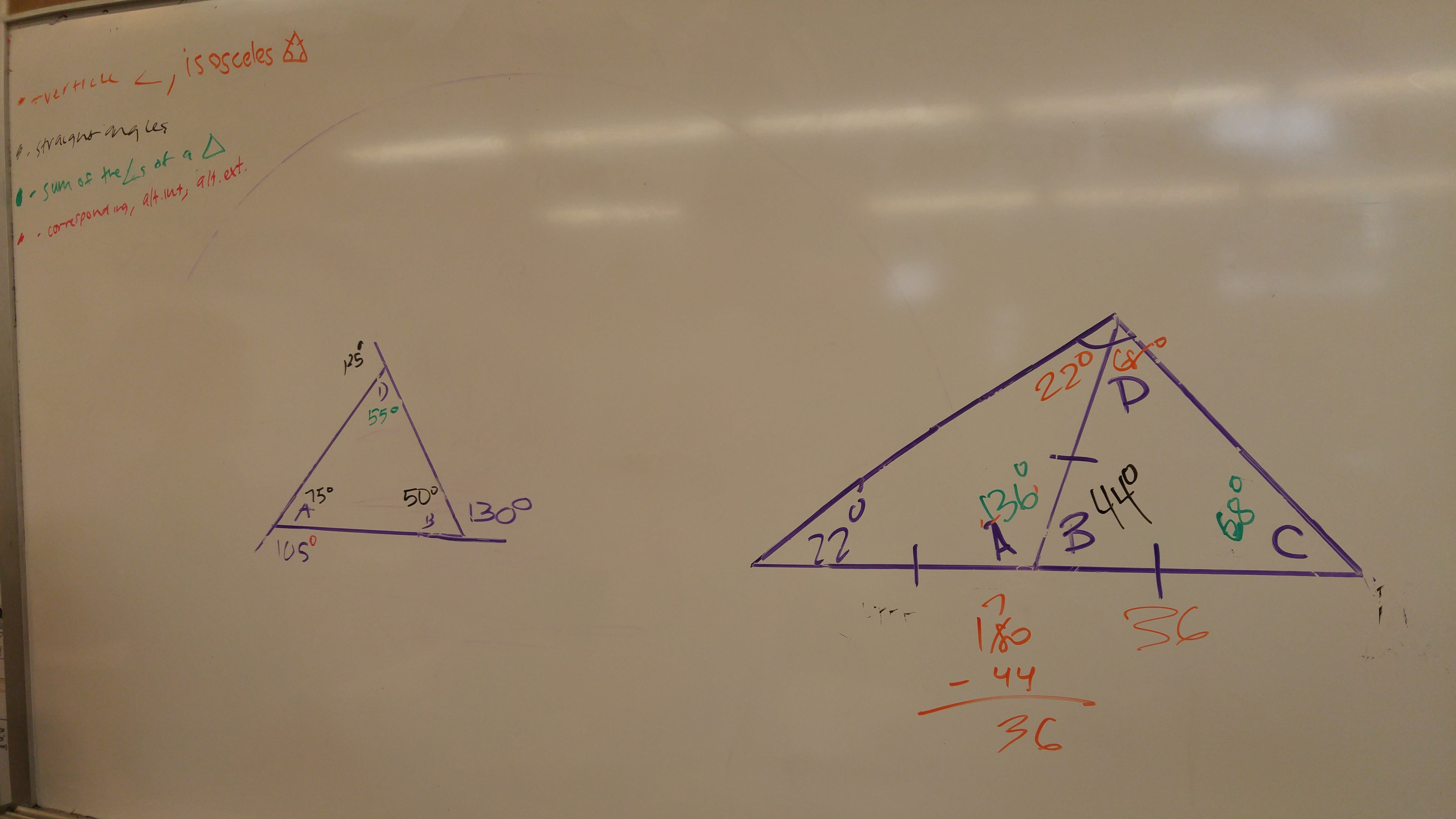
I wanted the students to work as a group up on the whiteboards, so I gave each person in each group a different color marker. I then had the students write a key in the corner. Each student’s color represented 1-3 of the theorems that they would have to use to solve the problems. Then they would draw up the diagram of the problem. As they went through, each person was only allowed to write when their theorem was used to deduce the measure of the angle. That way, with the colors, I could actually trace through the thought processes they used to solve the problem, which was really nice. (I wonder if I can use that as an assessment some how, having students trace through the same process. Maybe as a warm-up, once I get my smartboard working again.)

Here’s some pics of their great work.

20151211_133820 20151211_134150 20151211_134918 20151211_135139

Building Quadrilaterals and Their Diagonals

I wanted a lesson to explore the properties of the diagonals of different types of quadrilaterals, but the curriculum map I was following just lead to Khan Academy, and that’s not really my speed. And some scanning through MTBoS resources didn’t find me what I wanted, but chatting out my half-formed ideas with Jasmine in the morning focused the idea into what I did in class today.

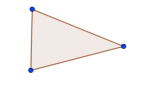
I started by having the students draw 6 triangles: 3 scalene, non-right triangles; 1 isosceles non-right triangle; 1 scalene right triangle; and 1 isosceles right triangle. Then we used each of those figures to create a quadrilateral by making some sort of diagonal. Each time, I asked them to identify the quadrilateral and what they noticed about the diagonals.

Screen Shot 2015-11-23 at 9.29.43 PMScreen Shot 2015-11-23 at 9.30.35 PM


Screen Shot 2015-11-23 at 9.51.13 PM


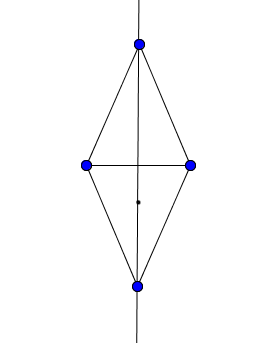
First, take one of the scalene triangles and reflect it over one of its sides. Thus we created a kite – which we know because the reflection creates the congruent adjacent sides. Then we can use the properties of isosceles triangles – we know the line of reflection is the median of the isosceles triangles because of the reflection, so it is also the altitude, meaning the diagonals are perpendicular.


Screen Shot 2015-11-23 at 9.29.43 PM

Screen Shot 2015-11-23 at 9.33.33 PM


Then, take another scalene triangle and reflect is over the perpendicular bisector of one of the sides. This makes an isosceles trapezoid – we know the top base is parallel to the bottom base because they are both perpendicular to the same line, and it’s isosceles because of the reflected side of the triangle. Then we notice the diagonals are also made of a reflected side of the triangle – and so we can conclude that the diagonals of an isosceles trapezoid are congruent.

Screen Shot 2015-11-23 at 9.29.43 PM Screen Shot 2015-11-23 at 9.34.33 PM


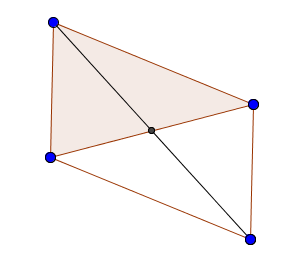
For the third one, I asked them to draw a median and then rotate the triangle 180°. The trickiest bit here is to prove that this is a parallelogram – previously we had classified the quadrilaterals by their symmetries, so using the symmetry definition we could say any quad with 180° rotational symmetry is a parallelogram. Or we can use the congruent angles to prove the sides are parallel. Once we did that, we saw that, because we used the median, that the intersection of the diagonals is the midpoint of both – and thus the diagonals bisect each other.

I then tasked them to figure out how to make a rhombus, rectangle, and square out of the remaining triangles using the triangles. Because we proved the facts about the diagonals of the parent figures, we could then determine the properties of the diagonals of the child figures.

Screen Shot 2015-11-23 at 10.20.00 PM Screen Shot 2015-11-23 at 9.40.37 PM Screen Shot 2015-11-23 at 9.41.27 PM


I think it went pretty well – the students performed the transformations and easily saw the connections between the diagonals. Tomorrow I think we’ll do something about whether or not those diagonal properties are reversible – if every quad with perpendicular diagonals is a kite, for example.