Trying to find math inside everything else

Archive for the ‘games’ Category

We Didn’t Playtest This At All

Yesterday was my best friend’s birthday and his wife got him the game We Didn’t Playtest This At All, which is a very silly game that was tons of fun. (We probably played it about 15 times.) The point of the game is to win or, barring that, to make everyone else lose. And that’s all the rules there are, other than Draw 1, Play 1. Everything else is in the cards.

One set of cards in the game has players all throw out 1 to 5 fingers on the count of three:

Huh, I just noticed that it's a Star Card, so you actually know if that's the one the person is playing!

Since you don’t know what card they are playing, even and odd really don’t matter. But winning on a prime…that’s interesting.

As I was leaving, I started to wonder if there was a best number you could throw out to maximize your chances of winnings (or, alternately, stopping to person who played the card from winning). Talking about it with another math teacher who was there, I hypothesized that, because of the lower density of prime numbers as numbers get larger, you’d want to throw smaller numbers to increase your chances of getting a prime.

But, of course, I couldn’t just leave that conjecture. I had to test it! For the purposes of this, I assumed all other players besides yourself throw out a random number of fingers, essentially becoming 5-sided dice.

It’s pretty simple to compute for two players:

  • If I throw out a 1, it’ll be prime if my opponent throws 1, 2, or 4.
  • If I throw 2, she needs to throw 1, 3, or 5.
  • If I throw 3, she needs to throw 2 or 4.
  • If I throw 4, she needs to throw a 1 or 3.
  • If I throw a 5, she needs to throw a 2.

This supports my hypothesis: throwing a 1 or 2 increase the odds of a prime, and a 5 radically decreases them. (Of course, then we can get all game theoretical — if I know you’re gonna throw 5, I should throw 2. But then, if you know that, you should throw 4, etc.)

What about for more than 2 players? The game box says we can have up to 10. I worked it out somewhat in my notebook on my train ride home, but then I had the power of Excel. (It actually took me longer than I would like to admit to re-figure out how to find the probabilities of, say, getting a total of 12 when 3 people throw out. I was counting up all the possibilities for a while until I realized the recursive method for calculating those probabilities. And if Wolfram-Alpha hadn’t been so hard to use in this regard, I might not have figured it out myself.)

Three to Five Players

On the left are the probabilities that you opponents’ total will be a certain number. On the right is the number of ways you can get prime if you throw out that number.

 For three players, 1 is still the champ is terms of getting you a prime, but surprisingly, 5 is second place! What had been the worst number to throw out to get primes for 2 players is now the second best with 3 players. And for 4 players, 1 and 5 are actually the worst (though only slightly), with 2, 3, and 4 coming out on top. But at this point, it’s pretty balanced. 5 players is almost equally likely no matter what you throw. It’s almost as if they playtested this?

But now, the pattern emerges.

But now, the pattern emerges.

When I extended to 6 or 7 players, though, it became clear that 1 really was the true winner and 5 the worst. Once we were out of the weeds of the prime-heavy teens, the hypothesis seems more true. (It also holds for 8 players.) Of course, I haven’t proven that it will always be true for 6+ players…but I leave that as an exercise to the reader.

 

Math Games

Back in January I participated in a panel on Math Games over at the Global Math. I meant to write this follow-up post shortly after, but January was a hell of a month for me and it slipped to the wayside. See my talk here, at the 2:55 mark.

I sorta hit the same point over and over, using six different games as examples, but that’s because I truly believe it is the most important point in both designing math games as well as choosing which games to use in your classroom. If the math action required is separate from the game action performed, then it will seem forced and lead students to believe that math is useless.

Global Math - Math Games.003This can be fine if you want. Maybe you want to play a trivia game, where the knowledge action is separate from the game action. But if you pretend that they are the same, then you have problems.

This is the same essential argument as the one against psuedocontext. It may seem like you could say “It’s just a game,” but students see it as a shallow way to spice something up that can’t stand on its own. (I’m not saying review games and trivia games don’t have their place, but they can’t expand beyond their place.)

Below are the six examples I gave, with the breakdown of their game action and math action. I hope to use what I learned in this process to have us make a new, better math game in the summer, during Twitter Math Camp.

Example 1 – Math Man

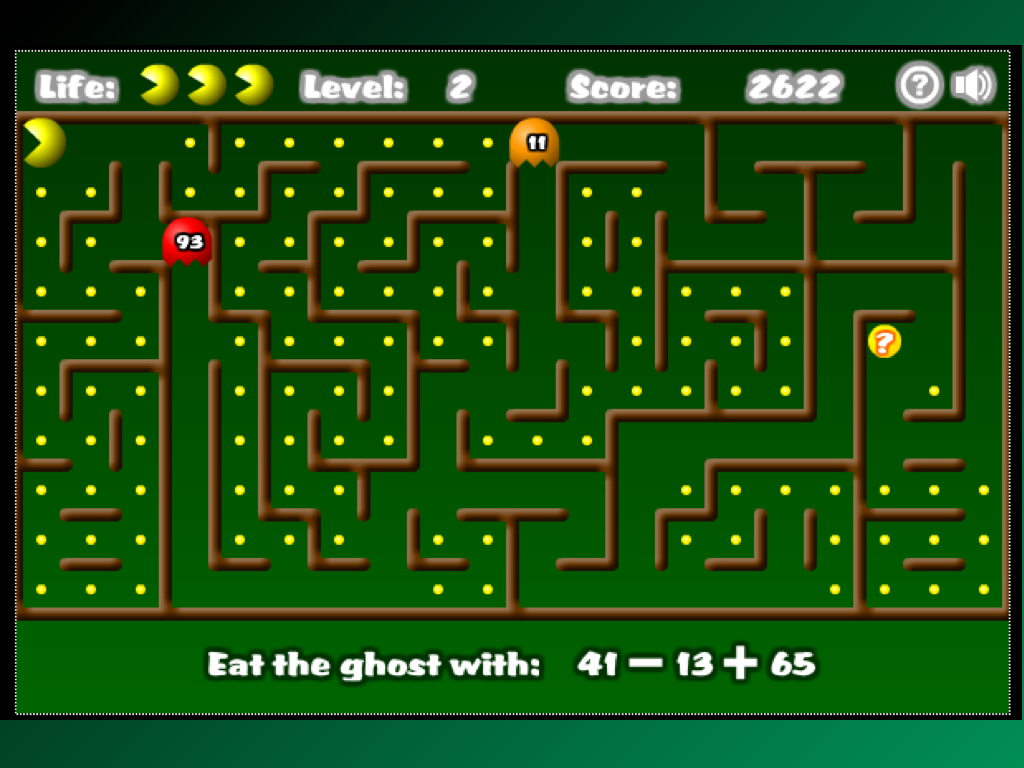
A Pac-Man game where you can only eat a certain ghost, depending on the solution to an equation.

Global Math - Math Games.005

If we apply the metric above and think about what is the math action and what is the game action? Here, the math actions are simplifying expressions and adding/subtracting, but the game actions are navigating the maze and avoiding ghosts. If I’m a student playing this game, I want to play Pac-Man. The math here is preventing me from playing the game, not aiding me, which makes me resentful towards that math.

Verdict: Bad

Example 2: Ice Ice Maybe

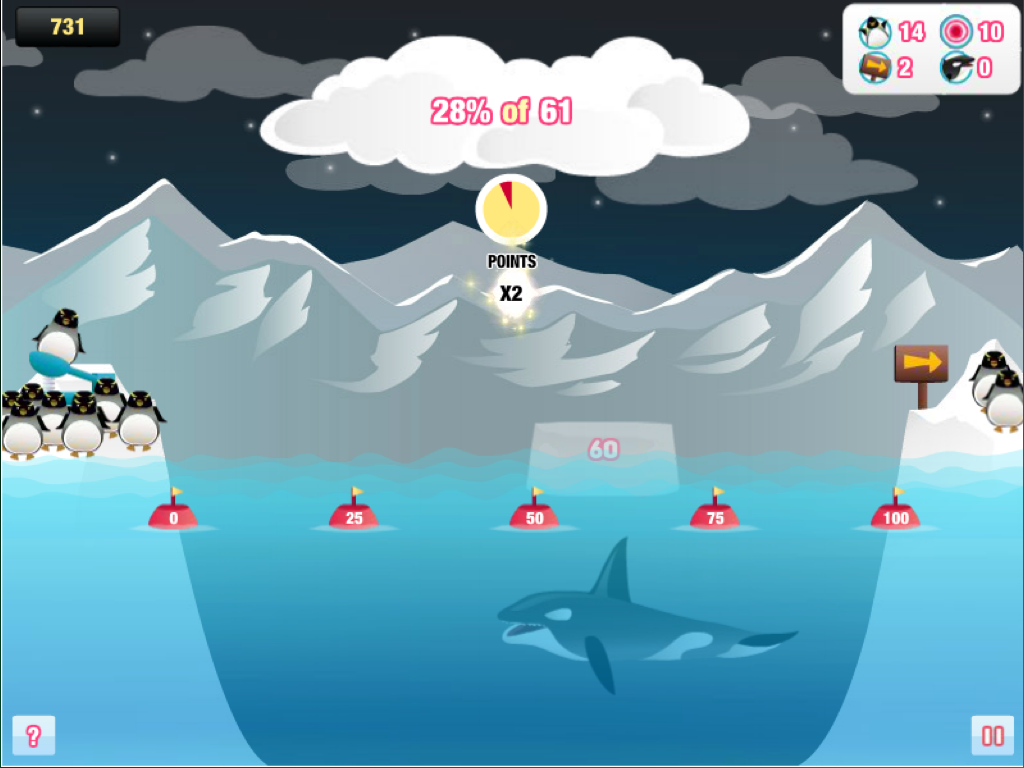
Global Math - Math Games.008In this game, you help penguins cross a shark filled expanse by placing a platform for them to bounce over. Because of a time limit, you can’t calculate precisely where the platform needs to go, so you need to estimate. That skill is both the math action and the game action, so that alignment means that this game accomplishes its goal.

Verdict: Good

Example 3: Penguin Jump

Global Math - Math Games.011Here you pick a penguin, color them, and then race other people online jumping from iceberg to iceberg. The problem is that the math action is multiplying, which is not at all the same. The game gets worse, though, because AS the multiplying is preventing you from getting to the next iceberg, because maybe you are not good at it yet, you visibly see the other players pulling ahead, solidifying in your mind that you are bad at math, at exactly the point when you need the most support. A good math game should be easing you into the learning, not penalizing you when you are at your most vulnerable point, the beginning of your learning.

Verdict: Terrible

Example 4: FactortrisGlobal Math - Math Games.014

This is a game that seems like it has potential: given a number, factor that number into a rectangle (shout-out to Fawn Nguyen here in my talk), then drop the block you created by factoring to play Tetris.

Again, the math action is factoring whole numbers and creating visual representations, which are good actions. But the game action is dropping blocks into a space to fill up lines. As Megan called it, though, we have a carrot and stick layout here, and often in many games. Do the math, and you get to play a game afterwards. (Also, the Tetris part doesn’t really pan out, because all the blocks are rectangles, which is the most boring game of Tetris ever.)

Verdict: Bad

Example 5: DragonboxGlobal Math - Math Games.017

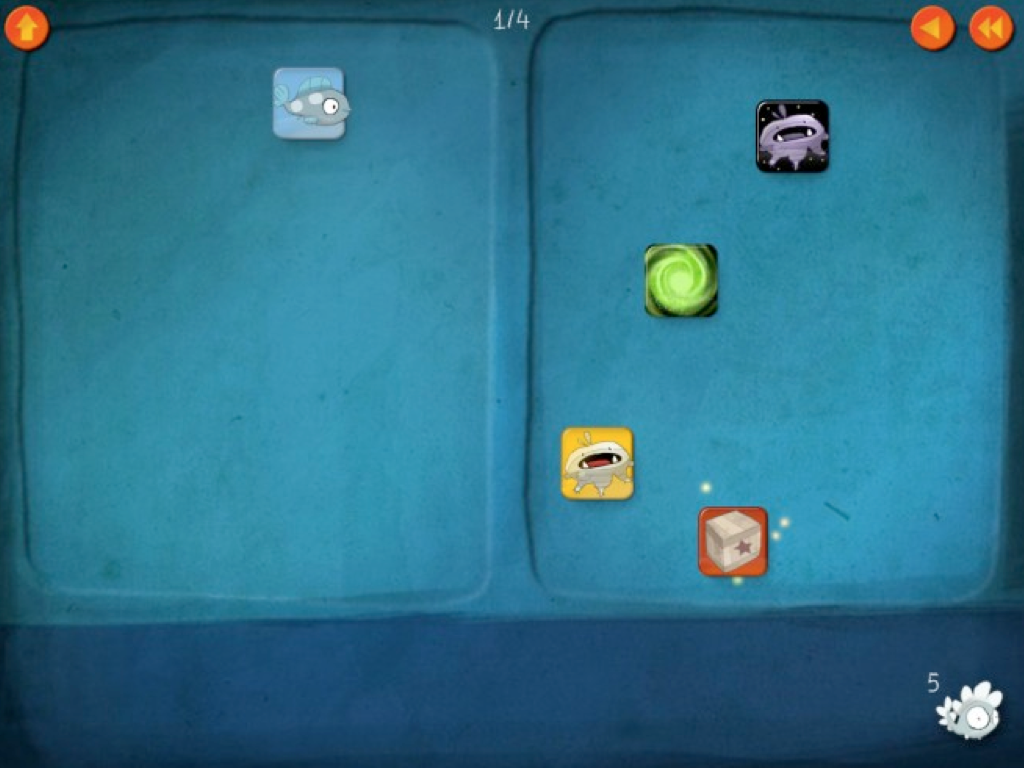
I’ve written about Dragonbox before, so I won’t write about it too much here. The goal of Dragonbox is to isolate the Dragon Box by removing extraneous monsters and cards. The math actions include combining inverses to zero-out or one-out, or to isolate variables. The game action is to combine day/night cards to swirl them out, or isolate the dragon box. The game action is in perfect alignment with the math action, which makes the game very engaging and very instructive.

Verdict: Good

Example 6: Totally RadicalPlaying the Root

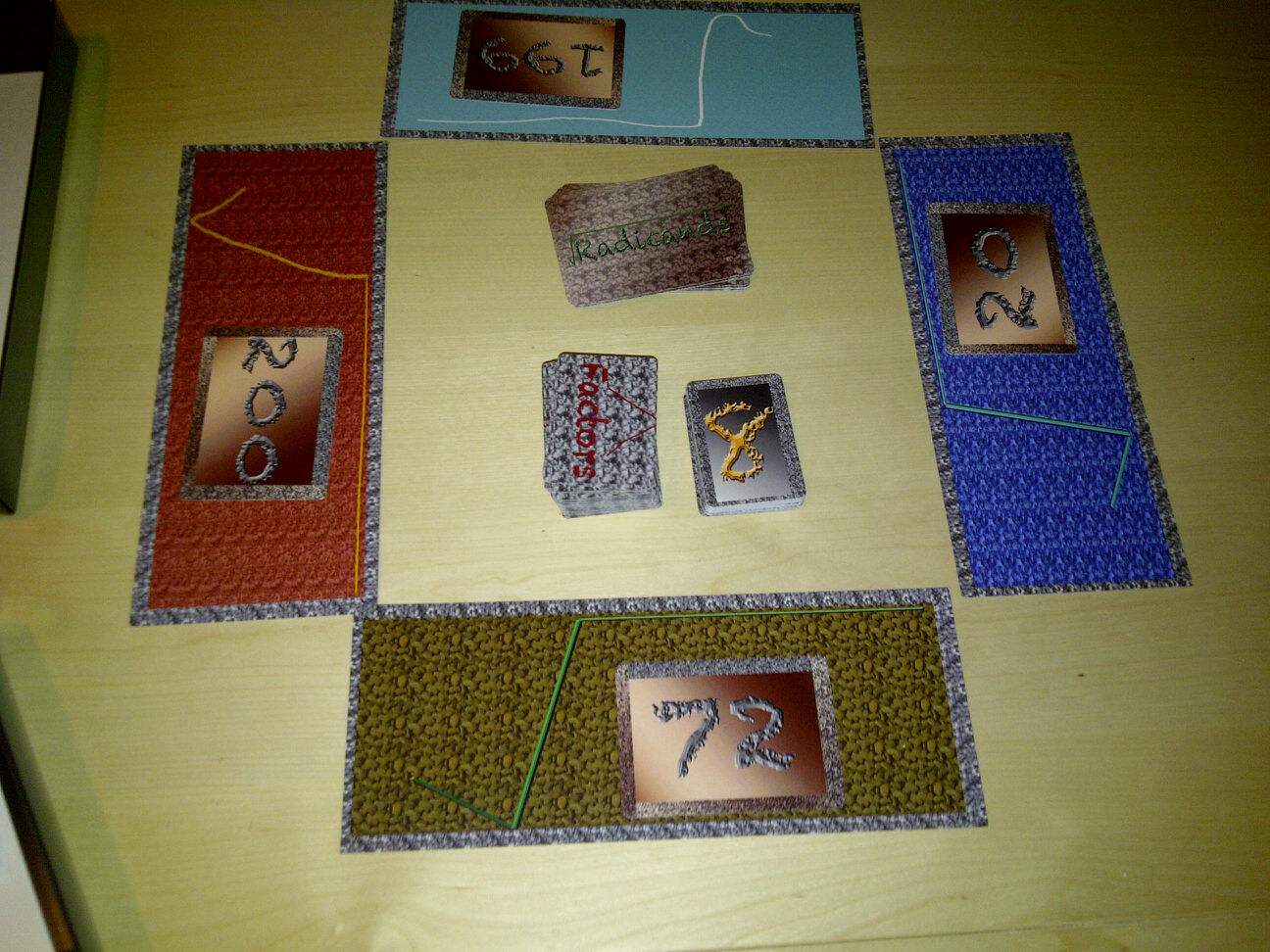
The board game I created last year (and you can also make your own free following instructions here, or buy at the above link). In this game, the game actions were designed to match up with math actions. Simplifying a radical by moving a root outside the radical sign, as in the picture above, is done by playing the root card outside and removing the square from the inside (and keeping it as points).Global Math - Math Games.021 You also need to identify when a radical is fully simplified, which you do in game actions by slapping the board (because everything is better with slapping) and keeping the cards there as points.

Verdict: Good

Final Note

One of the real challenges of finding good math games, as a teacher, is curriculum. Most math teachers know of several good math games, like Set or Blokus. While these games are great and very mathematical, they’re not the math content that we usually need to teach in our classes. So the challenge falls on us to create our own games, but making good math games is hard. (Making bad ones is pretty easy.) On that note, if you know of some good math games (that meet the criteria mentioned in this post), drop a line in the comments!


Wits and Wagers and Number Sense

I bought my boyfriend the game Wits and Wagers for Christmas, after seeing it on Tabletop and thinking he would enjoy it. (Feel free to watch the episode of Tabletop for a good example of how it works, though they play the Family edition, and we have the standard version.)

The basic premise of the game is that everyone is asked the same question, which always has a numerical answer (including dates). Everyone secretly writes down their guess, with the goal of being the closest without going over. Then, everyone reveals their answers and they are put in order on the board. At that point, everyone bets on which they think is the best answer. The answer is revealed, and the person who wrote the best answer and everyone who guessed it gets points.

I played it with him and some friends on New Year’s Eve, and saw some interesting results that made me think the game would be a good tool for developing number sense. In fact, one of his friends said that she wasn’t good at the game because she had no idea who was even a good range for an answer. But the game itself provides you with that sense, by consensus.

I know I read once, though I can’t remember where, about how when prompting a class for a guess, most student guesses will fall somewhere in the same order of magnitude as the first guess, even if that first guess is super ridiculous. (Like, for a guess at how tall the Eiffel Tower is, the first person guesses 6 miles. No, that can’t be right, the second person says. More like 4 miles.) The way to avoid this is to have people right down their answers ahead of time, a mechanic built into the game.

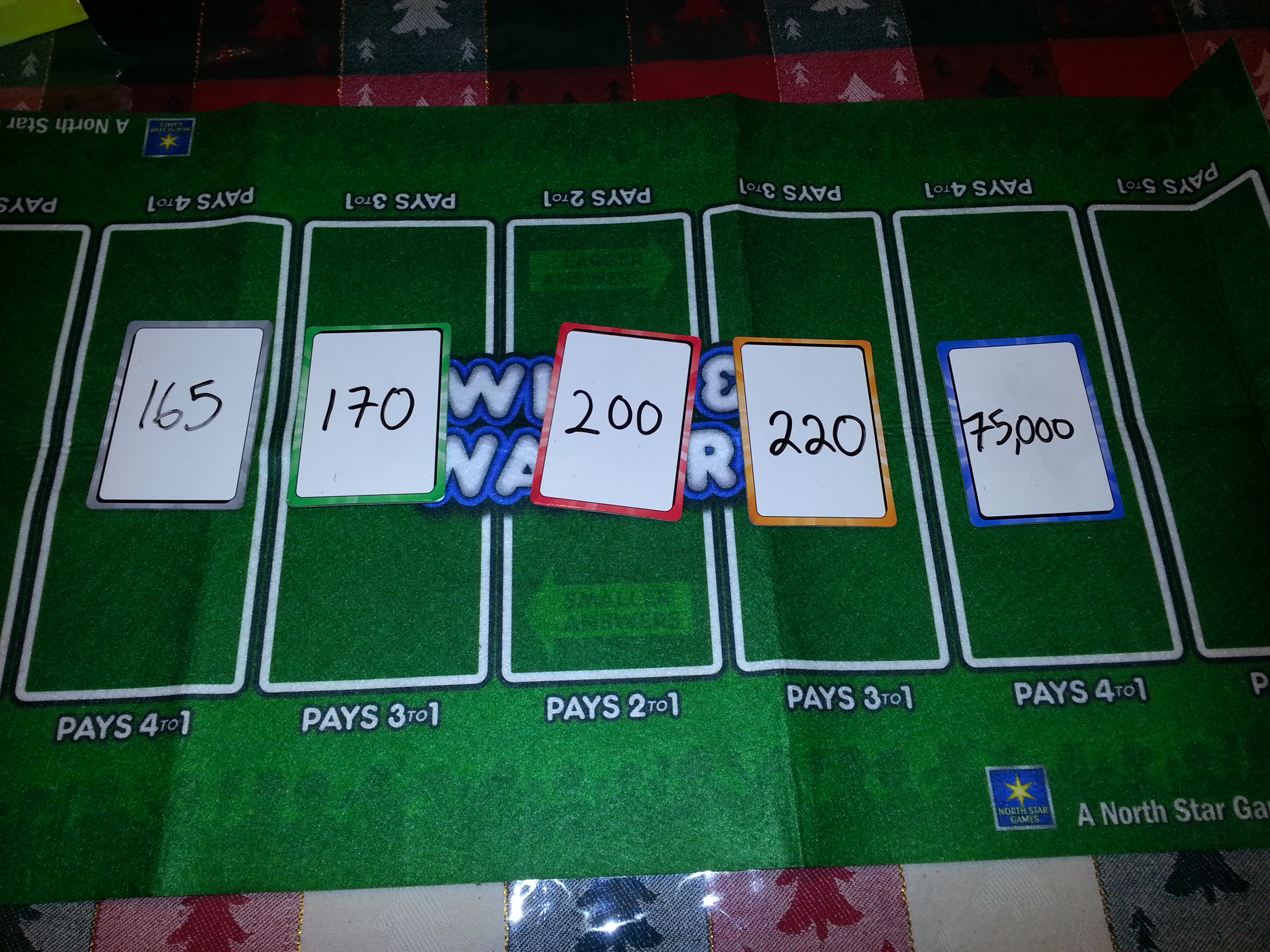
Sometimes that leads to interesting situations. One question asked how many episodes of Friends there had been, and this had been our responses:

Wits and Wagers

This almost feels like a Math Mistakes question, where did this person go wrong in their guess? But comparing their sense of answer to the consensus helps us get an idea of what’s right, and what’s misinterpreted. (In this case, the person thought it was asking how many episodes have been shown on TV ever, like in syndication and whatnot, in which her answer then makes a lot of sense. So never dismiss an answer just because it seems so far off the mark. There’s always a reason!)

A lot of questions had a historical bent as well (years), so then can help build a sense of time as well. (As long as a rogue history teacher isn’t sitting nearby shouting out answers even though he isn’t playing the game.)

In the end, I think this game could go along with something like Estimation180 for building number sense, but in a more communal gaming way. If you talk to people about how they chose their numbers, we can get a sense of their mathematical thinking. And that’s worth a lot.

Dragonbox in the Classroom

Last week, my students spent 2 double periods playing Dragonbox, the iPad (and computer) game designed to teach solving linear equations, which I think it does quite well. (I agree with many of Max Ray’s opinions when he writes about it here. Which makes sense, as Max first showed me the game this past summer.)

While one of my goals was teaching solving equations, it was not my only one, which is what I wanted to talk about here. (I’ll probably review the game itself later.) I told the students that I had forgotten to make a lesson, so we were just going to play a game on the iPad today. What I did want, though, was for them to home their ability to figure out how something works. To me, this is an even more important lesson to get than just solving equations.

To this end, I talked about how websites like GameFAQs has walkthroughs for all sorts of games, but one walkthroughs were all written by regular players, who sat down with a game right when they bought it, took notes on what they did, figured things out, and shared with others. So we were going to take that role. In their Interactive Notebooks, I told them to write down every thing they could do in the game. Whenever they came across a new rule, some new ability, or a new solution to a tough puzzle, write it down. Example: “Tap the green swirl to make it disappear.”

The surprising part was, they really did it, and quite well. Hey even discovered a lot of things about the game that I didn’t know, because I always played it “perfectly,” since I knew the rules of algebra. (Example: if you have a denominator under a green swirl (aka 0) and tap it, the while thing disappears. Or a green swirl won’t disappear if it is the only thing left on its side, which was fun to talk about later.)

At the end of my first double, with about 20 minutes left, I compiled all the notes they took using Novel Ideas Only (where all students stand and share things they have written, only sitting once everything they have written down is said, either by themselves or someone else), creating a master list of actions they could refer to next time.

The next class, they came in and immediately started playing. I must say, the entire time I used it, the kids were really into it, and most of them were really persistent. Some occasionally requested help, but my intervention was minimal. This time, I had this answer several questions after they had played some more, which really dove into the meat of the game. What does this card or action in the game represent in math? Why does a certain rule in the game happen that way?

One thing I really loved is how solid the game got them on how dividing something by itself won’t make it go away. It was a tactic many of them tried in several levels and it always got them stuck. I focused on the difference between “zeroing out” and “oneing out.”

We had one major downside, technology-wise, though. Each game had four save files, which worked out, because I had four sections. So one file per student. But there is nothing to stop a student in one class from playing on, or, even worse, DELETING, another student’s file. I e-mailed the company, and they said a solution would happen in a future update.

Today was the follow-up quiz, and they mostly did well. The things they stuck on was something that wasn’t well covered in the game: the distributive property. But we’ll work on that.

Totally Radical

So I’ve been working on creating this board game, Totally Radical. (Tagline: Don’t Be a Square.) After some play-testing and adjustments, and bouncing ideas off of other teachers, I’m ready to post about it.

(But first, thanks to my co-teacher Sarah for helping come up with the game, my coworkers Cindy and Jenn and my Tweeps Max, Jami, and Jamie for playtesting.)


The idea behind the game came before I didn’t really have a good application for simplifying radicals. But I’ve been annoyed at how I see math games designed: do some math action and, if you are correct, you then get to do some game action. While this is certainly how some games work (like Trivial Pursuit), it just separates the math from the game and makes the math seem worthless. So I wanted a game where the math action WAS the game action.

You can read the rules of the game right here: Totally Radical Rules. During the game you have a choice of 5 actions: 3 involve actions we take when simplifying (breaking a number into two factors, taking a root and putting it outside the radical symbol, multiplying two terms together) while two are purely game actions (draw a card, play a special “Action” card).

Other touches of note: the factor cards are exactly half the size of the radicand cards, so that students break up “larger” numbers into “smaller” ones.

You can use factor cards on their own or combined into multi-digit numbers, like so:

(the top would be two factors, 2 and 5, and the bottom would be one factor, 25)
The numbers in the radicand cards are not just simple numbers. There’s prime numbers, composite numbers that can’t be simplified, perfect squares, as well as numbers that can be simplified (going all the way up to 250).

So, how can get this game, you may ask? Two ways!

Make It Yourself

If you want it for free, or are just in that #Made4Math mindset, you can print out the following files on card stock:

Prototype Factor Deck

Prototype Radicand Deck

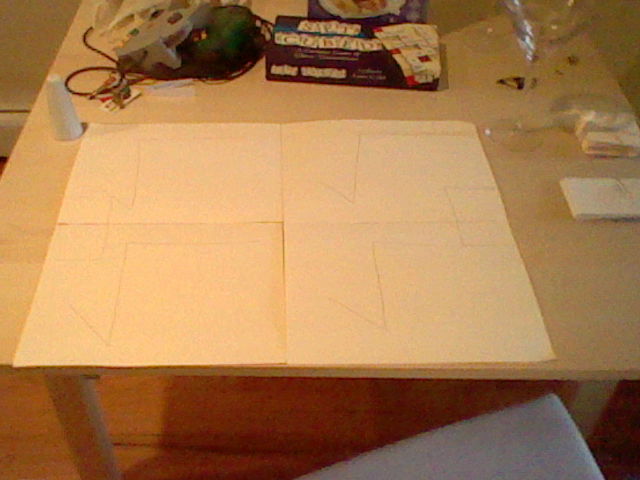
Cut the cards out and label the backs. Print out the instructions (found here). You’ll also need to make a board: 4 big radical signs (I also recommend cardstock.) That might look something like this:

(I also drew in spots to put the card decks in).

Don’t want to make it or want the awesome one pictured above? Then go for option 2:

Buy It

I found this great website called The Game Crafter where you can send in artwork, pick out the pieces, etc, and they will print and construct the game for you. So if you click the button below, it should bring you to the shop to buy it.

TOTALLY RADICAL
DON’T BE A SQUARE

My Prototype Has Arrived

About a month ago I made the following tweet:

I’m still waiting to hear back from some of the play-testers, so a more in-depth post will have to wait, but I’m really excited because the prototype I had made arrived in the mail today!


I think I’ll bring it to Twitter Math Camp, see if the people there have thoughts.

My Final Exam

My second post was about the game Facts in Five and how I thought the scoring system would be helpful for my assessments. I had also been having thoughts about the way to measure synthesis while using SBG. So I thought having a final exam specifically designed to measure synthesis would be the best way to go about it. Here’s how I went about it. (This was the final for the Fall semester, since for the Spring they have the Regents.)

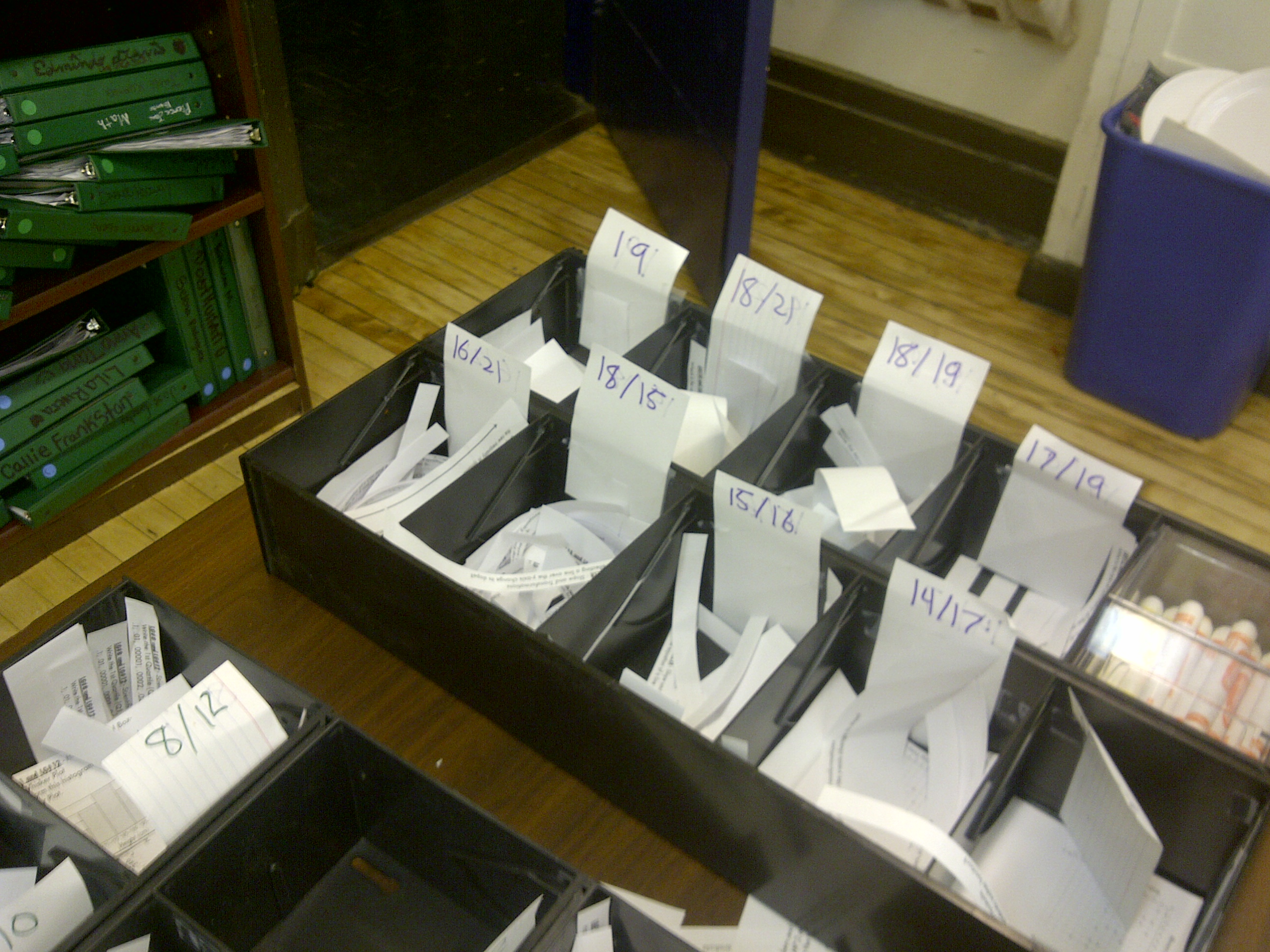
In each bin, I put a slip of paper containing a question. Students will go to the bins and choose which questions they would like to answer, and compile them into a coherent exam.

Those aren’t fractions on each bin label, though. They denote which Learning Goal each question consists of. Instead of having each Learning Goal have its own questions, they mix. But each goal still has 4 questions that apply to it, like so:

Not every topic can be combined with others, but now the student can choose which goals to work on: either they can try to improve a Learning Goal that they got a lower grade on, or pick ones they did well on and show they can perform Synthesis, which is above mastery. But, of course, all of these questions are harder than what they’ve done before.

To score the exams, I use the same scoring system as in Facts of Five, with students squaring what they get right in each Learning Goal. So they will get more points by focusing on completing a goal, instead of jumping around. An example:

Here this student got a decent score by focusing on completing four of the learning goals (9, 11, 16, and 18), and receiving assorted other points.

I definitely like the idea here, but I do need to refine the delivery. It was hectic. But I did not want to print out all 44 questions for everyone, when not everyone will do all of them. That would be a lot of paper. Suggestions are welcome.

Algebra Taboo

I remember reading about the idea of Math Taboo on Sam Shah’s blog, this post by Bowman Dickson. I feel like I had the idea independently, but it seems like many people have, by doing a cursory Google search of the phrase.

Unfortunately, there are lots of posts ABOUT math taboo, but no real materials provided. If I have seen anything, it’s a lesson plan on having the students make their own. Or I saw one for sale, but it was for the elementary level. So I made one myself.

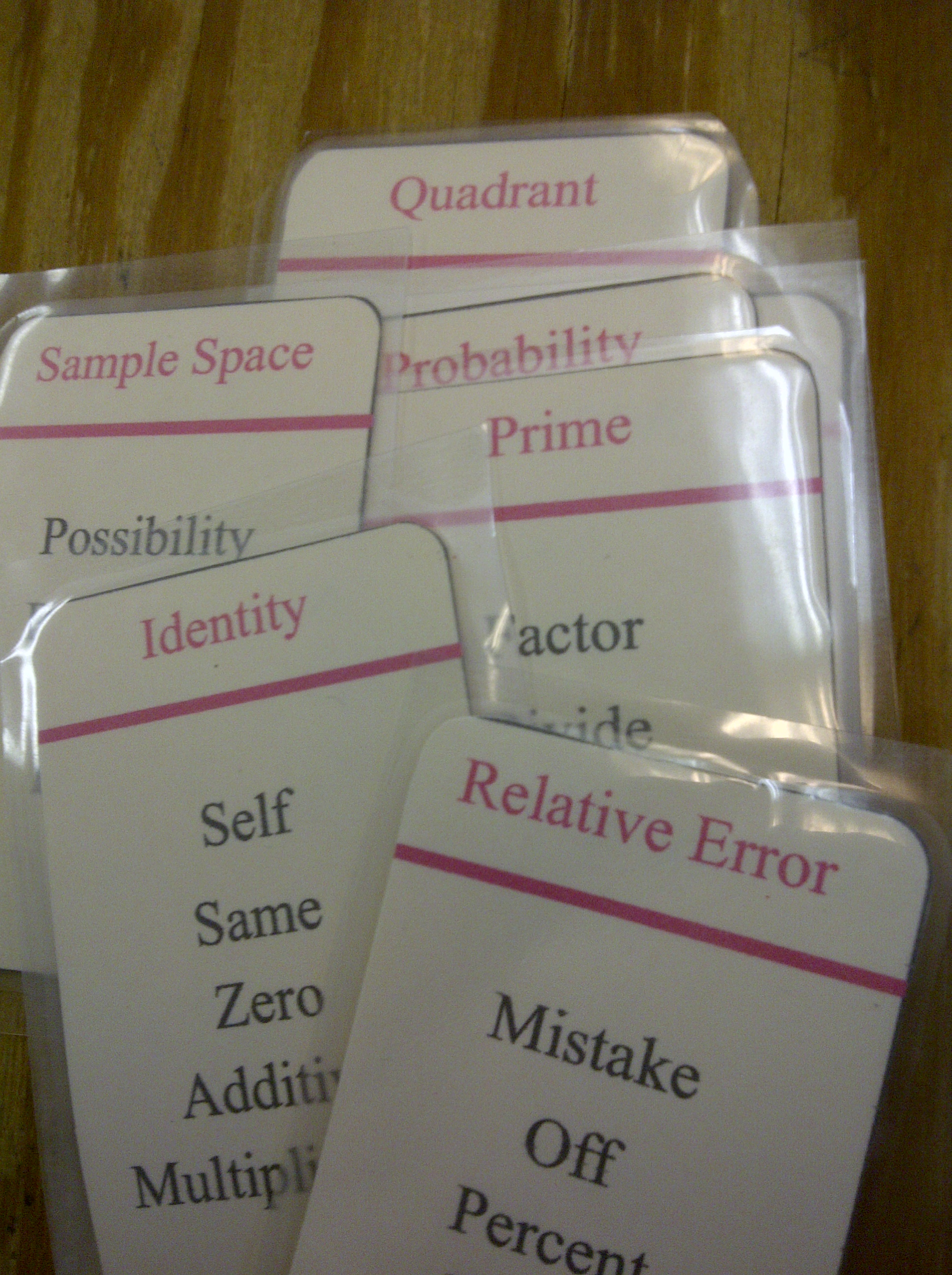
My co-teacher and I went through all the Integrated Algebra regents given since 2008 and pulled out any words that it’s possible a student might not know. I also went through my own lessons and pulled out any vocabulary I had given them. Below is the .pdf for printing your own (I used card stock and laminated), and two .doc templates if you’d like to make more, or alter the ones I have. I made a total of 126 cards (63 double sides – maybe slightly overboard).

Since I found no others, it makes sense to share.

Downloads

Math Taboo (full pdf)

Math Taboo Pink  Math Taboo Blue (doc template)

Facts in Five

On my last visit to my parents, I brought home a game we used to play when we were younger that I loved. It was called Facts in Five. I sat down today to take a look at it and the rules, reminded myself of how to play. (All I recalled was that it was like Scattergories, but better.)

For those who don’t know, a quick overview: in Facts in Five, players draw cards with to pick 5 categories and 5 letter tiles. The categories and letters are set up in a grid so that, once the time starts (5 minutes), you have to fill in answers that match the letter (rows) and the category (columns). So that’s five answers per category, five answers per letter, 25 answers total.

What really struck me was the scoring system. Instead of just tallying the number of answers, the grid itself contributes. If you have one answer in a column, you only get a point, but if you have two, you get four, 3 gets you 9, etc. Same works for rows. That way it is much more valuable to fill out one column completely (30 points) than to have one right in each column and row (10 points), even though it’s the same number of answers. Having a deep and complete knowledge of a category is more worthwhile than a weak knowledge of several topics.

This is the same thing I tell my students when I give them tests. My tests are usually split into sections based on the learning goals/standards they need to show mastery of. It is better to ace one standard and be done with it then to muddle through, especially in the limited time of a period, so I tell them to focus on the topic they know.

What I wonder is how I can perhaps implement Facts in Five into my assessment system, since it’s scoring system is an inherent way of supporting my system and is less holistic than what I currently have.