Trying to find math inside everything else

Archive for the ‘assessment’ Category

Discrete Math & Democracy, Weeks 5-6

This time I did purposefully combine two weeks – we had 3 days of no class between them, with the PSAT, a PD day, and a holiday.

We started week 5 with another quiz – they asked for this one to be on paper instead of on the computer, and who was I to go against the will of the people? So below is the quiz I gave:

At this point we wanted to finish off our chart of Methods vs Criteria (except for IIA).

We were able to explain the whether most of the methods passed or failed Condorcet and Anti-Condorcet logically or with a counterexample, but the proof that the Borda Count passes Anti-Condorcet is a little more subtle, and a little more algebraic, so I broke that out into a worksheet.

This led to a good combinatorics connection for me. The standard way to calculate the Borda Count is to assign points based on how many candidates you beat, so if you look at it from the point of view of a ballot, in an election of 5 candidates, e.g., a single ballot gives out 4 + 3 + 2 +1 + 0 = 10 points. But another way to view the Borda Count is that you earn a point from a candidate (as opposed to from the voter/ballot) every time you beat them in a 1v1 match. Well, with 5 candidates, how many possible 1v1 matches are there? 5C2 = 10. Oh wait, that’s the same as before! And shows why the C2 column of the Arithmetic Triangle (sometimes known as Pascal’s) is the Triangle Numbers.

Speaking of combinatorics, the next part was fun. First, we considered how many different ways there are to seed an 8 person tournament. There’s lots of ways to represent this number – my first conception of it involved double factorials!! (Sam was shocked I had found a natural use for double factorials.) Thought the final conception was came up with (n! / 2^k, where k is the number of symmetries in the bracket) was easier to calculate and made more sense.

But the real fun part was thinking, well, if there’s 315 different ways to seed the bracket, is there a way to seed it such that every person can win? So I challenged them to seed the tournament so that A wins, and then so that C wins. (Some candidates couldn’t win, like B and D, because they had fewer wins than the number of matches in the tournament. A and C were possible but harder because they had few paths to victory.)

After this I introduced the concept of a Condorcet method, which tournaments are, despite their manipulability flaw. So I expanded our chart to include the methods we’d be doing soon: Copeland’s, Minimax, Nanson, and Ranked Pairs.

Finally, we had another quiz:

Discrete Math & Democracy, Weeks 3-4

I totally purposefully combined these two weeks because they were short due to holidays, and not because I forgot about week 3. Yep.

First was our first quiz on what we covered in the first 7 days. (My quizzes are always slightly lagging, in all of my classes.) It was…longer than I anticipated. I think my usual metric for how long students need for work doesn’t apply to this class, because it’s so new to them. It was also testing some spreadsheet commands they needed to learn, so I made it an online quiz. I did it by sharing it through Google Classroom, highlighting cells they needed to fill in, and having them turn off their Wi-Fi once they opened the quiz. See below:

https://docs.google.com/spreadsheets/d/1qyLIkmBhQqvS-Zk4VsEivnQuTDUsYn_-BPJbXpW5iFw/edit?usp=sharing

We started off my returning to some of the criteria we looked at for two-candidate systems, now applied to the multi-candidate systems. We started filling out the chart in the first slide below.

We worked through counterexamples for why IRV/et al fails monotonicity, and why Borda and Survivor fail majority. I also discovered this website that both calculates winners and has a bunch of example elections, which has been very handy: https://rob-legrand.github.io/ranked-ballot-voting-calculator/

We also read this argument about why IRV failing monotonicity doesn’t matter: https://archive3.fairvote.org/reforms/instant-runoff-voting/irv-and-the-status-quo/how-instant-runoff-voting-compares-to-alternative-reforms/monotonicity-and-instant-runoff-voting/

Then we got to Condorcet, which took the bulk of our time. We learned how to make pairwise comparison matrices both by hand and using spreadsheets, which we see in the Pairwise Matrices tab of my example spreadsheet: https://docs.google.com/spreadsheets/d/11XoeRwnayoBUOO6psc2n4fGoKtOrDIDmWzkNwLCMKGE/edit?usp=sharing

This took the bulk of the time, and also I realized I needed to give more practice so we did more for the RCV election systems and the matrices.

The last thing we covered was using the pairwise matrix to find the Condorcet winner, loser, and also to resolve the results of a tournament/pairwise agenda election. We hinted at the idea that the person who sets the agenda/seeds the tournament has a lot of power to determine the winner, but that’s an idea we’ll dig into more this week.

Knowing, Doing, Being

When I started at my current school two years ago, one of the first conversations I had with my coteacher (Sam Shah!) was about grading, and coming to a compromise on our different grading systems. Often teachers will break down grades into categories, the weights of which can vary. But during that conversation I came up with what I thought of as the supra-categories, which I now use for all of my classes.

The first is Knowing Mathematics. In a standards based grading system, this would be the standards for content knowledge. In a traditional grading system, this would include things like tests, quizzes, projects, presentations, interviews – anything that shows what the student knows about the math itself.

The second is Doing Mathematics. In SBG, these would be process standards. In a traditional system, this might be classwork & homework, or class participation. I evaluate this typically with a portfolio of student work. (More on that below.)

The third is Being Mathematicians. I was doing Knowing/Doing before this, but this third category was how to incorporate some of what Sam had been doing with his portfolios, that I loved (and served a different purpose than mine). The assignments are about reflecting how the student fits into mathematical society – both on a small scale (in the class, reflecting on groupwork) and a larger scale (learning about other mathematicians, especially those from underrepresented populations, and about other mathematics outside of the scope of the class). This is also evaluated with a portfolio.


I first wrote about my portfolios in this post, and the general idea there still applies to my Doing Mathematics portfolio, but the structure is different.

Now I do the portfolio as an ongoing Google Slide. You can see the template for the portfolio I used for Calculus last fall here. Our school has a 7-day cycle, and once a cycle we have a double-period. So for that class, in the second half of the double I’d have a quiz about that cycle’s content (counting for Knowing Mathematics), and then afterwards they would work on their portfolio, picking one piece of classwork and one piece of homework from the cycle to reflect upon and include. This let me keep on top of the grading of the portfolio better than saving it for the end of the quarter/marking period, and also made it easier to make sure the portfolio was actually a collection of their work from the whole semester. They had to do two pieces per habit of mind, although usually I would wind up with only 16 done for the semester, not 18, to have a little wiggle room (because it’s hard to get them all). To make up for that, I include two extra slides for the work they were most proud of that quarter.


The Being Mathematicians Portfolio has a wider variety of assignments. Some will be reflections on how they work with their peers:

Some will be about mathematical debates:

Some will be learning about mathematicians (usually from underrepresented groups) or mathematics from underrepresented cultures.

Sometimes news in the math world, or other modern mathematics:

Sometimes about what it even means to do mathematics:

Students will occasionally get these as homework assignments, and we’ll usually discuss them the next class. (I’d like to be more consistent about it, as I am with the Doing Math – maybe that’s a goal for this year.) I’d also gladly take suggestions for assignments in any of these categories, or if you think there are subcategories I didn’t really hit on!

Here you can find the entire year’s worth of BM Portfolios for Geometry and Calculus. (About half of the slides were made by Sam. Wonder if you can guess which are made by whom!)

Making It Stick

After going to Anna Vance’s session on Make It Stick, I implemented some of the ideas she presented and thought I found reasonable success with them. However, as I hadn’t read the book, it was a little half-hearted and could be improved. When I was looking through my library’s education e-book collection and saw it there (amidst a sea of worthless looking books, save Other People’s Children, which I also checked out) I decided to pick it up.

A few things stuck out to me, some of which I tweeted, but the one that I keep thinking about is the Leitner System, which they describe thusly:

This struck me for a few reasons. First, I love the idea that the “flashcards” don’t have to be what we typically think of as flash cards, but rather representations of anything we need to practice. Second, it’s a system that is learner-led, so if I can get my young mathematicians onto the system, they can run it themselves. (And extend it to other parts of their lives.)

So my thought became thus: how can I weave this system into my classroom? Here’s my thoughts. I’d love some feedback.

  1. Create a system of boxes (folders? tabs?) – I’m envisioning four in a set – for each student.
  2. At the end of each lesson, have the class write on (an) index card(s) something from that lesson that they think they should know. (This practice of summarizing their learning is also mentioned in Make It Stick.) It could be a knowledge fact (the definition of a polygon), a skill (solving a linear equation), or something broader (what are some ways systems of linear inequalities are applied?). If it is a skill or broad question, it should not have a specific example. (So they shouldn’t have a card that has them solving 3x + 2 = 8 every time they see it.) Then put those cards in box 1.
  3. Their standing HW is to practice whatever is in Box 1 every day. If it says something like “Solve an equation,” they need to generate their own equation, then solve it. (Generation is also mentioned by Make It Stick as a way to increase stickiness.) When they get it right, move it down a box. When box 2 is full, practice those the next session, and so on.
  4. On Fridays, give some time in class for students to practice, especially their box 2 or 3, if they didn’t have the time to do that at home. Then give the usual quiz.
  5. After taking a quiz, they should then reflect on what they did and didn’t know, and if there is something they didn’t know that isn’t on one of their cards, make a card for it right then and put it in box 1.
  6. To qualify for a quiz retake, all the topics for a quiz need to be on cards in Box 3 or 4. Otherwise, they need to study more before they can retake. (This would mostly be an honor system, as nothing stops them from just putting the cards in there.)

Does that sound feasible? What needs improvement?

Whole Class Test

I teach an SAT Math Prep this year, which has been an interesting challenge. We basically started off with lessons on all the different content in the exam, then had a long section on tactics (which can be framed as test-taking tactics but I noticed are often just tactics for solving problems in general, which was nice). But we reached the end of those, and the (in-school) SAT is a month away. The obvious thing to do is to just keep doing practice exams, but that can get a bit boring, for both me and the students. Plus, the class that meets Tues/Thurs hasn’t had very many graded assessments this marking period, so I needed to give them something.

I had decided that grading them on correctness in a practice SAT is not appropriate. I had told them this before, and they knew their grades on their assignments were more for things like how they applied the tactic we were learning. But last class they walked in and I gave them a Part 3 exam (the non-calculator part) and told them it would be graded – but there would be a plot twist. For right now, just take it individually, except this half of the room should start from the back and go forward. Oh, and you get 5 fewer minutes than normal.

While they were working, I went around on my whiteboards and put up the numbers 1 through 20 well spread out, and an ABCD for 1-15. (I wish I had taken pictures!) This started to get them suspicious. When time was up, I told them my grading scheme: it was out of 5 pts, and they lost a point for every question they got wrong. So if you got 15 right, that’s a 0. But! They had the remaining 20 minutes of class to work together and figure out what the right answers should be. And if anyone got less than 15, the whole class lost a point – forcing them all to work together. (With limits, of course – they won’t be penalized for that kid who went to the bathroom for 15 minutes during this, for example.)

A suggestion I made to them was to go around and make votes for their answer for each question. A clear consensus might mean that that is the right answer. However! Don’t be afraid to put your answer down even if everyone else’s is different. I’ve seen questions where only one person got it right. I told them they need to convince each other of what the right answer is.

Let me tell you, I heard so many great conversations as they and I went around the room. Because it’s the SAT, no one gets them all right, so everyone is being pushed to make a convincing argument that their answer is right. Students who weren’t sure got explanations from others. It was delightful!

About halfway, I noticed a clear consensus for about 15 of the 20 questions, but the middle 5 were really quite split. So I lead the class in sharing out their reasoning for some of those questions – never saying what the right answer was, but again letting them convince each other.

It was a nice collaborative effort – I highly recommend it.

Vietnamese Age and the SAT

Dwight Eisenhower was born on October 14, 1890, and died on March 28, 1969. What was his age, in years, at the time of his death?

(A) 77
(B) 78
(C) 79
(D) 80

When my boyfriend went to his grandmother’s funeral, he found himself confused about exactly how old she was. Was she 93 or 94? He heard different people say different things. Eventually he figured it out. In Vietnam (and apparently in other places in East Asia), when you are born, you are 1. The next year, you are 2. And this ticks over at the beginning of the solar year, not on your birthday. So I, born on December 22, would, 374 days after my birth, have been considered to be 3 years old using this reckoning. (It might be more accurate to say that I’m in my 3rd year – being alive during 1985, 1986, and 1987 at that point.)

Earlier this week, in my SAT Problem Solving class, we encountered the problem at the top of this post. The correct answer, according to the book, is (B) 78. But according to the Vietnamese reckoning, he’d be 80, and the answer would be (D).

Before my boyfriend went to that funeral, I wouldn’t have even looked at this question twice. I had never heard of another way of determining age. And I’m willing to bet the people who wrote this question haven’t, either.

It’s a small example of the way tests can be biased, and how having more diverse voices in the process could help avoid this kind of mistake.

Quick but Comprehensive Feedback

So my portfolio idea was working out well, but I was getting overwhelmed with the written feedback. It took so long to write that sometimes my hand felt like it would fall off! I needed a new strategy. Luckily, David Wees had one for me, so I thought I’d share it with you all, since it’s worked really well.

Instead of writing all the feedback, as I go through and check an assignment and finding something I want to comment on, if I think it might be a common mistake, I type it up on a word document on my computer, numbered. Then I just put the circled number on the page itself. When I’m done I have a comprehensive list of feedback that I print out and attach to each assignment. Now every student knows both the common errors and has specific feedback on what they need to fix.

CAM00648 CAM00647 CAM00646 CAM00645

SoP Portfolios

When we learned about planning back in grad school, we were told that if something is important, you need to assess it; if you don’t assess it, then it’s not important. When the Common Core Standards came out, most math teachers were very excited about the Standards of Practice. The problem was, of course, that the Standards of Practice are hard to assess. So most standardized tests that use the Common Core don’t assess them, which of course means they don’t get implemented in the same way as the content standards. The Standards of Practice are important to me (though I frame them as the Mathematical Habits of Mind), and that means I need to find a way to assess them. But I’ve never had a really good way to test them before – I was always kind of making it up as I went along. Now, though, I think I’ve hit on something now that really works.

After seeing Ashli’s video about not putting grades on papers, I stopped doing it this year – but having the grades still be there in the online gradebook wasn’t quite what I wanted to do, and it became very hard to keep track things, especially because classwork and homework were what I used to measure the Standards of Practice. This semester I gave written feedback on all the assignments that I’ve given but recorded no grades – not even in my own gradebook – the only thing I kept track of was if something was incomplete or missing.

If we decide that every assignment is a formative assessment, we can’t possibly grade it as students are learning the material. So instead each assignment is like a first draft (or second or third) and students can read the feedback that I gave and make changes in order to improve their work. Come the end of the marking period (or eventually the end of the semester) students create a portfolio of their work. They don’t need to include everything that they’ve done but rather a representative sample that shows that they apply the Standards of Practice/Habits of Mind as they work.

The portfolio has a cover sheet (shown below) that that asks them to reflect on what habits they have used in their mathematical work this semester.

They have to find evidence of their own habits in their work and write a few sentences citing that evidence. I gave suggestions of which assignments might be easier to find evidence of those habits in. And they only had to include work that they cited as evidence as part of the portfolio.

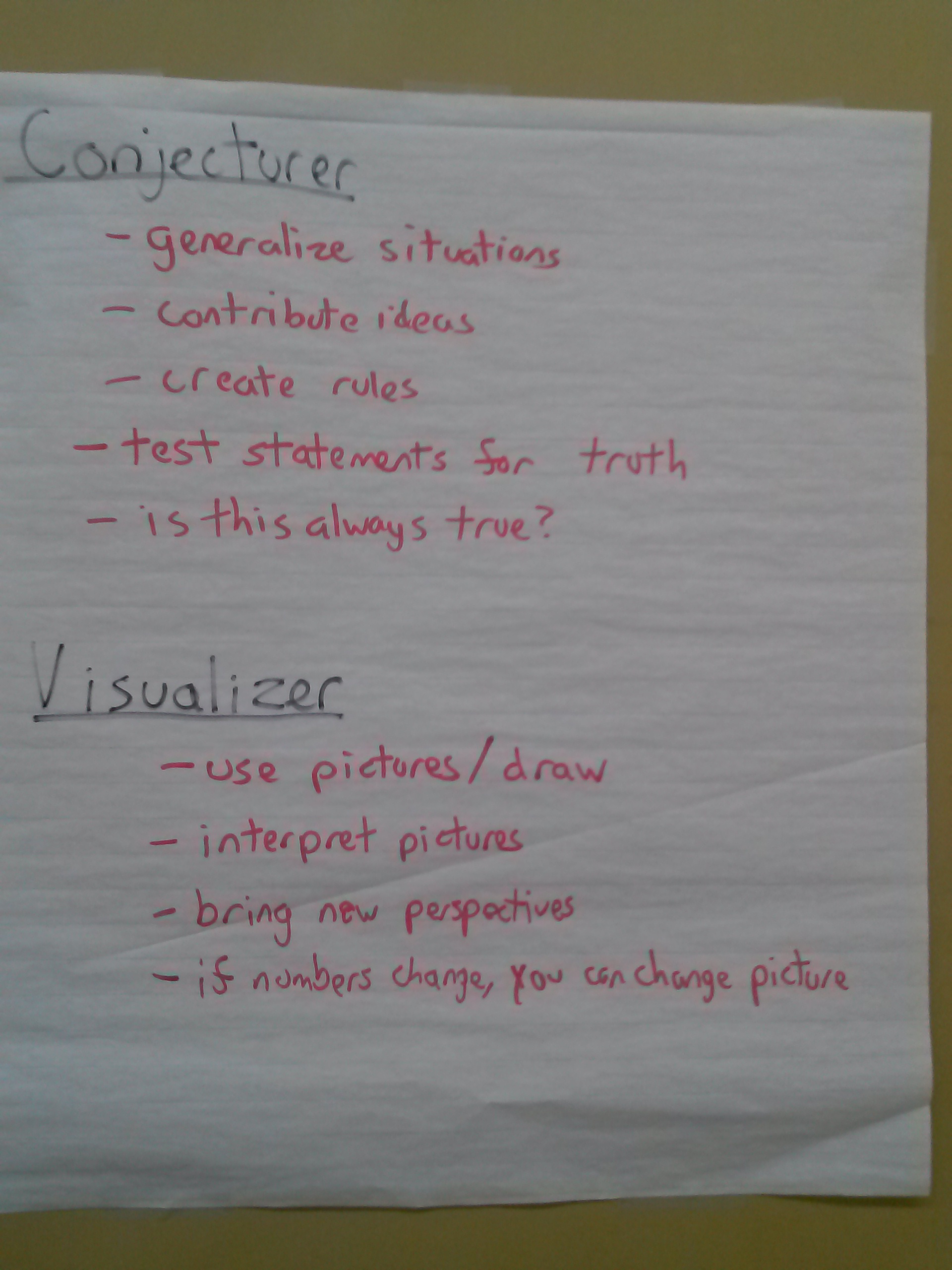
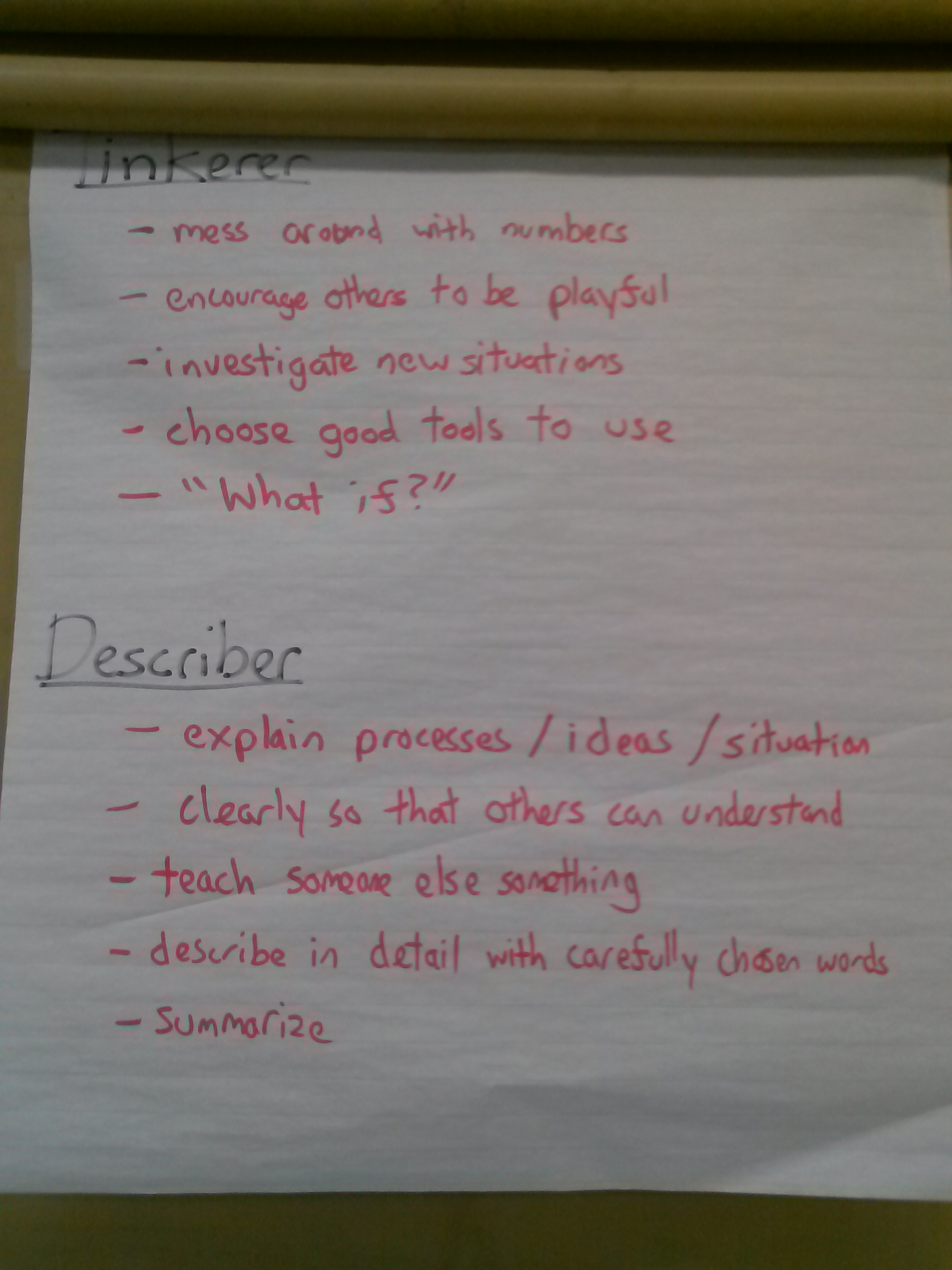
To get us started we read through the rubrics that I created for the habits and created posters of what those habits might look like when doing assignments. We have them hanging on the walls of my classroom – that way I can referr to them easily when something comes up (such as when we worked on Des-man, I tried to emphasize the tinkering nature of the process).

CAM00640CAM00641CAM00642 CAM00643

The first portfolios coming in have been graded and some of them were stellar and others need some work, but it was the first time and they are not really used to this whole reflective idea. But I have noticed that most of my students have started to use that vocabulary more and have become more aware of the kind of things that they are expected of them in the long-term, not just immediate math facts. I think if I start this from the beginning next year it’ll create a really great culture of thinking using the habits and the standards of practice.

End of Marking Period Grading

How did I let myself get so far behind? Maybe I did it on purpose – I was so annoyed with the focus on grades that I wanted to let it sit back and push toward focusing on the content. Maybe it was my minor addiction to Civilization V. Maybe I just give out too many assignments.

I stayed until 6 today, skipping out on happy hour, to try to whittle down the pile before bringing it home, because marking period grades are due on Tuesday. However, because I was also doing notebook checks, I prioritized those and didn’t do much whittling.

CAM00290

When a student saw how much I had to grade, he said, “Wow, that’s so much. But I can see why you’re behind – you actually have to read everything and make comments and check if it’s right, not like some other teachers.”

So at least my hard work is being noticed.

A Boss Fight?

One of the things about arranging your grading system like a game, as well as being a math game aficionado, is that it is pretty easy to combine the two. While yes, students can take quizzes or write essays to gain levels, they can also beat me in a math game. Of course, I’m not easy to beat, so winning against me would really show some mastery. (I do, though, allow them to gang up on me when the game is more than 2 players.)

The only students that really challenge me are the ones that hang out in my room at lunch, even though I’ve offered the challenge to everyone. And it’s cute because when they do lose they get even more determined, often because they may lose by a very small margin. (This is occasionally by design.)

The only game I’ve lost so far is Blokus, where the two Kevins beat me (but my score was still above the 4th player). As a reward, I gave them a level in Visualizer, as I figured that was the most applicable skill to winning the game. Planning ahead and visualizing paths in your mind is a useful skill. That same skill is the reward if they beat me in Ricochet Robots. In that game a team of Jane and Kevin tied me, so I still gave them reward, but they didn’t win.

It’s interesting trying to match games with skills. For example, the reward for winning at 24 is Tinkerer (since you need to play with numbers and try different things to succeed). It’s easy for games I made myself: if they can win at the Factor Draft (an upcoming post, I swear), they are a master of factoring. I have considered giving some points, not quite mastery, if they win against their classmates or my co-teacher, but to be a master, you gotta beat the final boss.

I’d love to have a bigger collection of games that I can use as assessment of skills, not just algebraic skills but the Standards of Practice as well. Any suggestions?