Lessons from NCTM, Part I
Oof, well, I certainly meant to write this up sooner, not almost a full month later, but it felt like it took this long just to feel caught up from having missed those three days! That’s definitely a struggle with the conference timing. Anyway, I figured I’d go through some of the sessions I went to, and my notes, as a way to debrief myself but also share any gems I picked up.
Two Students, One Device
I missed the beginning of this session because I went to two other ones first, neither of which worked out, but I knew Liz (Clark-Garvey) wouldn’t let me down (as well as Amanda Ruch and Quinn Ranahan). I’ve used the practice of two students on one device before, but I realized it was natural to do it back when I was at a school where we were using class carts of laptops/tablets, so I could just give one per pair. Now I’m at a school where everyone has their own device, so making them pair up needs to be a more intentional move, and it’s easy to default to not doing that.
So then the question is, when to do it? If students are doing practice problems on DeltaMath, that doesn’t need to be paired. This is the slide the presenters had for this:
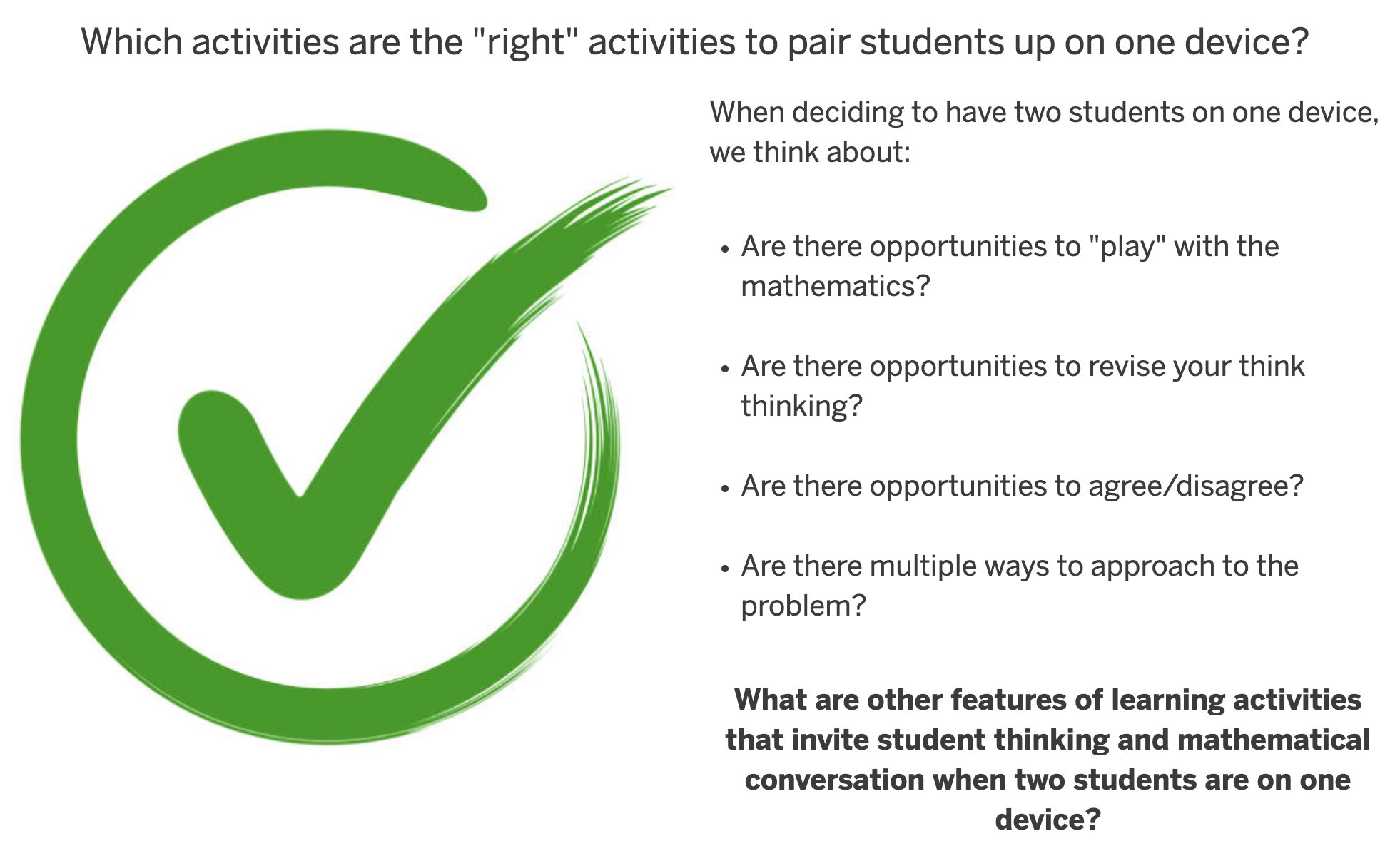
But they also talked about how just choosing the right activity isn’t enough, so other strategies are useful. For example, setting norms such as “type other people’s thoughts, not your own” or mixing up the groups and having them revise their responses.
Fawn
Sure, I could use the title, “Helping Students Become Powerful Math Learners,” but really this was the Fawn session. (Or should I say “The legendary Ms. Nguyen”?) The first quote I wrote down was “The pacing guide does one thing for me – it tells me how behind we are.”
Fawn had four maxims to follow:
- Ask students to seek patterns and generalize
- Ask students to provide reasoning
- Build fluency
- Assign non-routine tasks
One routine that stuck out was an open middle-type problem. We had to create the largest product using 5 numbers, 3-digit times 2-digits. Fawn had us all share our possibilities, and then we discussed which possibilities we could remove – someone would nominate one, explain how they knew it wasn’t the greatest (often because it was strictly less than another), and it would be removed only if there was 100% consensus. Then we could narrow it down before we ended up checking the top two choices.
Another thing of note was about the non-routine tasks and games: in particular, they should be non-curricular. This doesn’t mean not based on your curriculum at all, but rather not based on what they just did. This makes sense, as if they are always using the skill they just learned, that turns it into a routine, and thus won’t have the same benefit.
Just Civic Math
I don’t have that many notes from this session, and I don’t see any slides attached on the NCTM website. One note says “Limiting civics to just ‘social justice math’ is restricting. Dialogic math helps.” I think the idea here is similar to what I’ve used before, Ben Blum-Smith’s Math as Democracy. Jenna Laib’s Slow Reveal Graphs were mentioned, and I mentioned the similar graphs.world to the presenter. They also mentioned the book “Constitutional Calculus” which I will look into in the future.
Miscellaneous
Two notes I took on the patty paper session: use felt pens to be more visible on patty paper, and when folding, pinch from the middle and press outwards (more likely to get accurate folds on lines then).
I went to a really cool session on making art using mirrors and laser pointers from Hanan Alyami. Here’s the kite my group made in the time:

The project seemed cool and had some fun math, but I also don’t know when I could fit it in, as it’s a 3-day process.
I tried to go to John Golden’s session on games but it was full! I went to Christopher Danielson’s session on Definitions. Two things stuck out to me there: his reasoning for originally doing a hierarchy of hexagons was that it fought against status issues, since there was no pre-knowledge as with quadrilaterals; when asking if something is a vehicle, something that is so far from one, like a salad, just makes it a fun question, but something closer to an edge case, like a broken bus with no wheels, is harder and more contentious.
Okay, I was gonna keep going, but that seems like a lot – and that was all just Thursday! So maybe I’ll do separate posts for Friday & Saturday.
 James Cleveland-Tran
 The Roots of the Equation