Trying to find math inside everything else

Posts tagged ‘Mathematics’

Discrete Math & Democracy, Weeks 5-6

This time I did purposefully combine two weeks – we had 3 days of no class between them, with the PSAT, a PD day, and a holiday.

We started week 5 with another quiz – they asked for this one to be on paper instead of on the computer, and who was I to go against the will of the people? So below is the quiz I gave:

At this point we wanted to finish off our chart of Methods vs Criteria (except for IIA).

We were able to explain the whether most of the methods passed or failed Condorcet and Anti-Condorcet logically or with a counterexample, but the proof that the Borda Count passes Anti-Condorcet is a little more subtle, and a little more algebraic, so I broke that out into a worksheet.

This led to a good combinatorics connection for me. The standard way to calculate the Borda Count is to assign points based on how many candidates you beat, so if you look at it from the point of view of a ballot, in an election of 5 candidates, e.g., a single ballot gives out 4 + 3 + 2 +1 + 0 = 10 points. But another way to view the Borda Count is that you earn a point from a candidate (as opposed to from the voter/ballot) every time you beat them in a 1v1 match. Well, with 5 candidates, how many possible 1v1 matches are there? 5C2 = 10. Oh wait, that’s the same as before! And shows why the C2 column of the Arithmetic Triangle (sometimes known as Pascal’s) is the Triangle Numbers.

Speaking of combinatorics, the next part was fun. First, we considered how many different ways there are to seed an 8 person tournament. There’s lots of ways to represent this number – my first conception of it involved double factorials!! (Sam was shocked I had found a natural use for double factorials.) Thought the final conception was came up with (n! / 2^k, where k is the number of symmetries in the bracket) was easier to calculate and made more sense.

But the real fun part was thinking, well, if there’s 315 different ways to seed the bracket, is there a way to seed it such that every person can win? So I challenged them to seed the tournament so that A wins, and then so that C wins. (Some candidates couldn’t win, like B and D, because they had fewer wins than the number of matches in the tournament. A and C were possible but harder because they had few paths to victory.)

After this I introduced the concept of a Condorcet method, which tournaments are, despite their manipulability flaw. So I expanded our chart to include the methods we’d be doing soon: Copeland’s, Minimax, Nanson, and Ranked Pairs.

Finally, we had another quiz:

Discrete Math & Democracy, Weeks 3-4

I totally purposefully combined these two weeks because they were short due to holidays, and not because I forgot about week 3. Yep.

First was our first quiz on what we covered in the first 7 days. (My quizzes are always slightly lagging, in all of my classes.) It was…longer than I anticipated. I think my usual metric for how long students need for work doesn’t apply to this class, because it’s so new to them. It was also testing some spreadsheet commands they needed to learn, so I made it an online quiz. I did it by sharing it through Google Classroom, highlighting cells they needed to fill in, and having them turn off their Wi-Fi once they opened the quiz. See below:

https://docs.google.com/spreadsheets/d/1qyLIkmBhQqvS-Zk4VsEivnQuTDUsYn_-BPJbXpW5iFw/edit?usp=sharing

We started off my returning to some of the criteria we looked at for two-candidate systems, now applied to the multi-candidate systems. We started filling out the chart in the first slide below.

We worked through counterexamples for why IRV/et al fails monotonicity, and why Borda and Survivor fail majority. I also discovered this website that both calculates winners and has a bunch of example elections, which has been very handy: https://rob-legrand.github.io/ranked-ballot-voting-calculator/

We also read this argument about why IRV failing monotonicity doesn’t matter: https://archive3.fairvote.org/reforms/instant-runoff-voting/irv-and-the-status-quo/how-instant-runoff-voting-compares-to-alternative-reforms/monotonicity-and-instant-runoff-voting/

Then we got to Condorcet, which took the bulk of our time. We learned how to make pairwise comparison matrices both by hand and using spreadsheets, which we see in the Pairwise Matrices tab of my example spreadsheet: https://docs.google.com/spreadsheets/d/11XoeRwnayoBUOO6psc2n4fGoKtOrDIDmWzkNwLCMKGE/edit?usp=sharing

This took the bulk of the time, and also I realized I needed to give more practice so we did more for the RCV election systems and the matrices.

The last thing we covered was using the pairwise matrix to find the Condorcet winner, loser, and also to resolve the results of a tournament/pairwise agenda election. We hinted at the idea that the person who sets the agenda/seeds the tournament has a lot of power to determine the winner, but that’s an idea we’ll dig into more this week.

Discrete Math and Democracy, Week 2

So we ended the first week with a proof of May’s Theorem, but really only in the case of an even number of votes. I assigned the proof with an odd number for homework, and none of them where able to quite get it on their own but a majority got close.

(As an aside, here’s the chart I mentioned that we did in the previous post, but filled in.)

Then we started talking about voting systems with three or more candidates. In particular, not only how to tabulate the winner by hand, but how to tabulate automatically using spreadsheets. First, the slides:

When I first worked on these problems over the summer, my spreadsheet solutions were definitely…inelegant, let’s say. Compare what I did then vs. what I did this week with the students.

Summer: https://docs.google.com/spreadsheets/d/1Z0s_cQ9vAUZRDTXB_8BFCNlbjrrjVo8aoW8fjm9XH7Y/edit?gid=2074741057#gid=2074741057

Better: https://docs.google.com/spreadsheets/d/11XoeRwnayoBUOO6psc2n4fGoKtOrDIDmWzkNwLCMKGE/edit?gid=0#gid=0

What’s especially nice about the newer version is how it displays who wins or is eliminated in a particular round – learning the XLOOKUP command was pretty hand.

Anyway, going through those methods and implementing them in spreadsheets took the whole week, on top of additional practice with the second election preference schedule. (We did the Apple one as a class and then I assigned them the Alli/Bell/Choi/Diaz one to do on their own.)

Lessons from NCTM, Part I

Oof, well, I certainly meant to write this up sooner, not almost a full month later, but it felt like it took this long just to feel caught up from having missed those three days! That’s definitely a struggle with the conference timing. Anyway, I figured I’d go through some of the sessions I went to, and my notes, as a way to debrief myself but also share any gems I picked up.

Two Students, One Device

I missed the beginning of this session because I went to two other ones first, neither of which worked out, but I knew Liz (Clark-Garvey) wouldn’t let me down (as well as Amanda Ruch and Quinn Ranahan). I’ve used the practice of two students on one device before, but I realized it was natural to do it back when I was at a school where we were using class carts of laptops/tablets, so I could just give one per pair. Now I’m at a school where everyone has their own device, so making them pair up needs to be a more intentional move, and it’s easy to default to not doing that.

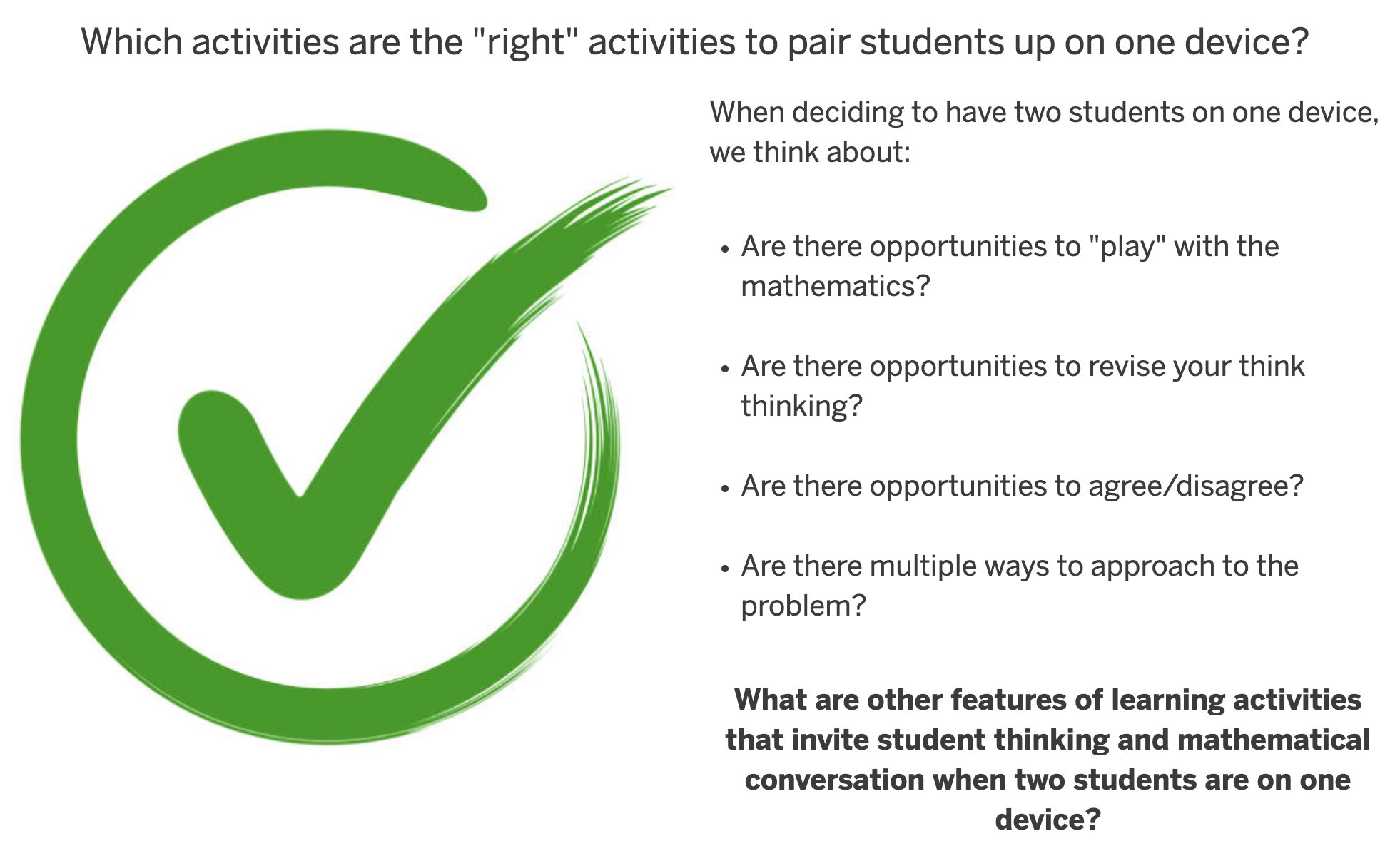
So then the question is, when to do it? If students are doing practice problems on DeltaMath, that doesn’t need to be paired. This is the slide the presenters had for this:

But they also talked about how just choosing the right activity isn’t enough, so other strategies are useful. For example, setting norms such as “type other people’s thoughts, not your own” or mixing up the groups and having them revise their responses.

Fawn

Sure, I could use the title, “Helping Students Become Powerful Math Learners,” but really this was the Fawn session. (Or should I say “The legendary Ms. Nguyen”?) The first quote I wrote down was “The pacing guide does one thing for me – it tells me how behind we are.”

Fawn had four maxims to follow:

  1. Ask students to seek patterns and generalize
  2. Ask students to provide reasoning
  3. Build fluency
  4. Assign non-routine tasks

One routine that stuck out was an open middle-type problem. We had to create the largest product using 5 numbers, 3-digit times 2-digits. Fawn had us all share our possibilities, and then we discussed which possibilities we could remove – someone would nominate one, explain how they knew it wasn’t the greatest (often because it was strictly less than another), and it would be removed only if there was 100% consensus. Then we could narrow it down before we ended up checking the top two choices.

Another thing of note was about the non-routine tasks and games: in particular, they should be non-curricular. This doesn’t mean not based on your curriculum at all, but rather not based on what they just did. This makes sense, as if they are always using the skill they just learned, that turns it into a routine, and thus won’t have the same benefit.

Just Civic Math

I don’t have that many notes from this session, and I don’t see any slides attached on the NCTM website. One note says “Limiting civics to just ‘social justice math’ is restricting. Dialogic math helps.” I think the idea here is similar to what I’ve used before, Ben Blum-Smith’s Math as Democracy. Jenna Laib’s Slow Reveal Graphs were mentioned, and I mentioned the similar graphs.world to the presenter. They also mentioned the book “Constitutional Calculus” which I will look into in the future.

Miscellaneous

Two notes I took on the patty paper session: use felt pens to be more visible on patty paper, and when folding, pinch from the middle and press outwards (more likely to get accurate folds on lines then).

I went to a really cool session on making art using mirrors and laser pointers from Hanan Alyami. Here’s the kite my group made in the time:

The project seemed cool and had some fun math, but I also don’t know when I could fit it in, as it’s a 3-day process.

I tried to go to John Golden’s session on games but it was full! I went to Christopher Danielson’s session on Definitions. Two things stuck out to me there: his reasoning for originally doing a hierarchy of hexagons was that it fought against status issues, since there was no pre-knowledge as with quadrilaterals; when asking if something is a vehicle, something that is so far from one, like a salad, just makes it a fun question, but something closer to an edge case, like a broken bus with no wheels, is harder and more contentious.

Okay, I was gonna keep going, but that seems like a lot – and that was all just Thursday! So maybe I’ll do separate posts for Friday & Saturday.

Knowing, Doing, Being

When I started at my current school two years ago, one of the first conversations I had with my coteacher (Sam Shah!) was about grading, and coming to a compromise on our different grading systems. Often teachers will break down grades into categories, the weights of which can vary. But during that conversation I came up with what I thought of as the supra-categories, which I now use for all of my classes.

The first is Knowing Mathematics. In a standards based grading system, this would be the standards for content knowledge. In a traditional grading system, this would include things like tests, quizzes, projects, presentations, interviews – anything that shows what the student knows about the math itself.

The second is Doing Mathematics. In SBG, these would be process standards. In a traditional system, this might be classwork & homework, or class participation. I evaluate this typically with a portfolio of student work. (More on that below.)

The third is Being Mathematicians. I was doing Knowing/Doing before this, but this third category was how to incorporate some of what Sam had been doing with his portfolios, that I loved (and served a different purpose than mine). The assignments are about reflecting how the student fits into mathematical society – both on a small scale (in the class, reflecting on groupwork) and a larger scale (learning about other mathematicians, especially those from underrepresented populations, and about other mathematics outside of the scope of the class). This is also evaluated with a portfolio.


I first wrote about my portfolios in this post, and the general idea there still applies to my Doing Mathematics portfolio, but the structure is different.

Now I do the portfolio as an ongoing Google Slide. You can see the template for the portfolio I used for Calculus last fall here. Our school has a 7-day cycle, and once a cycle we have a double-period. So for that class, in the second half of the double I’d have a quiz about that cycle’s content (counting for Knowing Mathematics), and then afterwards they would work on their portfolio, picking one piece of classwork and one piece of homework from the cycle to reflect upon and include. This let me keep on top of the grading of the portfolio better than saving it for the end of the quarter/marking period, and also made it easier to make sure the portfolio was actually a collection of their work from the whole semester. They had to do two pieces per habit of mind, although usually I would wind up with only 16 done for the semester, not 18, to have a little wiggle room (because it’s hard to get them all). To make up for that, I include two extra slides for the work they were most proud of that quarter.


The Being Mathematicians Portfolio has a wider variety of assignments. Some will be reflections on how they work with their peers:

Some will be about mathematical debates:

Some will be learning about mathematicians (usually from underrepresented groups) or mathematics from underrepresented cultures.

Sometimes news in the math world, or other modern mathematics:

Sometimes about what it even means to do mathematics:

Students will occasionally get these as homework assignments, and we’ll usually discuss them the next class. (I’d like to be more consistent about it, as I am with the Doing Math – maybe that’s a goal for this year.) I’d also gladly take suggestions for assignments in any of these categories, or if you think there are subcategories I didn’t really hit on!

Here you can find the entire year’s worth of BM Portfolios for Geometry and Calculus. (About half of the slides were made by Sam. Wonder if you can guess which are made by whom!)

Habits of Mind, Standards of Practice

For the past three years, I’ve loosely organized my classroom around the Mathematical Habits of Mind which I first read about in grad school at Bard. I would give the students a survey to determine which habits are their strengths and which are their weaknesses, group them so each group have many strengths, and go from there. Last year I even used the habits as the names of some of my learning goals in my grading.

As I was planning for this year and the transition to the Common Core, I was thinking about how to assess and promote the Standards of Practice. And I realized that they are very similar to what I was already doing with the Habits of Mind. In fact, having a habit of mind would often lead to performing a certain practice! In that way, the SoP are actually the benchmarks by which I can determine if the habits of mind are being used.

Let me demonstrate:

Students should be pattern sniffers. This one is fairly straight-forward. SoP7 demands that students look for and make use of structure. What else is structure but patterns? Those patterns are the very fabric of what we explore when we do math, and discovering them is what leads to even greater conclusions.

Students should be experimenters. The article mentions that students should try large or small numbers, vary parameters, record results, etc. But now think about SoP1 – Make Sense of Problems and Persevere in Solving Them. How else do you do that except by experimenting? Especially if we are talking about a real problem and not just an exercise, mathematicians make things concrete and try out things to they can find patterns and make conjectures. It’s only after they have done that that they can move forward with solving a problem. And if they are stuck…they try something else! Experimenting is the best way to persevere.

Students should be describers. There are many ways mathematicians describe what they do, but one of the most is to Attend to Precision (as evidenced in things like the Peanut Butter & Jelly activity, depending on how you do it.) Students should practice saying what they mean in a way that is understandable to everyone listening. Precision is important for a good describer so that everyone listening or reading thinks the same thing. How else to properly share your mathematical thinking?

Students should be tinkerers. Okay, this one is my weakest connection, mostly because I did the other 7 first and these two were left. But maybe that’s mostly because I don’t think SoP5 is all that great. Being a tinkerer, however, is at the heart of mathematics itself. It is the question “What happens when I do this?” Using Tools Strategically is related in that it helps us lever that situation, helping us find out the answer so that we can move on to experimenting and conjecturing.

Students should be inventors. When we tinker and experiment, we discover interesting facts. But those facts remain nothing but interesting until the inventor comes up with a way to use them. Once a student notices a pattern about, saying, what happens whenever they multiply out two terms with the same base but different exponents, they can create a better, faster way of doing it. This is exactly what SoP8 asks.

Students should be visualizers. The article takes care to distinguish between visualizing things that are inherently visual (such as picturing your house) to visualizing a process by creating a visual analog that to process ideas and to clarify their meaning. This process is central to Modeling with Mathematics (SoP4). It is very difficult to model a process algebraically if you cannot see what is going on as variables change. To model, one must first visualize.

Students should be conjecturers. Students need to make conjectures not just from data but from a deeper understanding of the processes involved. SoP3 asks students to construct viable arguments (conjectures) and critique the reasoning of others. Notable, the habit of mind asks that students be able to critique their own reasoning, in order to push it further.

Students should be guessers. Of course, when we talk about guessing as math teachers, we really mean estimating. The difference between the two is a level of reasonableness. We always want to ask “What is too high? What is too low? Take a guess between.” Those guesses give use a great starting point for a problem. But how do you know what is too high? By Reasoning Abstractly and Quantitatively, SoP2. Building that number sense of a reasonable range strengthens our mathematical ability. We need to consider what units are involved and know what the numbers actually mean to do this.

What we do, or practice, as mathematicians is important, but what’s more important is how we go about things, and why. A common problem found in the math class is students not knowing where to begin. But if a student can develop these habits of mind, through practice, that should never be a problem.

Math Games

Back in January I participated in a panel on Math Games over at the Global Math. I meant to write this follow-up post shortly after, but January was a hell of a month for me and it slipped to the wayside. See my talk here, at the 2:55 mark.

I sorta hit the same point over and over, using six different games as examples, but that’s because I truly believe it is the most important point in both designing math games as well as choosing which games to use in your classroom. If the math action required is separate from the game action performed, then it will seem forced and lead students to believe that math is useless.

Global Math - Math Games.003This can be fine if you want. Maybe you want to play a trivia game, where the knowledge action is separate from the game action. But if you pretend that they are the same, then you have problems.

This is the same essential argument as the one against psuedocontext. It may seem like you could say “It’s just a game,” but students see it as a shallow way to spice something up that can’t stand on its own. (I’m not saying review games and trivia games don’t have their place, but they can’t expand beyond their place.)

Below are the six examples I gave, with the breakdown of their game action and math action. I hope to use what I learned in this process to have us make a new, better math game in the summer, during Twitter Math Camp.

Example 1 – Math Man

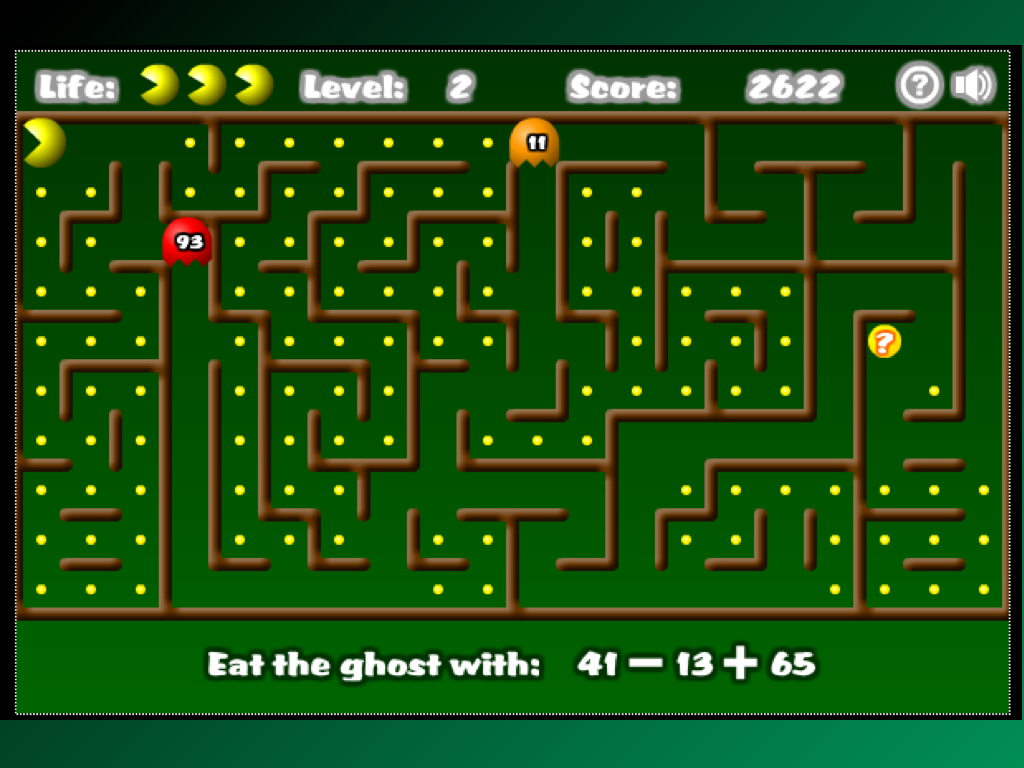
A Pac-Man game where you can only eat a certain ghost, depending on the solution to an equation.

Global Math - Math Games.005

If we apply the metric above and think about what is the math action and what is the game action? Here, the math actions are simplifying expressions and adding/subtracting, but the game actions are navigating the maze and avoiding ghosts. If I’m a student playing this game, I want to play Pac-Man. The math here is preventing me from playing the game, not aiding me, which makes me resentful towards that math.

Verdict: Bad

Example 2: Ice Ice Maybe

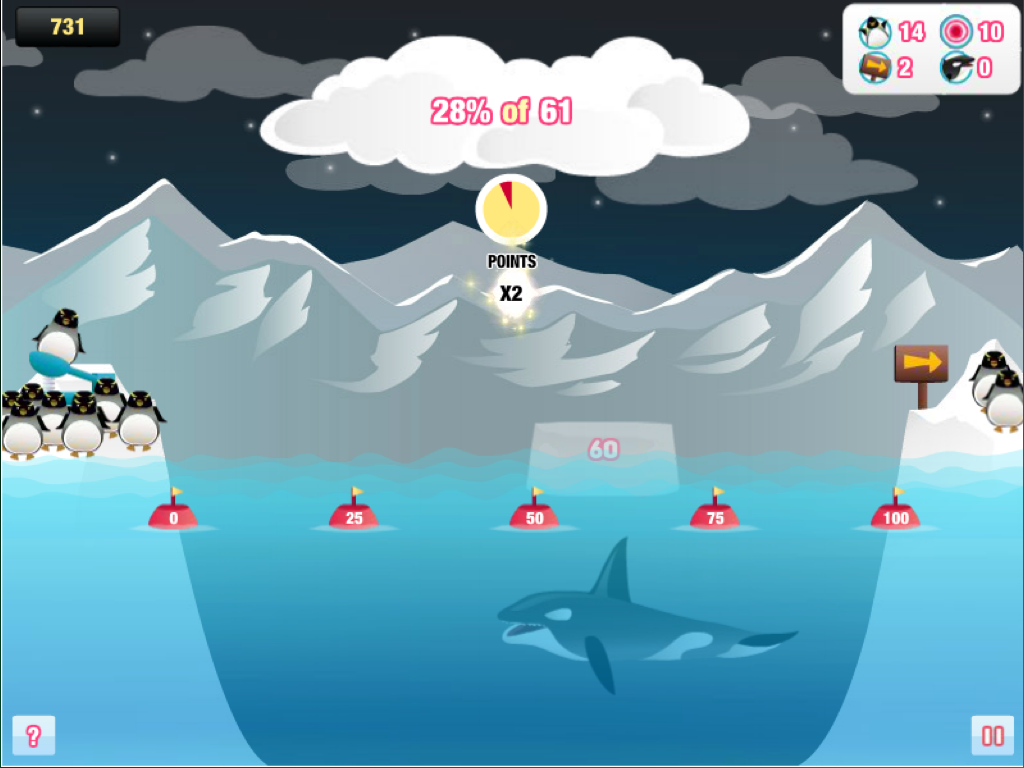
Global Math - Math Games.008In this game, you help penguins cross a shark filled expanse by placing a platform for them to bounce over. Because of a time limit, you can’t calculate precisely where the platform needs to go, so you need to estimate. That skill is both the math action and the game action, so that alignment means that this game accomplishes its goal.

Verdict: Good
Example 3: Penguin Jump

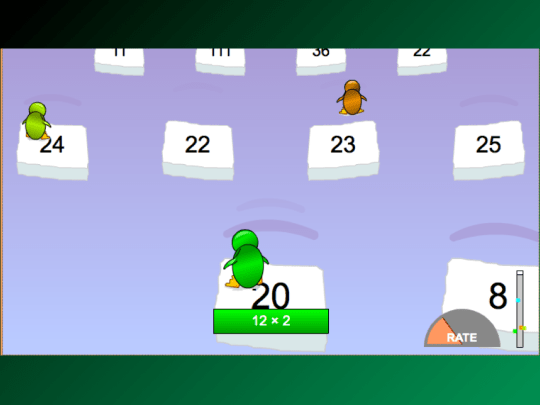
Global Math - Math Games.011Here you pick a penguin, color them, and then race other people online jumping from iceberg to iceberg. The problem is that the math action is multiplying, which is not at all the same. The game gets worse, though, because AS the multiplying is preventing you from getting to the next iceberg, because maybe you are not good at it yet, you visibly see the other players pulling ahead, solidifying in your mind that you are bad at math, at exactly the point when you need the most support. A good math game should be easing you into the learning, not penalizing you when you are at your most vulnerable point, the beginning of your learning.

Verdict: Terrible

Example 4: FactortrisGlobal Math - Math Games.014

This is a game that seems like it has potential: given a number, factor that number into a rectangle (shout-out to Fawn Nguyen here in my talk), then drop the block you created by factoring to play Tetris.

Again, the math action is factoring whole numbers and creating visual representations, which are good actions. But the game action is dropping blocks into a space to fill up lines. As Megan called it, though, we have a carrot and stick layout here, and often in many games. Do the math, and you get to play a game afterwards. (Also, the Tetris part doesn’t really pan out, because all the blocks are rectangles, which is the most boring game of Tetris ever.)

Verdict: Bad

Example 5: DragonboxGlobal Math - Math Games.017

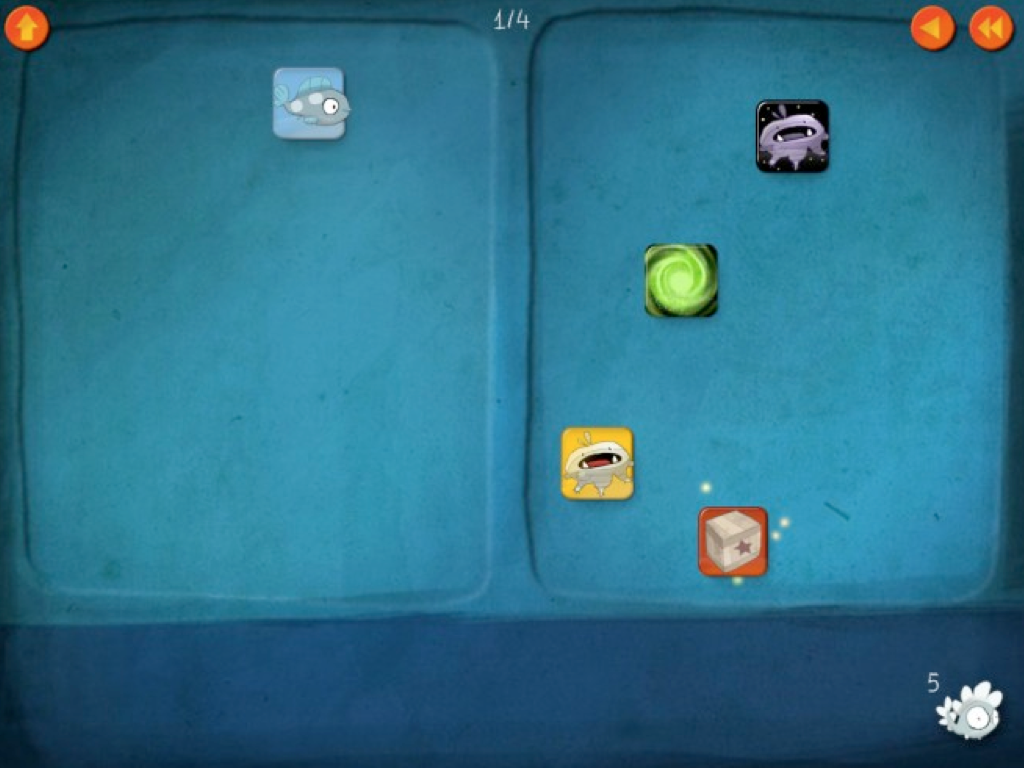
I’ve written about Dragonbox before, so I won’t write about it too much here. The goal of Dragonbox is to isolate the Dragon Box by removing extraneous monsters and cards. The math actions include combining inverses to zero-out or one-out, or to isolate variables. The game action is to combine day/night cards to swirl them out, or isolate the dragon box. The game action is in perfect alignment with the math action, which makes the game very engaging and very instructive.

Verdict: Good

Example 6: Totally RadicalPlaying the Root

The board game I created last year (and you can also make your own free following instructions here, or buy at the above link). In this game, the game actions were designed to match up with math actions. Simplifying a radical by moving a root outside the radical sign, as in the picture above, is done by playing the root card outside and removing the square from the inside (and keeping it as points).Global Math - Math Games.021 You also need to identify when a radical is fully simplified, which you do in game actions by slapping the board (because everything is better with slapping) and keeping the cards there as points.

Verdict: Good

Final Note

One of the real challenges of finding good math games, as a teacher, is curriculum. Most math teachers know of several good math games, like Set or Blokus. While these games are great and very mathematical, they’re not the math content that we usually need to teach in our classes. So the challenge falls on us to create our own games, but making good math games is hard. (Making bad ones is pretty easy.) On that note, if you know of some good math games (that meet the criteria mentioned in this post), drop a line in the comments!

 

No Right Answer

A bit ago I got yelled at by a commenter on Kate’s blog who claimed that being always right is why we like math. The problem with that point of view is that, while yes, you can always be right while doing computation, math isn’t just computation. So the other day I was talking with a friend of mine, and that prompted me to post the following tweets:

My friend Phil (@albrecht_letao) responded to the question, and he came up with an answer of $20/hr. When I worked it out with my friend, we came up with $14.25. Does that mean one of us is wrong, since we got different numbers?

No, of course not. What happened is we approached the problems in different ways. Phil only calculated the monetary value: with his amount, my friend would earn the same amount of money she does now. He figured this was an important way to look at it, for paying bills and whatnot. Our calculation came from thinking about how her time is being compensated. Since those 16 hours are being wasted (she has to work them for free; actually, she pays to lose that time), we calculated her “real” hourly rate and used that.

There can be more answers than even these two, depending on what you think is important. But it’s a clear example of a problem, solved using math, with no one right answer. That’s what math is about. I tweeted it thinking maybe it could be a problem worth considering in class, to show that essential idea to students.

What do you think?

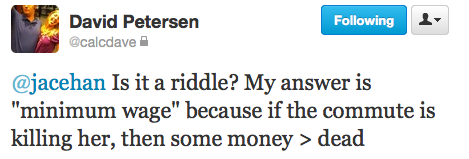
P.S. The right answer, of course, came from @calcdave:


Algebra Taboo

I remember reading about the idea of Math Taboo on Sam Shah’s blog, this post by Bowman Dickson. I feel like I had the idea independently, but it seems like many people have, by doing a cursory Google search of the phrase.

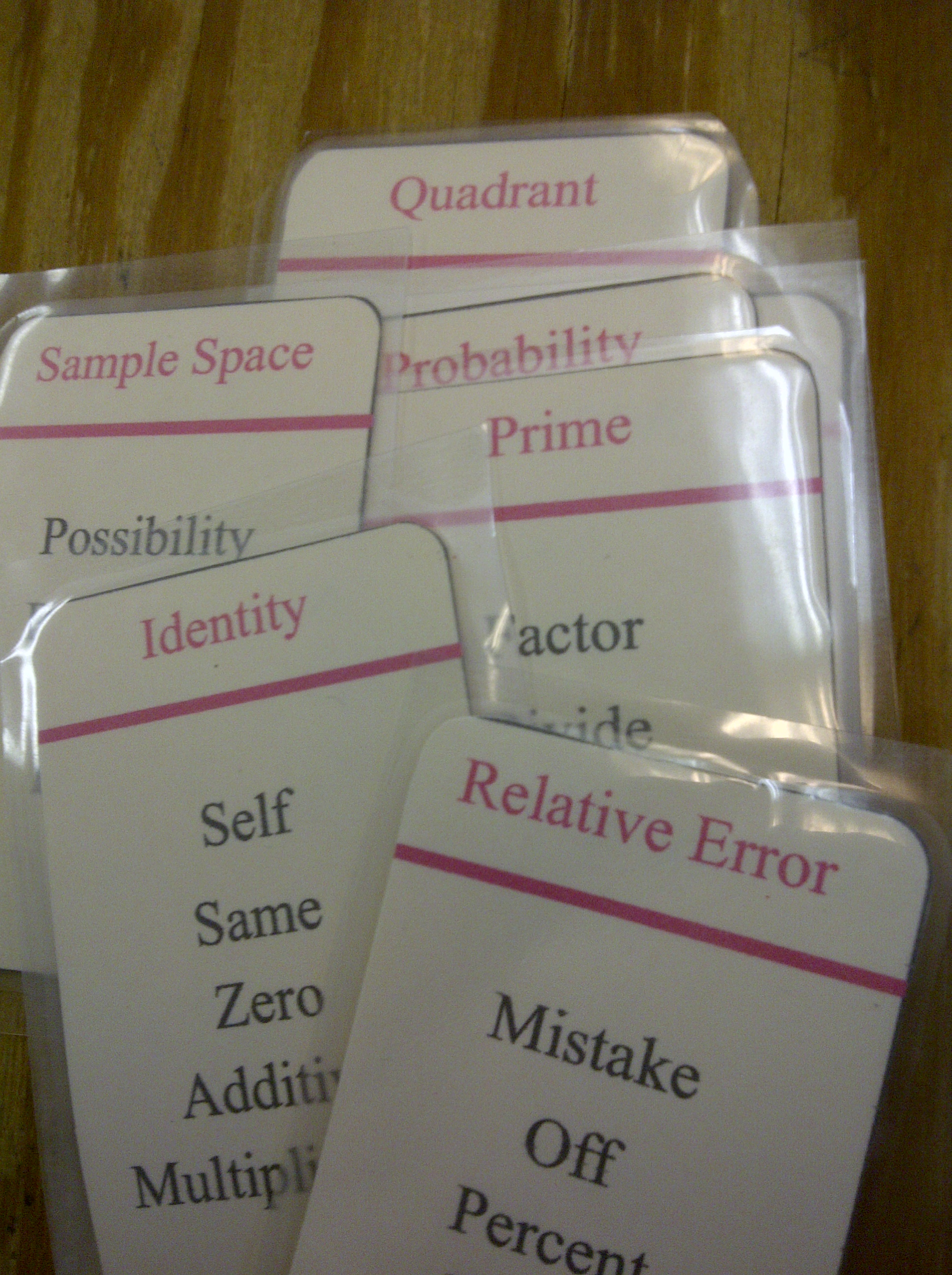
Unfortunately, there are lots of posts ABOUT math taboo, but no real materials provided. If I have seen anything, it’s a lesson plan on having the students make their own. Or I saw one for sale, but it was for the elementary level. So I made one myself.

My co-teacher and I went through all the Integrated Algebra regents given since 2008 and pulled out any words that it’s possible a student might not know. I also went through my own lessons and pulled out any vocabulary I had given them. Below is the .pdf for printing your own (I used card stock and laminated), and two .doc templates if you’d like to make more, or alter the ones I have. I made a total of 126 cards (63 double sides – maybe slightly overboard).

Since I found no others, it makes sense to share.

Downloads

Math Taboo (full pdf)

Math Taboo Pink  Math Taboo Blue (doc template)

Egyptian Fractions

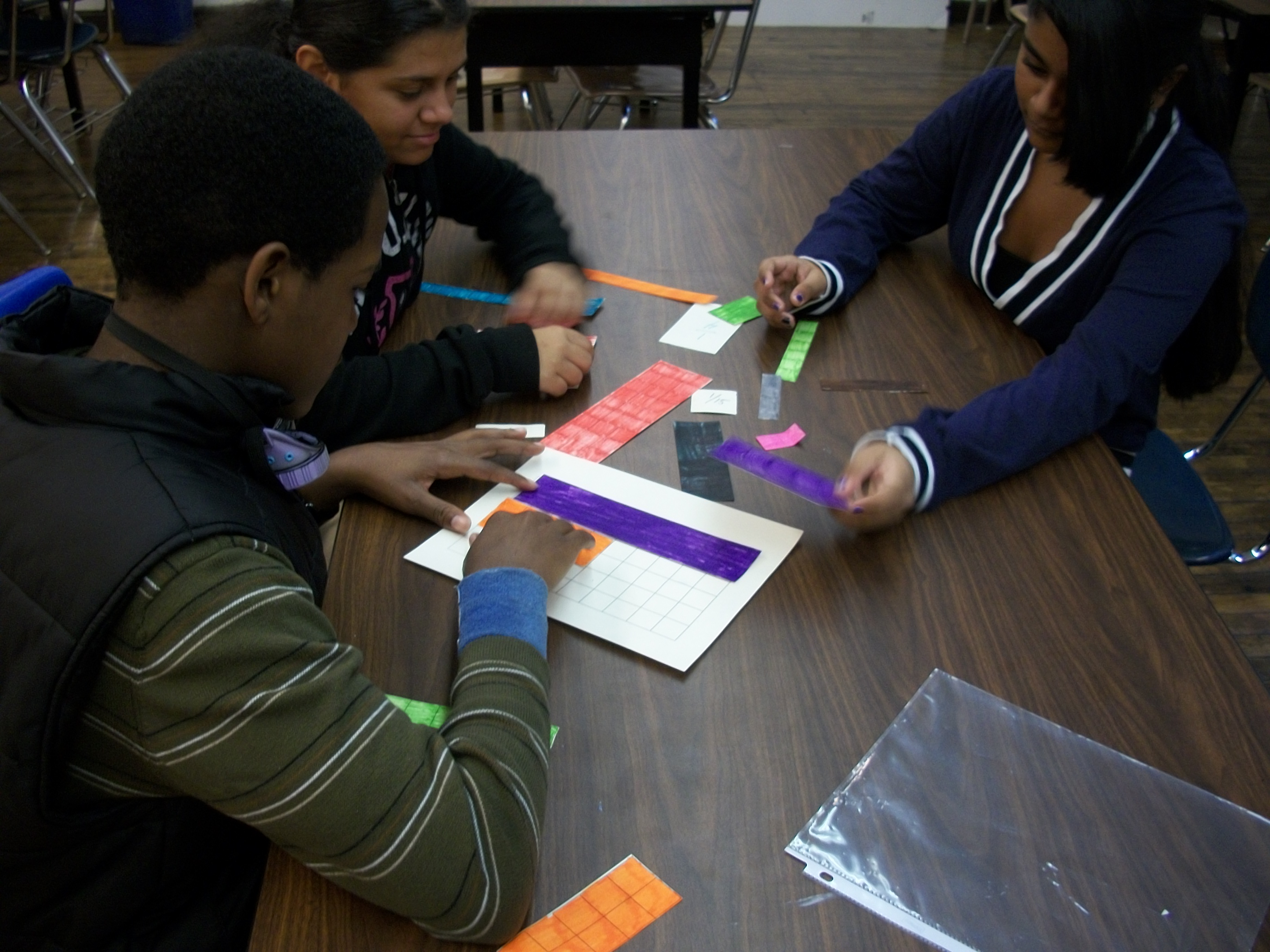
As I stated earlier, I’ve been trying hard this to integrate the other subjects more into my math lessons (and the other teachers are happy to work vice versa, because I’m on a great grade team). This process is made easier by actually having a Special Ed co-teacher for one section, and she specializes in math (and sees every subject, so can comment on all of them). So my first lesson explicitly tying history to math just went off, a lesson on Egyptian Fractions.

My goal for this lesson was really to get some fraction practice in while still learning something new, while also highlighting the “symbol that represents the multiplicative inverse,” , which I’d tie in on the next lesson about exponents (aka an exponent of -1). We worried, though, that the translation process would be too tough while dealing with fractions. That’s when we came up with this:

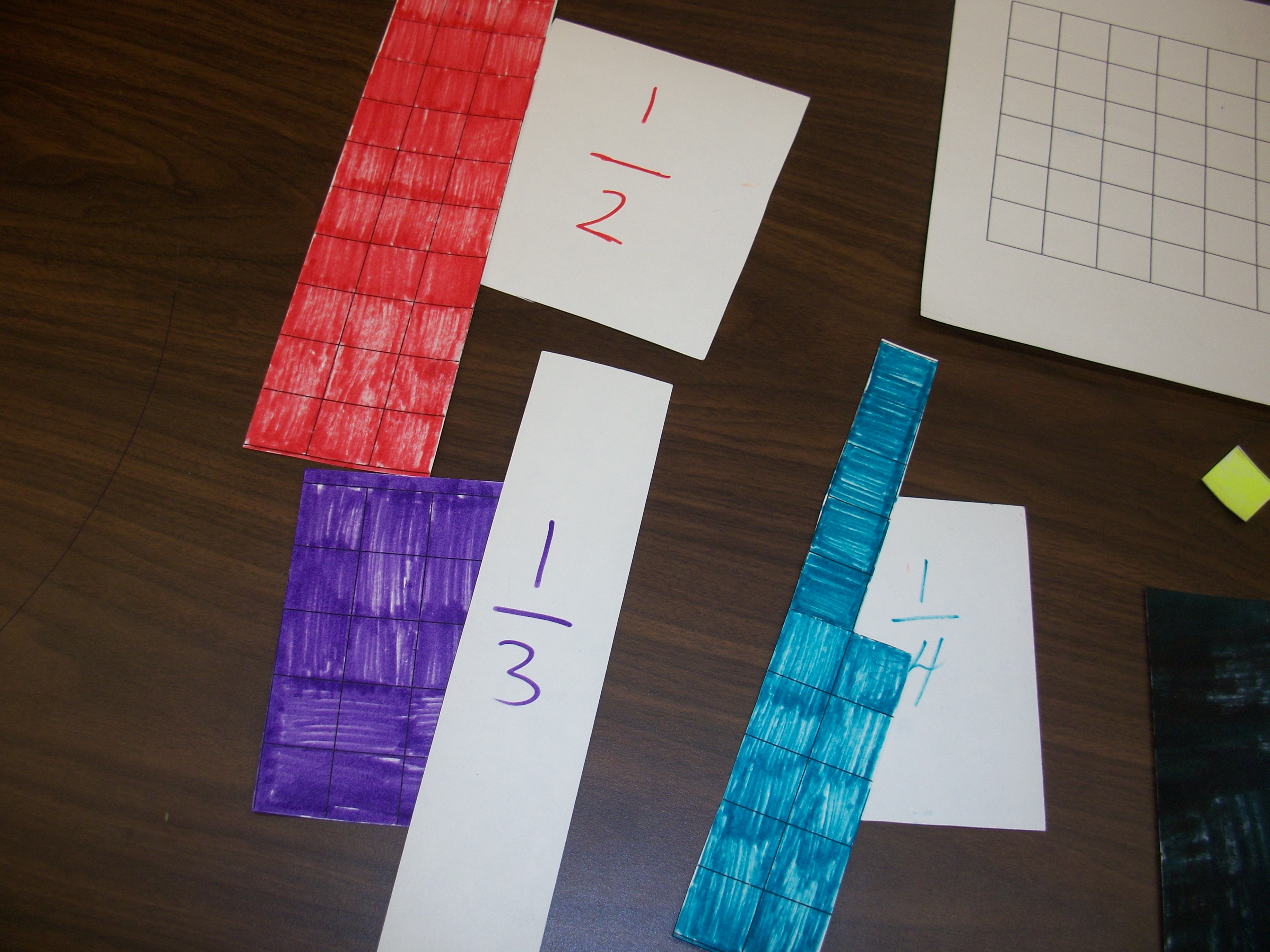
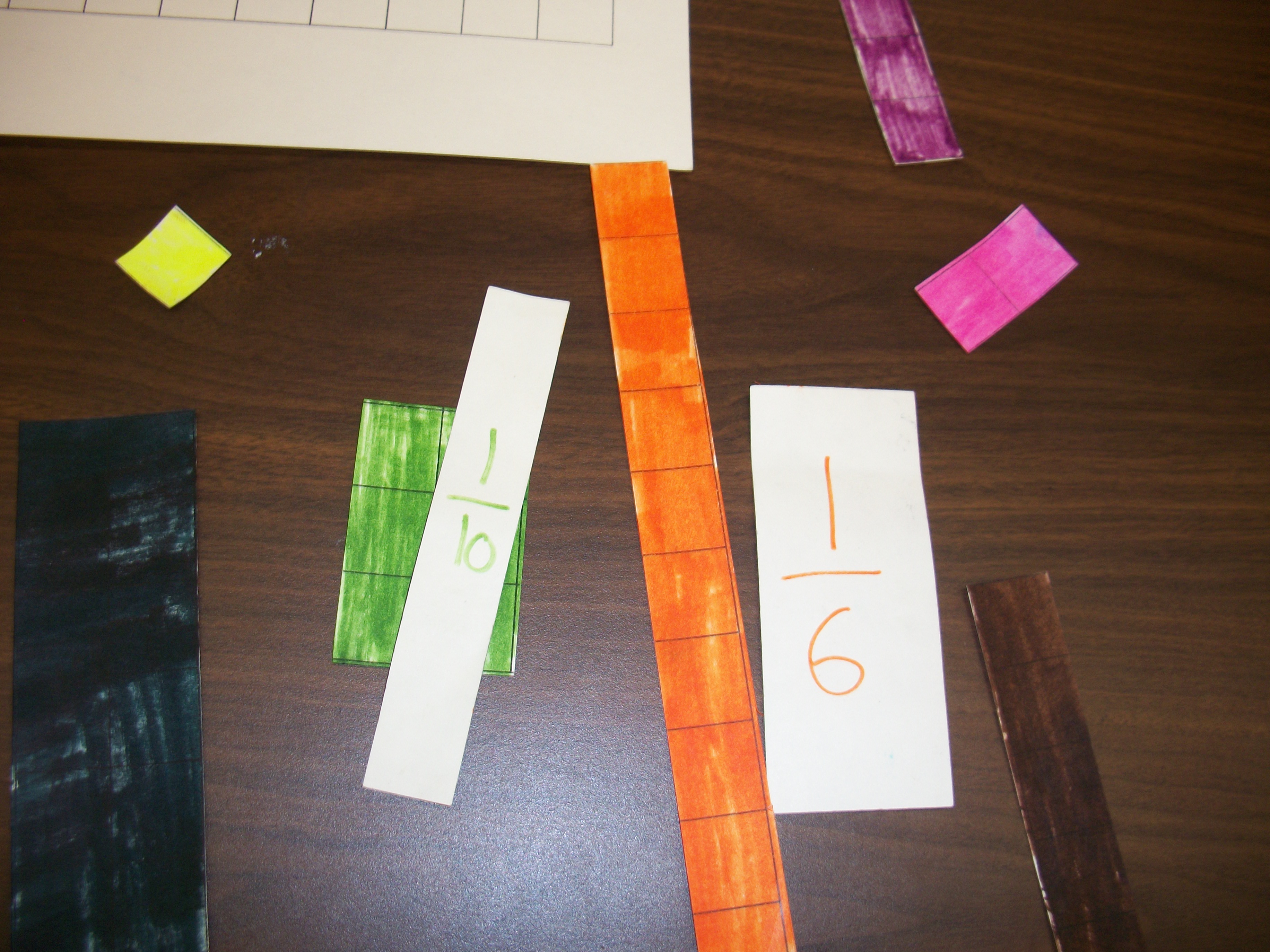
The Fraction Board has 60 square on it (which will be good reference for when I deal with sexagesimal Mesopotamian numbers soon), so each piece is cut to fit the amount of square that will cover that fraction of the board. To make the boards, I just made a 6×10 table in word as square-like as I could, printed on card stock. Then I cut the pieces out of the extra boards and had slave labor student volunteers color them in for me.

Each fraction have multiple pieces to represent the different ways you can fit them. (For example, 1/2 is 30 square, so I have a 3 x 10 piece and a 5 x 6 piece). But each fraction is also colored the same, because in Egyptian Fractions you can only use one of each unit fraction.

Then I would put up a slide like this on the board:

And the students would have to make that shape on their boards, with no overlapping and only using each color once. For the first one I shared a possible solution:

But I got really excited when the students could come up with multiple different solutions for each problem. And I would increase the difficulty of each one, until I would just get to a fraction with no picture:

And they still nailed it. Eventually I would move away from the boards and show the process of how to do it without the boards. We’d do some simultaneous calculation (using the greedy algorithm or more natural intuition) and checking on the board. Then we’d try with non-sexagesimal fractions. And every time we would translate our answers into hieroglyphics as well. So by the end of the lesson they could work on a worksheet where I just gave a fraction and they gave me hieroglyphics in return. (Not all of them could do this completely, but most could do some of the sheet). I think, overall, it went pretty well.

Egyptian Fraction Slides (Powerpoint)

Egyptian Fractions Slides (pdf)

(WordPress doesn’t seem like it’ll host my slides in their original Keynote form. That’s bothersome.)