Trying to find math inside everything else

Posts tagged ‘geometry’

Anagrams and Quads

In geometry we’re learning about the correspondence of congruence statements (i.e. ∆ABC ≅ ∆DEF means that A maps to D, BC = EF, angle CAB ≅ angle FDE, etc). One fun type of problem you can do with this is a self-referential congruence statement to highlight symmetry. For example, if LIMA ≅ MALI, what type of quadrilateral is it?

So the first question I had was “How many of these types of problems can you have?” The answer is not just the same as how many ways there are to arrange 4 letters (4!), because you still need to connect the four points in the same order (although you can change whether you go clockwise or counterclockwise). So if our starting ordering is 1234, you can have the following orderings:

1234IdentityOPTS
2143Isosceles TrapezoidPOST
2341SquarePTSO
3412ParallelogramTSOP
4123SquareSOPT
1432KiteOSTP
4321Isosceles TrapezoidSTPO
3214KiteTPOS

(As a side note, how do you solve these problems? You can list out all the sub-congruencies and mark up a diagram. But I like to think of the mapping of points and determine what transformation that would be. For example, with OPTS to POST, P and O switch places, and S and T switch places, so it must be a reflection with the line of reflection down the middle of lines PO and ST. This makes an isosceles trapezoid.)

I picked OPTS as a starting point because it’s the four-letter work with the most anagrams (OPTS, STOP, SPOT, POST, POTS) so I figured some would should up in this work and was surprised there was only one. But then I realized that which one I start with matters: if I start with OPTS, only POST is a valid shape, but if I start with STOP, then SPOT and POTS are valid.

So then I went through a list of four letter anagrams to find more that fit the patterns I need above. Below is a non-comprehensive list you can use for these types of problems if you, like me, like using words instead of just ABCD.

2143MANEAMEN
2143ACTSCAST
2143TIMEITEM
2143SUREUSER
2341EMITMITE
2341MITEITEM
2341EACHACHE
2341ABETBETA
3412MALILIMA
3412EMITITEM
3412ARTSTSAR
3412REPOPORE
3412CODEDECO
3412DEMOMODE
3412GOERERGO
4123ALESSALE
4123LOTSSLOT
4123OPENNOPE
1432BETABATE
1432DEMODOME
1432MATEMETA
1432GORYGYRO
4321ABUTTUBA
4321TIMEEMIT
4321RATSSTAR
4321BARDDRAB
3214AGEDEGAD
3214TIMEMITE
3214RATSTARS
3214MANENAME

If you have more anagram suggestions, leave them in the comments!
Lessons from NCTM, Part I

Oof, well, I certainly meant to write this up sooner, not almost a full month later, but it felt like it took this long just to feel caught up from having missed those three days! That’s definitely a struggle with the conference timing. Anyway, I figured I’d go through some of the sessions I went to, and my notes, as a way to debrief myself but also share any gems I picked up.

Two Students, One Device

I missed the beginning of this session because I went to two other ones first, neither of which worked out, but I knew Liz (Clark-Garvey) wouldn’t let me down (as well as Amanda Ruch and Quinn Ranahan). I’ve used the practice of two students on one device before, but I realized it was natural to do it back when I was at a school where we were using class carts of laptops/tablets, so I could just give one per pair. Now I’m at a school where everyone has their own device, so making them pair up needs to be a more intentional move, and it’s easy to default to not doing that.

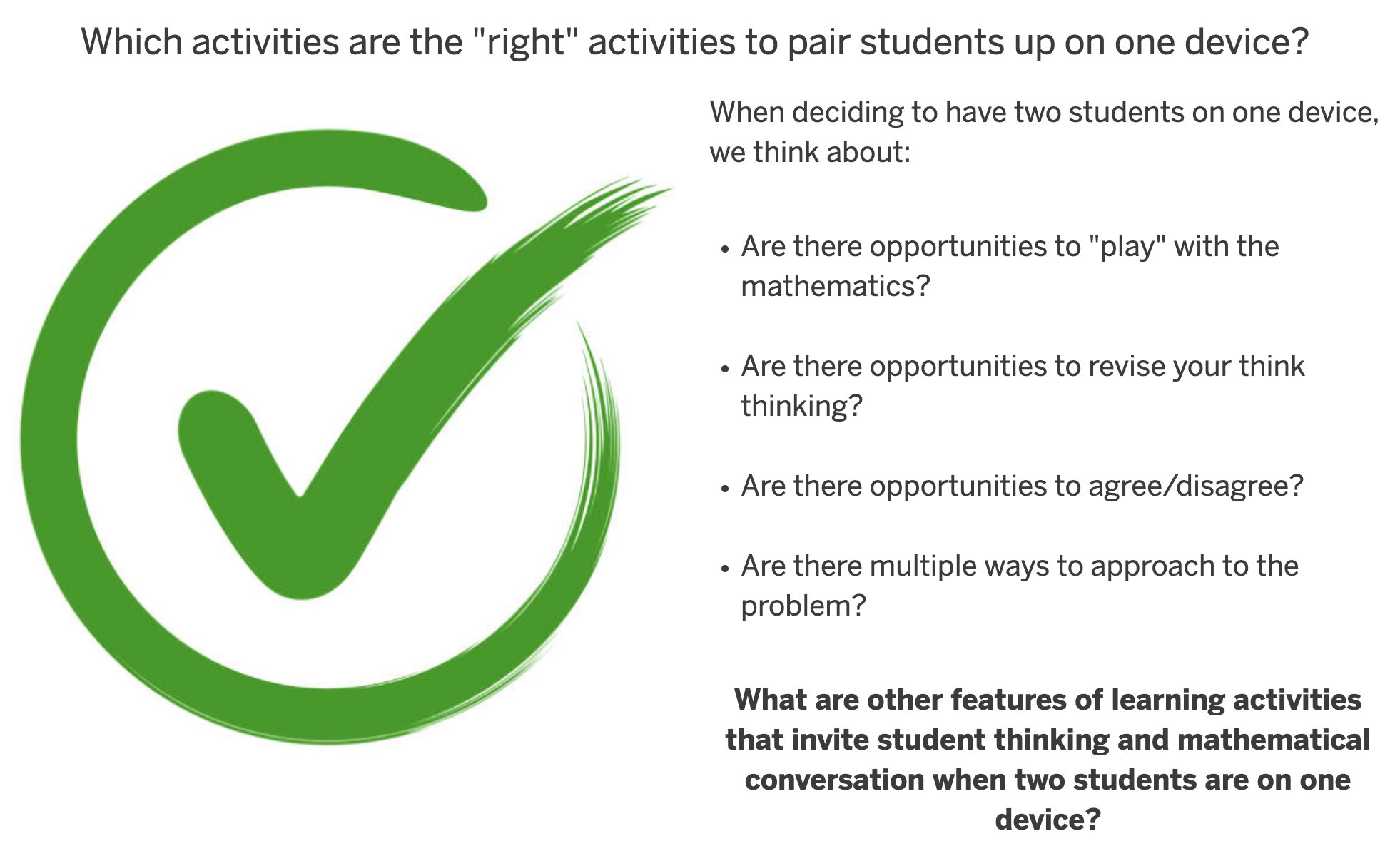
So then the question is, when to do it? If students are doing practice problems on DeltaMath, that doesn’t need to be paired. This is the slide the presenters had for this:

But they also talked about how just choosing the right activity isn’t enough, so other strategies are useful. For example, setting norms such as “type other people’s thoughts, not your own” or mixing up the groups and having them revise their responses.

Fawn

Sure, I could use the title, “Helping Students Become Powerful Math Learners,” but really this was the Fawn session. (Or should I say “The legendary Ms. Nguyen”?) The first quote I wrote down was “The pacing guide does one thing for me – it tells me how behind we are.”

Fawn had four maxims to follow:

  1. Ask students to seek patterns and generalize
  2. Ask students to provide reasoning
  3. Build fluency
  4. Assign non-routine tasks

One routine that stuck out was an open middle-type problem. We had to create the largest product using 5 numbers, 3-digit times 2-digits. Fawn had us all share our possibilities, and then we discussed which possibilities we could remove – someone would nominate one, explain how they knew it wasn’t the greatest (often because it was strictly less than another), and it would be removed only if there was 100% consensus. Then we could narrow it down before we ended up checking the top two choices.

Another thing of note was about the non-routine tasks and games: in particular, they should be non-curricular. This doesn’t mean not based on your curriculum at all, but rather not based on what they just did. This makes sense, as if they are always using the skill they just learned, that turns it into a routine, and thus won’t have the same benefit.

Just Civic Math

I don’t have that many notes from this session, and I don’t see any slides attached on the NCTM website. One note says “Limiting civics to just ‘social justice math’ is restricting. Dialogic math helps.” I think the idea here is similar to what I’ve used before, Ben Blum-Smith’s Math as Democracy. Jenna Laib’s Slow Reveal Graphs were mentioned, and I mentioned the similar graphs.world to the presenter. They also mentioned the book “Constitutional Calculus” which I will look into in the future.

Miscellaneous

Two notes I took on the patty paper session: use felt pens to be more visible on patty paper, and when folding, pinch from the middle and press outwards (more likely to get accurate folds on lines then).

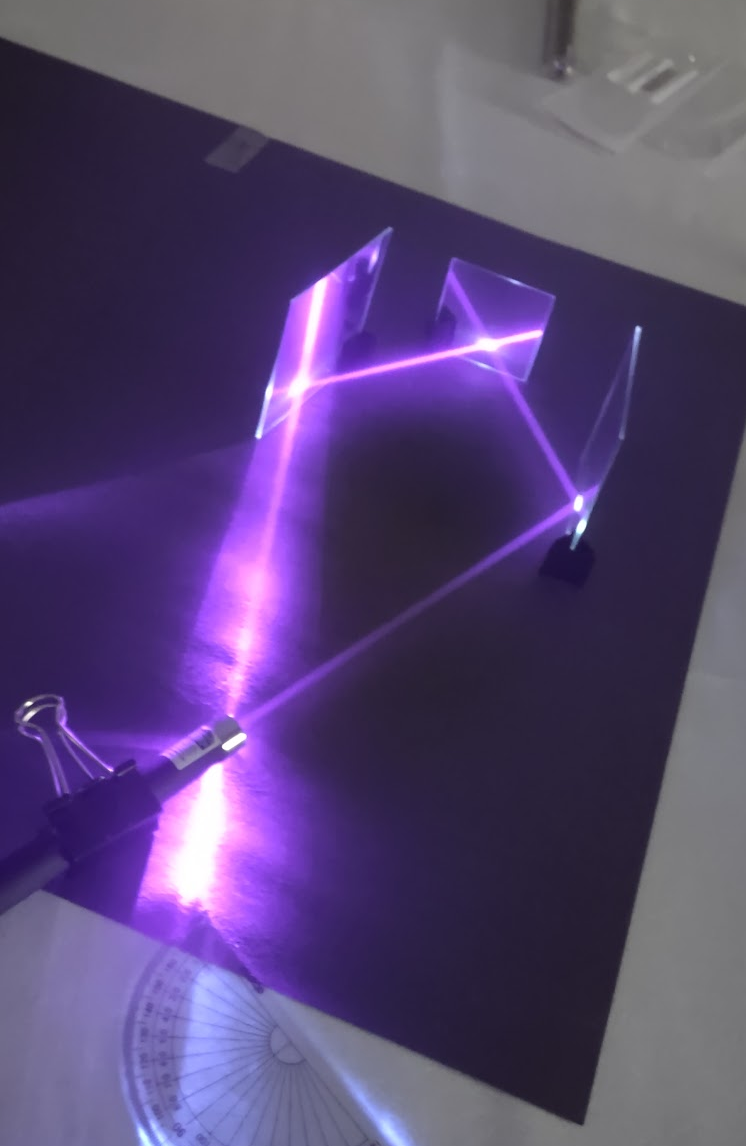
I went to a really cool session on making art using mirrors and laser pointers from Hanan Alyami. Here’s the kite my group made in the time:

The project seemed cool and had some fun math, but I also don’t know when I could fit it in, as it’s a 3-day process.

I tried to go to John Golden’s session on games but it was full! I went to Christopher Danielson’s session on Definitions. Two things stuck out to me there: his reasoning for originally doing a hierarchy of hexagons was that it fought against status issues, since there was no pre-knowledge as with quadrilaterals; when asking if something is a vehicle, something that is so far from one, like a salad, just makes it a fun question, but something closer to an edge case, like a broken bus with no wheels, is harder and more contentious.

Okay, I was gonna keep going, but that seems like a lot – and that was all just Thursday! So maybe I’ll do separate posts for Friday & Saturday.

A Way to Foster Productive Struggle?

My school has been trying to better create conditions for productive struggle in our classes, because a lot of students have taken a very receiving stance. So early in our Area and Volume unit, I decided to use this task from Illustrative Mathematics.

1_745c7d05e1fdafd29cf6e8e5ca7f8117

The task is a 7th grade task, and so involved nothing new for my high school geometry students – just area and perimeter/circumference. But the task has a lot of parts, not all of which are obvious from looking at it. So I gave them task, and then I was “less helpful.” In fact, I barely spoke during the lesson, only quietly clarifying things, but reflecting their proximity questions back towards themselves and their other group members.

Almost every group that attempted the task solved the problem on their own. (I followed up with an extension where they designed their own stained class on the coordinate plane and found the price using the same pricing, for those who finished quickly.) I had a group of three girls who don’t usually feel very confident in my class feel like rock stars after figuring the whole thing out themselves.

A few days ago, I saw this tweet:

I thought it really applied here. While the content was still related to what we were learning in high school geometry, the opportunity to solve a complex task with little scaffolding was really helped by using a task from an earlier grade. I recommend it.

The Great Geometry Review

Since Kate asked us to post more unsexy things, I thought I would throw up this review book I made for geometry, which basically covers all the things students should “know” (not necessarily be able to do, or deeper understandings) for the course, especially for the NY Regents (Common Core). The students can fill in the blanks and are then left with a nice study guide. So far my students seem to like it! (Although one student said they wouldn’t do it if they didn’t get a grade for it – so frustrating!

Great Geometry Book (doc)

Great Geometry Book (pdf)

Circles, Lines, and Angles

My math coach gave me this idea as we were planning my Circles unit. I think it went fairly well, so I’ll share it here. The idea is that we have, essentially, three basic objects that we’ve combined in different ways in geometry: circles, lines (including segments), and angles. So, as an opening activity to the unit, the task was this:

“Think of as many ways as possible to combine those three objects.”

First they brainstormed individually, as I reminded them that they can use multiple lines or angles or circles if they wanted. Then they went up to groups and made a master list per pair or group, eliminating ones that were “pretty  much” the same. I gave them some vocabulary based on what I saw they drew, and they had to use that vocabulary to describe what each drawing had. Finally, they chose one example and created one neat, fully correct example, in color that we combined into class posters. (I approved what they chose, to ensure a variety of possible layouts.)

20160414_144226_HDR 20160415_075653_HDR

Between my two classes, they came up with almost every scenario I could think of that we would learn in the unit, with the exception of Tangent Line & Radius, which I drew and put in myself. Now they are hanging in the classroom, acting as a guide for our journey into circles.

Angle Chasing

On Friday our school was supposed to have a Quality Review, but it was canceled at the last minute. (That’s a whole ‘nother story.) But that pushed me to do a lesson that I probably wouldn’t’ve done otherwise, so that’s good. I actually think it went pretty well.

I noticed in our last exam that I should probably explicitly teach angle chasing as a problem solving strategy, so I asked the MTBoS for some good problems. Justin Lanier came through in the most wonderful way. So I picked out some problems into a nice sequence that would use a bunch of the theorems we’ve already done.

I wanted the students to work as a group up on the whiteboards, so I gave each person in each group a different color marker. I then had the students write a key in the corner. Each student’s color represented 1-3 of the theorems that they would have to use to solve the problems. Then they would draw up the diagram of the problem. As they went through, each person was only allowed to write when their theorem was used to deduce the measure of the angle. That way, with the colors, I could actually trace through the thought processes they used to solve the problem, which was really nice. (I wonder if I can use that as an assessment some how, having students trace through the same process. Maybe as a warm-up, once I get my smartboard working again.)

Here’s some pics of their great work.

20151211_133820 20151211_134150 20151211_134918 20151211_135139

Building Quadrilaterals and Their Diagonals

I wanted a lesson to explore the properties of the diagonals of different types of quadrilaterals, but the curriculum map I was following just lead to Khan Academy, and that’s not really my speed. And some scanning through MTBoS resources didn’t find me what I wanted, but chatting out my half-formed ideas with Jasmine in the morning focused the idea into what I did in class today.

I started by having the students draw 6 triangles: 3 scalene, non-right triangles; 1 isosceles non-right triangle; 1 scalene right triangle; and 1 isosceles right triangle. Then we used each of those figures to create a quadrilateral by making some sort of diagonal. Each time, I asked them to identify the quadrilateral and what they noticed about the diagonals.

Screen Shot 2015-11-23 at 9.29.43 PMScreen Shot 2015-11-23 at 9.30.35 PM


Screen Shot 2015-11-23 at 9.51.13 PM


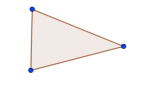
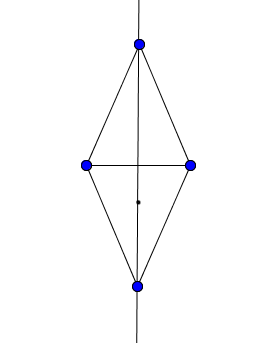
First, take one of the scalene triangles and reflect it over one of its sides. Thus we created a kite – which we know because the reflection creates the congruent adjacent sides. Then we can use the properties of isosceles triangles – we know the line of reflection is the median of the isosceles triangles because of the reflection, so it is also the altitude, meaning the diagonals are perpendicular.


Screen Shot 2015-11-23 at 9.29.43 PM

Screen Shot 2015-11-23 at 9.33.33 PM


Then, take another scalene triangle and reflect is over the perpendicular bisector of one of the sides. This makes an isosceles trapezoid – we know the top base is parallel to the bottom base because they are both perpendicular to the same line, and it’s isosceles because of the reflected side of the triangle. Then we notice the diagonals are also made of a reflected side of the triangle – and so we can conclude that the diagonals of an isosceles trapezoid are congruent.

Screen Shot 2015-11-23 at 9.29.43 PM Screen Shot 2015-11-23 at 9.34.33 PM


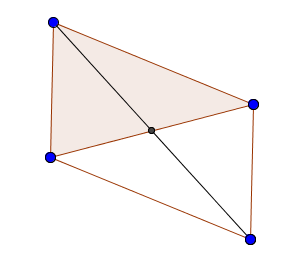
For the third one, I asked them to draw a median and then rotate the triangle 180°. The trickiest bit here is to prove that this is a parallelogram – previously we had classified the quadrilaterals by their symmetries, so using the symmetry definition we could say any quad with 180° rotational symmetry is a parallelogram. Or we can use the congruent angles to prove the sides are parallel. Once we did that, we saw that, because we used the median, that the intersection of the diagonals is the midpoint of both – and thus the diagonals bisect each other.

I then tasked them to figure out how to make a rhombus, rectangle, and square out of the remaining triangles using the triangles. Because we proved the facts about the diagonals of the parent figures, we could then determine the properties of the diagonals of the child figures.

Screen Shot 2015-11-23 at 10.20.00 PM Screen Shot 2015-11-23 at 9.40.37 PM Screen Shot 2015-11-23 at 9.41.27 PM


I think it went pretty well – the students performed the transformations and easily saw the connections between the diagonals. Tomorrow I think we’ll do something about whether or not those diagonal properties are reversible – if every quad with perpendicular diagonals is a kite, for example.

Crossing the Transverse

Oh my god, I haven’t blogged since August! This has been a hell of a year, let me tell you. But maybe I’ll tell you in another post, because this one is about the new game I made in my Geometry class. (My first non-Algebra game!)

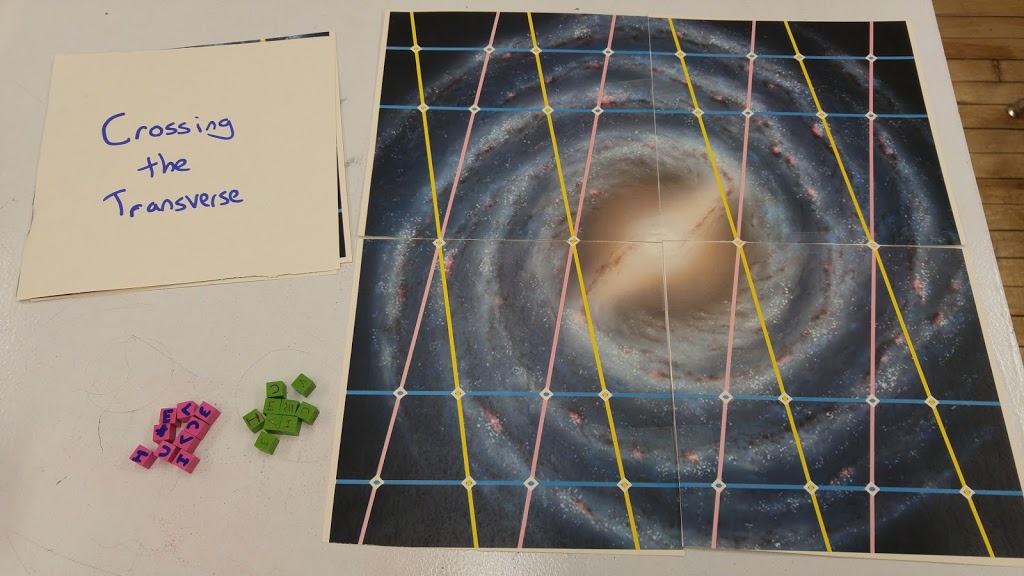
So the game is called Crossing the Transverse. The goal of the game (pedagogically) is to help identify the pairs of angles formed by lines cut by a transversal, even in the most complex of diagrams. The goal of the game (play-wise) is to capture your enemy’s flagship.

Here’s the gameboard:

Crossing the Transverse Map

I printed out the board in fourths, on four different pieces of card stocked, and taped them together to make a nice quad-fold board. Then I made the fleet of ships out of centimeter cubes I had, by writing in permanent marker on the pieces the letter for each ship.

Quad Fold Board

Here’s the rules.

In the game, each type of ship moves a different way, which makes it feel a lot like chess – trying to lay a trap for the enemy flagship without being captured yourself.  Many of my students really enjoyed it when we played it yesterday. Today, though, to solidify, I followed up with this worksheet where they had to analyze the angles of a diagram much like on the game board. They did pretty well on it, so I’m satisfied!

Materials

Crossing the Transverse Rules

Printable Map (Prints on 4 pages)

No Stars Printable Map (If printing the background galaxy is not for you, here’s a more barebones version.)

Zip File with Everything, including Pages, Doc, and GGB files