Trying to find math inside everything else

Oh my god, I haven’t blogged since August! This has been a hell of a year, let me tell you. But maybe I’ll tell you in another post, because this one is about the new game I made in my Geometry class. (My first non-Algebra game!)

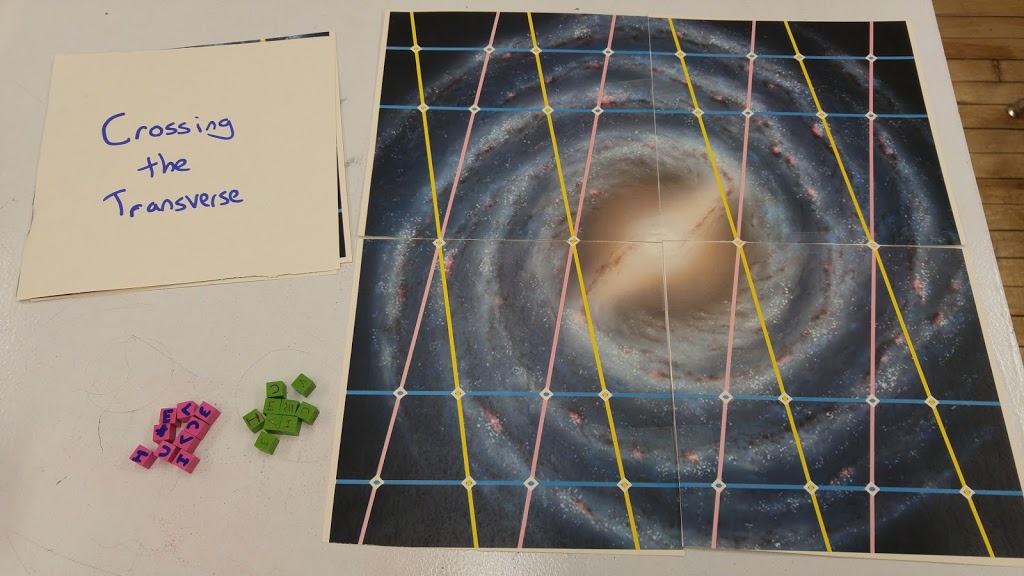
So the game is called Crossing the Transverse. The goal of the game (pedagogically) is to help identify the pairs of angles formed by lines cut by a transversal, even in the most complex of diagrams. The goal of the game (play-wise) is to capture your enemy’s flagship.

Here’s the gameboard:

Crossing the Transverse Map

I printed out the board in fourths, on four different pieces of card stocked, and taped them together to make a nice quad-fold board. Then I made the fleet of ships out of centimeter cubes I had, by writing in permanent marker on the pieces the letter for each ship.

Quad Fold Board

Here’s the rules.

In the game, each type of ship moves a different way, which makes it feel a lot like chess – trying to lay a trap for the enemy flagship without being captured yourself.  Many of my students really enjoyed it when we played it yesterday. Today, though, to solidify, I followed up with this worksheet where they had to analyze the angles of a diagram much like on the game board. They did pretty well on it, so I’m satisfied!

Materials

Crossing the Transverse Rules

Printable Map (Prints on 4 pages)

No Stars Printable Map (If printing the background galaxy is not for you, here’s a more barebones version.)

Zip File with Everything, including Pages, Doc, and GGB files

I just read the book One Man Guy by Michael Barakiva. (Pretty good, but has some problems). I wanted to share a scene from the book. (Emphasis mine.)

“Does that mean your absence last Friday, unlike your earlier absences this semester, was unexcused?” Mr. Weedin asked.

“It does,” Alek admitted.

“Mr. Khederian, you clearly have a strong grip on this material, and if you hadn’t cut, I would’ve considered recommending you for the Honor Track next year. But I’m afraid that I can’t go around making exceptions for students, regardless of how bright they appear.” Mr. Weedin’s picked up his paper and continued reading.

His teacher’s resolution almost made Alek give up. But he knew how important this was for his parents. And, he had to admit, for himself as well.

“Mr. Weedin, don’t you think failing me in a class when you think I’m capable of delivering Honor Track material is counterproductive?” Alek cleared his throat. ” ‘Let us once lose our oaths to find ourselves, / Or else we lose ourselves to keep our oaths.’ ”

“Is that Shakespeare?” Mr. Weedin asked, intrigued.

“Yeah, it’s from Love’s Labour’s Lost. I just wrote an essay comparing and contrasting that play to Romeo and Juliet in English, and that quote really stuck in my head.”

“Why?” Mr. Weeding leaned back and slid his glasses down so he could peer at Alek unobstructed.

“I guess I feel like we spend so much time trying to keep the promises we make, or the rules we set up, but it’s also important to look at those promises and rules and make sure they’re actually doing what we want them to do, and not the other way around.”

“Well, Mr. Khederian, you make a persuasive case.” Mr. Weedin tapped his pencil against his desk three times. “I’m not going to make it easy for you. For the remainder of this class, I’m going to double your homework load. If you complete it all satisfactorily, then I will reduce the penalty from failing to dropping your grade one full letter. So the highest grade you could receive would be a B.”

Alek had to stop himself from hugging Mr. Weeding. “Thank you, Mr. Weedin, thank you so, so much. I promise that I’ll do my best.”

“What is your best, I wonder?”

“I don’t know, Mr. Weeding, but I’m looking forward to finding out.”

“Me too, Alek.”

This was a major theme of the book and one I appreciated (it reminds me of Fiddler on the Roof in a way, especially the climax of the book). This isn’t the most moving scene but as this is ostensibly a teaching blog, I thought I would share it.

This seems especially relevant given the two articles I saw earlier today – one about the student who passed because of admin pressure even though she “deserved to fail” and the other about the student who passed because her teacher felt she should, despite her parents thinking she “deserved to fail.”

It’s interesting on its own to contrast the two articles. But now look at it through the lens of the quotation above. What does it mean to pass or fail a student, and why do we do it?  What is the goal of the grades that we give? Often teachers set rules in their classrooms, or grading policies, and stick to them rigidly, thinking that is what is right. But it is easy to lose sight of why we made these rules in the first place – because we want our students to be the best they can be. Most of the time those rules will help that happen – but sometimes they don’t, and so we need to be willing to change when that occurs. It is the spirit of the law that matters, so try not to get lost in the letter.

At the Math Games morning session at Twitter Math Camp 15, we’ve been created curricular games that hit on some topics that there aren’t really good games for. I came up with the idea for this one, and worked on refining it with the help of Paula Torres (@lohstorres1) and John Golden (@mathhombre).

This game is about measures of central tendency (and range for good measure). Not only do students have to determine all of those over and over as they play the game, but they can see how changing the data set changes the values, especially as the size of the data set increases or decreases. It seems really good because it drives the need to make those calculations.

All you need is two decks of cards. The game is designed as a two-player game, but it would definitely be best done as two pairs playing against each other, so they can talk to each other about their strategies and calculations. We also recommend having students keep a running tally of the values.

Last year, before Twitter Math Camp, I was packing and trying to figure out which games to bring with me for the game night we were having before the conference started. I basically had three attributes I was considering: how big the game was, how good it was, and how many players could play it. I wanted to minimize the first one while maximizing the latter two.

So I tried to come up with a bunch of formulas for figuring it out, but nothing was quite working out. (I used BoardGameGeek ratings for “how good it was.”) At first I tried doing {\frac{r \cdot p}{v}}, but it was putting some games that just weren’t very good as top choices. The problem was that the volume was having too big of an effect – games could come in thousands of cubic centimeters of volume, but max at around 8 for rating and 12 for players. (I had to use amazon.ca to look up the dimensions because I wanted to use centimeters.)

So then I tried cube rooting the volume, or doing an exponential functions like {\frac{p \cdot e^{r}}{v}}%s=2, or finding the geometric mean of the three numbers, but still nothing came out right.

I was basically using three games as test cases: Dominion, which is one of the best games I own but it really big; Pixel Tactics, which is one of the smallest but is only 2 players; and The Resistance, which is small-ish, really good, and can go to 10 players. I figured that any good method should tell me to leave the first two games at home, but to bring the Resistance. If they didn’t, it wasn’t right.

Eventually, after doing some research, I determined that a common technique used in psychology when comparing variables of different ranges of values is called standardizing the variables. Basically, for each attribute, I would find the mean and standard deviation. Then, for each game, I would subtract its value from the mean and divide by the standard deviation to get a standardized value. Then I just needed to add up the three standardized values and the ones with the highest score would win. And, as predicted, The Resistance came out on top.

Screen Shot 2015-07-17 at 8.34.15 PM

Whiteboard Desks

After TMC14, I heard a lot of talk about Vertical Non-Permanent Surfaces (though I didn’t go to that session myself). After reading Alex Overwijk’s post about it, I wanted to use the idea in my classroom, but getting vertical boards up seemed challenging considering how long everything takes in school. The researched showed the horizontal non-permanent surfaces were the second best thing, so I decided to take matters into my own hands. I went to the hardware store, bought some whiteboard paint, and got to work.

I put the paper down to prevent drips but, of course, dripped anyway.

Overall the desks have been amazing. The students love getting the markers and working with them, especially because they hate committing things to paper when they might be wrong. (Yes, kids do doodle/play tic tac toe/etc on the desks, too, but I think that’s no different that what they’d do on paper.) Another benefit is how easy it is for me to interact with the students when I go around. Instead of having to write something on the student’s paper or notebook, which always felt intrusive, I can jot something quickly down on the table itself, leaving it to the student to work it into their own thinking. It’s worked great for tutoring (so I don’t have to get up and go to the board). The paint might not last as long as it could when the room is used by other classes who don’t know what’s up (our night school in particular, I’d say), but it’ll last the year, at least, and I’m more than happy to repaint them before next year.

The only picture of student work on desks I had that wasn’t blurry as hell. I need to work on my photography.


A Better Day

Today went so much better than yesterday it’s hard to believe. I think the real problem was that I forgot to give them new seats yesterday, as I had intended, because my bag of numbers to randomly assign them had gone missing. Today, not only did they have new seat, but they also had a real desire to figure out what they hell went wrong yesterday, because I had asked them all to do as much as the assignment as possible for homework and pretty much no one in the class figured it out correctly. But because of that, we got to experience the benefit of using a table and all the kinds of information you could find in one, we got to transform functions and explain what they mean in a situation, and I got to actually work with several groups of students without going nuts. So maybe the assignment wasn’t actually that bad, and yesterday was just off. We’ll see how tomorrow goes.

Post Vacation Blues

The day after Spring Break is rough. Not only am I jet-lagged, but the students haven’t seen each other in over a week and thus are non-stop talking. That probably could have been fine, however, if the lesson I designed was a little stronger. While the Estimation180 intro went fine, the other activity (modeling profit and demand with quadratic and linear functions) was less so. I tried to start with a notice and wonder that mostly flopped. And then, in question 2 (see below) when I asked them to write a function, the one that was easiest to come up with was not in any of the quadratic forms we had already talked about (standard, vertex, factored), so it was less clear what to do with it. I’m going to have to revisit it tomorrow and try again. I feel like today was mostly a wash.

Suspensions

We’d been having a little bit of a suspension problem at my school. It felt like we had a secret police – students would just disappear and no one would know where they went, only to find out upon their return that they had been suspended. This breakdown of communication was bad enough, but then we would find out the reasons some students were suspended. Playing dice together in the stairwell? Yes, sure, gambling is frowned upon, but it’s not a suspension-worthy offense. It’s not even like it was a gambling ring – it was just three friends. Being suspended for being late? How does that even make sense?

As a believer in restorative justice, after I found out about this, I tweeted the following:

Screen Shot 2015-04-11 at 1.57.43 PM

My friend Abbie disagreed, and we wound up having the following discussion, which I think was enlightening on both ends.

Abbie: I disagree. I was bullied severely in school as a child. Mental abuse is scarring and should be treated just as seriously and part of the reason it went on for years was because “they never touched her.”  Bullshit. Mental attacks are violence.

James: I’m sorry you went through that. I’m not saying that mental abuse should not be taken seriously but that suspension is not the answer. In general, Restorative Justice is a more effective approach.

Abbie: I like the idea of such a program but I have serious doubts about the feasibility in many systems. Many of my problems were a failure of administrators to recognize or react at all.

James: But I guess that’s true regardless of which reaction is appropriate.

Abbie: I recognize there are many excellent admin & teachers out there. But my experience is that there are not enough.

James: Now that’s true.

Abbie: And I’m not sure, if I were in my mother’s shoes, that I’d have trusted the school to handle a public discussion. I guess my biggest frustration is that the response is to remove the victim from the situation. Maybe restorative justice can help that? If so it would be a welcome change.

James: That’s true. Even now, Safety Transfers (as per NCLB) remove victims, not perpetrators.

Abbie: It was one of my greatest frustrations with schools.

James: It must also be situational, as well – some have to deal with a reluctance to suspend or take action to support a victim, whereas I am seeing an overzealousness for suspensions in my school. I imagine there is some sweet spot in the middle.

Abbie: Hmm. Yes, that’s tough. It’s not a cure all by any means. My impulse is to always protect the victims first, but mindless suspensions won’t accomplish that. But asking the victim to relive the experience publicly makes me very uncomfortable. Either response extends the experience for them.

James: Well, publicly really depends on the situation. Restorative justice could be as small as one other person (a mediator).

Abbie: Mmmm. All depends on the mediator! If everyone’s trained and on board I could see its positives.

James: True! It’s certainly not an easy system to accomplish. That makes me amend my earlier statement that suspensions can have their place, but definitely not for victimless crimes.

Abbie: Very fair! I can easily agree with that.

Here we have two problems on opposite ends of the scale: a suburban (mostly White) school that does not take enough disciplinary action, and an urban (mostly PoC) school that takes too much. Which of course, is the story of our country.

After that, I ranted about it at the math department meeting and had the other math teachers (one of whom is a dean) bring it up in their grade team meetings, to push back against these policies. I don’t know how effective this was; I have noticed fewer suspensions since then, but correlation is not causation. However, Chancellor Fariña is pushing for a more restorative approach as well, so I have hope for the future. (At a recent meeting, one of the Deans made a comment about how we wouldn’t be happy about the upcoming changes – speak for yourself, dude!)

Hiking and Slope

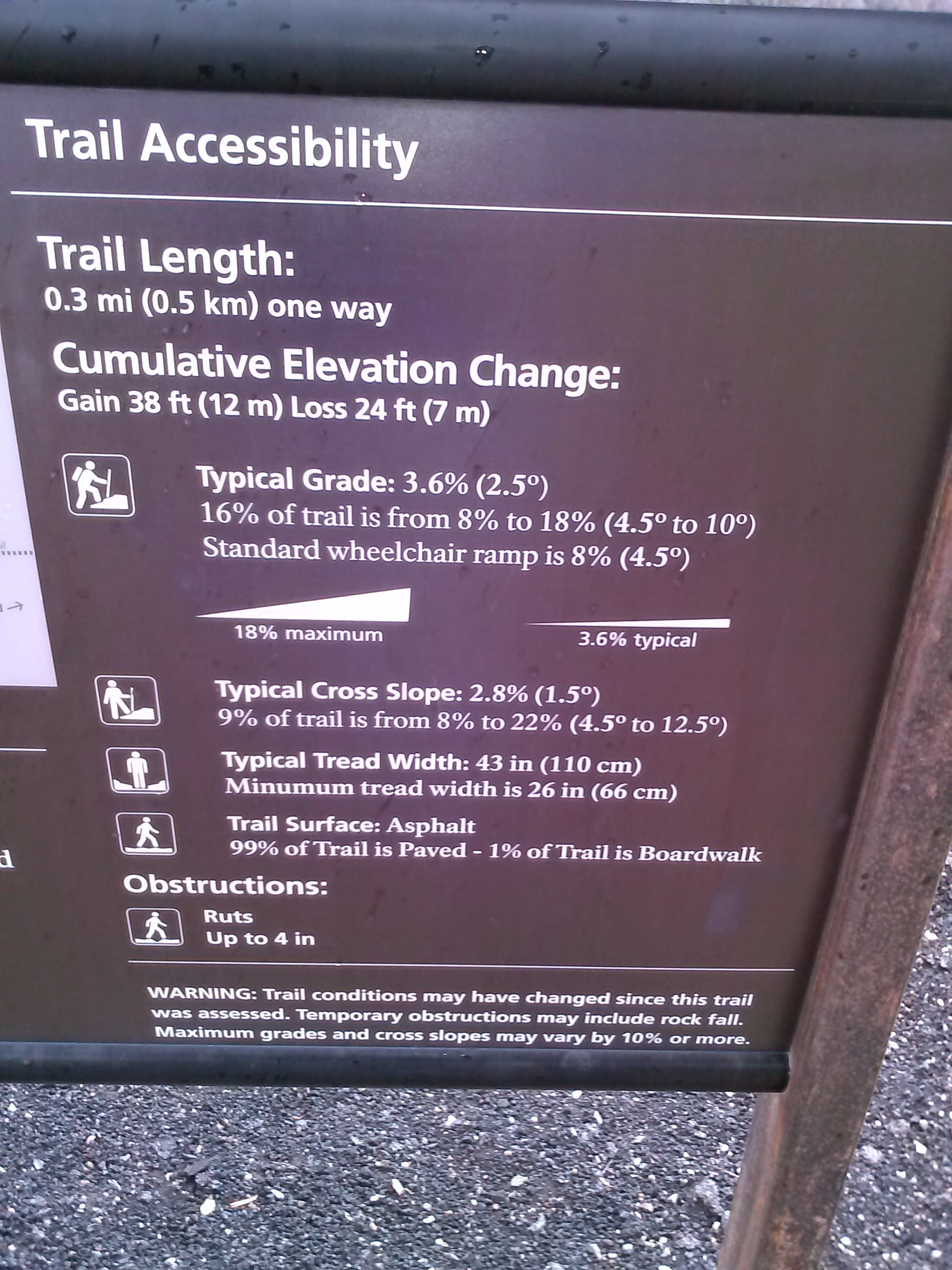
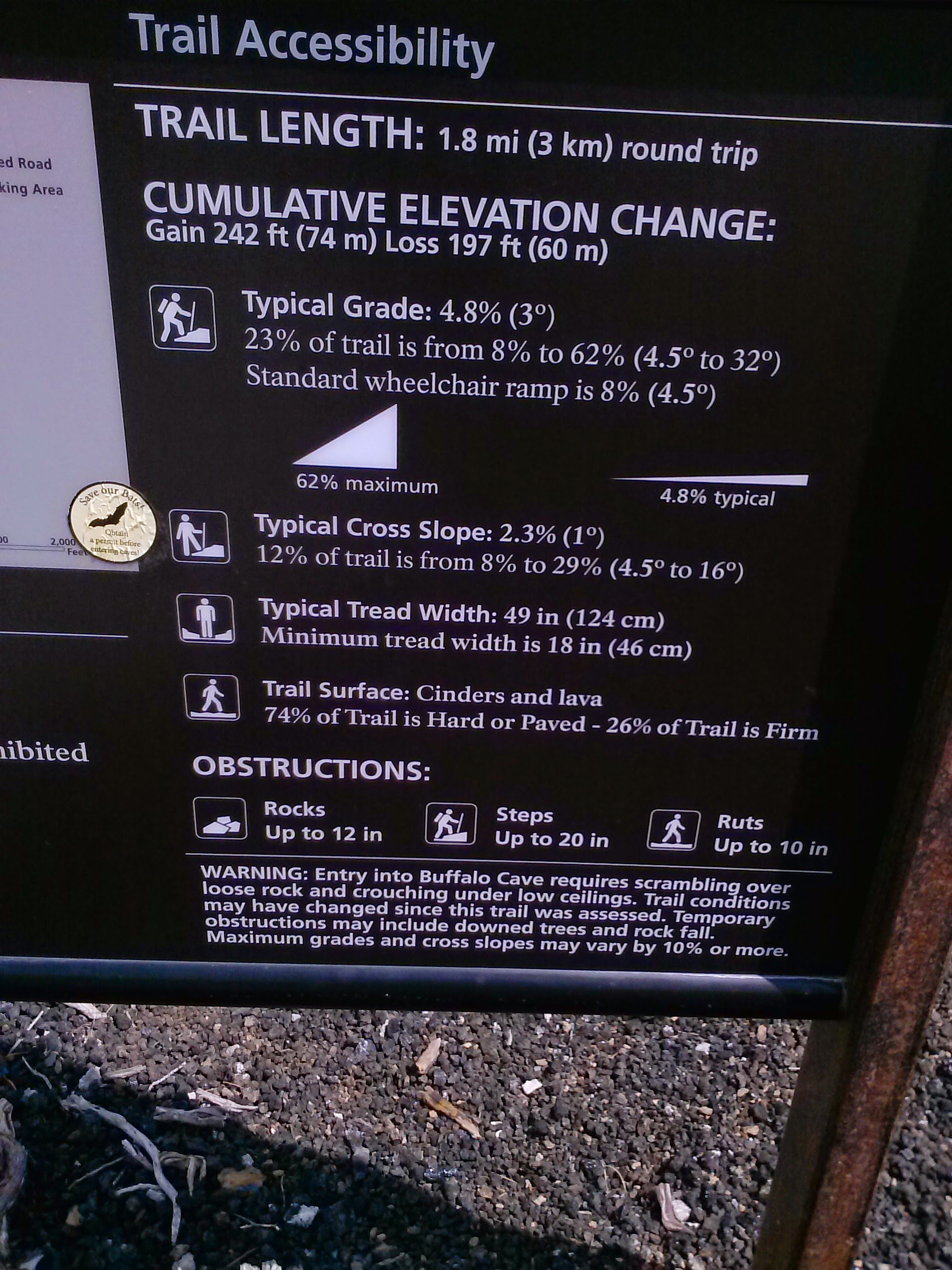
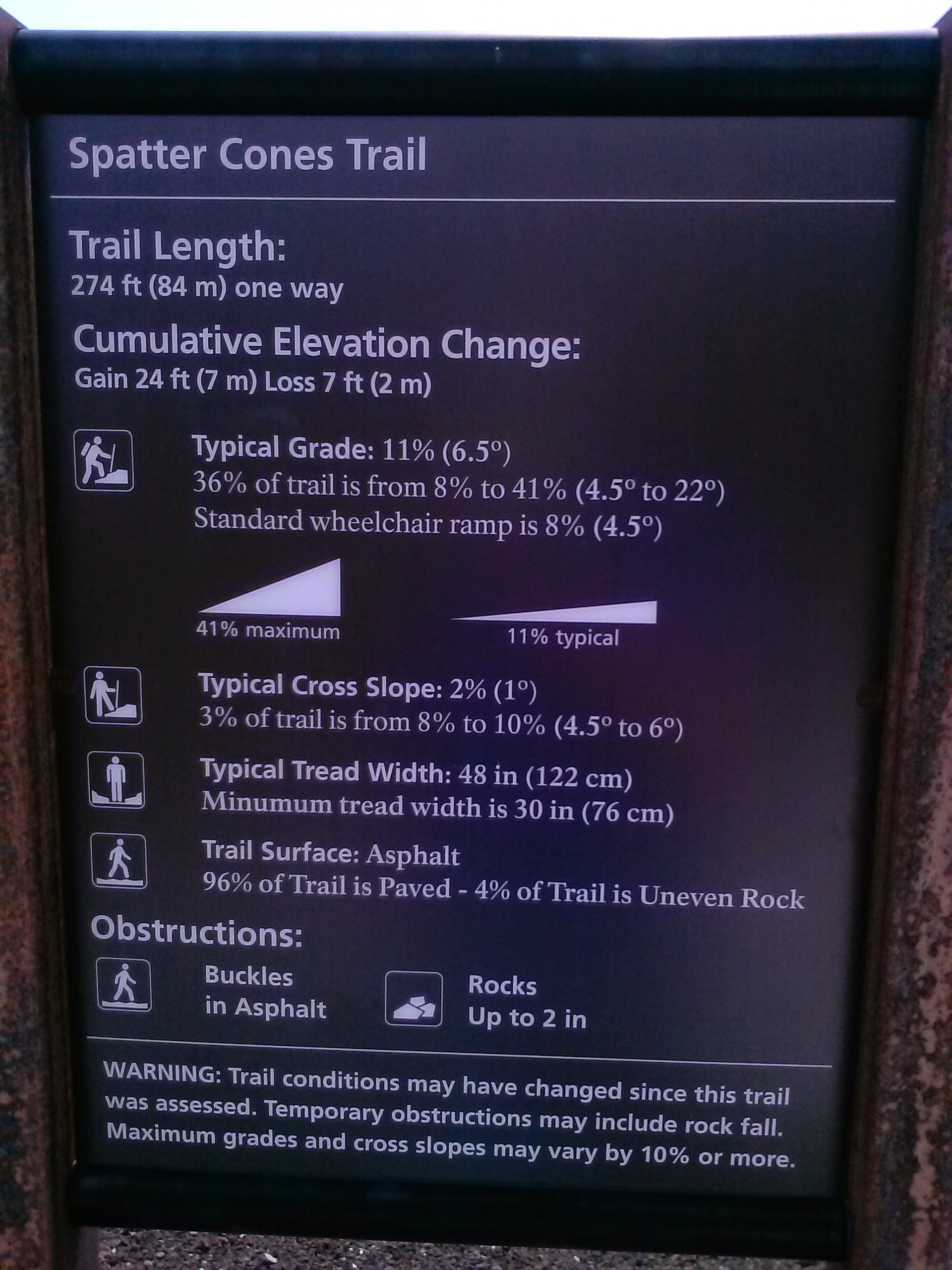
Last summer, I went on vacation out west to see some National Parks (Yellowstone, Glacier, Craters of the Moon). At Craters of the Moon, all the trails had these lovely signs talking about how steep they were – since one of us hikers had a bad knee, we needed to make sure the trails weren’t too tough. What’s interesting is that they didn’t just talk about the average grade, which many hiking books do (as we learned to our chagrin in Glacier), but also the maximum and minimum. I feel like this is a good opportunity to talk about average rate of change versus instantaneous.

Later on in the trip, we had a discussion about what it means if a trail is twice as steep as another one. If I told you the the next trail is twice as steep as this one, what would you expect? What would it feel like? Then we also talked about whether we were doubling the slope or double the angle. That distinction is tricky because, for angles less than 10°, which are the most common, the difference between doubling the slope or doubling the angle (up to 20°) is less than 1% extra grade.

Anyway, there’s a lot of data here, so I pose to you: what could you do with this?

CAM00368 CAM00367 CAM00365 CAM00364 CAM00363 CAM00362 CAM00359

In my intro-level computer science class, we spent the last two weeks before break investigating sorting algorithms and search algorithms. However, because we were kinda burnt out of Java, I decided to do it computer-free. We used small decks of cards instead. To simulate the computer only comparing two values at a time (to limit the kids using their more powerful brains to speed up the process), students were only allowed to move cards that were face-up, and could only have two cards face-up at a time. The first day I had them come up with their own algorithms and count how many steps it took them, steps being flipping a card or moving a card.

In the subsequent days, I wrote up several common sorting algorithms as they would be applied to the cards. For each of them, we kept track of how many steps the process took, which was always the same for some (Selection) but we had to think about best and worst cases with the others.

We then considered how many steps they would take for 4 cards, 5, 6, 7, 8, then n. And so we wound up creating functions to represent the complexity of the algorithm. Many of these wound up being quadratic and linear functions. All of my students had previously taken Algebra and none had problems with the linear, but the quadratic functions sometimes caused problems. But we would work what exactly changes each step, find second differences, etc, to create the functions. And no one thought this was a weird place for quadratic functions to come up – it just seemed like a natural thing that arose when we started investigating the algorithms.

Below I attached the algorithms I wrote up for the sorts. Go get a set of 8 cards and try them out. Can you figure out the function? (Note: for the Worst Case of the Merge Sort and the Quick Sort, it’s a recursive function that doesn’t necessarily have a nice explicit form.)