Trying to find math inside everything else

Archive for the ‘geometry’ Category

Anagrams and Quads

In geometry we’re learning about the correspondence of congruence statements (i.e. ∆ABC ≅ ∆DEF means that A maps to D, BC = EF, angle CAB ≅ angle FDE, etc). One fun type of problem you can do with this is a self-referential congruence statement to highlight symmetry. For example, if LIMA ≅ MALI, what type of quadrilateral is it?

So the first question I had was “How many of these types of problems can you have?” The answer is not just the same as how many ways there are to arrange 4 letters (4!), because you still need to connect the four points in the same order (although you can change whether you go clockwise or counterclockwise). So if our starting ordering is 1234, you can have the following orderings:

1234IdentityOPTS
2143Isosceles TrapezoidPOST
2341SquarePTSO
3412ParallelogramTSOP
4123SquareSOPT
1432KiteOSTP
4321Isosceles TrapezoidSTPO
3214KiteTPOS

(As a side note, how do you solve these problems? You can list out all the sub-congruencies and mark up a diagram. But I like to think of the mapping of points and determine what transformation that would be. For example, with OPTS to POST, P and O switch places, and S and T switch places, so it must be a reflection with the line of reflection down the middle of lines PO and ST. This makes an isosceles trapezoid.)

I picked OPTS as a starting point because it’s the four-letter work with the most anagrams (OPTS, STOP, SPOT, POST, POTS) so I figured some would should up in this work and was surprised there was only one. But then I realized that which one I start with matters: if I start with OPTS, only POST is a valid shape, but if I start with STOP, then SPOT and POTS are valid.

So then I went through a list of four letter anagrams to find more that fit the patterns I need above. Below is a non-comprehensive list you can use for these types of problems if you, like me, like using words instead of just ABCD.

2143MANEAMEN
2143ACTSCAST
2143TIMEITEM
2143SUREUSER
2341EMITMITE
2341MITEITEM
2341EACHACHE
2341ABETBETA
3412MALILIMA
3412EMITITEM
3412ARTSTSAR
3412REPOPORE
3412CODEDECO
3412DEMOMODE
3412GOERERGO
4123ALESSALE
4123LOTSSLOT
4123OPENNOPE
1432BETABATE
1432DEMODOME
1432MATEMETA
1432GORYGYRO
4321ABUTTUBA
4321TIMEEMIT
4321RATSSTAR
4321BARDDRAB
3214AGEDEGAD
3214TIMEMITE
3214RATSTARS
3214MANENAME

If you have more anagram suggestions, leave them in the comments!
Lessons from NCTM, Part I

Oof, well, I certainly meant to write this up sooner, not almost a full month later, but it felt like it took this long just to feel caught up from having missed those three days! That’s definitely a struggle with the conference timing. Anyway, I figured I’d go through some of the sessions I went to, and my notes, as a way to debrief myself but also share any gems I picked up.

Two Students, One Device

I missed the beginning of this session because I went to two other ones first, neither of which worked out, but I knew Liz (Clark-Garvey) wouldn’t let me down (as well as Amanda Ruch and Quinn Ranahan). I’ve used the practice of two students on one device before, but I realized it was natural to do it back when I was at a school where we were using class carts of laptops/tablets, so I could just give one per pair. Now I’m at a school where everyone has their own device, so making them pair up needs to be a more intentional move, and it’s easy to default to not doing that.

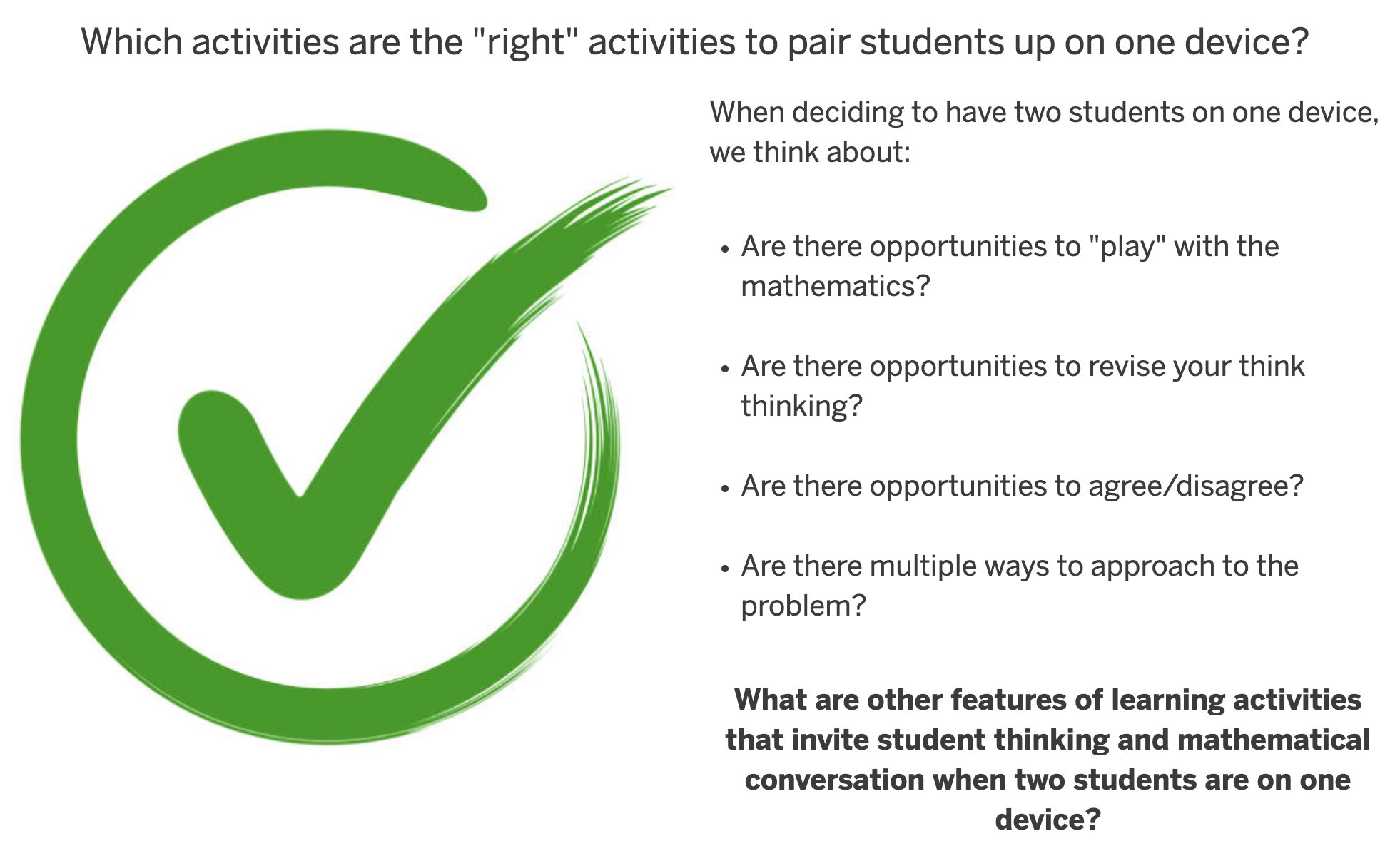
So then the question is, when to do it? If students are doing practice problems on DeltaMath, that doesn’t need to be paired. This is the slide the presenters had for this:

But they also talked about how just choosing the right activity isn’t enough, so other strategies are useful. For example, setting norms such as “type other people’s thoughts, not your own” or mixing up the groups and having them revise their responses.

Fawn

Sure, I could use the title, “Helping Students Become Powerful Math Learners,” but really this was the Fawn session. (Or should I say “The legendary Ms. Nguyen”?) The first quote I wrote down was “The pacing guide does one thing for me – it tells me how behind we are.”

Fawn had four maxims to follow:

  1. Ask students to seek patterns and generalize
  2. Ask students to provide reasoning
  3. Build fluency
  4. Assign non-routine tasks

One routine that stuck out was an open middle-type problem. We had to create the largest product using 5 numbers, 3-digit times 2-digits. Fawn had us all share our possibilities, and then we discussed which possibilities we could remove – someone would nominate one, explain how they knew it wasn’t the greatest (often because it was strictly less than another), and it would be removed only if there was 100% consensus. Then we could narrow it down before we ended up checking the top two choices.

Another thing of note was about the non-routine tasks and games: in particular, they should be non-curricular. This doesn’t mean not based on your curriculum at all, but rather not based on what they just did. This makes sense, as if they are always using the skill they just learned, that turns it into a routine, and thus won’t have the same benefit.

Just Civic Math

I don’t have that many notes from this session, and I don’t see any slides attached on the NCTM website. One note says “Limiting civics to just ‘social justice math’ is restricting. Dialogic math helps.” I think the idea here is similar to what I’ve used before, Ben Blum-Smith’s Math as Democracy. Jenna Laib’s Slow Reveal Graphs were mentioned, and I mentioned the similar graphs.world to the presenter. They also mentioned the book “Constitutional Calculus” which I will look into in the future.

Miscellaneous

Two notes I took on the patty paper session: use felt pens to be more visible on patty paper, and when folding, pinch from the middle and press outwards (more likely to get accurate folds on lines then).

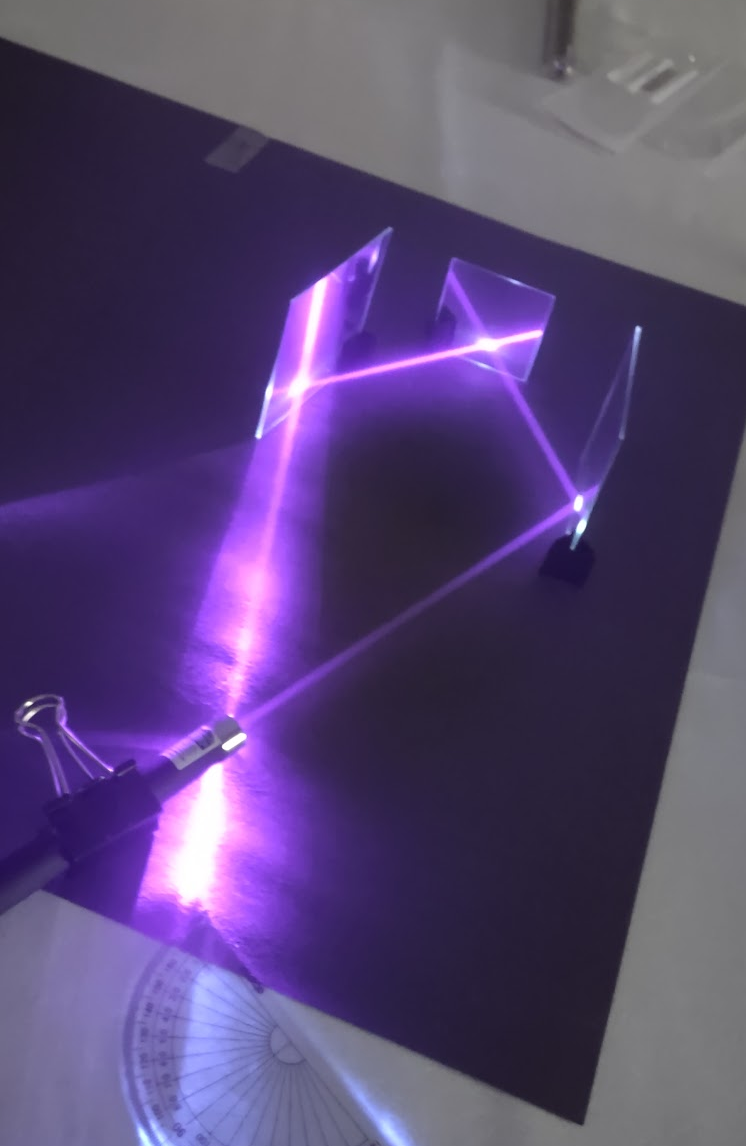
I went to a really cool session on making art using mirrors and laser pointers from Hanan Alyami. Here’s the kite my group made in the time:

The project seemed cool and had some fun math, but I also don’t know when I could fit it in, as it’s a 3-day process.

I tried to go to John Golden’s session on games but it was full! I went to Christopher Danielson’s session on Definitions. Two things stuck out to me there: his reasoning for originally doing a hierarchy of hexagons was that it fought against status issues, since there was no pre-knowledge as with quadrilaterals; when asking if something is a vehicle, something that is so far from one, like a salad, just makes it a fun question, but something closer to an edge case, like a broken bus with no wheels, is harder and more contentious.

Okay, I was gonna keep going, but that seems like a lot – and that was all just Thursday! So maybe I’ll do separate posts for Friday & Saturday.

Knowing, Doing, Being

When I started at my current school two years ago, one of the first conversations I had with my coteacher (Sam Shah!) was about grading, and coming to a compromise on our different grading systems. Often teachers will break down grades into categories, the weights of which can vary. But during that conversation I came up with what I thought of as the supra-categories, which I now use for all of my classes.

The first is Knowing Mathematics. In a standards based grading system, this would be the standards for content knowledge. In a traditional grading system, this would include things like tests, quizzes, projects, presentations, interviews – anything that shows what the student knows about the math itself.

The second is Doing Mathematics. In SBG, these would be process standards. In a traditional system, this might be classwork & homework, or class participation. I evaluate this typically with a portfolio of student work. (More on that below.)

The third is Being Mathematicians. I was doing Knowing/Doing before this, but this third category was how to incorporate some of what Sam had been doing with his portfolios, that I loved (and served a different purpose than mine). The assignments are about reflecting how the student fits into mathematical society – both on a small scale (in the class, reflecting on groupwork) and a larger scale (learning about other mathematicians, especially those from underrepresented populations, and about other mathematics outside of the scope of the class). This is also evaluated with a portfolio.


I first wrote about my portfolios in this post, and the general idea there still applies to my Doing Mathematics portfolio, but the structure is different.

Now I do the portfolio as an ongoing Google Slide. You can see the template for the portfolio I used for Calculus last fall here. Our school has a 7-day cycle, and once a cycle we have a double-period. So for that class, in the second half of the double I’d have a quiz about that cycle’s content (counting for Knowing Mathematics), and then afterwards they would work on their portfolio, picking one piece of classwork and one piece of homework from the cycle to reflect upon and include. This let me keep on top of the grading of the portfolio better than saving it for the end of the quarter/marking period, and also made it easier to make sure the portfolio was actually a collection of their work from the whole semester. They had to do two pieces per habit of mind, although usually I would wind up with only 16 done for the semester, not 18, to have a little wiggle room (because it’s hard to get them all). To make up for that, I include two extra slides for the work they were most proud of that quarter.


The Being Mathematicians Portfolio has a wider variety of assignments. Some will be reflections on how they work with their peers:

Some will be about mathematical debates:

Some will be learning about mathematicians (usually from underrepresented groups) or mathematics from underrepresented cultures.

Sometimes news in the math world, or other modern mathematics:

Sometimes about what it even means to do mathematics:

Students will occasionally get these as homework assignments, and we’ll usually discuss them the next class. (I’d like to be more consistent about it, as I am with the Doing Math – maybe that’s a goal for this year.) I’d also gladly take suggestions for assignments in any of these categories, or if you think there are subcategories I didn’t really hit on!

Here you can find the entire year’s worth of BM Portfolios for Geometry and Calculus. (About half of the slides were made by Sam. Wonder if you can guess which are made by whom!)

Slopes and Lattices Game

Okay, here’s a game I came up with off the cuff today. It kinda worked, but I guess if other people tried it and gave feedback, that’d be swell.

Players: 2 (or 2 teams), each with two colors

Board: A 10×10 grid.

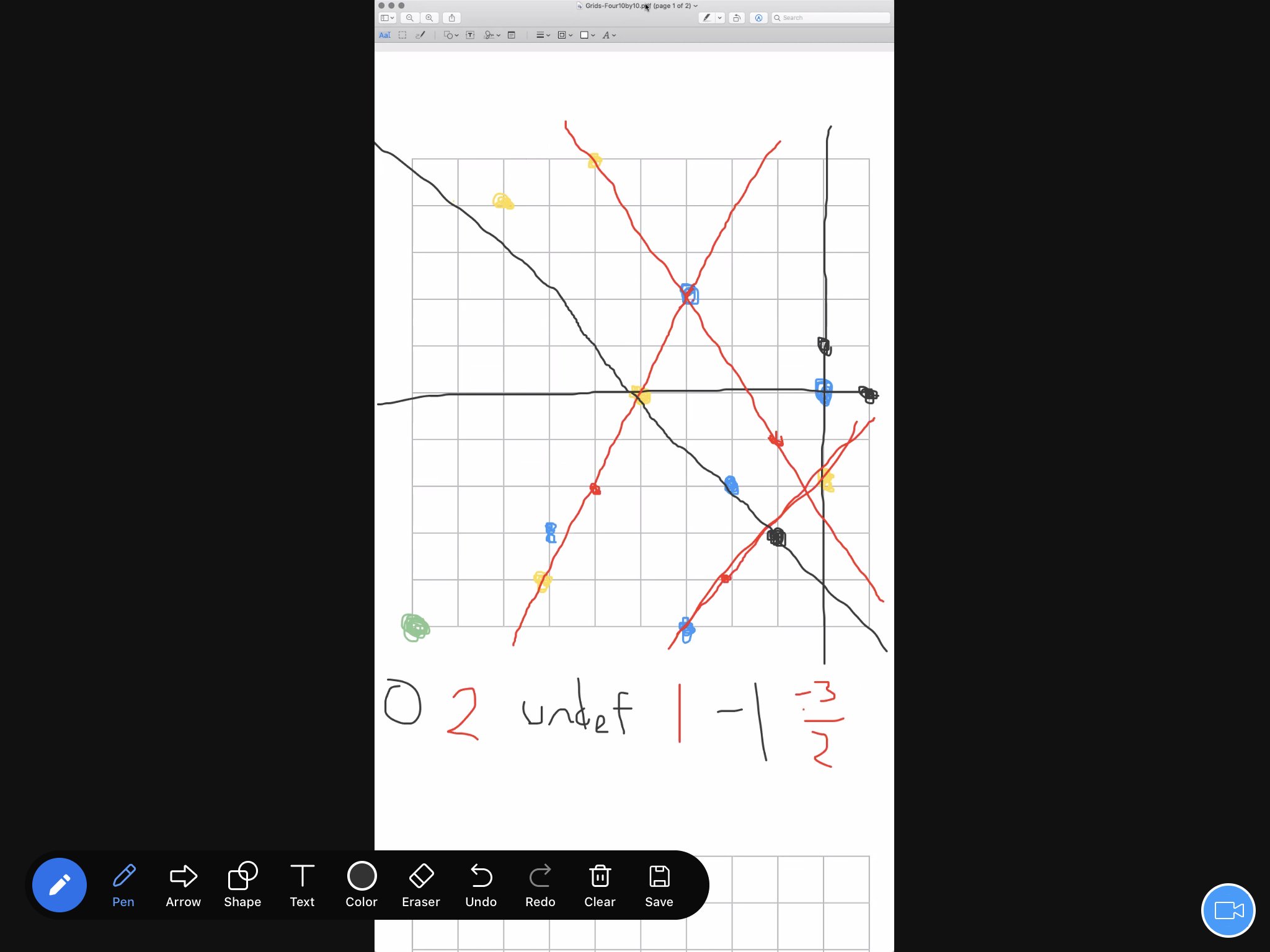
The game is played in two phases. In the first phase, each team takes turns placing points on the grid, until each team has placed 5 points. The origin always is claimed as a neutral point. Every point has to be on a lattice point. (In the example below, I was blue and my student was yellow.)

In the second phase, on their turn, each player may place a new lattice point and form a line with one of their original 5 points. If that line then passes through one (or more!) of the opponent’s original 5 points, those points are stricken. If one player can strike out all of the other player’s points first, they win. (If not, then whoever strikes out the most.)

There is one caveats to round 2 – when a line is drawn, determine the slope of that line and write it below. That slope can’t be used again.

Image
A game in progress. I was blue&red, and have struck out 4 of my student’s points. They were yellow&black and have struck out two of mine. It’s their turn.

After playing the first time, it became clear that much of the game came down to placing the points. If you could place one of your points so it was collinear with two of your opponents, you can strike them both with a single line. (But this only works if there is space for a 4th, alternate color point in phase 2 to form the line.) You also want to place your points defensively, with weird slopes that don’t pass through a lot of lattice points, to keep them safe. The second player definitely has an advantage when placing points, but the first player has an advantage when drawing lines, so I’m hoping those balance out.

Thoughts?

The Secret of the Chormagons

(Doesn’t that title sound like it should be a YA fantasy book?)

I shared this Desmos Activity Builder I made on Twitter, but never wrote a post about it. Oops! Let’s do that now.

First, here’s the activity.

This activity is basically adapted from Sam’s Blermions post that I had helped him think about but he did all the hard work of creating questions and sequencing them. I’ve used the blermion lesson in the past and it went well, but that last part lacked the punch I was hoping for, having to work with analog points and compiling them together myself. But then I thought – wait, Desmos AB does overlays that will do this beautifully, if I can just figure out how to get the Computation Layer to do what I want. So I set to it.

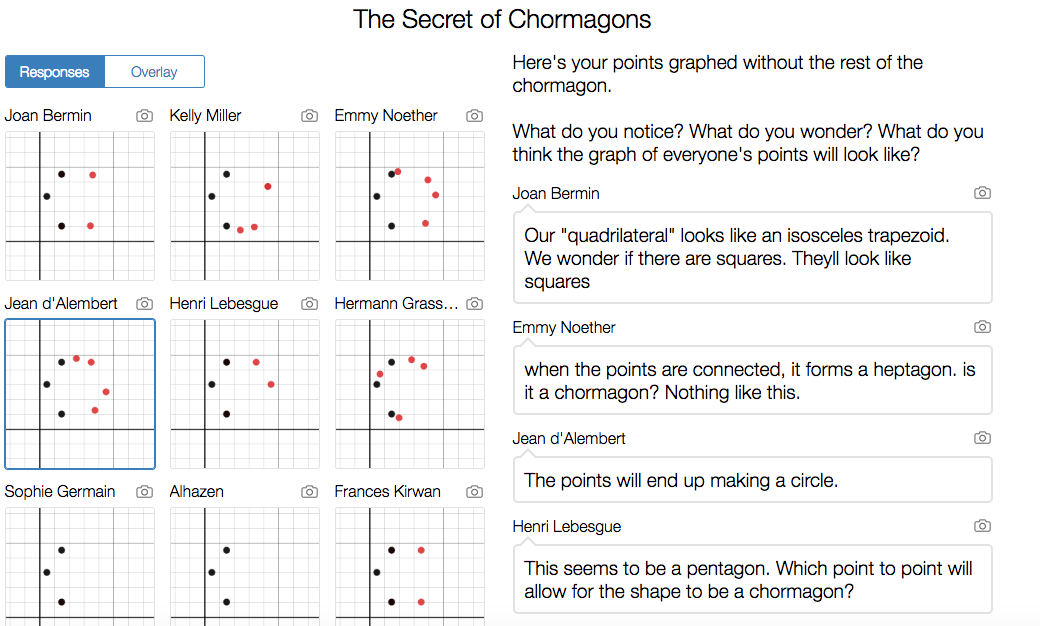
The pacing helped pause things to conjecture about what chormagons are – I stopped them at slide 5 so they can make those conjectures. I then advanced the pacing to 6 for the “surprise,” and 7-8 to make further conjectures. Look at some of theirs below.

Screen Shot 2018-08-02 at 12.30.13 PM

Even showing them everyone’s, I tended to get conjectures about the shape their points make – a trapezoid, a pentagon, a heptagon, etc. (One person seemed to guess the truth, but that was uncommon.)

Then I showed them the overlay.

Screen Shot 2018-08-02 at 12.31.05 PM

I saw at least one jaw literally drop, which totally made my day. We talked about why it might be a circle, and what that means for these shapes, then I introduce the proper terminology “cyclic quadrilaterals.” (I taught this lesson as an interstitial between my Quads unit and my Circles unit.)

Speaking of proper terminology, you may notice I called them Chormagons here, as opposed to Blermions. That’s important – Blermions is very google-able, it leads right to Sam’s post! But Chormagons led them nowhere. (And they were so mad about that!)

Now Chormagons will lead right here. So this is an important tip if you use this DAB: make sure you change the name of the shape!

One Problem, Eight Ways

I had a pretty good lesson recently that I wanted to share. It was at the end of my quadrilaterals unit, and so we were working on coordinate proofs. I love coordinate proofs because you can get so much information from just a pair of coordinates, which lends itself to lots of different ways of solving the same problem. Add to that how many different ways there are to prove something is a square, and we have the start of something good.

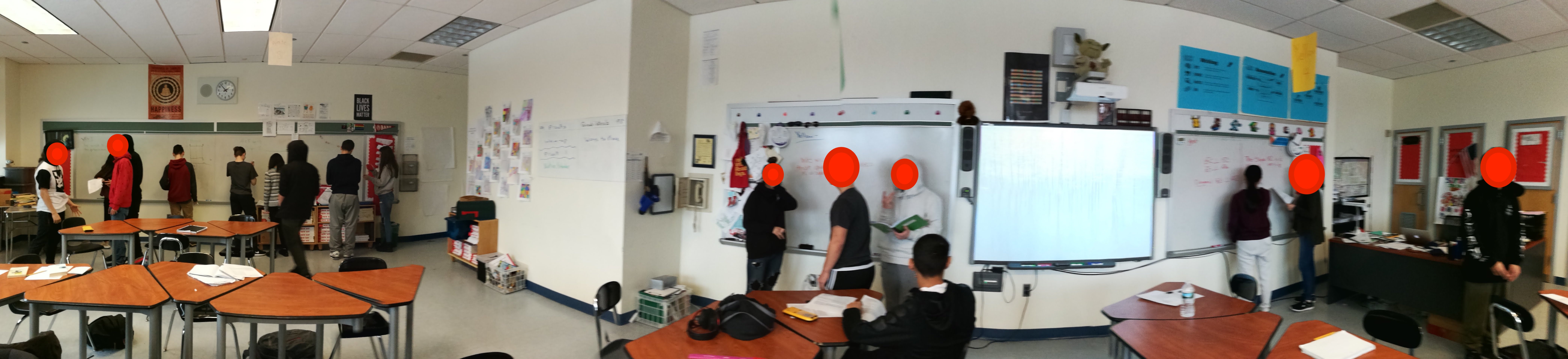
I gave the students the above sheet, starting off with some noticing/wondering about the graphed figure. Then I assigned each table a different method to prove that the quadrilateral is a square. Each group was off to their whiteboards to get started.

IMG_20180308_135259 (1)

It was really great to see each group discussing the problem so intently, and it reminded me how easy it is to facilitate discussion when up at the vertical whiteboards. Afterwards, the students went around in a gallery walk to compare their proofs to the other methods. They analyzed how they were similar, how they were different, and thought about which method they might prefer in the future. (Some comments included things like preferring method 2 because it only involved slopes, even though it involves more lines.)

The whole lesson went so smoothly and had tons of intra- and inter-group discussion. Need to use the structure again.

The Great Geometry Review

Since Kate asked us to post more unsexy things, I thought I would throw up this review book I made for geometry, which basically covers all the things students should “know” (not necessarily be able to do, or deeper understandings) for the course, especially for the NY Regents (Common Core). The students can fill in the blanks and are then left with a nice study guide. So far my students seem to like it! (Although one student said they wouldn’t do it if they didn’t get a grade for it – so frustrating!

Great Geometry Book (doc)

Great Geometry Book (pdf)

Natural Circle Measures

Yesterday I introduce radians to my students for the first time. I started out by asking why they thought a circle had 360°. There were a few good answers – four right angles makes a circle, so 4*90 is 360; a degree is some object they measured in ancient Greece, and so a circle was made of 360 of them; something to do with the number of days in the year. All good answered, but I told them it was completely arbitrary based on the Babylonian number system.

Once we decided that it was arbitrary, I asked them to come up with their own method of measuring a circle. I would classify their responses into three categories

  1. Divide the circle up into 200 “degrees” (most common)
  2. Divide the circle up into 100 “degrees”
  3. Divide the circle up into 2 “degrees” (least common)

I was expecting 100 “degrees” to be the most common, so I was very surprised to see that most of the students want to split the circle into two sections, each with 100 parts.

I have been a proponent of tau for a while, as I thought it was natural to think of radians as pieces of a whole circle, but my students were clearly thinking of the circle as two semicircles right off the bat.

I pushed the students who came up with the third way in a whole class discussion. If this whole semicircle is one student-name-degree, what would you call this section? And so we got to using fractions of those degrees.

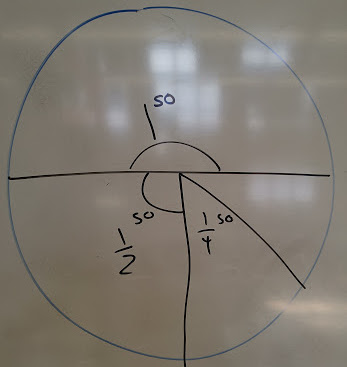
20160412_152234_HDR.jpg

That made a pretty easy transition into radians. I went a little into the history; instead of using a degree, some mathematicians decided to use names based on the arc length – and so that semicircle’s angle was 1 π radians, instead of 1 student-name-degree. And the fractions we used were the same.

This almost made me doubt my tau ways – maybe π was more natural. But then, as we started converting angles from degrees to radians, some students kept complaining that, for example, 90° was 1/2 π instead of 1/4, since it was clearly a quarter-circle – so maybe I can stay a tau-ist.

Angle Chasing

On Friday our school was supposed to have a Quality Review, but it was canceled at the last minute. (That’s a whole ‘nother story.) But that pushed me to do a lesson that I probably wouldn’t’ve done otherwise, so that’s good. I actually think it went pretty well.

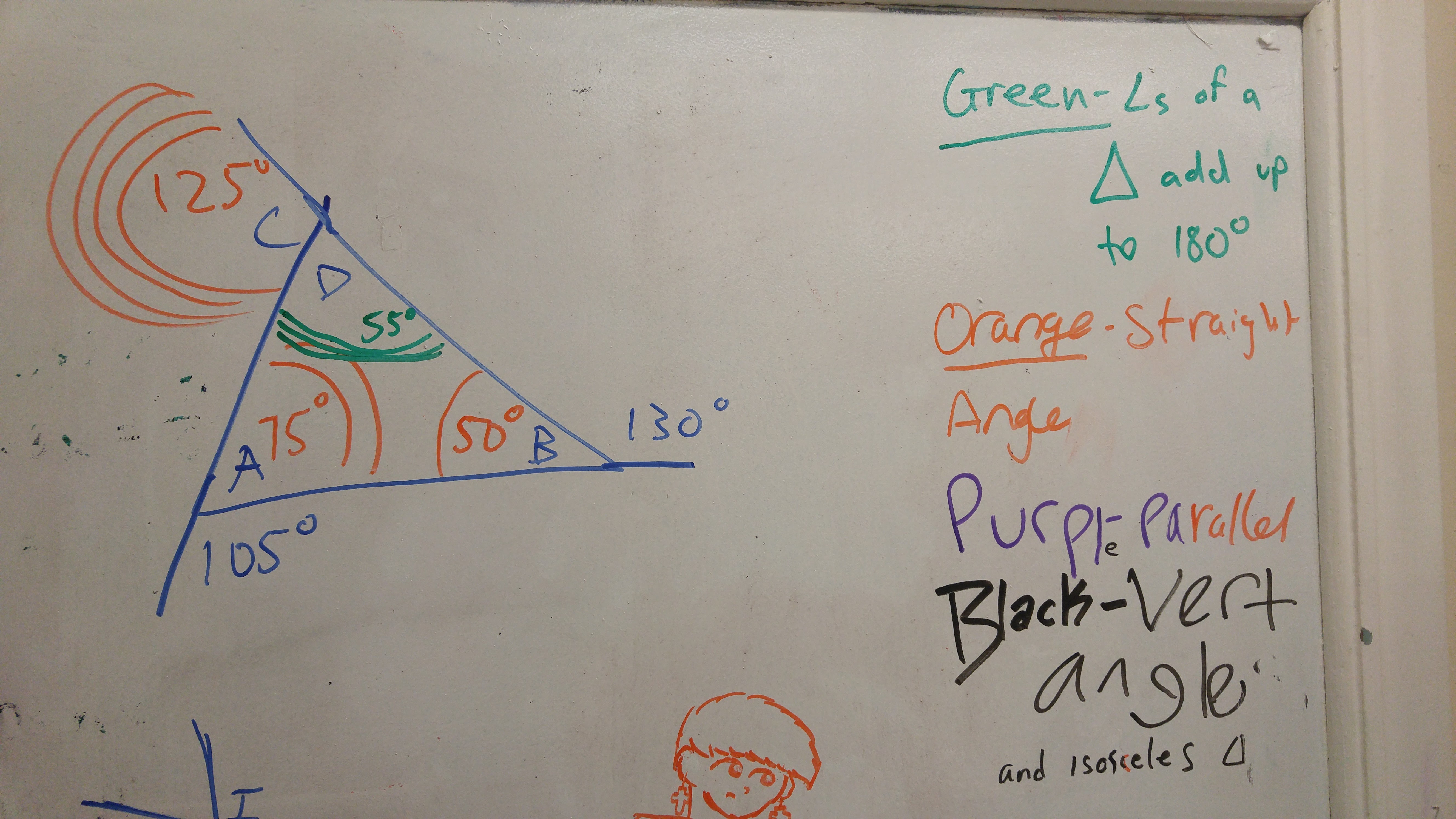
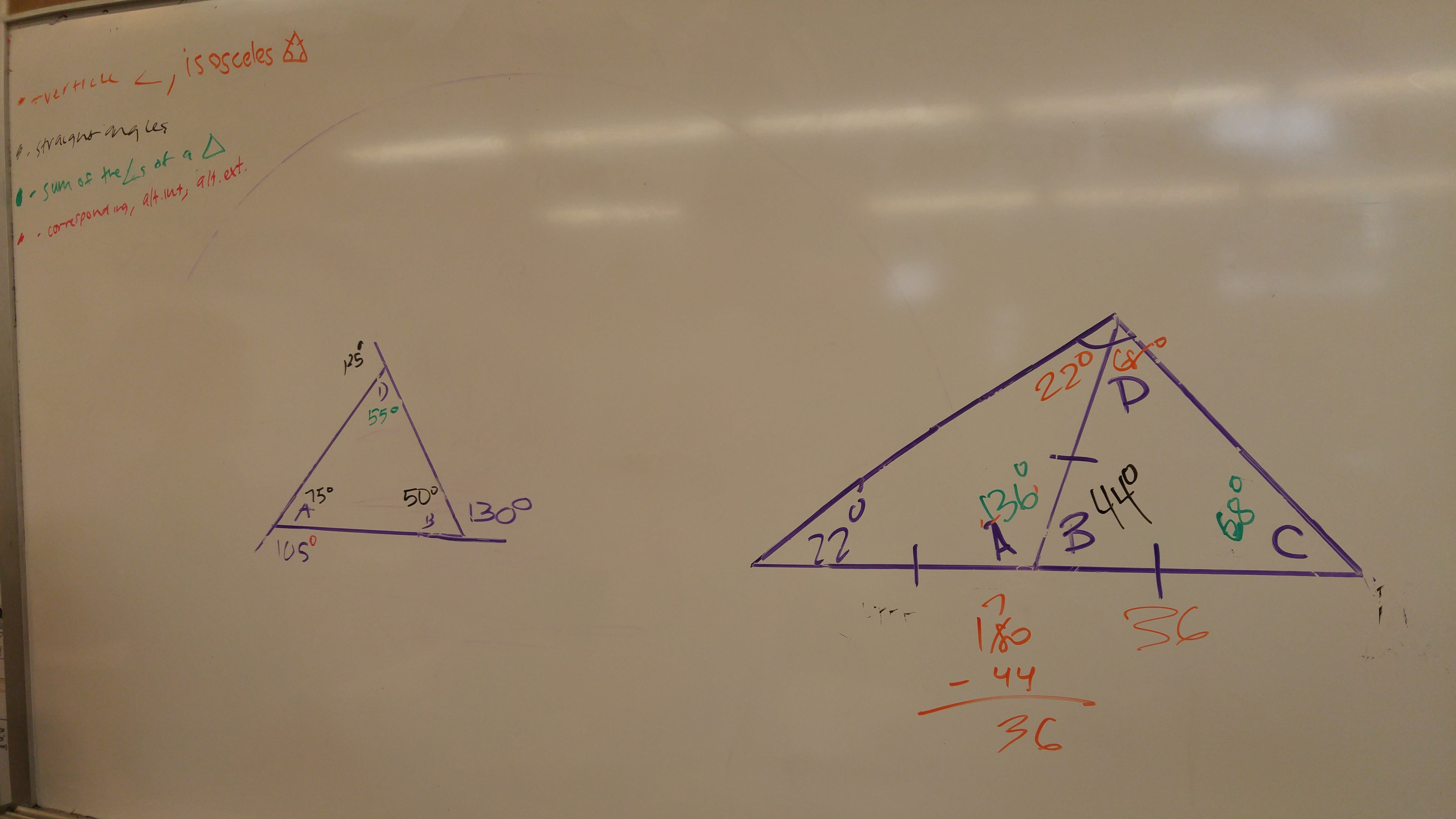
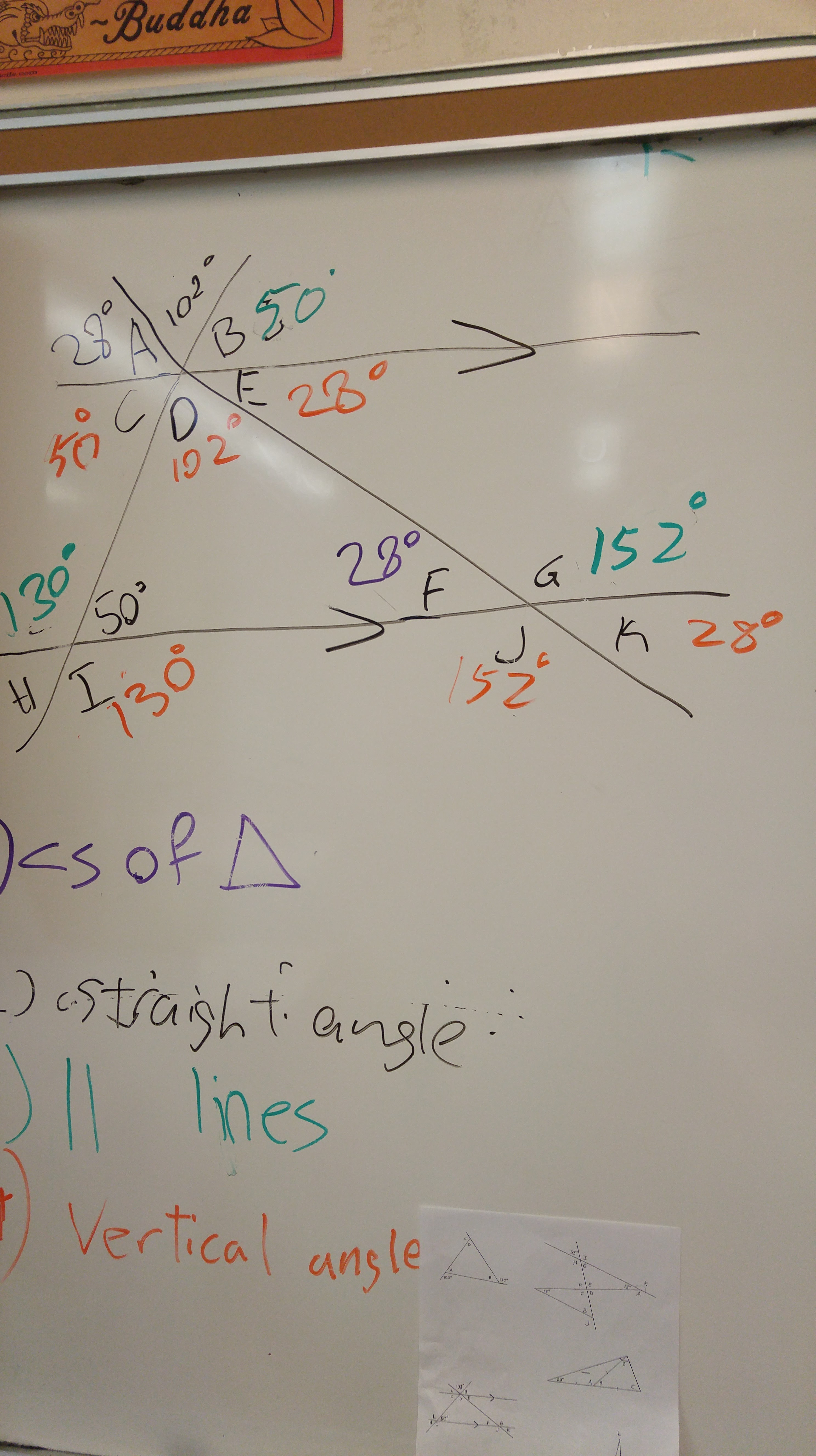
I noticed in our last exam that I should probably explicitly teach angle chasing as a problem solving strategy, so I asked the MTBoS for some good problems. Justin Lanier came through in the most wonderful way. So I picked out some problems into a nice sequence that would use a bunch of the theorems we’ve already done.

I wanted the students to work as a group up on the whiteboards, so I gave each person in each group a different color marker. I then had the students write a key in the corner. Each student’s color represented 1-3 of the theorems that they would have to use to solve the problems. Then they would draw up the diagram of the problem. As they went through, each person was only allowed to write when their theorem was used to deduce the measure of the angle. That way, with the colors, I could actually trace through the thought processes they used to solve the problem, which was really nice. (I wonder if I can use that as an assessment some how, having students trace through the same process. Maybe as a warm-up, once I get my smartboard working again.)

Here’s some pics of their great work.

20151211_133820 20151211_134150 20151211_134918 20151211_135139

Quadrilateral Congruence

Stressful as it is, I am loving teaching new courses. When I first start teaching, I felt like I was learning new stuff all the time, stuff about algebra (and how it connects to other courses) that I didn’t know I didn’t know, and now it keeps happening with geometry, especially with the more transformational tinge CC geometry has.

One of the things that struck me was, last week, when I used this Illustrative Mathematics task as a follow-up to my lesson about the diagonals of quadrilaterals. I feel like the understanding I had internalized that you can prove triangles congruent with less information because they are rigid structures, but quadrilaterals are not, so there are no quadrilateral congruence theorems. But I realized that’s not true.

Last time, we constructed all of the special quadrilaterals by taking a triangle and applying a rigid motion transformation. That meant that every special quadrilateral can be split into two congruent triangles. Therefore, if you had enough information to prove one pair of triangles is congruent, you could prove the whole quadrilaterals are congruent.

Parallelogram SSSS

So if we’re looking at SSSS in terms of the triangles, we really only know two sides of the triangles. Since that’s not information to prove the triangles congruent, then it’s not enough for the parallelograms. But SAS is enough for the triangles, so it’s enough for the parallelograms.

Isosceles Trapezoid SSA

Here’s a non-parallelogram example. Here are two isosceles trapezoids with the same diagonals, same legs, and the same angle between the diagonals and one of the bases, but the trapezoids are not congruent. But that’s because, when you look at the triangles, we have Angle-Side-Side, which we all know is not a congruence theorem. If, instead, we had had SSS (a leg, a base, and a diagonal), then they would be congruent.