Trying to find math inside everything else

Archive for the ‘conference’ Category

Lessons from NCTM, Part I

Oof, well, I certainly meant to write this up sooner, not almost a full month later, but it felt like it took this long just to feel caught up from having missed those three days! That’s definitely a struggle with the conference timing. Anyway, I figured I’d go through some of the sessions I went to, and my notes, as a way to debrief myself but also share any gems I picked up.

Two Students, One Device

I missed the beginning of this session because I went to two other ones first, neither of which worked out, but I knew Liz (Clark-Garvey) wouldn’t let me down (as well as Amanda Ruch and Quinn Ranahan). I’ve used the practice of two students on one device before, but I realized it was natural to do it back when I was at a school where we were using class carts of laptops/tablets, so I could just give one per pair. Now I’m at a school where everyone has their own device, so making them pair up needs to be a more intentional move, and it’s easy to default to not doing that.

So then the question is, when to do it? If students are doing practice problems on DeltaMath, that doesn’t need to be paired. This is the slide the presenters had for this:
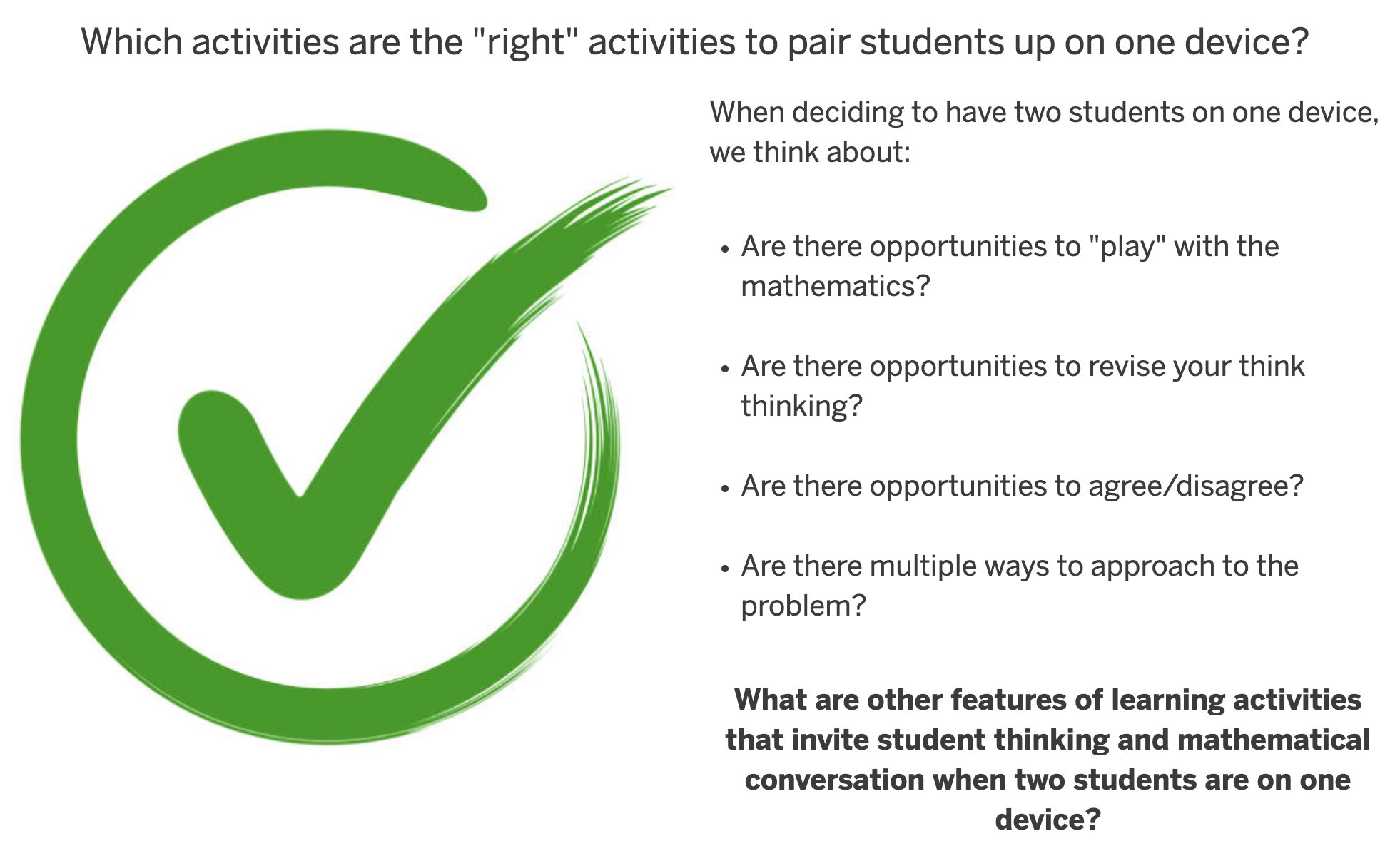
But they also talked about how just choosing the right activity isn’t enough, so other strategies are useful. For example, setting norms such as “type other people’s thoughts, not your own” or mixing up the groups and having them revise their responses.

Fawn

Sure, I could use the title, “Helping Students Become Powerful Math Learners,” but really this was the Fawn session. (Or should I say “The legendary Ms. Nguyen”?) The first quote I wrote down was “The pacing guide does one thing for me – it tells me how behind we are.”

Fawn had four maxims to follow:

  1. Ask students to seek patterns and generalize
  2. Ask students to provide reasoning
  3. Build fluency
  4. Assign non-routine tasks

One routine that stuck out was an open middle-type problem. We had to create the largest product using 5 numbers, 3-digit times 2-digits. Fawn had us all share our possibilities, and then we discussed which possibilities we could remove – someone would nominate one, explain how they knew it wasn’t the greatest (often because it was strictly less than another), and it would be removed only if there was 100% consensus. Then we could narrow it down before we ended up checking the top two choices.

Another thing of note was about the non-routine tasks and games: in particular, they should be non-curricular. This doesn’t mean not based on your curriculum at all, but rather not based on what they just did. This makes sense, as if they are always using the skill they just learned, that turns it into a routine, and thus won’t have the same benefit.

Just Civic Math

I don’t have that many notes from this session, and I don’t see any slides attached on the NCTM website. One note says “Limiting civics to just ‘social justice math’ is restricting. Dialogic math helps.” I think the idea here is similar to what I’ve used before, Ben Blum-Smith’s Math as Democracy. Jenna Laib’s Slow Reveal Graphs were mentioned, and I mentioned the similar graphs.world to the presenter. They also mentioned the book “Constitutional Calculus” which I will look into in the future.

Miscellaneous

Two notes I took on the patty paper session: use felt pens to be more visible on patty paper, and when folding, pinch from the middle and press outwards (more likely to get accurate folds on lines then).

I went to a really cool session on making art using mirrors and laser pointers from Hanan Alyami. Here’s the kite my group made in the time:
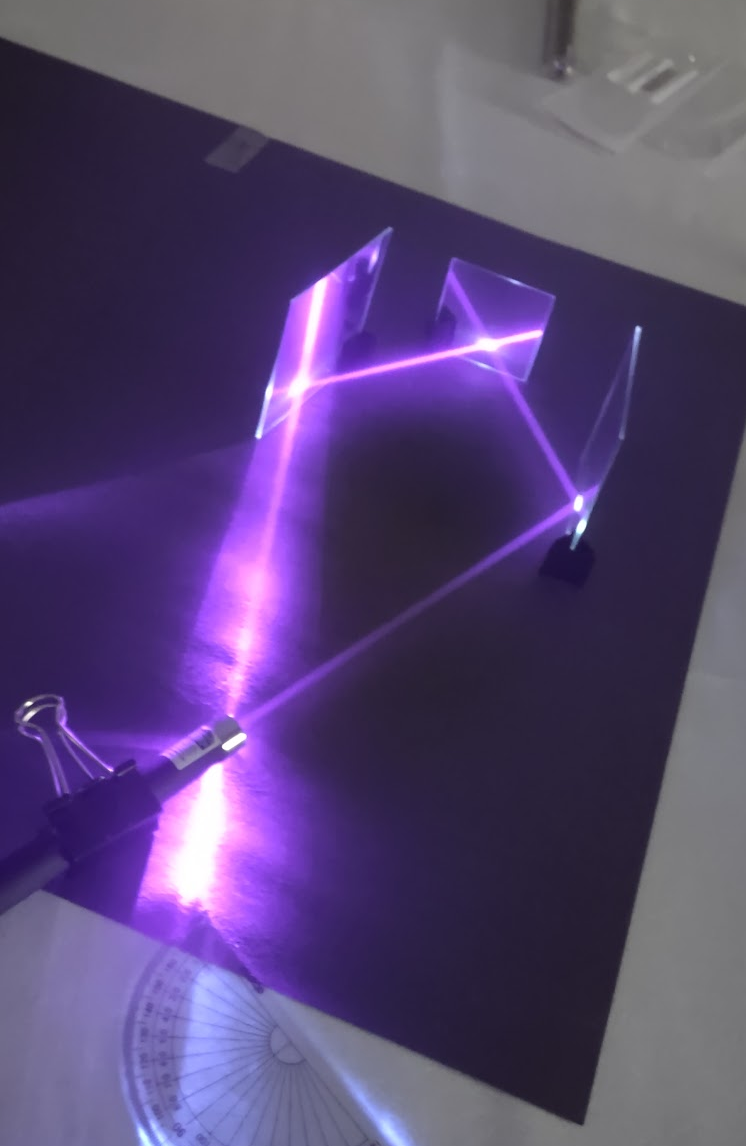
The project seemed cool and had some fun math, but I also don’t know when I could fit it in, as it’s a 3-day process.

I tried to go to John Golden’s session on games but it was full! I went to Christopher Danielson’s session on Definitions. Two things stuck out to me there: his reasoning for originally doing a hierarchy of hexagons was that it fought against status issues, since there was no pre-knowledge as with quadrilaterals; when asking if something is a vehicle, something that is so far from one, like a salad, just makes it a fun question, but something closer to an edge case, like a broken bus with no wheels, is harder and more contentious.

Okay, I was gonna keep going, but that seems like a lot – and that was all just Thursday! So maybe I’ll do separate posts for Friday & Saturday.

Thoughts on NCTM ’24

I’m on the plane Chicago right now, heading home from my first NCTM (and first conference since 2019). Here’s some top level thoughts I have.

  1. I really loved seeing some friends I haven’t seen in 5-6 years – but I don’t know how to answer “What’s new?” after that period of time. A lot! Plus I don’t know what you know from social media. And so then I’d sputter and think “Wait, do I not know how to talk to people? Have I forgotten?” But getting past those opening bits made it all work out.
  2. Sometimes I would go to sessions about things I already “knew,” but it was good to have a reminder, because 2019-2021 was such a big disruption in my teaching career that there were many things I used to do that got dropped, and I feel like I’ve been slowly piecing them back together the past few years. So it was good to go “Oh yeah, I used to do that” and commit to doing it again.
  3. On the other hand, I wish when sessions listed the intended audience, it would also be about whether it’s for beginners in that topic. The hot thing, of course, is Building Thinking Classrooms, but having learned about all of those things so long ago, I didn’t need to be pitched on how it worked in a session. Especially in a session that didn’t say it was doing that.
  4. I don’t often use an agenda in my class, but I really appreciated the speakers who did. This let me know when, if even, they would get to the meat. So many sessions would start with other things like intros, or bios, or reasons why, without any indication of what they actually did, so sometimes if it was 15-20 minutes in and we didn’t get to the point, it would be voting-with-feet time. But I could give more grace when I knew what was coming up. (Now, of course, students in school can’t vote with their feet, but what if they could? Would they still stay in your class?)
  5. One thing about the NCTM vibe, compared to other conferences I’ve been to, extends from the exhibition/vendor floor. But it’s not just the floor itself – it’s that so many people are there to output information or ideas. Every conference I’ve been to before has been bidirectional: all the speakers want to teach something, but also learn something. So having so many people talk as part of their job, without the learning part – feels icky. (I’m sure, of course, that many people who were there to speak as part of there job were also there to learn. But it didn’t feel universal.)

Oh, okay, that’s a good amount of thoughts. I do want to go into some specific things I learned and was amazed by in some of the conversations and sessions I participated in, but I think I’d need to reference my notes and such to do that, which is hard to do on this cramped tray table. Let’s just save that for next time.

Grading Talking Points

Two main things I wound up talking about at MfA Summer Think were talking in math class and grades. One thing we talked about in regards to grades is that students (and parents) often flip out when introduced to a new grading system that is different from what they are used to, even if by the end of the semester they come around and say that they are glad it was done that way.

I thought, then, instead of just springing my grading/SBG system on them, that we could reflect on what grading systems really mean and what they should do first, to prime the transition. So I created a grading Talking Points (with help from my Twitter mentions for some statements).

Free-writes

At the MfA Summer Think, I went to a Teacher’s Poetry Circle. It was pretty great. Below are what I wrote during the two free-write times, slightly edited/punched up.

Why do I teach?

To learn about math
To learn about people
To learn about cultures
To learn about relationships

To rebel in small ways
To rebel in larger ways
To comprehend a system that was not designed with our best interests at heart

To spread joy
To share knowledge
To forge connections and broaden horizons
To create experiences that linger in hearts and minds

To help others reach their true potential
To help myself reach it, too
To help us all figure out how this world works
To help us all figure out where to go next

Hard

This is hard
but there are harder things.
Changing the world
Dismantling structures that oppress
that
is hard.

But maybe that’s what this is,
just at a smaller scale?
Maybe “hard” is just a matter of scale.
Can we scale up what we do?

Maybe it is impossible –
the square-cube law restricts us all
and our attempts to scale up
collapse
under their own weight.

Sometimes a law must be broken
To do what is right.
Why not this one?
Why not push ourselves to the edge
of the possible?
Will we fail?
Will we fall?

I allow myself to fall
because only by falling can you see
the true heights and depths of where you were and where you can go

From the air, you can see everything.

TMC17 Speaker Proposals

We are starting to gear up for TMC17, which will be at Holy Innocents’ Episcopal School  in Atlanta, GA (map is here) from July 27-30, 2017. We are looking forward to a great event! Part of what makes TMC special is the wonderful presentations we have from math teachers who are facing the same challenges that we all are.

To get an idea of what the community is interested in hearing about and/or learning about we set up a Google Doc (http://bit.ly/TMC17-1). It’s a GDoc for people to list their interests and someone who might be good to present that topic. The form is still open for editing, so if you have an idea of what you’d like to see someone else present as you’re writing your own proposal, feel free to add it!

This conference is by teachers, for teachers. That means we need you to present. Yes, you! In the past everyone who submitted on time was accepted, however, this year we cannot guarantee that everyone who submits a proposal will be accepted. We do know that we need 10-12 morning sessions (these sessions are held 3 consecutive mornings for 2 hours each morning) and 12 sessions at each afternoon slot (12 half hour sessions that will be on Thursday, July 27 and 48 one hour sessions that will be either Thursday, July 27, Friday, July 28, or Saturday, July 29). That means we are looking for somewhere around 70 sessions for TMC17.

What can you share that you do in your classroom that others can learn from? Presentations can be anything from a strategy you use to how you organize your entire curriculum. Anything someone has ever asked you about is something worth sharing. And that thing that no one has asked about but you wish they would? That’s worth sharing too. Once you’ve decided on a topic, come up with a title and description and submit the form. The description you submit now is the one that will go into the program, so make sure it is clear and enticing. Please make sure that people can tell the difference between your session and one that may be similar. For example, is your session an Intro to Desmos session or one for power users? This helps us build a better schedule and helps you pick the sessions that will be most helpful to you!

If you have an idea for something short (between 5 and 15 minutes) to share, plan on doing a My Favorite. Those will be submitted at a later date.

The deadline for submitting your TMC Speaker Proposal is January 16, 2017 at 11:59 pm Eastern time. This is a firm deadline since we will reserve spots for all presenters before we begin to open registration on February 1st.

Thank you for your interest!

Team TMC17 – Lisa Henry, Lead Organizer, Mary Bourassa, Tina Cardone, James Cleveland, Daniel Forrester, Megan Hayes-Golding, Cortni Muir, Jami Packer, Sam Shah, and Glenn Waddell

Twitter Math Camp ’16

I’m currently on the road back from TMC16 in Minneapolis. (Ed: See, that’s when I started this post….) This long drive back is giving us all a lot of time to process and reflect on the experience. (I guess Rachel was right about that!)

I think I approached TMC differently this year. Lots of people have spoken about the rejuvenative properties of TMC, and I think I really needed them. I mean, everyone always feels tired when the summer finally rolls around, and rest and energy makes that better, but this time I needed something more than that. And TMC provided.

It started with Descon. You can read more about that in Rachel’s post here. But when I was struggling to choose a morning session, I settled on Tessellation Nation. Both those experiences gave me a deep joy of forming questions, exploring ideas, having successes, failures, and breakthroughs. It was like doing a hard reboot on my mind.

Some things I played with in the morning session:

20160717_104610_HDR

Here I was trying to picture creating some sort of "inversion" tile that would connect the lizards of different chirality.

Here I was trying to picture creating some sort of “inversion” tile that would connect the lizards of different chirality.

With that in mind, my afternoons provided me with guidance about the upcoming school year. Really, I can sort them in what, how, and why.

What: I went to Jonathan’s session about hacking up the curriculum. His main idea was that the curriculum should not be focused around the nouns, but rather the verbs. That is, instead of having, say, a linear unit where you solve, graph, model, and then a quadratic unit where you do the same, have a solve unit where you do both types.

The approach sorta lends itself to the kind of spiraling that I was inspired by Mary Bourassa and Alex Overwijk to try, but was afraid to. So this is a step in the right direction.

How: I’ve heard about Talking Points for a while, but never had any experience with them, so I had to go to Elizabeth’s session. It was really nice to walk through the activities and see how the points can spark cognitive dissonance in their sequencing. I also enjoyed Elizabeth’s “deleted scenes” method of instructions, which reminded me of the dialogues in the Algebra Project.

Julie‘s session on giving feedback was helpful. I’ve worked on giving feedback without grades, but it can get a little overwhelming, so it was nice to get some strategies for streamlining the process. I think the most important one for me to remember as I start the year is to make space for the comments built right in to the assignment. That’ll make the whole process easier. Also, I need to remember that EVERYTHING should get a comment, not just things that are wrong. That way comments don’t become a proxy for grades.

Joe‘s session on teaching moves for implementing games was just what I needed. I can come up with some great games, but sometimes when it comes time to play them in class, it looks more like “Okay, here’s a game, go play it.” The most important one IMO was to have the students notice/wonder about the board/materials before the game is introduced. It’s a tenet of game design that a game is well-designed if players can (mostly) figure out how to play without looking at the instruction booklet. So the noticing and wondering works well with that.

Tracy’s keynote was amazing in so many ways, but she did hit on something I’ve been working on with my math coach and is now, I’m glad to see, becoming more of the thing in the MTBoS – never skip the close. Gotta work on that more.

Why: Social Justice, of course. Jose’s keynote obviously hit on those notes – as he said, students need to trust you before they can learn from you.

I went to Andrew’s session, which wound up just being a small conversation with him, me, Sadie, and Sharon. That’s where I decided my #1TMCThing – to decorate my classroom with more explicit social justice signifiers (like a rainbow flag, or a BLM poster).

Then at Annie’s session, she talked about her Mathematicians: Not Just White Dudes project where she tried to present mathematicians that identify the same as her students – even when they got super precise on her (“Is there a gay female Dominican mathematician?”) I definitely want to bring that into my class – although I would like it if, since I’ll be teaching calculus, I could get a good variety who contributed to calculus (or I guess just used it.) There as a group we also decided to start using the hashtag #sjmath (after I determined it wasn’t be used for anything else) to share social justice math resources, which Julie pulled a lot together here.


I started writing this on the ride home from TMC, but I ended it now, and I think that was actually a good thing. TMC is so early in the summer (for me) that I don’t go into vacation-mode until after. Now that I’m actually ramping up for school again, it was good to reflect and remember what I actually want to bring into my class. So my procrastination actually paid off! (For once!)

To conclude, here’s the camp song in MP3 form.

Speaker Proposals for TMC16

We are starting to gear up for TMC16, which will be at Augsburg College in Minneapolis, MN (map is here) from July 16-19, 2016. We are looking forward to a great event! Part of what makes TMC special is the wonderful presentations we have from math teachers who are facing the same challenges that we all are.
To get an idea of what the community is interested in hearing about and/or learning about we set up a Google Doc (http://bit.ly/TMC16-1). It’s a GDoc for people to list their interests and someone who might be good to present that topic. The form is still open for editing, so if you have an idea of what you’d like to see someone else present as you’re writing your own proposal, feel free to add it!
This conference is by teachers, for teachers. That means we need you to present. Yes, you! In the past everyone who submitted on time was accepted, however, this year we cannot guarantee that everyone who submits a proposal will be accepted. We do know that we need 10-12 morning sessions (these sessions are held 3 consecutive mornings for 2 hours each morning) and 12 sessions at each afternoon slot (12 half hour sessions that will be on Saturday, July 16 and 48 one hour sessions that will be either Saturday, July 16, Sunday, July 17, or Monday, July 18). That means we are looking for somewhere around 70 sessions for TMC16.
What can you share that you do in your classroom that others can learn from? Presentations can be anything from a strategy you use to how you organize your entire curriculum. Anything someone has ever asked you about is something worth sharing. And that thing that no one has asked about but you wish they would? That’s worth sharing too. Once you’ve decided on a topic, come up with a title and description and submit the form. The description you submit now is the one that will go into the program, so make sure it is clear and enticing. Please make sure that people can tell the difference between your session and one that may be similar. For example, is your session an Intro to Desmos session or one for power users? This helps us build a better schedule and helps you pick the sessions that will be most helpful to you!
If you have an idea for something short (between 5 and 15 minutes) to share, plan on doing a My Favorite. Those will be submitted at a later date.
The deadline for submitting your TMC Speaker Proposal is January 18, 2016 at 11:59 pm Eastern time. This is a firm deadline since we will reserve spots for all presenters before we begin to open registration on February 1st.
Thank you for your interest!

Team TMC – Lisa Henry, Lead Organizer, Mary Bourassa, Tina Cardone, James Cleveland, Cortni Muir, Jami Packer, Megan Schmidt, Sam Shah, Christopher Smith, and Glenn Waddell

TMC 15 Speaker Proposals

Have you heard of Twitter Math Camp? It’s the best weekend of professional development and enthusiasm replenishment around. Don’t end up in the jealousy camp this summer! Sign up to present and you’ll get early access to registration:

We are starting our gear up for TMC15, which will be at Harvey Mudd College in Claremont, CA (outside of LA – map is here) fromJuly 23-26, 2015. We are looking forward to a great event! Part of what makes TMC special is the wonderful presentations we have from math teachers who are facing the same challenges that we all are.

To get an idea of what the community is interested in hearing about and/or learning about we set up a Google Doc (http://bit.ly/TMC15-1). It’s an open GDoc for people to list their interests and someone who might be good to present that topic. If multiple people were interested in a session idea, he/she added a “+1” after it. The doc is still open for editing, so if you have an idea of what you’d like to see someone else present as you’re writing your own proposal, feel free to add it!


This conference is by teachers, for teachers. That means we need you to present. Yes, you! In the past everyone who submitted on time was accepted, so we really, honestly and truly need you to submit/present! What can you share that you do in your classroom that others can learn from? Presentations can be anything from a strategy you use to how you organize your entire curriculum. Anything someone has ever asked you about is something worth sharing. And that thing that no one has asked about but you wish they would? That’s worth sharing too. Once you’ve decided on a topic, come up with a title and description and submit the form. The description you submit now is the one that will go into the program, so make sure it is clear and enticing.


If you have an idea for something short (between 5 and 15 minutes) to share, plan on doing a My Favorite. Those will be submitted at a later date.


The deadline for submitting your TMC Speaker Proposal is January 19, 2015 at 11:59 pm Eastern time. This is a firm deadline since we will reserve spots for all presenters before we begin to open registration on February 1st.


Thank you for your interest!


Team TMC – Lisa Henry, Lead Organizer, Mary Bourassa, Tina Cardone, James Cleveland, Cortni Kemlage, Jami Packer, Max Ray, Glenn Waddell, and Darryl Yong


P.S. Remember, the more presenters we have, the more space we will have at the conference! Everyone has something to share, so don’t be shy about signing up – I know I wasn’t. I presented at all three TMCs, even if I didn’t always feel like I had a “right” to present. You do! Do it!

TMC14

I’m on the plane on my way back from Twitter Math Camp ’14, and it was, as it was the last two years, an amazing experience.

I’m trying to process everything – of course, a lot of that is looking through all of the resources I saw, which I can’t do on the plane. More of it is writing blog posts about specific things I want to talk about – those will come later.

But i want to write about, perhaps, not #whyMTBoS but #whyTMC. Maybe a few short vignettes:

– In my algebra morning session, we had a workshop where we created assessments/tasks for certain units (you can find those here) – when I pulled up the exam I wrote for functions last year, one person told me we could just use that as a product, they liked it so much. We didn’t – we made something even better than what I made myself.

– After Steve Leinwald’s keynote on Thursday full of spit and fire, I felt really energized, even though I had been tired just before.

– Thursday night a small group of people going to get BBQ snowballed to about 30 people, and no one was bothered by that – everyone was welcomed. The restaurant was super accomodating and even made a separate check for everyone (a theme during the trip) – though that wasn’t necessary, as the wonderful Jason covered all of those bills.

– On Friday Dan expanded all of our minds about the size of our community and how much more there is out here.

– Throughout the conference different people gave us “sneak peeks” on things they were working on, and we could get to see inside the process of making these cool things.

– On Friday night I was up until 230 having deep conversations and really connecting with people. It made me realize how much I’m affected by the negativity and positivity of others – TMC is so positive, my coworkers are sometimes negative, and I need to not accept it but work to change it, if I don’t want to absorb all that negativity.

– On Saturday I saw Mary Bourassa and Alex Overwijk present their spiraled task-based curriculum. I was amazed and wanted to be there, but I was scared about it. Alex said in the session that “When you try to make small incremental changes, it is so easy for the kids to pull you back down and flip back to what you’ve always done. But if you start with the huge change, even when you slide, some of that change remains.” I thought of people like Lisa who are worried about changing and how maybe those words might help.

– The last thing I did on Saturday was to take place in a body-scale number line exploration led by Max Ray and Malke Rosenfield I got to share my insights and experiences with number lines that others may not have had, I got to see it in other people’s eyes, and I experienced new revelations and am excited to dive into them deeply.

This last things leads me to my final thought. During our work with the number line, Malke constantly pushed back – what are we actually gaining my working with the number line using our bodies, instead of just paper and pen? It pushed us to keep developing new insights and sharing them until one moment I heard Malke make an involuntary gasp – there was a moment of breakthrough, one we never would have had without using our bodies.

So you could ask the same question – what do we gain from using our bodies to meet in person at TMC, instead of just writing to each other as we do in the MTBoS? There’s this energy that infuses all of it that you can’t feel remotely, these deep experiences and quiet moments that can’t be done publicly, this sense of connection that makes all the other work we do more powerful.

There’s a reason I am always following so many more people after TMC – I need that connection and once it’s there, I want to keep it going and make it grow. And even as there are more and more old friends I want to see at TMC and so little time, I still somehow make so many new friends. And that’s why.

Twitter Math Camp ’14 – Speaker Proposals

I feel like anyone who reads my blog will have seen this elsewhere, but the more the better!

We are starting our gear up for TMC14, which will be at Jenks High School in Jenks, OK (outside of Tulsa – map is here) from Thursday, July 24 through Sunday, July 27, 2014. We are looking forward to a great event. Part of what makes TMC special is the wonderful presentations we have from math teachers who are facing the same challenges that we all are.


To get an idea of what the community is interested in hearing about and/or learning about we set up a Google Doc (http://bit.ly/TMC14-1). It’s an open GDoc for people to list their interests and someone who might be good to present that topic. If multiple people were interested in a session idea, he/she added a “+1” after it. The doc is still open for editing, so if you have an idea of what you’d like to see someone else present as you’re writing your own proposal, feel free to add it!


This conference is by teachers, for teachers. That means we need you to present. Yes, you! What can you share that you do in your classroom that others can learn from? Presentations can be anything from a strategy you use to how you organize your entire curriculum. Anything someone has ever asked you about is something worth sharing. And that thing that no one has asked about but you wish they would? That’s worth sharing too. Once you’ve decided on a topic, come up with a title and description and submit the form.


If you have an idea for something short (between 5 and 15 minutes) to share, plan on doing a My Favorite. Those will be submitted at a later date.


The deadline for submitting your TMC Speaker Proposal is January 20, 2014. This is a firm deadline since we will reserve spots for all presenters before we begin to open registration on February 1, 2014.


Thank you for your interest!

Team TMC – Lisa Henry, Lead Organizer, Shelli Temple, Justin Aion, Mary Bourassa, Tina Cardone, James Cleveland, Cortni Kemlage, Jami Packer, Anthony Rossetti, and Glenn Waddell